How to Check If Your Goods Are Banned for Export From Pakistan
Check if your goods are banned for export from Pakistan before you sign. TIPP lists wheat, flour, sugar, pulses, livestock, timber and antiques. See steps.
Short answer: Open the Banned Commodities and Countries page on the Trade Information Portal of Pakistan (tipp.gov.pk) and read its Exports section before you sign an export contract. It lists what Schedule-I of the Export Policy Order, 2022 bans, including wheat and flour, sugar, pulses, livestock, fertilizer, timber, charcoal and antiques over 75 years old.
An exporter in Sialkot gets a large order for wheat flour from abroad and signs it in a day. The shipment then cannot clear, because flour is on the banned list. The signature came first, and the check came never. It should be the other way round.
We read the TIPP page on banned commodities on 14 October 2026. It summarises Schedule-I of the Export Policy Order, 2022. A ban can be lifted by government decision, so we also checked how a recent sugar approval fits. We did not read every customs code.
The export ban list in plain words
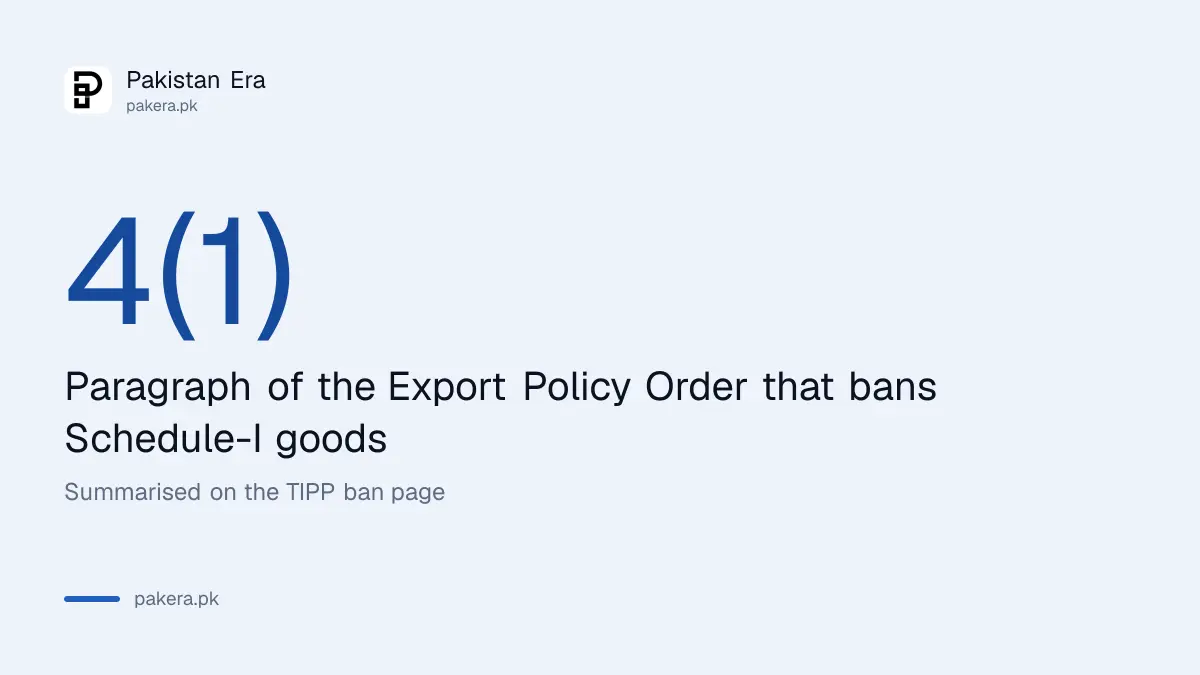
Paragraph 4(1) of the Export Policy Order bans export of the goods in its Schedule-I, with the exceptions shown beside each. If your goods match a row, you cannot export them without the permission that row names. If there is no exception, the answer is no.
The page repeats the list with customs codes and an exceptions column. It says the ban applies to goods "from any country and origin", so it is the same whether the goods are grown, made or only passing through Pakistan.
Food and farm goods on the list
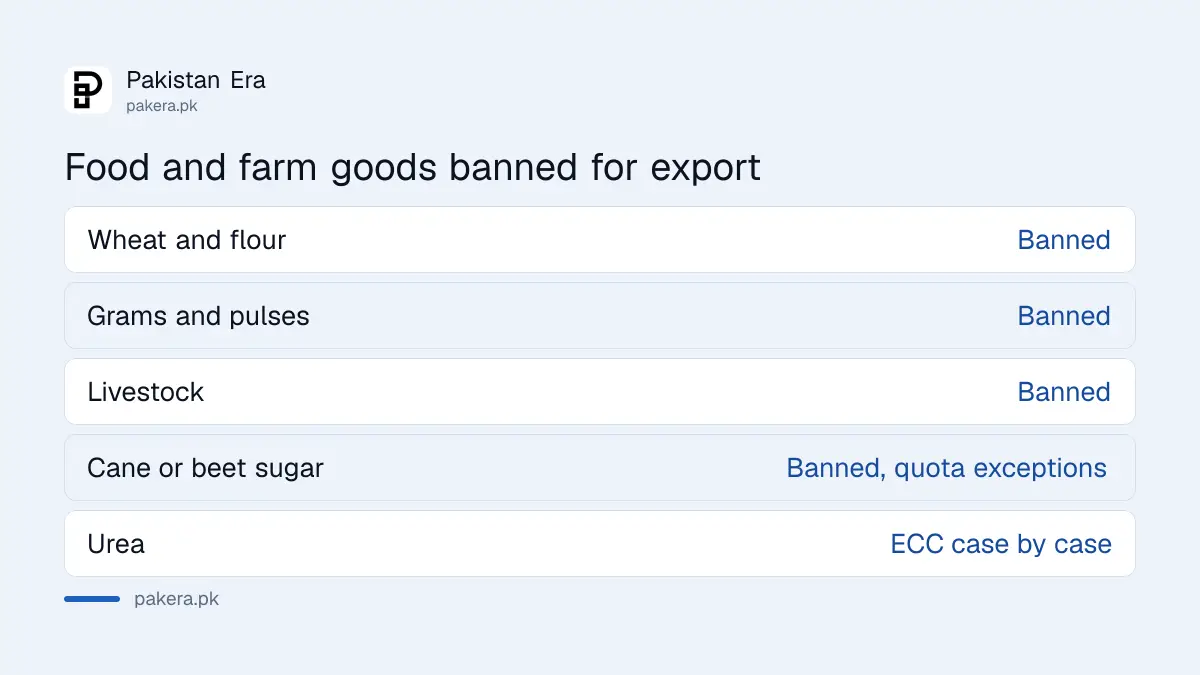
Several everyday food items are on the list. Wheat, wheat flour and wheat products such as fine flour, maida and suji are banned. So are all grams and pulses, gram flour, livestock, and cane or beet sugar. Charcoal and firewood are listed too.
| Goods | Exception on the page |
|---|---|
| Wheat, flour, maida, suji | None shown |
| Grams and pulses of all sorts, gram flour | None shown |
| Livestock | None shown |
| Cane or beet sugar | None shown on the page |
| Urea | Case by case, with approval of the Economic Coordination Committee |
| DAP and other fertilizers | Re-export by UNDP and other UN agencies |
| Charcoal and firewood | None shown |
| Wood and timber | None shown |
Sugar needs a note. The page shows sugar as banned with no exception, yet the State Bank has told banks to process a government-approved export of 200,000 tonnes. A ban in Schedule-I can be lifted by a special decision for a set quantity. Read the background in the approval of the sugar export.
Other banned exports, from timber to antiques
Beyond food, the list covers wildlife, chemicals, wood and antiques. Wood and timber are banned, as are poplar shuttering material and sann hemp. Antiquities at least seventy-five years old cannot be exported, and nor can anti-personnel landmines or fissionable material.
Wildlife is a large group. Species listed under the international convention on endangered species, CITES, and animals protected under provincial laws, may not leave, with permits as the exception. Scheduled chemicals need prior permission from the National Authority in the Ministry of Foreign Affairs, and sometimes a licence.
Alcohol, poppy straw and related alkaloids are on the list. The one exception shown is export of alcoholic drinks by non-Muslim enterprises to countries outside the Organisation of Islamic Cooperation. Counterfeit products are banned, with no exception.
A five-step check before you sign
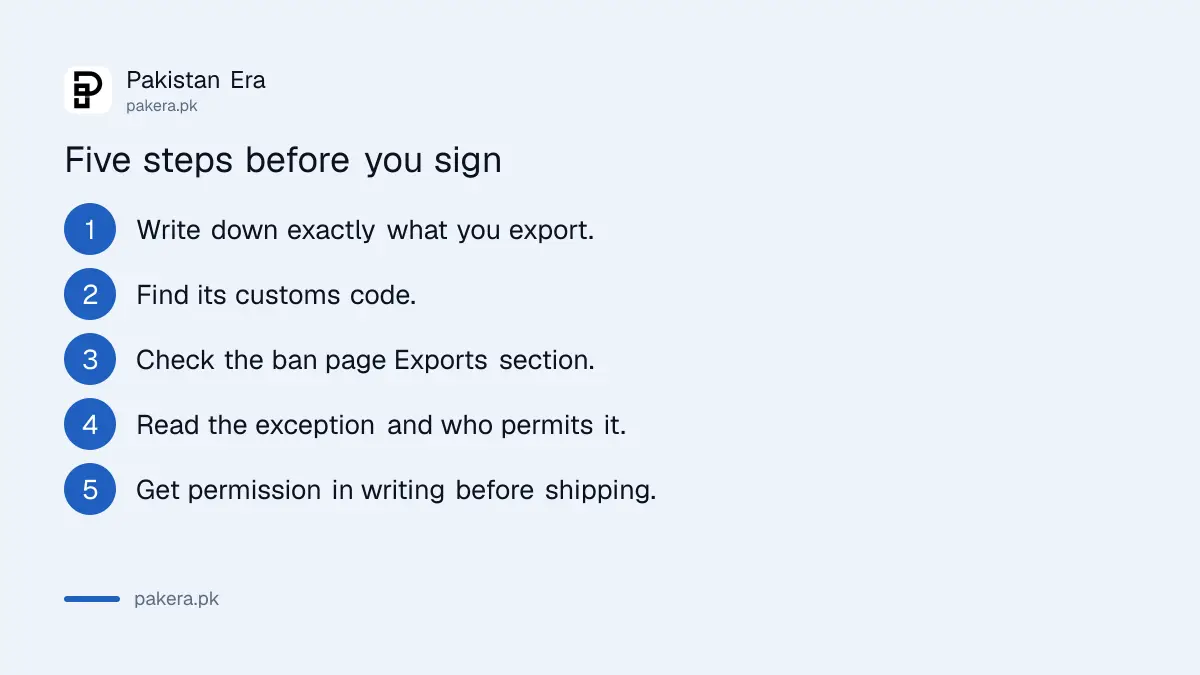
Match the goods, check the exception, ask for permission if one is named, and only then sign. If the goods are on the list and no exception fits, tell the buyer early. A late refusal costs more than an early no.
- Write down exactly what you will export, including form (raw, flour, cut timber, live).
- Find its customs code on the TIPP commodity search.
- Open the Exports section of the ban page and look for the code or the description.
- If it is listed, read the exception column and note which body gives permission.
- Get that permission in writing before you sign or ship.
If your goods are allowed, the next job is registration. See how to register as an exporter and how to claim the export rebate. Bank paperwork is covered in the bank price check for trade.
Why the list changes
The sugar case shows the government can allow an exception for a set quantity, and the order can be amended. A page that was right last year may be wrong today, so treat the TIPP page as a starting point and confirm the current notification with your bank or the Ministry of Commerce.
The page itself does not give a date for its last update. We found no change notice on it. For the latest export figures, see September's trade numbers.
Common questions
Where is the official export ban list?
It is in Schedule-I of the Export Policy Order, 2022. The TIPP page on banned commodities repeats it with customs codes.
Can I export wheat flour?
The page lists wheat flour, maida and suji as banned with no exception. Ask the Ministry of Commerce for any special permission before you sign.
Is sugar banned for export?
The standing list bans it. A recent government decision allows 200,000 tonnes for eligible mills, so the ban has a limited exception for that quantity.
Can I export antiques?
Not if they are at least seventy-five years old. That rule covers antiquities in the codes the page lists.
Do banned exports need a customs code to check?
Codes make it easy. Some rows give only a description, such as counterfeit products, and apply under every code.
How we verified this
What we checked, where we read it, and what we could not confirm.
Last checked on 14 October 2026, Pakistan time. We read the TIPP page Banned Commodities and Countries, Exports section, and the State Bank sugar export circulars of October 2026. We did not read the full Export Policy Order. We could not find a current notice from the Ministry of Commerce, so the list may have changed since the page was last edited.
About the author

Tax, Bills and Technology Writer
Ali Akhtar is a young and curious voice here at Pakistan Era. He is currently pursuing his A-Levels and has a growing interest in Pakistan’s changing industrial landscape and educational trends. Ali likes to write in a way that helps him explain and explore the world around him. His writing reflects the perspective of the new generation navigating the evolving trends of Pakistan where technology, youth innovation, and shifting opportunities are reshaping the country’s future.