Sugar Export Pakistan 2026: ECC Allows 200,000 Tonnes, Retail Rs 145
The ECC approved export of 200,000 tonnes of surplus sugar on 14 September 2026 with price safeguards. Retail is Rs 145.59 a kg per PBS.
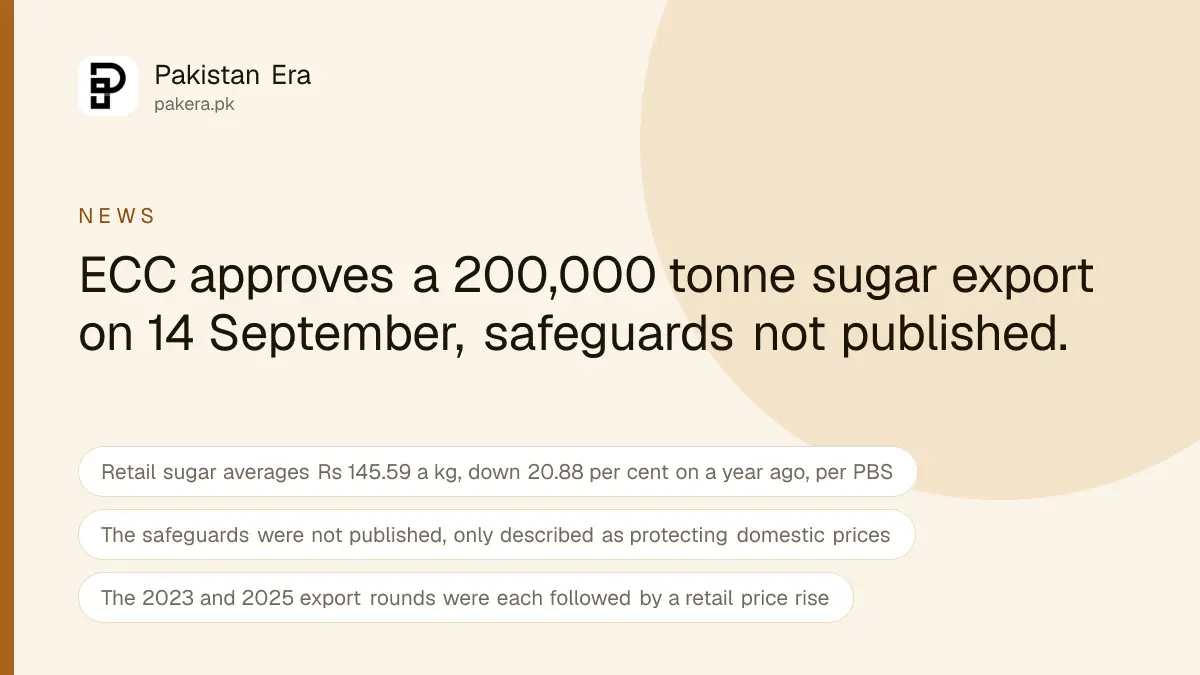
The Economic Coordination Committee of the cabinet approved the export of 200,000 tonnes of surplus sugar on 14 September 2026, on a summary from the National Food Security and Research Division and with what the Finance Division calls "appropriate safeguards to maintain domestic price stability." Retail sugar averaged Rs 145.59 a kilogram in the week to 10 September, according to the Pakistan Bureau of Statistics, down 20.88 per cent on a year ago. The safeguards themselves have not been published.
Update, 10 October 2026: Sugar averaged Rs 142.99 a kilo in Pakistan in the week to 8 October 2026, 22% cheaper than a year earlier. Read the update.
Sugar is cheaper this September than last by nearly Rs 40 a kilo. That is the backdrop to the sugar export Pakistan 2026 decision, and it is also the reason the mills asked for it. A surplus that cannot be sold abroad pushes the shelf price down, and the shelf price is where a household meets this story.
We read the Finance Division's press release of 14 September, PR No 636, and the PBS weekly price bulletin for the week ended 10 September. The rest is reporting, and we say whose.
What did the ECC approve on 14 September 2026?
Export of 200,000 metric tonnes of surplus sugar, on the recommendation of the Steering Committee on Sugar, with safeguards for domestic prices. The meeting was chaired by Finance Minister Muhammad Aurangzeb and also approved the Rs 75 billion fuel relief scheme and a restructuring plan for the national shipping corporation.
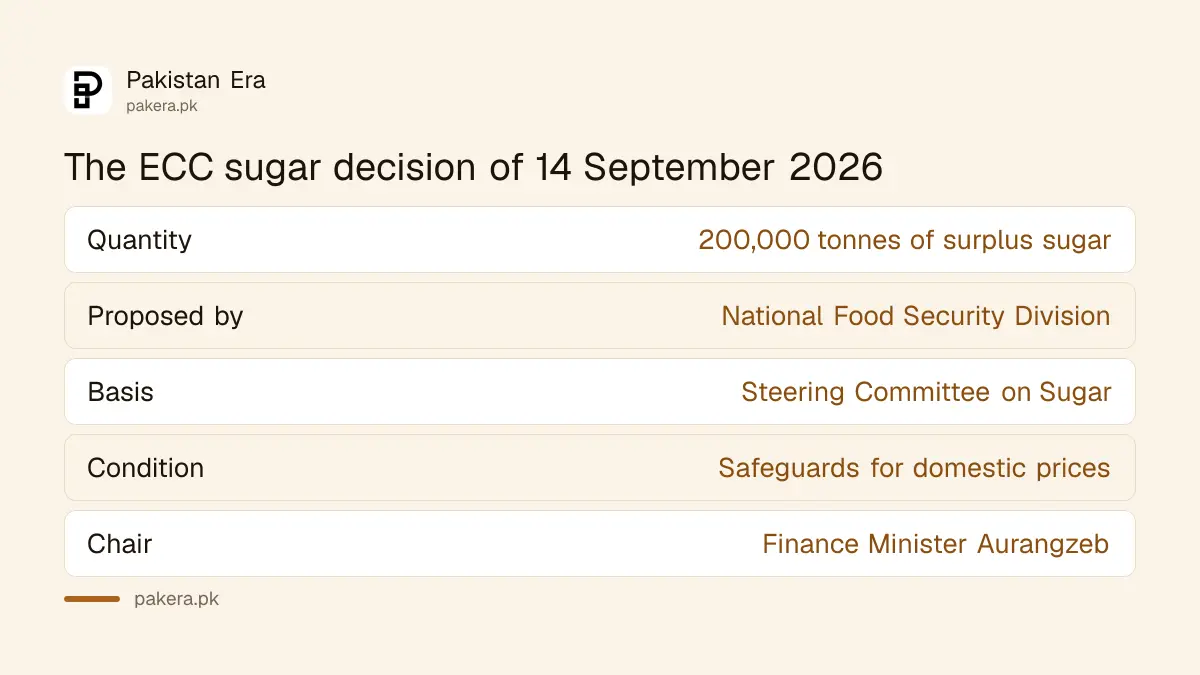
The release runs to two sentences on sugar. The ECC "considered the summary submitted by the National Food Security and Research Division regarding permission for export of 200,000 MT of surplus sugar" and "approved the recommendations of the Steering Committee on Sugar, including appropriate safeguards to maintain domestic price stability in the local market." That is all it says.
The steering committee had met on 9 September under Deputy Prime Minister Ishaq Dar, per The Express Tribune, and recommended the quantity on the basis that stocks were sufficient and a surplus of more than 600,000 tonnes was expected. The Tribune also reported that the committee decided to develop a mechanism so that prices do not rise despite the export. What that mechanism is has not been made public.
What are the price safeguards?
Nobody has said. The Finance Division names them without describing them, the Tribune reports a mechanism still to be developed, and the one body that was going to be made responsible for prices, the Trading Corporation of Pakistan, had that clause removed last month. Until a notification appears, the safeguard is a sentence.
The TCP episode is the useful precedent. On 19 August the ECC let TCP export 108,000 tonnes of the sugar it imported in 2025, through international tenders. The draft decision said TCP "shall also ensure that the disposal/export does not adversely affect domestic sugar availability and prices." The ECC deleted that line, and TCP said so publicly on 8 September, per Business Recorder, adding that price stabilisation of food commodities is the job of the Ministry of National Food Security and Research under the Rules of Business, 1973, not TCP's.
So for the August export the price condition was removed. For the September one it is described but not written down. The Finance Minister's own test, stated at the August meeting per Dawn, was that exports should go ahead only if they earn reasonable foreign exchange and do not spike local prices. Whether that is a rule with a trigger or a hope depends on what gets notified.
| Export round | Decided | Quantity | Published price condition |
|---|---|---|---|
| TCP imported stock | 19 August 2026 | 108,000 tonnes | Clause on domestic prices deleted |
| Mills' surplus | 14 September 2026 | 200,000 tonnes | "Appropriate safeguards", not described |
What does sugar cost on the shelf now?
Rs 145.59 a kilogram on the national average, per the PBS bulletin for the week ended 10 September 2026, ranging from Rs 136 in the cheapest city to Rs 160 in the dearest. That is 0.42 per cent lower than the week before and 20.88 per cent lower than the same week of 2025, when it was Rs 184.01.
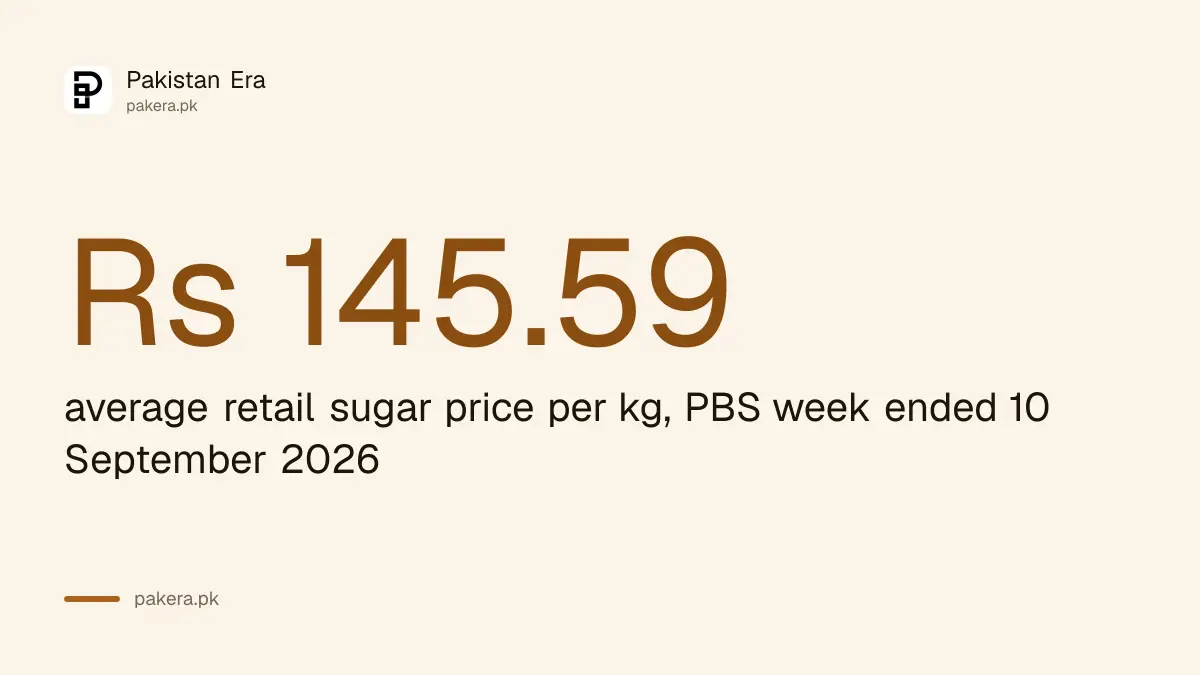
PBS collects these prices from cities across the country every week for its Sensitive Price Indicator, the basket of 51 everyday items it uses to track short term inflation. Sugar was one of ten items that fell in the week, alongside chicken, onions and tomatoes.
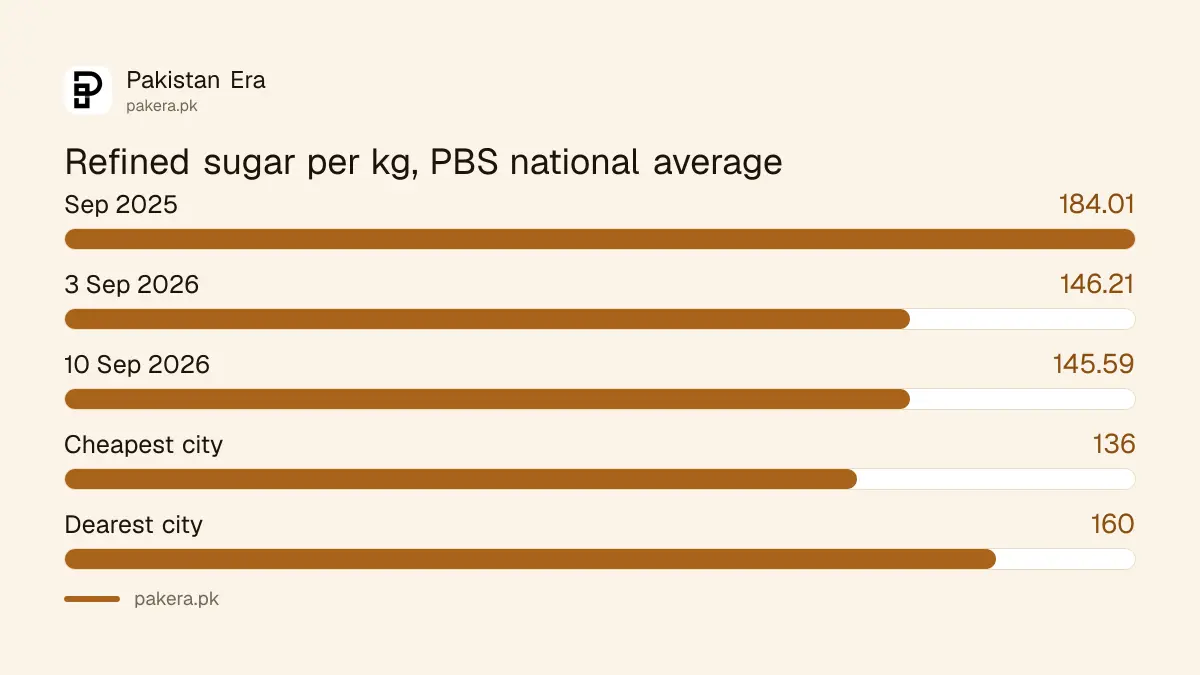
The Tribune quoted Rs 148 a kilo and an 18 per cent fall on the year, from its own market check. PBS's number is a little lower and the fall a little larger, but the two agree on the direction. Sugar is at its cheapest in more than a year, and that is the price the export decision was taken against.
Shops in Punjab are required to display the price and issue a receipt, which is the simplest way to hold your local rate to the published one; our explanation of the price display and receipt rules for Punjab shops covers what a shop must show.
What happened after the last exports?
Prices went up, every time. In 2023 retail sugar rose from Rs 88 a kilo to Rs 140 over the ten months after exports were allowed. In 2025 a large export round was followed by Rs 220 a kilo and an emergency import of 300,000 tonnes. This year's decision is being taken with a smaller quantity and a lower starting price than either.
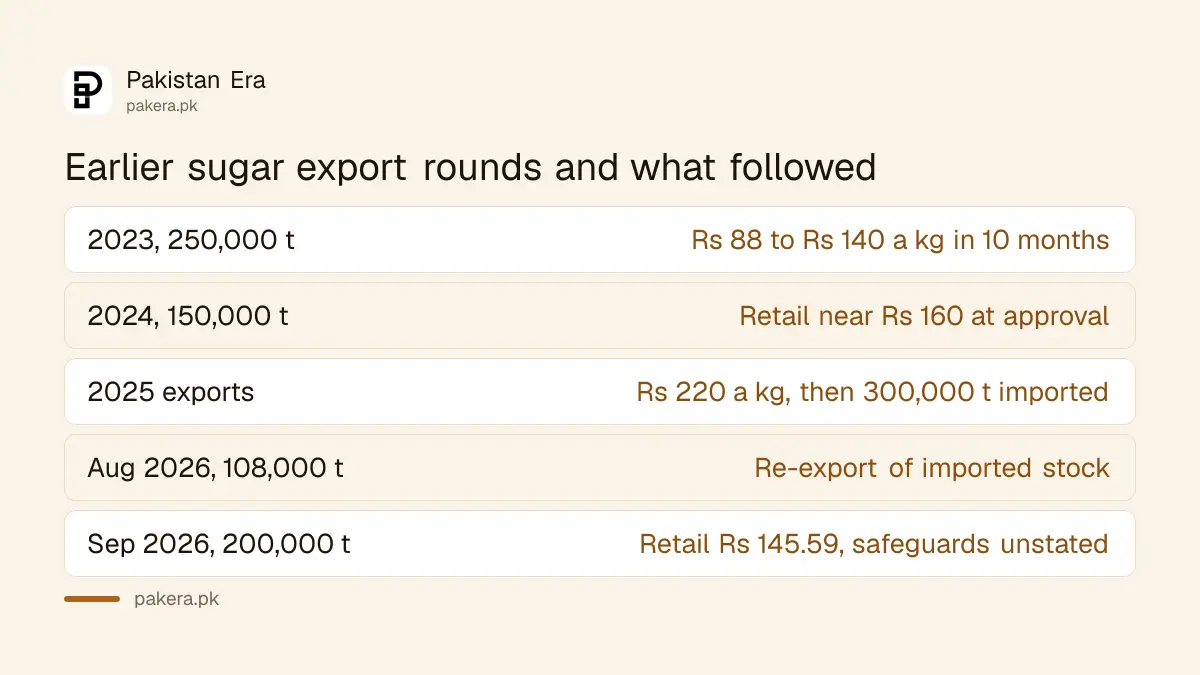
- January 2023. The government allowed 250,000 tonnes. By June, 216,000 tonnes had gone. The Express Tribune reported in August 2023 that retail sugar had risen 59 per cent in ten months, from Rs 88 a kilo in October 2022 to Rs 140.
- June 2024. The Sugar Advisory Board conditionally approved 150,000 tonnes with retail near Rs 160 a kilo, per Dawn, on the minister's promise that the ex mill price would not be raised "under any circumstances."
- 2025. PRIME, the Islamabad think tank, puts the year's exports at 765,734 tonnes. A 15 per cent fall in production followed, retail went to Rs 220 a kilo per the Tribune, and the government imported 300,000 tonnes through TCP with tax exemptions.
- August 2026. The ECC allowed TCP to re-export 108,000 tonnes of that same imported sugar, because two local tenders to sell it had failed and world prices were lower than what it cost.
- September 2026. 200,000 tonnes of the mills' own surplus, at a retail price of Rs 145.59.
The 2025 cycle, export then import, is the one the government is trying not to repeat, and Dawn reported that the August decision was deliberately routed through tenders rather than a straight approval so the cabinet could look again before anything shipped.
Why do the mills want to export?
Because the surplus is holding the price down. Industry stocks were above 3 million tonnes at 31 July, per Dawn, against consumption of about 564,000 tonnes a month. An agreement fixing the ex mill price at Rs 165 to Rs 171 a kilo through 15 October 2025 collapsed, per the Tribune, and mills have been selling below it since.
Our arithmetic: 200,000 tonnes is about thirteen days of national consumption and about 7 per cent of the July stock. On those numbers it should not create a shortage. What it can do is set a floor under the ex mill price, which is the point of asking for it.
The industry has said the quota is too small. Pakistan Today's headline on 16 September reported that mills want the permission raised to 1 million tonnes; we could not open the report itself. Former finance minister Miftah Ismail, per ProPakistani, has warned that exporting ahead of the crushing season will push domestic prices up by around Rs 50 a kilo. Both are positions, not findings. The finding is the record above.
What should a household watch?
The PBS weekly figure and your own shop. The average is Rs 145.59 now. If it climbs past Rs 155 in the weekly bulletin, or your shop moves more than Rs 10 in a fortnight, the export is reaching the shelf and the safeguards, whatever they are, are not.
- Check the PBS weekly SPI each Friday. It publishes the sugar price per kilo for the week and the change on the week before.
- Note your shop's price today. Rs 136 to Rs 160 is the current range across cities, so anything above Rs 160 is already at the top of it.
- Watch for the safeguard notification. If the Ministry of National Food Security publishes a price trigger or a monthly release schedule for the export, that is the document that matters.
- Watch the crushing season. Mills usually start crushing in November, and the new crop is what decides whether the surplus persists.
- Watch diesel. Sugar travels by road, and diesel is Rs 421.45 a litre from 17 September, which feeds into what a bag costs by the time it reaches a shop regardless of the export.
Our own view is that 200,000 tonnes at a Rs 145 retail price is a modest decision, and that the thing to hold the government to is not the quantity but the promise attached to it. A safeguard that is never written down cannot be checked, and 2023 and 2025 both show what happens when nobody checks.
Common questions about the sugar export decision
How much sugar is Pakistan exporting in 2026?
200,000 tonnes of surplus sugar approved by the ECC on 14 September 2026, on top of 108,000 tonnes of imported stock that TCP was allowed to re-export on 19 August.
What is the sugar price in Pakistan today?
Rs 145.59 a kilogram on the PBS national average for the week ended 10 September 2026, ranging from Rs 136 to Rs 160 across cities.
Will the sugar export raise prices?
It did in 2023 and in 2025. This round is smaller and starts from a lower price. The ECC says safeguards apply, but they have not been published.
What are the safeguards?
Not stated. The Finance Division describes them only as protecting domestic price stability. The steering committee was reported to be developing a mechanism.
Who is responsible for keeping sugar prices stable?
The Ministry of National Food Security and Research, according to TCP's own clarification citing the Rules of Business, 1973. TCP has said it has no such mandate.
Why is sugar cheaper than last year?
Because production improved and stocks are high. PBS puts the price 20.88 per cent below September 2025, when it was Rs 184.01 a kilo.
How we verified this
What we checked, where we read it, and what we could not confirm.
Last checked 17 September 2026. We read the Finance Division's press release No 636 of 14 September 2026 on finance.gov.pk, Finance Minister Chairs ECC Meeting, which records that the ECC considered the National Food Security and Research Division's summary for export of 200,000 MT of surplus sugar and approved the Steering Committee on Sugar's recommendations including appropriate safeguards to maintain domestic price stability, and which does not describe those safeguards. We read the Pakistan Bureau of Statistics weekly Sensitive Price Indicator for the week ended 10 September 2026, the annexure and the executive summary, for the refined sugar average of Rs 145.59 a kilogram, the previous week's Rs 146.21, the year earlier figure of Rs 184.01, the changes of minus 0.42 and minus 20.88 per cent, and the city range of Rs 136 to Rs 160. The meeting's chair and other agenda items are from Dawn on 15 September. The 9 September steering committee meeting, the expected surplus above 600,000 tonnes, the Rs 148 market price, the Rs 220 a kilo that followed the 2025 exports and the collapsed ex mill agreement of Rs 165 to 171 are from The Express Tribune. The 19 August decision on 108,000 tonnes, TCP's role, the Finance Minister's condition, stocks above 3 million tonnes at 31 July and monthly consumption of about 564,000 tonnes are from Dawn on 20 August. TCP's clarification that the ECC deleted the price clause and that price stabilisation belongs to the food security ministry is from Business Recorder on 8 September. Miftah Ismail's warning is from ProPakistani. The 2023 figures are from The Express Tribune of 4 August 2023 and the June 2024 approval from Dawn. The 2025 export volume of 765,734 tonnes and the 300,000 tonne import are from PRIME's analysis of the sugar market. The Pakistan Today report on the mills' demand for 1 million tonnes could not be opened and is cited by its headline only. The retail range of Rs 145 to Rs 165 quoted in some coverage did not appear in anything we read, and we have used the PBS range instead. The thirteen days of consumption and 7 per cent of stock are our own arithmetic. A safeguard notification, if one is issued, will change this page, and we will update it.
About the author

Tax, Bills and Technology Writer
Ali Akhtar is a young and curious voice here at Pakistan Era. He is currently pursuing his A-Levels and has a growing interest in Pakistan’s changing industrial landscape and educational trends. Ali likes to write in a way that helps him explain and explore the world around him. His writing reflects the perspective of the new generation navigating the evolving trends of Pakistan where technology, youth innovation, and shifting opportunities are reshaping the country’s future.