Pakistan Raises Wheat Import Limit to 2.5 Million Tonnes as Flour Hits Rs 3,277
The ECC raised Pakistan's wheat import ceiling from 1.0 to 2.5 million tonnes on 27 November 2026. Provinces need 1.7 million tonnes. What it means for atta.
یہ صفحہ اردو میں پڑھیں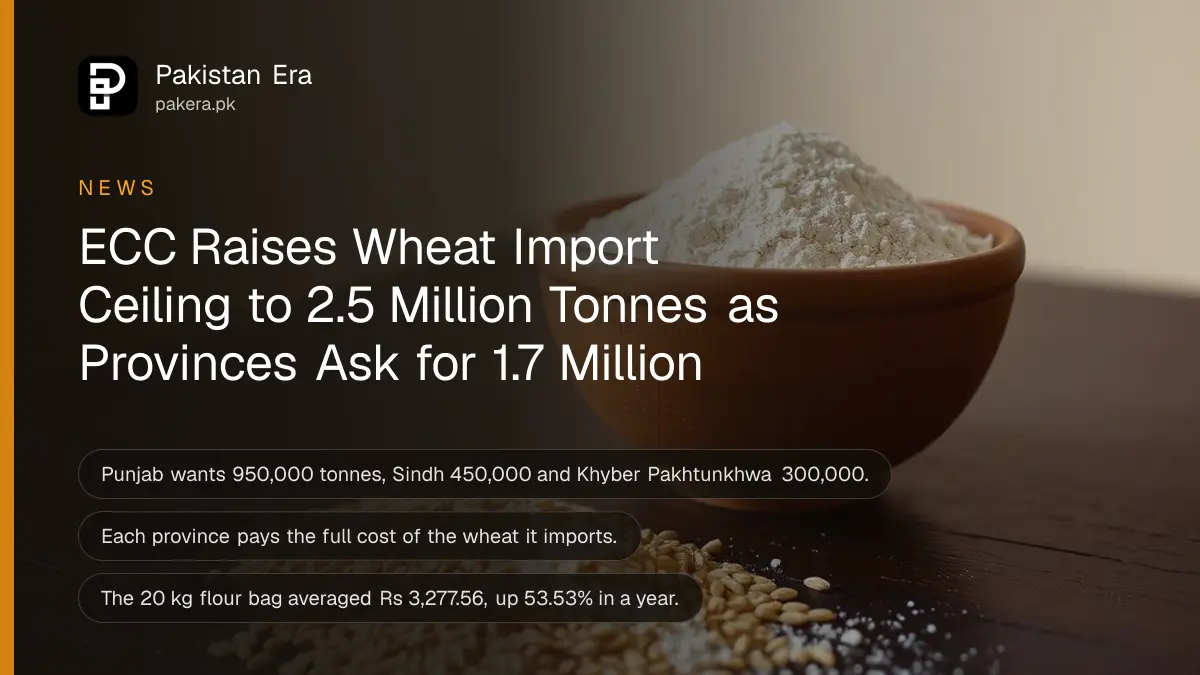
Short answer: The Economic Coordination Committee (ECC) of the federal cabinet approved in principle on 27 November 2026 a rise in Pakistan's wheat import ceiling from 1.0 million tonnes to up to 2.5 million tonnes for the food year 2026-27. The provinces now say they need about 1.7 million tonnes. The federal cabinet still has to ratify the decision, and each province pays the full cost of its own imports.
The decision came the day after the 20 kg flour bag hit a national average of Rs 3,277.56, up 53.53% in a year, in the weekly figures of the Pakistan Bureau of Statistics (PBS). Finance Minister Muhammad Aurangzeb chaired the meeting in Islamabad.
The ECC raised the wheat import ceiling to 2.5 million tonnes
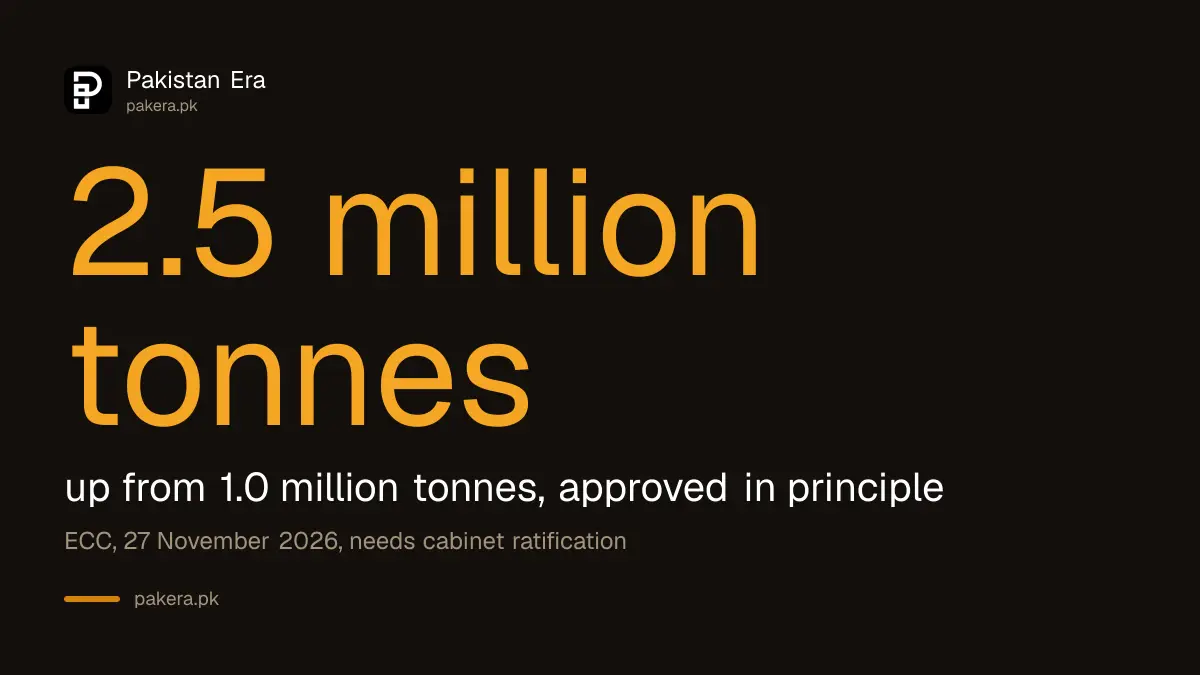
The ECC approved in principle a wheat import ceiling of up to 2.5 million metric tonnes for food year 2026-27, up from the 1.0 million tonnes allowed before. The ceiling is a maximum. Actual imports will depend on what the provinces confirm and on market conditions.
The official release says the higher ceiling is meant to cover extra provincial needs or a shortfall in stocks without asking for a fresh approval each time. It is the first import quantity the government has put a number on this season. When the federal wheat import committee met on 21 October, its release gave no quantity at all, as we reported in our story on the wheat import committee meeting of 21 October.
| Point | ECC decision, 27 November 2026 |
|---|---|
| Chair | Finance Minister Muhammad Aurangzeb |
| Old import ceiling | 1.0 million tonnes |
| New import ceiling | Up to 2.5 million tonnes |
| Period | Food year 2026-27 |
| Status | Approved in principle, needs federal cabinet ratification |
| Who pays | Each importing province, in full |
| Oversight | Steering committee headed by the Deputy Prime Minister |
The provinces now ask for about 1.7 million tonnes
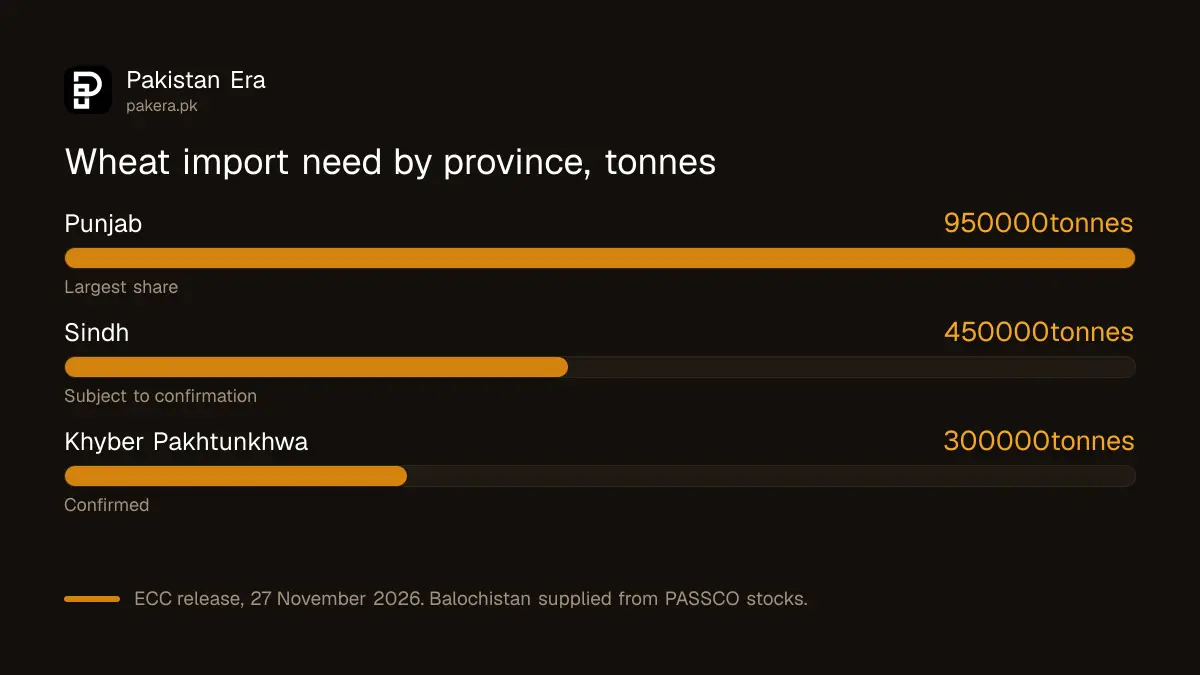
The provinces' combined import need has risen to about 1.7 million tonnes. Punjab wants 950,000 tonnes, Sindh 450,000 tonnes and Khyber Pakhtunkhwa 300,000 tonnes. Balochistan will be supplied from the stocks of PASSCO, the federal grain agency.
The figure has moved up fast. The release says the provinces first put their need at 750,000 tonnes and then cut it to 550,000 tonnes. They raised it again after recent price rises and heavier releases from government stocks. The Sindh figure is still subject to confirmation.
| Province | Import need (tonnes) | Note |
|---|---|---|
| Punjab | 950,000 | Largest share |
| Sindh | 450,000 | Subject to confirmation |
| Khyber Pakhtunkhwa | 300,000 | Confirmed in the release |
| Balochistan | None imported | Met from PASSCO stocks |
| Total | About 1.7 million | Ceiling leaves room for 800,000 more |
Provinces pay the full cost and must confirm in writing
Each province bears the whole cost of the wheat it imports: the purchase, freight, insurance, transport, port charges, taxes and duties. Before any order, a province must confirm its need in writing and arrange advance payment or a banking arrangement.
This matters for the price you pay later. Imported wheat that costs a province more than its local stock may be sold to mills at a subsidised rate, or the cost may be passed on. The ECC release does not set a release price for imported wheat, and no province has announced one yet.
The federal side will help at the ports. Ships carrying wheat get priority berthing, arranged with the Ministry of Maritime Affairs and the port authorities.
Flour costs Rs 3,277.56 a bag, up 53.53% in a year
The PBS put the average 20 kg flour bag at Rs 3,277.56 in the week to 26 November 2026. That is up 5.72% in one week and 53.53% from Rs 2,134.85 in the same week of 2025. Loose wheat averaged Rs 1,525.41 for 10 kg, up 2.41% in a week.
Prices differ widely by city. We took these averages from the PBS annex for 26 November.
| City | 20 kg flour bag, 26 November 2026 |
|---|---|
| Hyderabad | Rs 3,749.73 |
| Islamabad | Rs 3,687.68 |
| Bannu | Rs 3,600.00 |
| Quetta | Rs 3,584.99 |
| Karachi | Rs 3,426.81 |
| Peshawar | Rs 3,360.91 |
| Lahore | Rs 2,830.03 |
| Multan | Rs 2,730.70 |
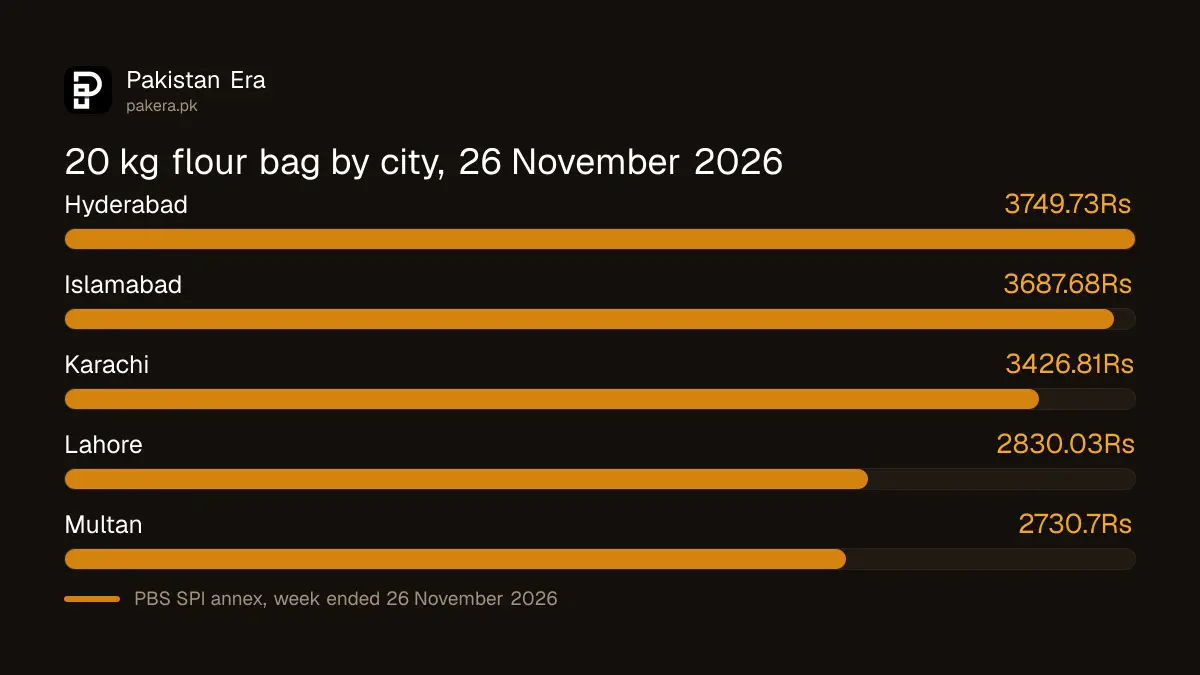
A family that buys two 20 kg bags a month now pays about Rs 2,285 more each month than a year ago, at the national average. That is our arithmetic from the PBS figures. The week before, the bag was Rs 3,100.19, as recorded in our report on the SPI for the week to 19 November.
What the decision means for your atta bill
The decision does not lower the flour price today. It allows more wheat to come in over the coming months, which should ease supply once ships arrive. Until then, provincial rates and stock releases set what you pay at the shop.
Here is what you can do now.
- Compare your shop's price with your district's official flour rate, set by the Deputy Commissioner, and with the PBS city average above.
- Convert the wheat price per maund to a fair kilo price for flour with our wheat maund to flour price converter.
- In Punjab, report overcharging on 0800-02345 or through the Qeemat Punjab app. The supply order behind it is in our story on Punjab doubling wheat and flour supply.
- Elsewhere, complain to your district price control magistrate or the Assistant Commissioner's office.
- Do not stock up in panic. The 2.5 million tonne ceiling is larger than the 1.7 million tonnes the provinces have asked for.
The federal cabinet must ratify it before it is final
ECC decisions take effect only after the federal cabinet ratifies them. Until then, the 2.5 million tonne ceiling is approved in principle. After ratification, each province must still confirm its quantity and payment before it can import.
Oversight sits with a steering committee headed by the Deputy Prime Minister. The Ministry of National Food Security and Research runs day-to-day monitoring. Problems that need a decision go straight to the Prime Minister's Office. How the ECC works, and who sits on it, is set out in our explainer on the Economic Coordination Committee.
The finance minister also asked for action against speculation and market manipulation. The release does not name any new penalty or agency for that.
Common questions
How much wheat will Pakistan import in 2026-27?
Up to 2.5 million tonnes is now allowed, subject to cabinet ratification. The provinces have asked for about 1.7 million tonnes so far. The final amount depends on what each province confirms and pays for.
Will the flour price come down after this decision?
Not at once. Imported wheat has to be bought, shipped and released to mills first. The decision sets no flour price. Watch your district's official rate and the weekly PBS figures.
Who is importing the wheat, the federal government or the provinces?
The provinces. Each one pays the full cost, including freight, insurance, port charges, taxes and duties. The federal government sets the ceiling, arranges priority berthing and oversees the process.
Does Balochistan import wheat under this decision?
No. The release says Balochistan's needs will be met from available PASSCO stocks.
Is the decision final?
Not yet. The ECC approved it in principle on 27 November 2026. It becomes final when the federal cabinet ratifies it.
What was the old wheat import limit?
1.0 million tonnes for food year 2026-27. The ECC has now raised that limit to up to 2.5 million tonnes.
How we verified this
What we checked and where we read it.
We read the Press Information Department release PR No. 385 of 27 November 2026 on the ECC meeting on 28 November 2026, and took the flour and wheat prices from the PBS Sensitive Price Indicator annex for the week ended 26 November 2026. City prices are the PBS average for each city.
Free on WhatsApp
Get the next change first on WhatsApp
Price changes, new rules and deadlines that affect your money, in a few short posts a day.
Follow Pakera on WhatsAppOther followers cannot see your number.
About the author

Global Affairs & Political Economy Writer
Muhammad Hatim is a book lover who started writing because he enjoys it. At Pakistan Era he writes about international relations, geopolitics and the global economy, with a particular interest in South Asia and the forces behind current events.