ECC of the Federal Cabinet in Pakistan: 9 Members From 13 October 2026, Its Charter, and When Its Decisions Apply
The ECC of Pakistan's federal cabinet has 9 members from 13 October 2026, chaired by the Finance Minister. Its 15 point charter and when its decisions apply.
The Economic Coordination Committee (ECC) is the federal cabinet's committee for urgent economic decisions. Since 13 October 2026 it has nine members, chaired by the Minister for Finance and Revenue. Its decisions must be ratified by the full federal cabinet, unless the cabinet has said otherwise, before ministries act on them.
Most weeks the ECC approves something that reaches your bill or your shop: a gas supply decision, an import restriction, a support price or a grant. Knowing who sits on it, what it can decide and when its decision actually becomes law helps you read the news correctly.
Who sits on the ECC from 13 October 2026
The Cabinet Division reconstituted the ECC on 13 October 2026, replacing its notification of 20 May 2026. The Minister for Finance and Revenue is chairman, and eight other federal ministers are members. Twenty-one officials attend by special invitation but are not members.
| Seat | Role on the ECC |
|---|---|
| Minister for Finance and Revenue | Chairman |
| Minister for Board of Investment | Member |
| Minister for Commerce | Member |
| Minister for Economic Affairs | Member |
| Minister for National Food Security and Research | Member |
| Minister for Petroleum | Member |
| Minister for Power | Member |
| Minister for Planning, Development and Special Initiatives | Member |
| Minister for Federal Education and Professional Training | Member |
The special invitees include the Governor of the State Bank of Pakistan, the Deputy Chairman of the Planning Commission, the National Coordinator of the SIFC, the Chairman of the SECP, the Chairman of the Board of Investment, the Adviser to the Prime Minister on Industries and Production, the Minister of State for Railways and Finance and Revenue, and 14 federal secretaries, including the Secretary Revenue who is also Chairman FBR.
The notification names offices, not people. It was copied to every cabinet member, the President's Secretary and all federal secretaries, and sent to the Printing Corporation of Pakistan for the Gazette.
What the ECC can decide
The ECC's charter has 15 items. In plain terms it handles urgent economic matters, prices, imports and exports, energy needs, oil and gas exploration licences, tariff problems and the performance of major state bodies, plus any task the federal cabinet hands it.
- Urgent economic matters and coordination of economic policies between ministries.
- Watching prices of goods used by ordinary people, and the money and credit situation.
- Import policy and its effect on production, and export performance.
- Energy requirements, and agreements and licences for oil exploration.
- Tariff problems and cases of fiscal anomalies.
- Oversight of important autonomous bodies, and half-yearly review of private industrial projects.
- Major national surveys, such as the Labour Force Survey and household income surveys.
Technical supplementary grants, which add money to a ministry's budget during the year, also reach the ECC as summaries from the Finance Division. Our explainer on technical supplementary grants covers how those are later laid before the National Assembly.
When an ECC decision becomes binding
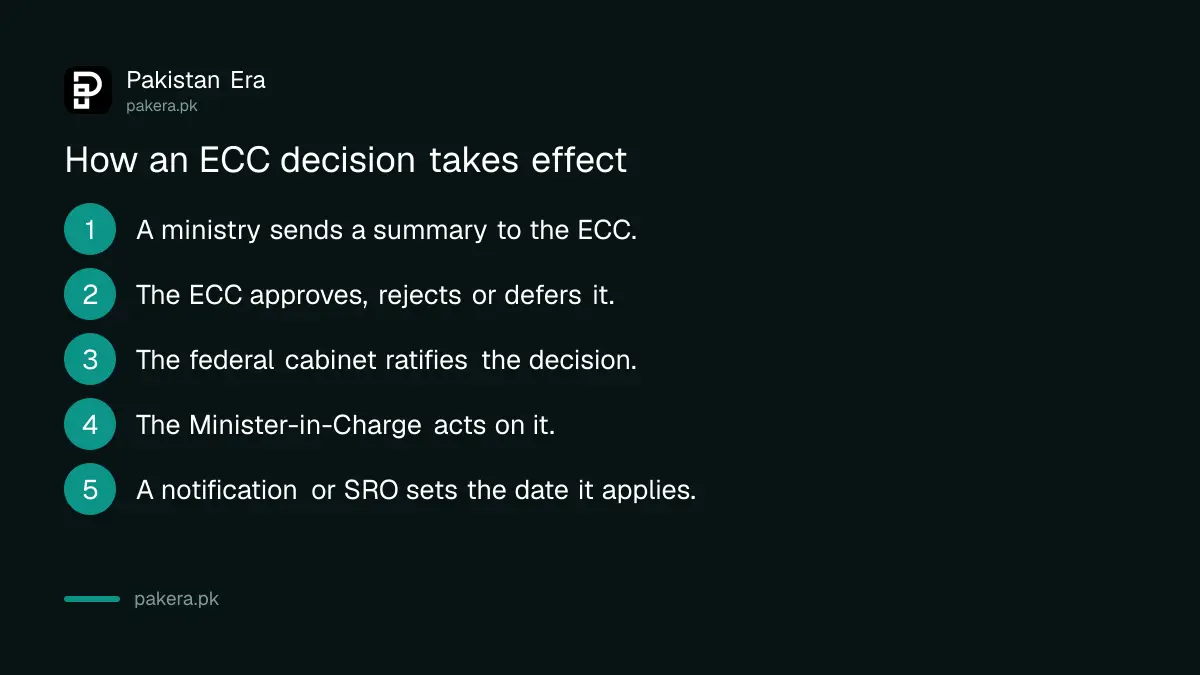
An ECC approval is a decision of a cabinet committee, not yet a law or a notified rate. Under Rule 17 of the Rules of Business, 1973, the full cabinet must ratify it, unless the cabinet has authorised otherwise. Then the ministry concerned issues the notification that changes what you pay.
- Summary. A ministry or division sends a summary to the ECC through the Cabinet Division.
- ECC meeting. The committee approves, rejects or defers it. The Finance Division usually issues a press release the same day.
- Cabinet ratification. The federal cabinet ratifies the decision at a later meeting.
- Action by the ministry. Under Rule 24, the Minister-in-Charge must act promptly to give effect to it.
- Notification. Where a price, duty or rule changes, the ministry, regulator or FBR issues a notice or SRO. That is the date the change applies to you.
So a headline that says "ECC approves" tells you the direction of policy. It does not mean a new duty or tariff applies from that morning. Wait for the notification, and check its effective date.
Recent ECC decisions that affect people
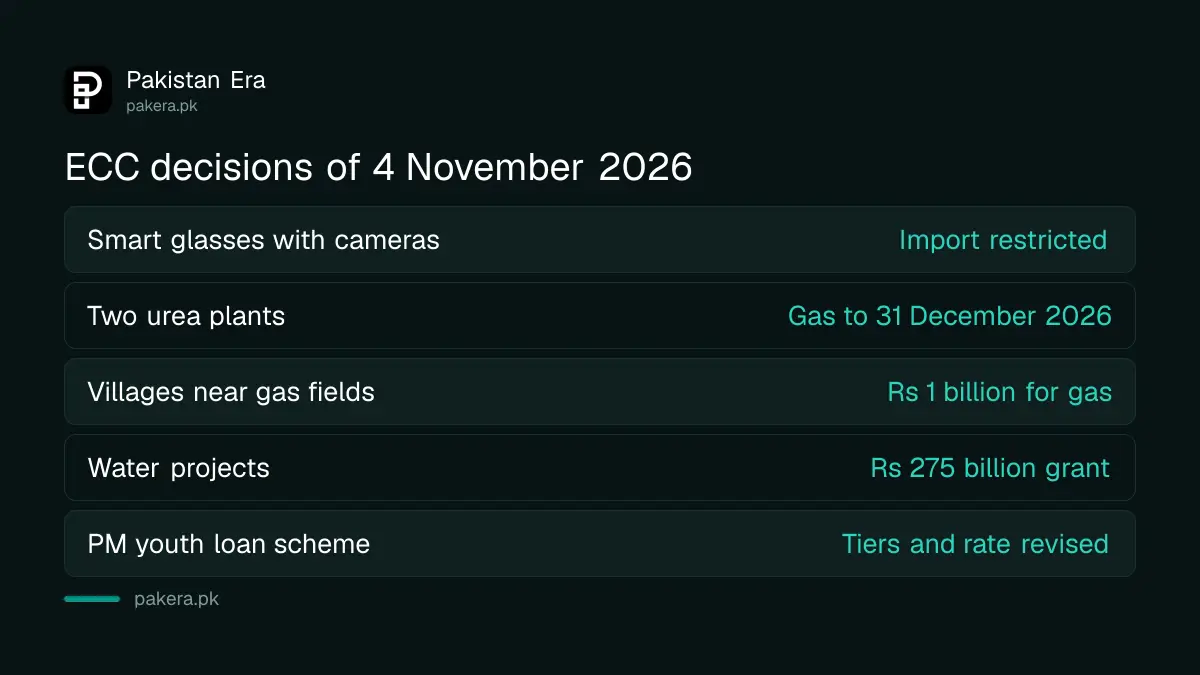
The Finance Division's press release of 4 November 2026 shows the range. The ECC restricted the import of camera-enabled smart glasses, extended gas supply to two urea plants until 31 December 2026, and approved Rs 1 billion to bring gas to villages near gas fields.
| Decision, 4 November 2026 | Who it affects |
|---|---|
| Restriction on import of camera-enabled smart glasses | Importers, shops and buyers of smart glasses |
| Gas supply to FatimaFert and Agritech urea plants up to 31 December 2026 | Farmers who depend on urea supply |
| Rs 1 billion grant for gas to villages within 5 km of gas fields, FY 2026-27 | Households near producing gas fields |
| Rs 275 billion grant for water sector projects | Ministry of Water Resources projects |
| Revised tiers and bank rate for the PM Youth Business and Agriculture Loan Scheme | Young borrowers |
For the full list from that meeting, see the ECC decisions of 4 November 2026. Other cabinet committees meet too; the cabinet committee decisions of 13 November 2026 are one example.
How ECC meetings are run
The Cabinet Division calls ECC meetings on the chairman's direction, and the chairman presides. A member minister who cannot attend may send the federal secretary of his division instead. Officials from ministries and provinces can be asked to join the discussion when needed.
These rules are in Rule 23 of the Rules of Business. Rule 24 adds that a decision is conveyed as a decision of the federal government. Who said what inside the meeting is not disclosed, which is why ECC press releases list decisions but not votes.
ECC compared with the federal cabinet and ECNEC
The federal cabinet is the full body of ministers and has the final say. The ECC is a standing committee of it for economic cases. ECNEC, the Executive Committee of the National Economic Council, is a separate body under Rule 22, appointed by the Prime Minister with its own terms of reference.
Some matters cannot stop at the ECC. Rule 16 sends proposals for legislation, ordinances, the budget and new taxes to the full cabinet. That is why a tax change approved in principle by the ECC still needs cabinet approval and, often, a Finance Act.
Common questions about the ECC
Who is the chairman of the ECC in Pakistan?
The Minister for Finance and Revenue, under the Cabinet Division's notification of 13 October 2026.
How many members does the ECC have?
Nine federal ministers, including the chairman. Twenty-one officials, such as the State Bank Governor, attend by special invitation.
Does an ECC decision need cabinet approval?
Yes. Rule 17 of the Rules of Business says committee decisions are ratified by the cabinet unless the cabinet has authorised otherwise.
Who appoints the ECC?
The Prime Minister, under Rule 17(2) of the Rules of Business, 1973. The Cabinet Division issues the notification.
Does an ECC approval change prices at once?
No. Prices, duties and tariffs change when the ministry, regulator or FBR issues its notification, which names the effective date.
How we verified this
What we checked and where we read it.
Last checked 15 November 2026. Membership and charter are from the Cabinet Division's ECC notification of 13 October 2026, marked "to be published in the Gazette of Pakistan Extraordinary". Rules 16, 17, 23 and 24 are from the Rules of Business, 1973, amended up to 23 July 2026. The 4 November 2026 decisions are from the Finance Division press releases page. The charter list above is our plain-English summary of its 15 items.
About the author

Global Affairs & Political Economy Writer
Muhammad Hatim is a book lover who started writing because he enjoys it. At Pakistan Era he writes about international relations, geopolitics and the global economy, with a particular interest in South Asia and the forces behind current events.