Technical Supplementary Grant in Pakistan Explained: How the ECC Approved Rs 360 Billion in One Day
A Technical Supplementary Grant is extra money for a ministry beyond the budget. How Article 84 works, and the six TSGs worth Rs 360 billion of 4 November 2026.
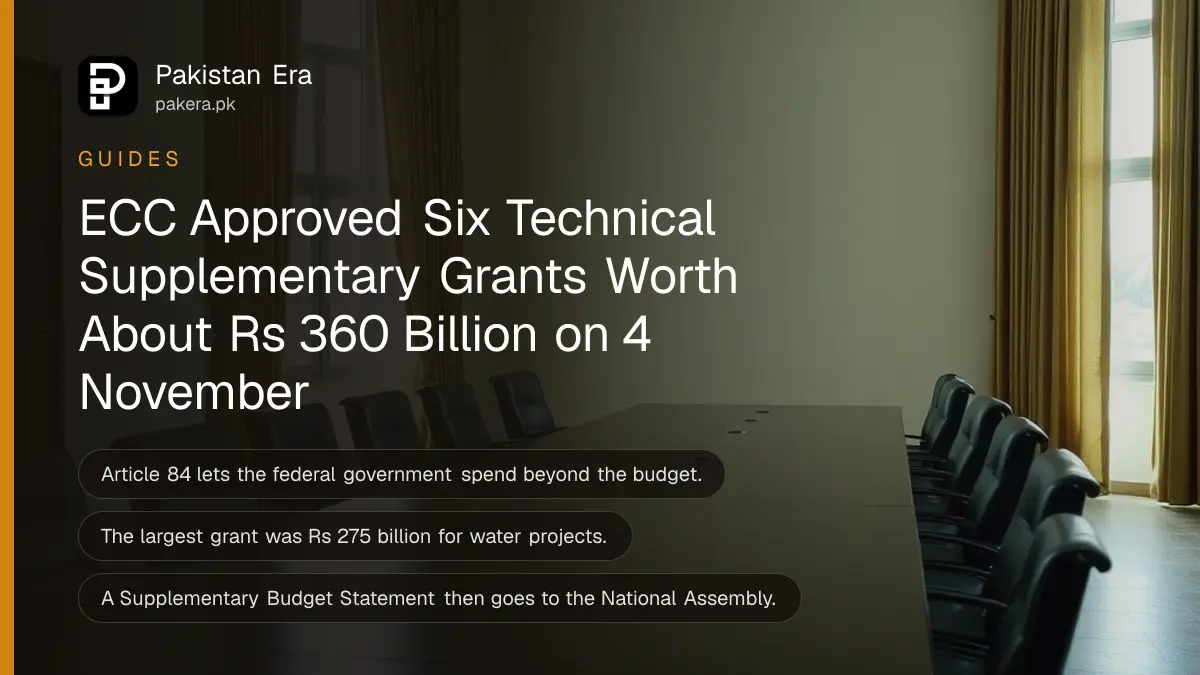
A Technical Supplementary Grant (TSG) is extra money the federal government approves for a ministry during the financial year, beyond what the budget gave it. In Pakistan the power comes from Article 84 of the Constitution, and the grants are usually cleared by the Economic Coordination Committee (ECC) of the Cabinet. On 4 November 2026 alone the ECC approved six TSGs worth about Rs 360 billion.
We read Article 84 in the Constitution published by the National Assembly, and the Finance Division's release on the ECC meeting of 4 November 2026, on 6 November. This guide explains what a TSG is, who approves it, how Parliament sees it later, and how you can track these grants yourself. Our news report on the ECC decisions of 4 November covers the other items from that meeting.
A supplementary grant is spending the budget did not plan for
Parliament passes the federal budget in June for the year starting 1 July. When a ministry runs short, or a new need appears that the budget did not include, the government can still spend. Article 84 allows it, on the condition that the extra spending is later put before the National Assembly.
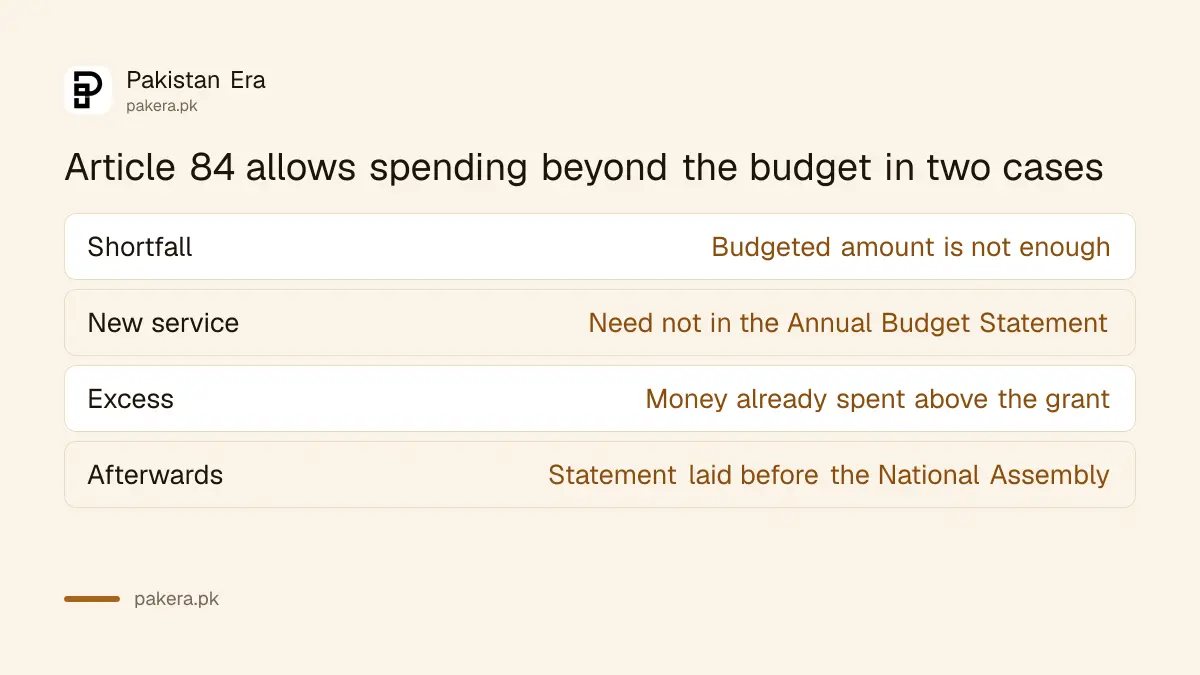
Article 84 covers two cases. The text says the power applies where it is found:
- "that the amount authorized to be expended for a particular service for the current financial year is insufficient, or that a need has arisen for expenditure upon some new service not included in the Annual Budget Statement for that year"; or
- "that any money has been spent on any service during a financial year in excess of the amount granted for that service for that year".
In either case, "the Federal Government shall have power to authorize expenditure from the Federal Consolidated Fund". The Federal Consolidated Fund is the government's main account, where taxes and other federal receipts go.
The word technical is the ECC's label, not the Constitution's
The Constitution speaks only of "supplementary and excess grants". The phrase "Technical Supplementary Grant" is the label used in the ECC's decisions for grants it approves during the year. The Finance Division's releases do not define the word, so we do not add a meaning of our own.
Two other terms in Article 84 are worth knowing:
| Term | What it means | What goes to the National Assembly |
|---|---|---|
| Supplementary grant | Money for a shortfall or a new service in the current year | A Supplementary Budget Statement |
| Excess grant | Money already spent above what was granted for a service | An Excess Budget Statement |
| Technical Supplementary Grant | The ECC's label for supplementary grants it approves | Covered by the Supplementary Budget Statement |
Article 84 then says Articles 80 to 83 apply to these statements as they apply to the annual budget. Those are the articles on laying the budget, voting on demands for grants, and authenticating the schedule of spending.
The ECC approved six TSGs on 4 November 2026
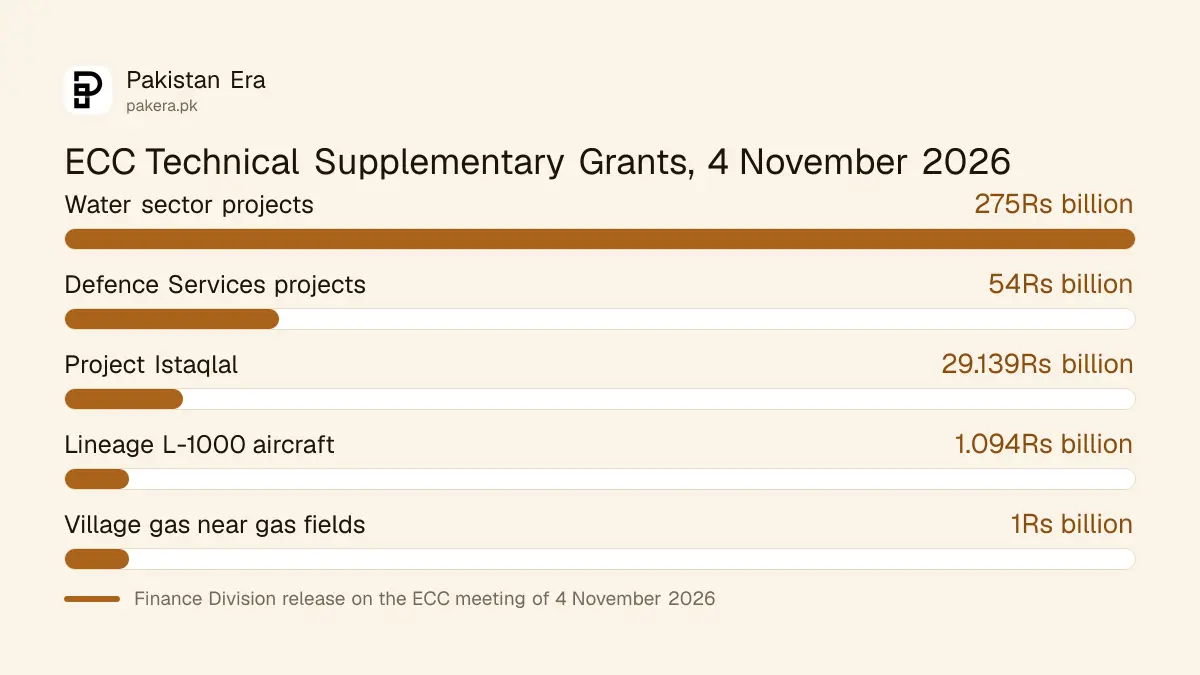
The Finance Division's release lists six Technical Supplementary Grants from the ECC meeting of 4 November 2026, chaired by Finance Minister Muhammad Aurangzeb. The largest was Rs 275 billion for water projects. Together they add up to about Rs 360.2 billion, by our sum of the release's figures.
| Purpose | Ministry or Division | Amount |
|---|---|---|
| Important water sector projects | Water Resources | Rs 275 billion |
| Ongoing Defence Services projects | Defence | Rs 54 billion |
| Project Istaqlal | Defence | Rs 29.139 billion |
| Induction of a Lineage L-1000 aircraft | Defence | Rs 1.094 billion |
| Gas for villages within 5 km of gas fields, FY 2026-27 | Not named in the release | Rs 1 billion |
| Helicopter maintenance, Frontier Corps Balochistan (North) | Interior and Narcotics Control | Rs 3.71 million |
The same meeting also moved Rs 15.625 billion of savings from austerity and fuel conservation into the Prime Minister's Austerity Fund 2026. That is a transfer of savings, not a TSG, so it is not in the total.
Parliament sees the grants after the money is approved
Under Article 84, the federal government authorises the spending first and then "shall cause to be laid before the National Assembly" a Supplementary Budget Statement. So the National Assembly reviews the grant after the ECC and the government have approved it, not before.
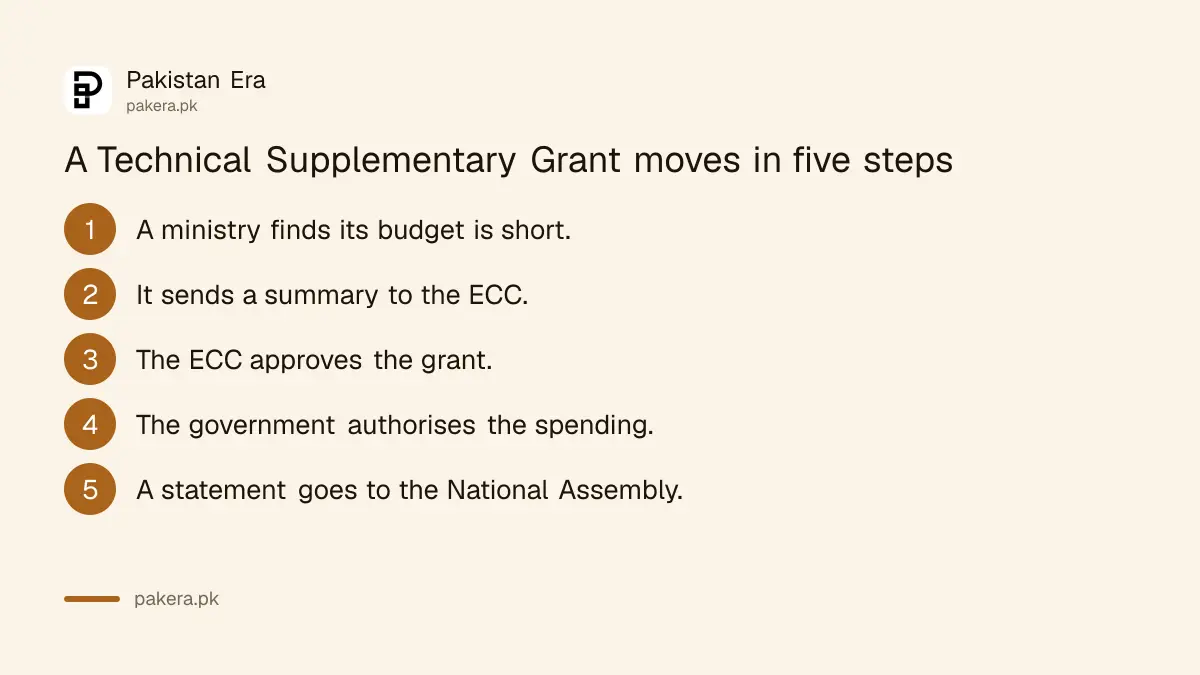
The order of steps, as the Constitution and the ECC's practice set it out, runs like this:
- A ministry finds its budget is not enough, or needs money for something new.
- It sends a summary to the ECC, the Cabinet's economic committee.
- The ECC approves the Technical Supplementary Grant.
- The federal government authorises the spending from the Federal Consolidated Fund.
- A Supplementary Budget Statement is laid before the National Assembly, which deals with it under Articles 80 to 83.
Our guide to how a bill becomes law in Pakistan explains how the National Assembly handles money bills and the budget.
Why supplementary grants matter to taxpayers
Every rupee in a TSG is spending the budget did not show in June. When grants pile up during the year, the final spending can end well above what Parliament first approved. That gap affects the deficit, borrowing and the room left for other spending. Interest payments already take a large share of the federal budget.
Our report on interest taking 43 percent of federal spending in 2026-27 shows how tight that room is. A Rs 360 billion day of grants is large next to many single budget lines.
How to track Technical Supplementary Grants yourself
The quickest way is to read each ECC release. The Finance Division posts them on its press release page, and the Press Information Department carries them the same day. Each release names the ministry, the purpose and the amount. Article 84 then requires a Supplementary Budget Statement to be laid before the National Assembly.
When you read a release, look for three things: whether the item is called a TSG, the ministry that asked for it, and whether the release says the money is for the current financial year. Keep a running total if you follow a sector, such as water, energy or defence.
Common questions
What is a Technical Supplementary Grant in Pakistan?
It is extra money approved for a ministry during the financial year, beyond its budget. The ECC approves it, using the federal government's power under Article 84.
Which article of the Constitution covers supplementary grants?
Article 84 for the federal government. Article 124 is the matching provision for the provinces.
Does Parliament approve a supplementary grant first?
No. The government authorises the spending, then lays a Supplementary Budget Statement before the National Assembly.
How much did the ECC approve in TSGs on 4 November 2026?
Six grants, about Rs 360.2 billion in all, led by Rs 275 billion for water projects.
What is the difference between a supplementary and an excess grant?
A supplementary grant covers a shortfall or a new need in the current year. An excess grant covers money already spent above the amount granted.
Where can I read ECC decisions?
On the Finance Division's press release page and on the Press Information Department's website, usually the same day as the meeting.
What we checked and sources
We read Articles 84 and 124 in the Constitution as published by the National Assembly, and the Press Information Department's release on the ECC meeting of 4 November 2026, which matches the Finance Division's own press release page, on 6 November 2026. The total of Rs 360.2 billion is our addition of the six amounts in that release. We did not find an official definition of the word "technical", so none is given.
About the author

Global Affairs & Political Economy Writer
Muhammad Hatim is a book lover who started writing because he enjoys it. At Pakistan Era he writes about international relations, geopolitics and the global economy, with a particular interest in South Asia and the forces behind current events.