Pak Army Soldier Test Syllabus 2026: Physical Test, Written Paper Weights by Trade and Medical Standards
Pak Army soldier test 2026: one mile in 7 minutes, 3 chin-ups and 15 push-ups, paper weights for every trade, the syllabus and BMI 17 to 23 standards.
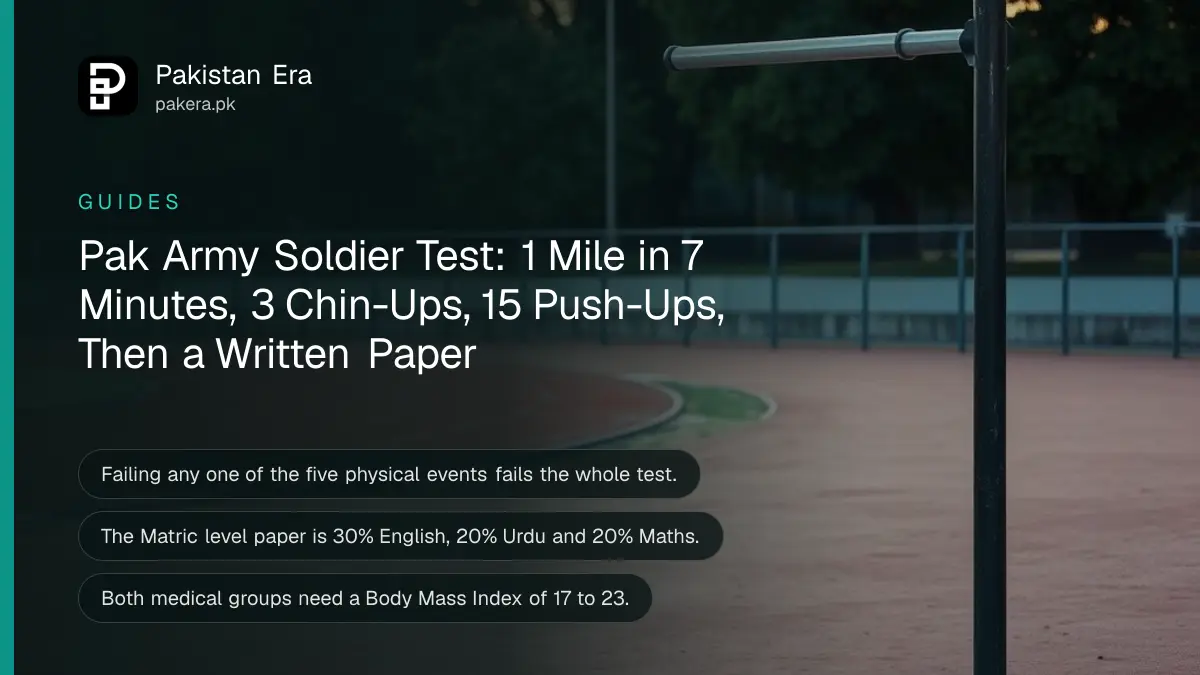
Short answer: The Pak Army soldier selection starts with a physical test: a one mile run in 7 minutes, 3 chin-ups, 15 push-ups, 20 sit-ups and a 7 foot ditch crossing. Fail any one and you are out. Then come an intelligence test, a personality test and a written paper. For Matric candidates the paper is 30% English, 20% Urdu, 20% Maths and 10% each Islamiyat, General Knowledge and Geography.
The Army publishes the full weighting for every trade on its recruitment site. Clerks sit an English heavy paper at Intermediate level. Technical trades sit Maths and Physics at Matric Science level. Nursing Assistants are tested on Biology, Physics and Chemistry at Intermediate pre-medical level.
The physical test has five events and you must pass all five
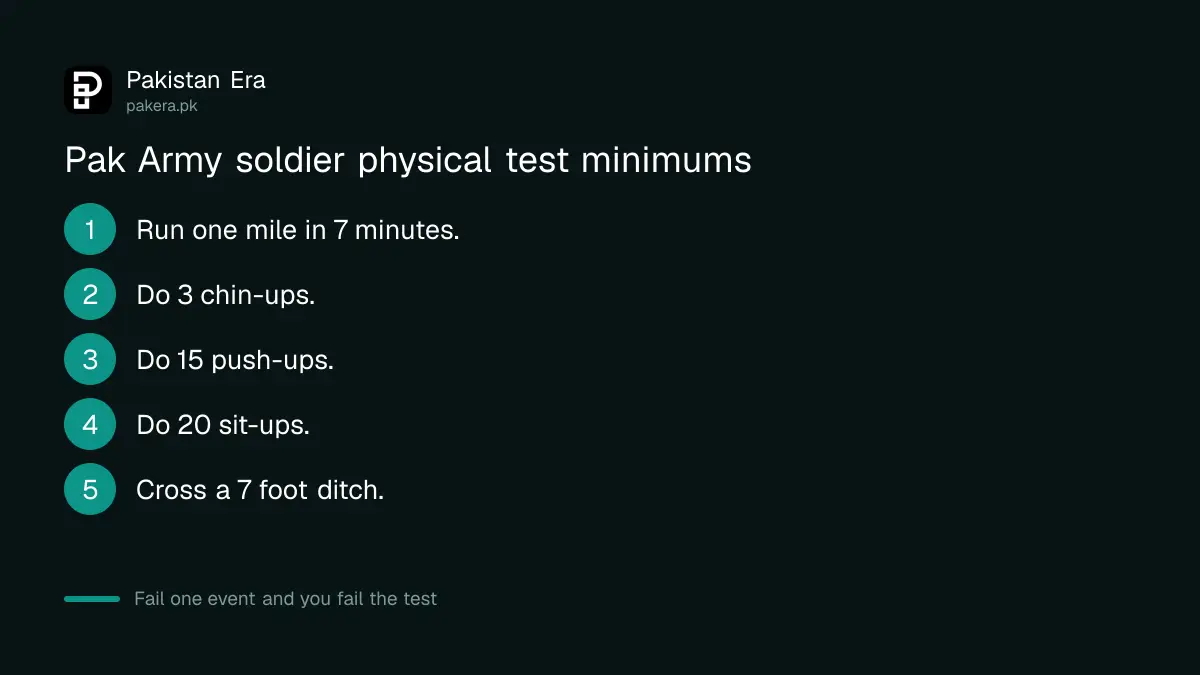
The physical test comes before any paper. A candidate must run one mile in 7 minutes, do 3 chin-ups, 15 push-ups and 20 sit-ups, and cross a 7 foot ditch. The Army says failing any single event counts as failing the whole test.
| Event | Minimum to pass |
|---|---|
| One mile run | 7 minutes |
| Chin-ups | 3 |
| Push-ups | 15 |
| Sit-ups | 20 |
| Ditch crossing | 7 feet |
The run is where most people need practice. A 7 minute mile means about 1 minute 45 seconds for each 400 metre lap of a track. Train for it over several weeks, not the night before. The Army's recruitment site links to its own video guide to the physical tests.
The intelligence and personality tests come after the physical
Candidates who pass the physical sit two short tests. The intelligence test asks questions based on common sense and everyday reasoning. The personality test gives several options for each question, and you pick the one that matches how you think.
There is no syllabus to learn for either test. The personality test has no right answer, so answer honestly and quickly. Trying to guess what the Army wants tends to give answers that do not match each other.
The written paper weighting depends on your trade
Matric and under matric candidates sit a paper weighted 30% English, 20% Urdu, 20% Maths and 10% each in Islamiyat, General Knowledge and Geography. Matric candidates get Matric level questions, and under matric candidates get Class 8 level.
| Trade | Paper weighting | Level |
|---|---|---|
| Matric and under matric candidates | English 30%, Urdu 20%, Maths 20%, Islamiyat 10%, General Knowledge 10%, Geography 10% | Matric, or Class 8 for under matric |
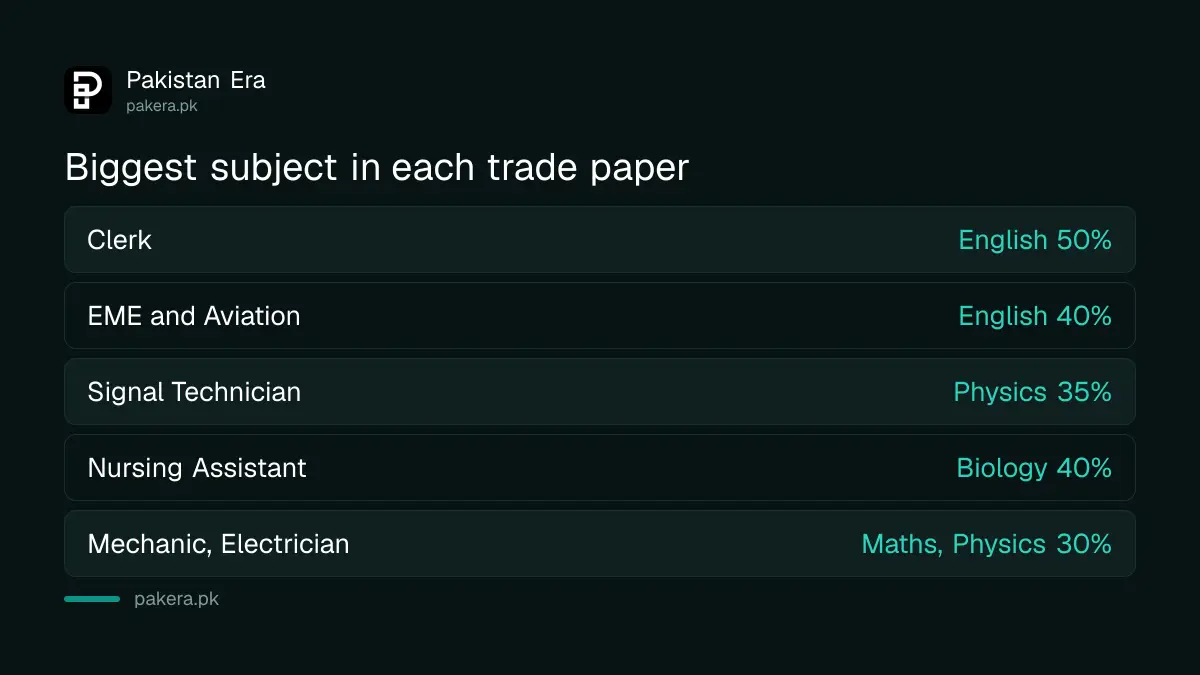
| Clerk | English 50%, Computer 20%, General Knowledge 20%, Islamiyat 10% | Intermediate |
| Vehicle Mechanic and Electrician | English 20%, Maths 30%, Physics 30%, General Knowledge 10%, Islamiyat 10% | Matric Science |
| EME and Aviation | English 40%, Maths 30%, Physics 30% | Matric Science |
| Signal Technician | English 25%, Maths 25%, Physics 35%, General Knowledge 15% | Matric Science |
| Nursing Assistant | English 10%, Biology 40%, Physics 30%, Chemistry 20% | Intermediate pre-medical |
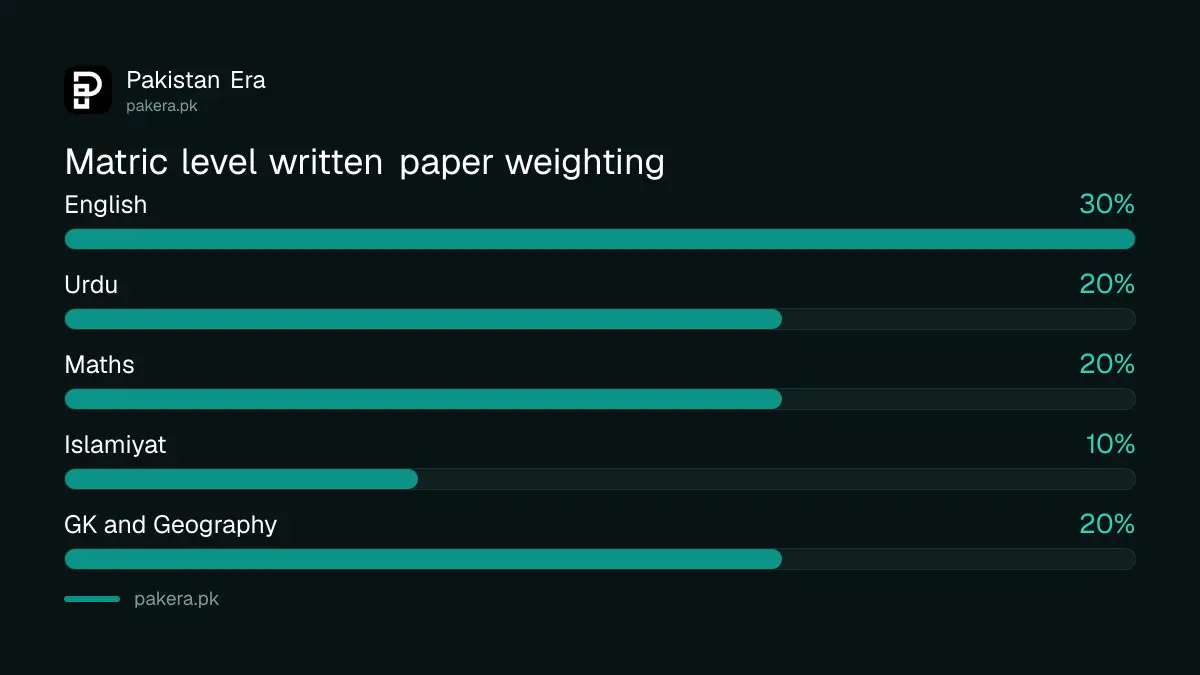
English carries the most weight in four of the six papers. For a clerk it is half the paper. If you have only a few weeks, spend most of them on English grammar and translation.
What to study for each subject
The Army's syllabus is short and sits inside the Matric board books. English and Urdu test grammar and short paragraph writing. Maths covers algebra, percentage and ratio. General Knowledge covers Pakistan, geography and sports, and Islamiyat follows the Matric syllabus.
- English: short paragraphs on topics like My School, My Father or My Best Friend, singular and plural, masculine and feminine, and translation from Urdu to English and English to Urdu.
- Urdu: short paragraphs on everyday topics such as school, teacher, parents, Basant or friends, masculine and feminine, and singular and plural, as in the Matric board grammar.
- Maths: basic questions on algebra, percentage and ratio and proportion from the Matric syllabus.
- General Knowledge and Geography: basic questions about Pakistan, its geography and sports.
- Islamiyat: simple questions from the Matric Islamiyat syllabus.
A one month plan that works for most candidates:
- Week 1: English grammar from your Matric book, with five translations a day.
- Week 2: Maths exercises on percentage, ratio and simple algebra.
- Week 3: Urdu paragraphs and grammar, plus Islamiyat chapters.
- Week 4: Pakistan general knowledge, geography and sports, then timed practice papers.
- Every day: run, chin-ups and push-ups, so the physical test does not end your chance before the paper.
Medical standards: BMI 17 to 23 and the foot and joint checks
The Army splits recruits into two medical groups. Group A covers most combat trades. Group B covers Drivers, Clerks, Technicians, Cooks, Religious Teachers and non combatants. Both groups need a Body Mass Index of 17 to 23, and a local board may accept 16 to 24.
| Check | Group A | Group B |
|---|---|---|
| Body Mass Index | 17 to 23 (board may accept 16 to 24) | 17 to 23 (board may accept 16 to 24) |
| Carrying angle of the arm | 5 to 18 degrees | 5 to 20 degrees |
| Elbow extension | 0 to 10 degrees | 0 to 15 degrees |
| Big toe angle (hallux valgus) | 10 to 17 degrees | 10 to 17 degrees |
| Knee extension | 0 to 5 degrees | 0 to 5 degrees |
| High arched foot (pes cavus) | Up to 32 degrees | Up to 32 degrees |
Flat feet are judged by a simple test. If the arch appears when you stand on your toes and you have no pain, the Army treats it as flexible flat feet and fit. If the arch stays flat, or the sole is tender, it is rigid flat feet and unfit.
The Army says a full medical is done even if your BMI is above the standard, so a slightly high BMI does not stop the process at the door. A bunion or an overriding toe is treated as a growing deformity and can fail you even inside the angle limit.
Common mistakes that end a candidate's chances
Most candidates who drop out fail the run or the chin-ups, not the paper. Others are sent back for missing documents. A few lose their place by paying agents who promise selection, which the Army does not sell.
- Arriving without original certificates and two attested photocopies of each.
- Not training for the mile run, which has a hard 7 minute limit.
- Ignoring the English section, which carries 20% to 50% of every paper.
- Paying anyone for a "confirmed" seat. Selection goes through the recruitment centre only.
Officer candidates face a different process, with the Inter Services Selection Board (ISSB) after the initial tests. The ISSB schedule and centres apply to them, and the officer intakes on joinpakarmy.gov.pk have their own eligibility.
Common questions
How long is the Pak Army soldier physical test run?
One mile, to be finished in 7 minutes. It is one of five events, along with 3 chin-ups, 15 push-ups, 20 sit-ups and a 7 foot ditch.
What happens if I fail one physical event?
The Army says a candidate who fails any one of the five events is treated as having failed the whole physical test.
What is the syllabus for the Pak Army clerk test?
English 50%, Computer 20%, General Knowledge 20% and Islamiyat 10%, with questions at Intermediate level.
What BMI does Pak Army accept for soldiers?
17 to 23 for both medical groups. A local board may accept 16 to 24, and a full medical is still done if BMI is higher.
Are flat feet a reason for rejection in Pak Army?
Only rigid flat feet. If the arch appears when you stand on your toes and there is no pain, the Army treats it as fit.
Is there negative marking in the Pak Army soldier written test?
The Army's recruitment page does not mention negative marking. It lists only the subjects, their weights and the level of questions.
How we verified this
What we checked and where we read it.
We checked the soldier recruitment page on joinpakarmy.gov.pk, including its registration and selection tab, and the medical standards for soldiers recruitment page on 15 November 2026. The physical test minimums, test order, paper weights and syllabus are from the first page, which is written in Urdu; the translation is ours. The medical groups and limits are from the second. The 400 metre lap time and the study plan are our own working, not Army figures.
About the author

Global Affairs & Political Economy Writer
Muhammad Hatim is a book lover who started writing because he enjoys it. At Pakistan Era he writes about international relations, geopolitics and the global economy, with a particular interest in South Asia and the forces behind current events.