FBR S.R.O. 2009: ACs, Fridges, Washing Machines, TVs and Batteries Now Need Tax Stamps in Pakistan
FBR S.R.O. 2009 of 2026 adds ACs, fridges, deep freezers, washing machines, TVs and batteries to track and trace. What makers, importers and shops must do now.
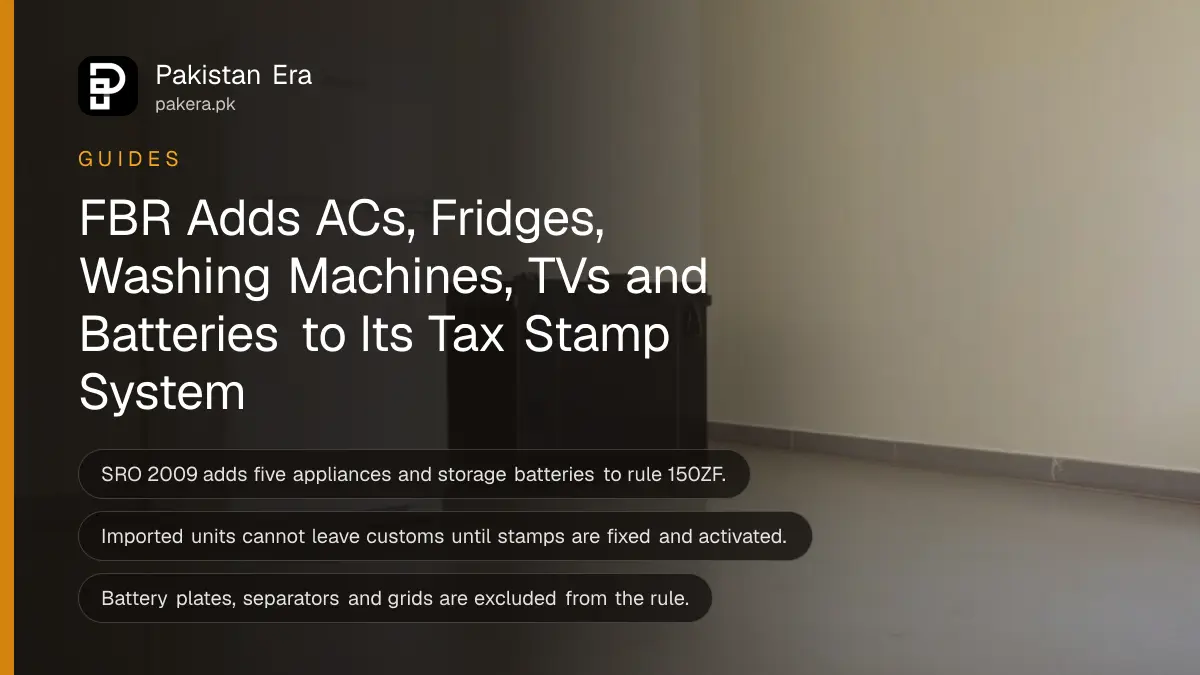
FBR has added air conditioners, refrigerators, deep freezers, washing machines, televisions and storage batteries to its track and trace system. S.R.O. 2009(I)/2026, dated 3 November 2026, means makers and importers of these goods must put an FBR tax stamp on each product and its packing. Imported units cannot leave customs until the stamps are fixed and activated.
Until now, the tax stamp regime in Chapter XIV-B of the Sales Tax Rules, 2006 covered eight groups of goods, from cigarettes to tiles. These two new groups are the first big consumer durables on the list. Below is what changed, who must act, and what shops and buyers should check.
What S.R.O. 2009 changes in the Sales Tax Rules
S.R.O. 2009(I)/2026 adds two new groups of "specified goods" to rule 150ZF: five household electrical goods and storage batteries. It also allows stamps to be applied by hand, lets state-owned enterprises hold a licence, and limits each licence to the goods it names.
FBR issued the notification under section 50, read with section 40C, of the Sales Tax Act, 1990. Section 40C is the power that lets FBR monitor and track goods electronically. The main changes, rule by rule, are in the table.
| Rule | What changed |
|---|---|
| 150ZF | New clause (i): air conditioners, refrigerators, deep freezers, washing machines (including automatic ones) and televisions, in finished form for sale. New clause (j): storage batteries in finished form |
| 150ZG | A state-owned enterprise can now apply for a licence, as defined in the State-Owned Enterprises (Governance and Operations) Act 2023 |
| 150ZH(5) | For the two new groups, stamps go on the product and its packing, including by manual application, as FBR specifies |
| 150ZI | Each licence must name the goods it covers. A licensee has no right over other goods |
| 150ZO(5) | All data the system collects belongs to FBR and is handed back when a licence ends |
| 150ZQG(1) | The licensee charges the fee for stamps, services and equipment directly from the maker or importer |
| 150ZQJ(1)(n) | Importers must not clear specified goods from customs without fixing and activating tax stamps |
Which goods now need an FBR tax stamp
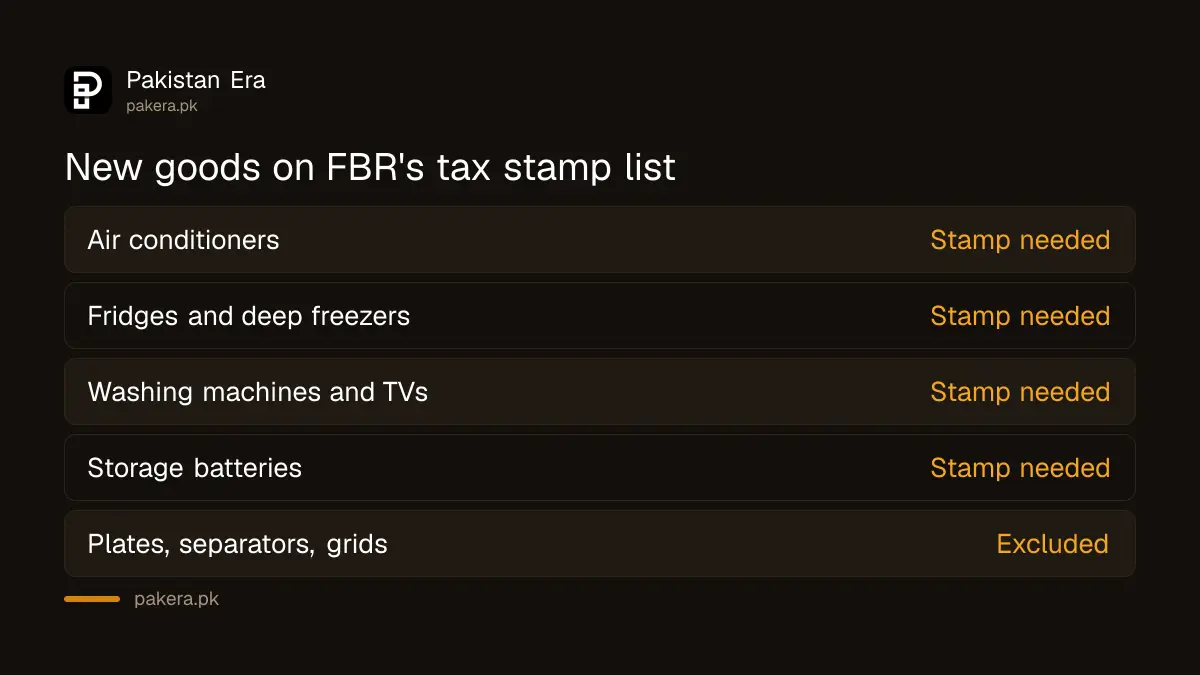
Ten groups of goods now sit on the rule 150ZF list. The original eight are tobacco products, beverages, sugar, fertilizer, cement, petroleum products, the steel sector and tiles. S.R.O. 2009 adds five household appliances and storage batteries as clauses (i) and (j).
- Household electrical goods (clause i): air conditioners, refrigerators, deep freezers, washing machines including automatic washing machines, and televisions. Only finished units made for sale are covered. The rule describes them as goods specified in the Third Schedule to the Sales Tax Act, which is the retail price schedule.
- Storage batteries (clause j): finished batteries, whether sold for retail or supplied to car and motorcycle makers or assemblers. This includes batteries listed in the Third Schedule.
Two kinds of battery item stay outside the rule. Battery parts are excluded, which the notification names as plates, separators and grids. Batteries that are exempt from sales tax under the Sixth Schedule are excluded too.
| Item | Needs a tax stamp? |
|---|---|
| New split or window AC, finished, for sale | Yes |
| Refrigerator or deep freezer, finished | Yes |
| Automatic or semi-automatic washing machine | Yes |
| Television set, finished | Yes |
| Car, bike or UPS storage battery, finished | Yes, unless exempt under the Sixth Schedule |
| Battery plates, separators and grids | No, parts are excluded |
Shoppers checking whether an appliance meets Pakistani standards should also look for the PSQCA mark, which is a separate scheme. The PSQCA check for ACs, fridges, washing machines and TVs explains it, and there is a matching PSQCA check for car, bike and UPS batteries.
What makers and importers must do
A maker or importer of these goods must route every unit through the licensed system, fix a stamp on each product and its packing, and pay the licensee's fee. Importers must fix and activate stamps before customs releases the goods. The duties already apply to other stamped goods.
Rule 150ZQJ lists the duties of the manufacturer or importer. The main ones are below, in the order a factory or import house meets them.
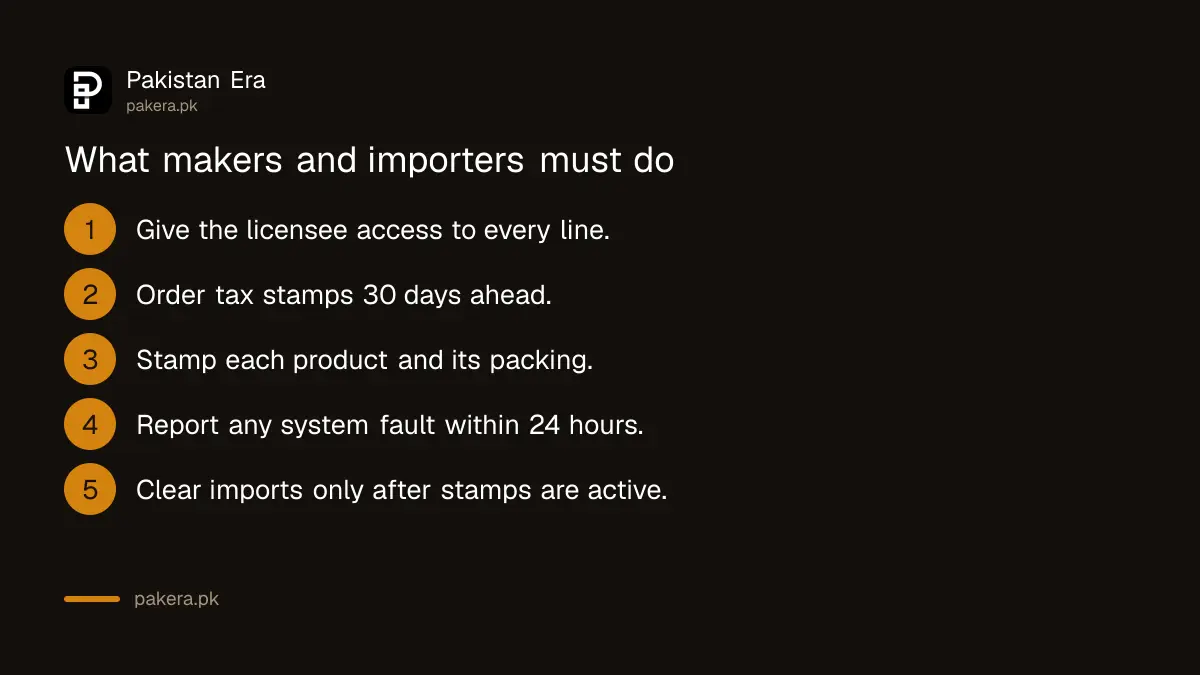
- Give the licensee access to every production line to install the system and keep it running.
- Order the stamps from the licensee at least 30 days ahead, and tell FBR.
- Fix a tax stamp on each product and its packing. For appliances and batteries this can be done by hand, in the way FBR specifies.
- Never supply goods without routing them through the system and stamping them.
- Report any breakdown, damage or tampering of the system to FBR and the Commissioner Inland Revenue within 24 hours.
- Give FBR 30 days' notice before a new brand, a new package design, or a change to a production line.
- For imports, do not clear the goods from customs until the stamps are fixed and activated.
The fee goes to the licensee, not to FBR. Under the new wording of rule 150ZQG, it covers the stamps, the related services and any application equipment the licensee provides. FBR may also choose automatic, semi-automatic or manual equipment for each production line, based on its yearly volume.
What shops, dealers and buyers should check
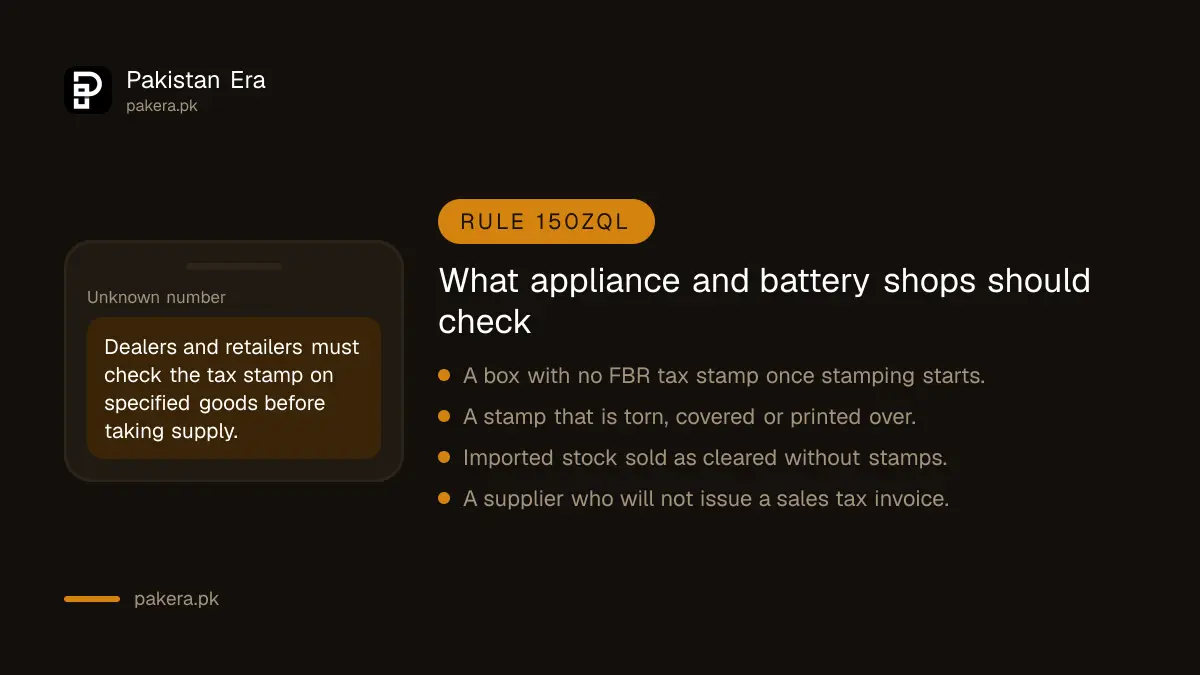
Rule 150ZQL already makes every distributor, wholesaler, dealer and retailer check the tax stamp on specified goods before taking supply. Once stamping starts, an appliance or battery shop should refuse unstamped stock. Buyers can ask to see the stamp on the box.
The stamp is built with security features that let anyone in the supply chain, or an authorised FBR officer, check that it is real. Rule 150ZH(2) says the features exist to stop fakes and to count production. Shops that sell stamped goods also need to follow the usual sales tax rules, which the sales tax registration rules for retailers set out.
When stamping starts for appliances and batteries
S.R.O. 2009 adds the goods to the list but sets no start date for stamps on appliances or batteries. Under the rule 150ZF proviso, FBR applies the system through its own instructions and orders. A licence naming these goods comes first.
That is how FBR has rolled out other monitoring. It sets dates through general orders, as with the tyre production monitoring order with a 30 November deadline. Makers and importers of appliances and batteries should watch for a similar order naming a date.
A clue sits in the licensing changes. Each licence must now name the goods it covers, and older licences stay limited to their original goods unless FBR extends them. So the current tobacco or cement licensees do not get appliances or batteries automatically.
Common questions
Do I need a tax stamp on an AC I already bought?
No. The rule puts the duty on the maker or importer before supply. A household buyer has nothing to fix or register.
Are battery plates and grids covered?
No. S.R.O. 2009 excludes parts of storage batteries, including plates, separators and grids, and batteries exempt under the Sixth Schedule.
Can imported TVs be cleared without stamps?
No. Under the new clause (n) of rule 150ZQJ(1), an importer must not clear specified goods from customs without fixing and activating tax stamps.
Who pays for the tax stamps?
The maker or importer. The licensee charges the fee for stamps, services and any equipment directly from them, under rule 150ZQG(1).
Is the PSQCA mark the same as the FBR tax stamp?
No. PSQCA certifies that a product meets a Pakistani standard. The FBR tax stamp tracks production and supply for sales tax.
Which other goods already carry FBR tax stamps?
Tobacco products, beverages, sugar, fertilizer, cement, petroleum products, the steel sector and tiles, all listed in rule 150ZF.
How we verified this
What we checked and where we read it.
We read S.R.O. 2009(I)/2026, dated 3 November 2026, on the FBR download server on 15 November 2026, and compared it with the Sales Tax Rules, 2006, updated to 31 July 2026 for the existing rule 150ZF list and the duties in rules 150ZH, 150ZQJ and 150ZQL. The notification is listed on FBR's Sales Tax SRO page under the title "Amendments in Chapter XIV-B, Sales Tax Rules, 2006". Two clause letters in the printed notification are hard to read in the scan; we used the order of the text to place them. For other 2026 notifications, see the full list of FBR sales tax SROs for 2026.
About the author

Tax, Bills and Technology Writer
Ali Akhtar is a young and curious voice here at Pakistan Era. He is currently pursuing his A-Levels and has a growing interest in Pakistan’s changing industrial landscape and educational trends. Ali likes to write in a way that helps him explain and explore the world around him. His writing reflects the perspective of the new generation navigating the evolving trends of Pakistan where technology, youth innovation, and shifting opportunities are reshaping the country’s future.