Who Must Register for Sales Tax in Pakistan: FBR's Section 14 List, Cottage Industry Rs 8 Million Limit and Tier-1 Retailers
Section 14 of the Sales Tax Act lists who must register with FBR: manufacturers, importers, wholesalers, Tier-1 retailers. See the Rs 8 million cottage rule.
Under section 14 of the Sales Tax Act 1990, you must register for sales tax with FBR if you are a manufacturer (unless you run a cottage industry), an importer, a wholesaler, dealer or distributor, a retailer liable to sales tax, or an exporter who wants refunds. A cottage industry is exempt only if its turnover stays at or below Rs 8 million and it meets three other tests.
Small business owners ask this constantly, usually after a supplier refuses to deal with an unregistered buyer. We read section 14, the cottage industry and Tier-1 retailer definitions in section 2, and rule 5 of the Sales Tax Rules 2006, in FBR's updated copies, on 1 November 2026. Here is who is in, who is out, and what happens next.
Section 14 lists six groups who must register
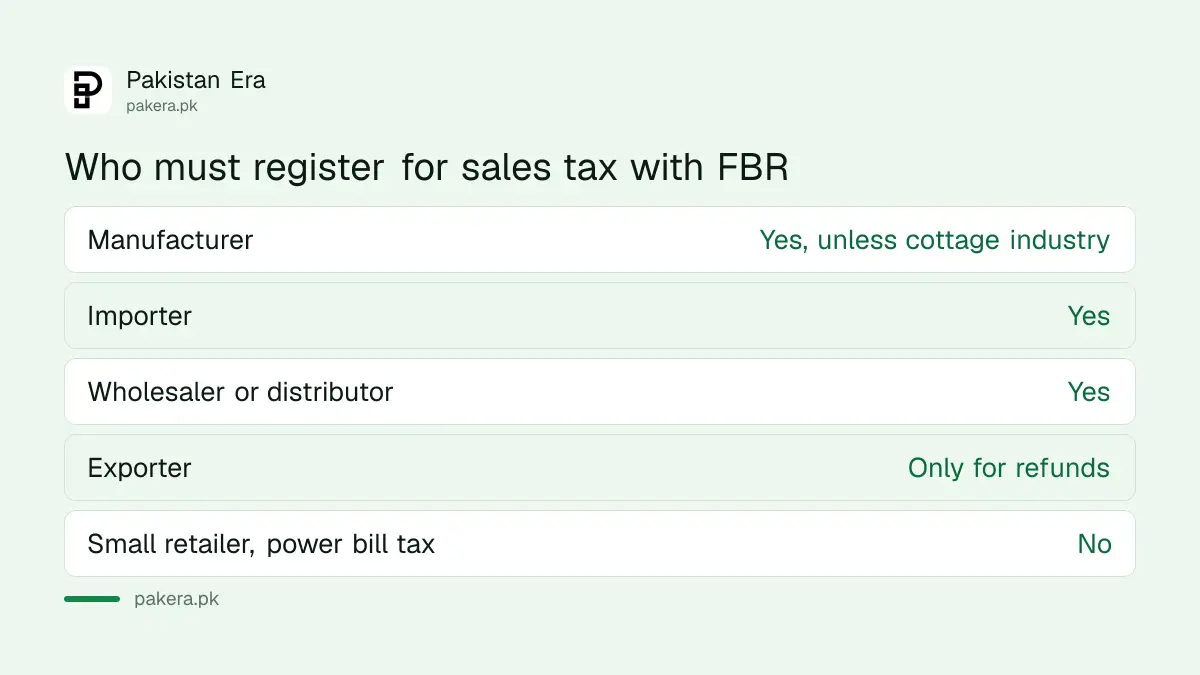
Section 14(1) covers anyone making taxable supplies in Pakistan, including zero-rated supplies, who falls in one of six groups. Manufacturers, liable retailers, importers, refund-seeking exporters, wholesalers and distributors, and people registered under another tax law all must register before making taxable supplies.
| Group under section 14(1) | Must register? | Exception |
|---|---|---|
| (a) Manufacturer | Yes | A cottage industry |
| (b) Retailer liable to sales tax | Yes | Retailers who pay sales tax through the electricity bill under section 3(9) |
| (c) Importer | Yes | None |
| (d) Exporter | Only if it wants sales tax refunds | Exporters not claiming refunds |
| (e) Wholesaler, dealer or distributor | Yes | None |
| (f) Person registered under another federal or provincial levy collected like sales tax | Yes | None |
Section 14(2) also lets people who are not making taxable supplies register voluntarily if they need it for imports or exports. This page is about federal sales tax on goods. Services are taxed by the provinces, so a Punjab service provider registers with PRA, as in PRA e-registration for sales tax on services.
A cottage industry must meet four tests to stay out
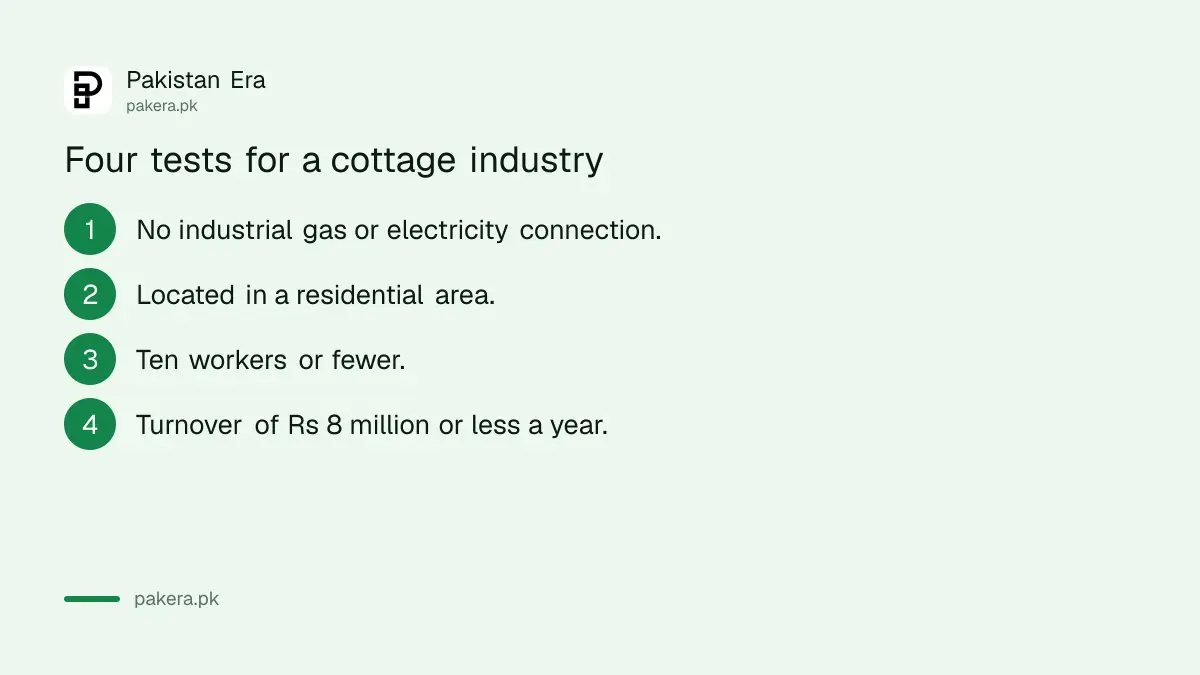
Section 2(5AB) defines a cottage industry as a manufacturing concern that meets all four conditions: no industrial gas or electricity connection, located in a residential area, no more than ten workers, and annual turnover from all supplies not above Rs 8 million.
- No industrial gas or electricity connection.
- Located in a residential area.
- Total labour force of ten workers or fewer.
- Annual turnover from all supplies of Rs 8 million or less.
Fail any one of them and you count as an ordinary manufacturer. A home workshop that installs an industrial meter, or hires an eleventh worker, has to register. The Rs 8 million limit covers all supplies, not just taxable ones, so count your full sales.
Tier-1 retailers must register and connect to FBR's POS system
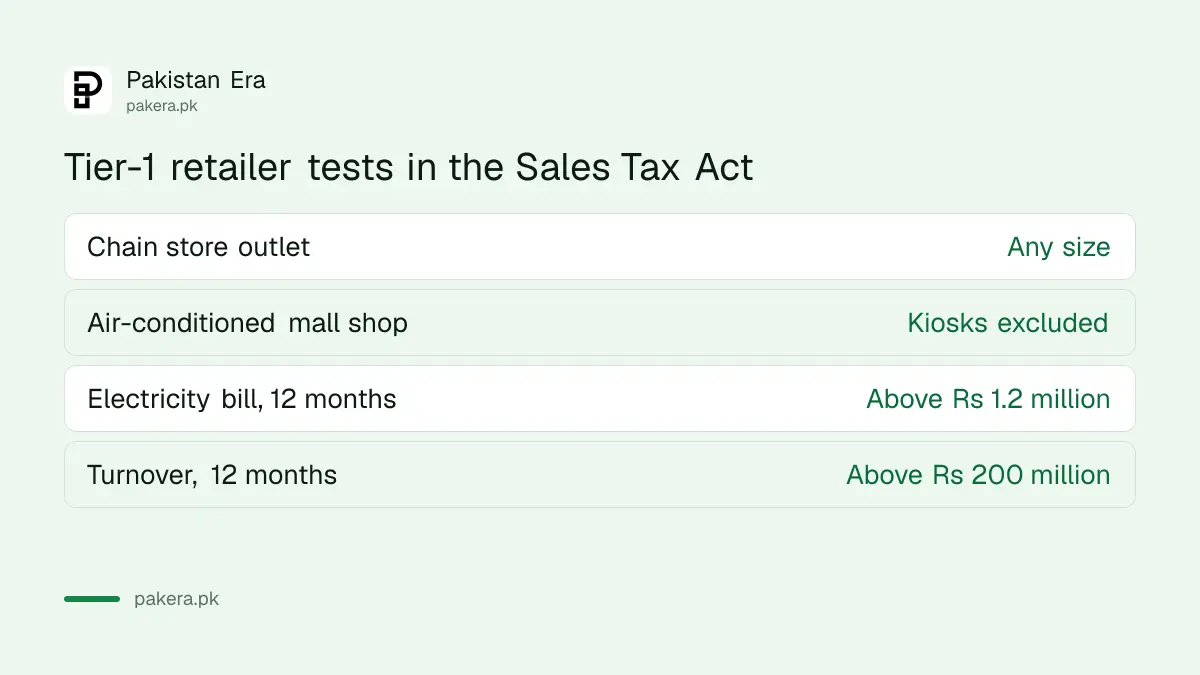
Section 2(43A) defines Tier-1 retailers. They include chain store outlets, shops in air-conditioned malls or plazas except kiosks, retailers whose electricity bills over the last twelve months exceed Rs 1.2 million, and retailers or wholesale-retailers with turnover above Rs 200 million.
| Tier-1 retailer test (section 2(43A)) | Threshold |
|---|---|
| Unit of a national or international chain of stores | Any size |
| Shop in an air-conditioned mall, plaza or centre | Kiosks excluded |
| Cumulative electricity bill, last 12 months | Above Rs 1.2 million |
| Wholesaler-cum-retailer in bulk import and supply | Turnover above Rs 200 million |
| Retailer by declared or worked-back turnover | Above Rs 200 million in last 12 months |
Tier-1 retailers must also integrate their outlets with FBR's computerised system. Buyers can check that a receipt is real using FBR POS invoice verification. Smaller retailers who pay sales tax through their electricity bill are outside the registration duty, and Karachi shopkeepers can read about the sales tax exclusion on K-Electric bills.
Online sellers and marketplaces have their own rule
Section 14(1A), added by the Finance Act 2025, requires anyone selling digitally ordered goods from within Pakistan through a marketplace, website or app to apply for registration. Cottage industries and electricity-bill retailers are excluded. Section 14(1B) stops marketplaces and couriers serving sellers without an NTN.
Where section 14(1A) applies, the marketplace or courier must also see a sales tax registration before letting the seller trade. So a seller on a big platform may be asked for both numbers. The online side is covered in more detail in tax registration for online sellers.
Ignoring the duty can mean forced registration and cut connections
Section 14(2A) lets the Commissioner compulsorily register a person who should have registered, after a hearing. Section 14AB lets FBR order gas and power companies to cut connections of anyone who fails to register, and of registered Tier-1 retailers not integrated.
Registering is done online. Under rule 5 of the Sales Tax Rules, you apply on FBR's system on Form STR-1 before making taxable supplies, upload GPS-tagged photos of the premises, and, for individuals and small firms other than manufacturers, a balance sheet showing business capital. After registration, you visit a NADRA e-Sahulat centre within a month for biometric verification.
Individuals must repeat that biometric check every July. Miss the first one and your name is taken off the sales tax Active Taxpayers List. The document list FBR can ask for is in sales tax registration documents, and monthly filing after that is explained in filing the monthly sales tax return.
Common questions
Who must register for sales tax in Pakistan?
Manufacturers other than cottage industries, liable retailers, importers, wholesalers and distributors, exporters seeking refunds, and online sellers of goods covered by section 14(1A).
What is the turnover limit for a cottage industry?
Rs 8 million a year from all supplies. It must also have no industrial gas or electricity connection, be in a residential area and have ten workers or fewer.
Is a small shop required to register for sales tax?
Not if it is not a Tier-1 retailer and pays sales tax through its electricity bill under section 3(9). Tier-1 retailers must register and integrate.
What makes a retailer Tier-1?
Being part of a chain, sitting in an air-conditioned mall or plaza, an electricity bill above Rs 1.2 million in twelve months, or turnover above Rs 200 million.
Can FBR register me without my application?
Yes. Section 14(2A) allows compulsory registration after a hearing if the Commissioner believes you are liable.
Do I need biometric verification after registering?
Yes. Rule 5(4) requires a NADRA e-Sahulat visit within a month, and individuals re-verify every July.
How we verified this
What we checked, where we read it, and what we could not confirm.
Last checked 1 November 2026. We read sections 2(5AB), 2(43A), 14 and 14AB in FBR's Sales Tax Act 1990, amended up to 30 June 2026, and rule 5 in FBR's Sales Tax Rules 2006, updated to 31 July 2026, on 1 November 2026. Provincial sales tax on services has separate rules in each province. We did not apply for a registration ourselves.
About the author

Global Affairs & Political Economy Writer
Muhammad Hatim is a book lover who started writing because he enjoys it. At Pakistan Era he writes about international relations, geopolitics and the global economy, with a particular interest in South Asia and the forces behind current events.