Land Demarcation (Hadbandi) in Punjab: How to Apply Under Section 117 and Appeal
Land demarcation (hadbandi) in Punjab under section 117: where to apply, the papers, how boundary marks are fixed, eviction under section 122 and appeal limits.
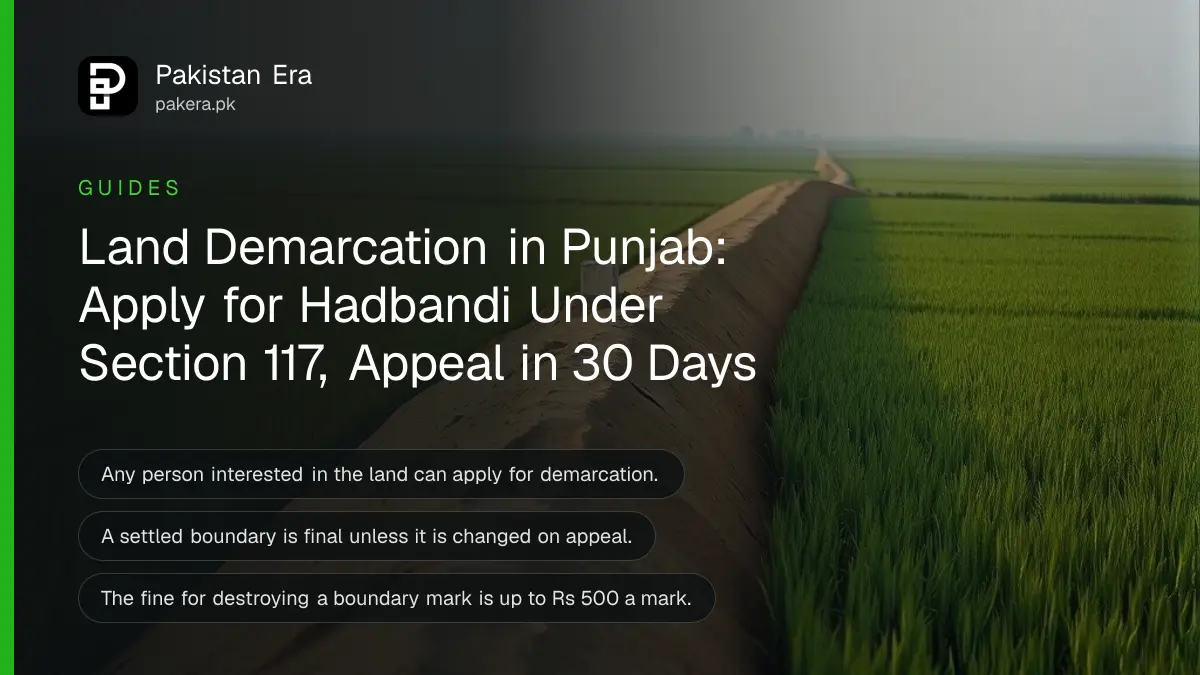
To get your land's boundary fixed in Punjab, apply to the Revenue Officer of your tehsil under section 117 of the Punjab Land Revenue Act 1967 for demarcation (hadbandi) of your field or holding. The officer can measure the land, fix its limits and order boundary marks to be set up. The result settles the boundary, and you can appeal it within 30 days to the Collector.
Demarcation helps when a neighbour's wall, a crop line or a new owner has moved onto land you think is yours. Before you go to the police or a court, fix where the line actually is.
Section 117 lets a Revenue Officer fix your boundary
Section 117 of the Punjab Land Revenue Act 1967 allows a Revenue Officer, on the application of any person interested, to define the limits of an estate, holding, field or part of one, and to require boundary marks to be erected or repaired.
"Any person interested" means you do not need the other side to agree. An owner, a co-owner or a buyer with a sanctioned mutation can apply. The officer can also put marks on a boundary that a court or another Revenue Officer already decided, or restore a mark set up by an earlier order.
The Act lists six classes of Revenue Officer: the Board of Revenue, the Commissioner, the Collector (the Deputy Commissioner of the district), the Assistant Commissioner, and Assistant Collectors of the first and second grade. The Tehsildar runs the revenue work of each tehsil and uses the powers of an Assistant Collector given to that post.
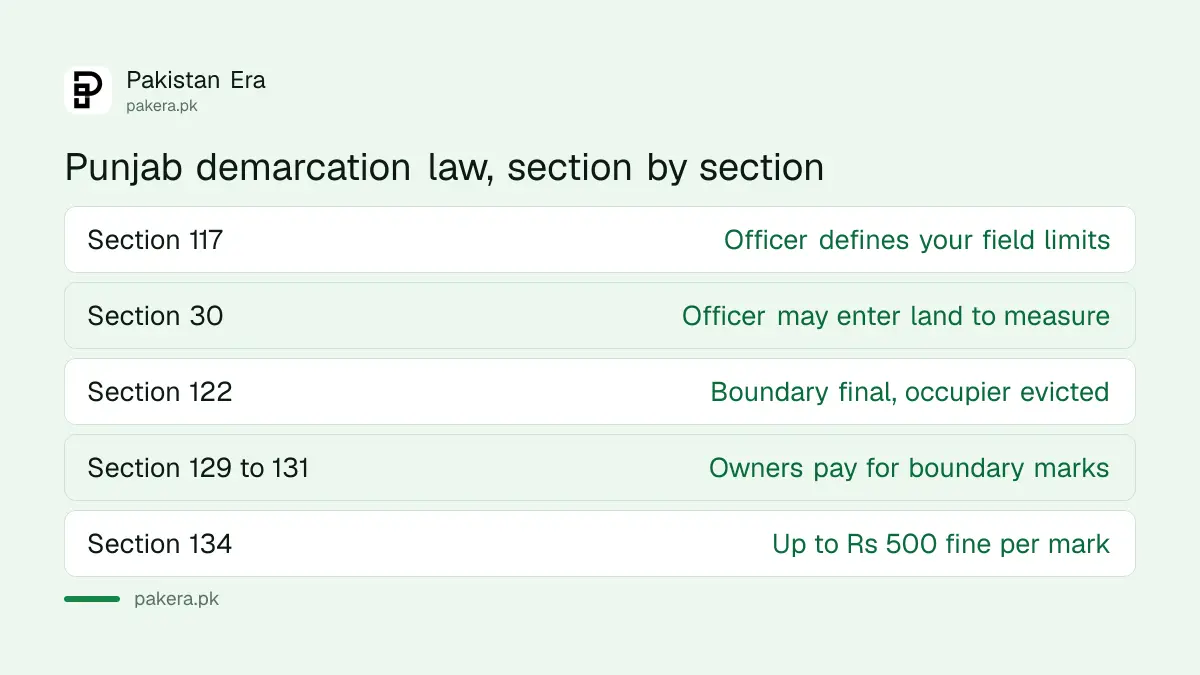
| Section of the Act | What it does for you |
|---|---|
| Section 117 | Revenue Officer defines the limits of your field or holding on your application |
| Section 30 | The officer and staff under his orders may enter the land to measure and fix boundaries |
| Section 122 | The settled boundary is final, subject to appeal, and a wrongful occupier can be evicted |
| Sections 129 to 131 | Owners pay for and maintain boundary marks |
| Section 134 | Fine of up to Rs 500 a mark for destroying or removing one |
| Sections 161 and 162 | Appeal in 30, 60 or 90 days depending on the officer |
Papers to bring before you apply
Bring a fresh fard for the khasra numbers you want demarcated, the aks shajra (the copy of the village field map), your CNIC and your ownership papers. A written application names the khasra numbers and the neighbours on each side.
- Application to the Revenue Officer of the tehsil, naming the mouza (revenue estate), khewat, khatooni and khasra numbers, and asking for demarcation under section 117.
- Fresh fard for those khasra numbers. You can get a Punjab fard at an Arazi Record Centre.
- Aks shajra, the field map copy that shows the shape and position of each khasra.
- Ownership papers: registry, sanctioned mutation (intiqal) or decree, as the case may be.
- CNIC, and the names and addresses of the neighbouring owners.
If the terms on a fard are new to you, the meaning of khewat, khatooni, khasra and intiqal is explained separately. Check the fard before you apply. If the record itself is wrong, demarcation will only fix the boundary to a wrong record.
Five steps from application to boundary marks
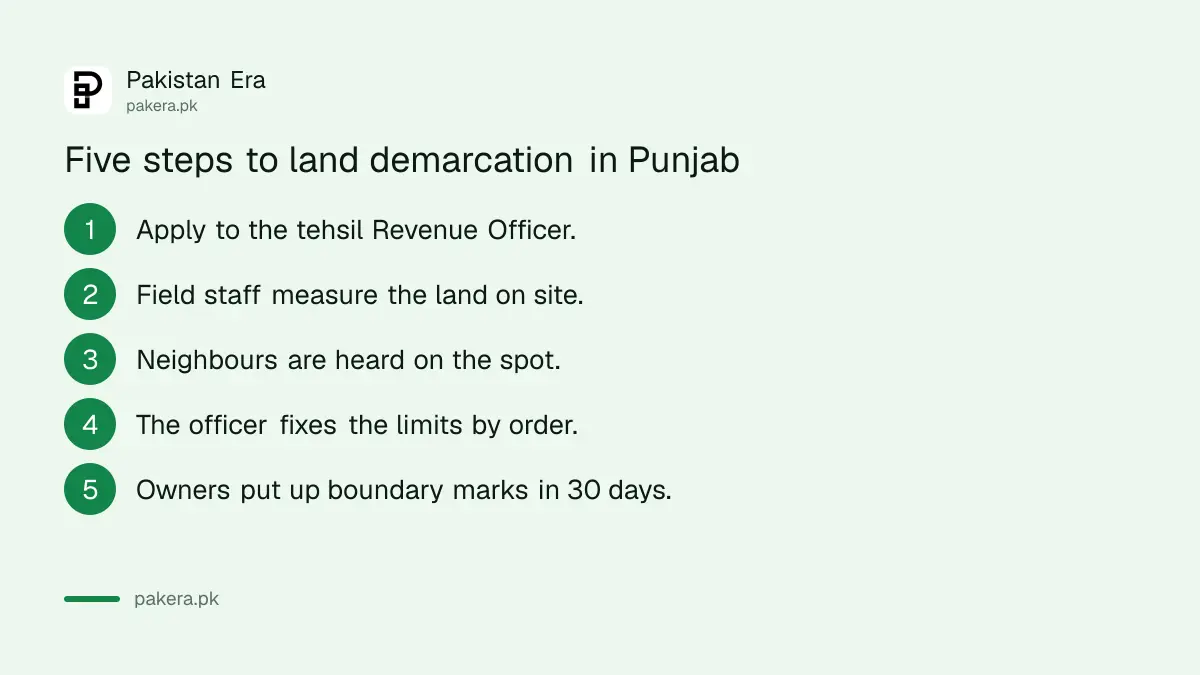
File the application, the officer orders the field staff to measure the land against the record, the neighbours are heard, the officer fixes the limits, and boundary marks are set up at the owners' cost. The Act gives owners 30 days to erect a mark once required.
- File the application with the Revenue Officer of your tehsil, with the fard, aks shajra and ownership papers.
- Measurement on site. Section 30 lets the officer and staff under his orders enter the land to measure and fix boundaries.
- Hearing of the other side. Be on site on the measurement day and ask for the neighbours to be present. The settled boundary decides their rights as well as yours.
- Order fixing the limits. The officer defines the limits of your field or holding and may require boundary marks.
- Boundary marks. Owners erect and repair marks at their own cost. If they do not within 30 days of being told, the officer can have them put up and recover the cost like land revenue.
Ask for a copy of the demarcation report and the order. You need both if you appeal, or if you later take the matter to a court or tribunal.
A settled boundary is final unless you appeal
Section 122 makes a settled boundary decisive on where the line is and on the rights of owners on each side, subject to appeal. The Collector can then evict anyone wrongly in possession of land found not to be theirs.
That is the real value of demarcation. Once the boundary is settled, a neighbour who has built over it is in possession of land the record says is yours. Section 122 lets the Collector evict that person, under rules made by the Board of Revenue.
Where someone has taken land by force, demarcation is often only the first step. A qabza complaint in Punjab or a civil suit may follow, and the demarcation report becomes evidence. A dispute that threatens violence can also reach a magistrate, under the section 145 procedure on land disputes.
Appeal within 30, 60 or 90 days
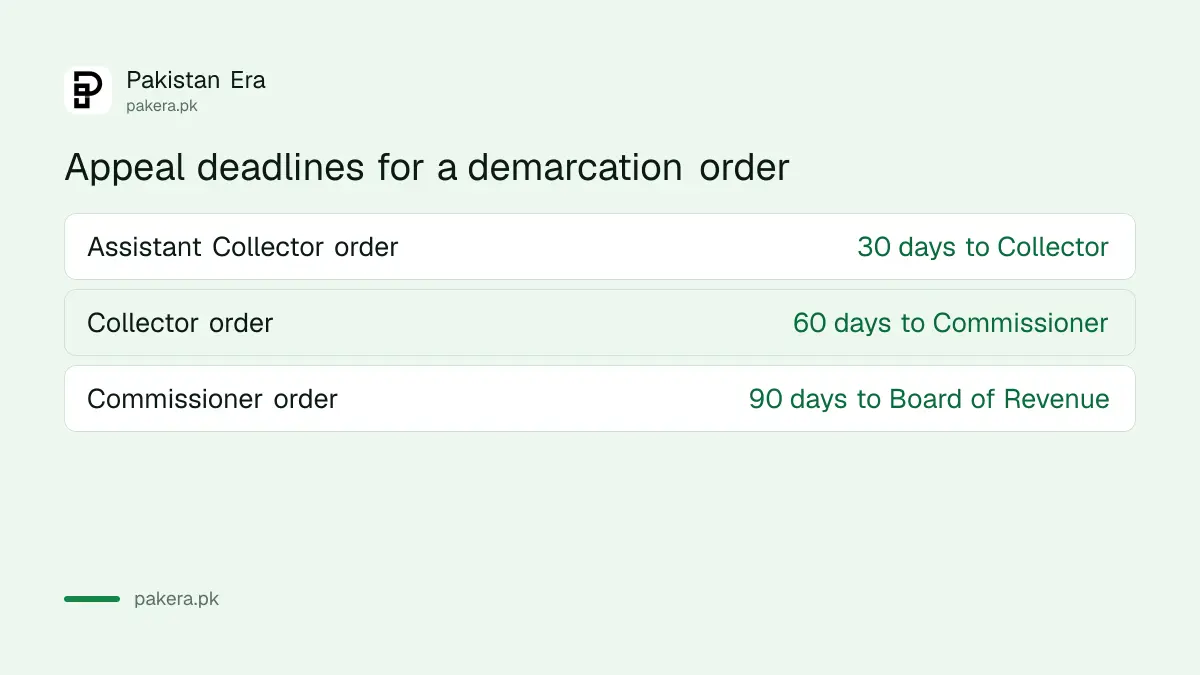
Appeal an Assistant Collector's or Assistant Commissioner's order to the Collector within 30 days, a Collector's order to the Commissioner within 60 days, and a Commissioner's order to the Board of Revenue within 90 days, on a point of law only.
| Order made by | Appeal to | Time limit |
|---|---|---|
| Assistant Collector or Assistant Commissioner | Collector | 30 days |
| Collector | Commissioner | 60 days |
| Commissioner | Board of Revenue, on a point of law | 90 days |
The time runs from the date of the order. If you find new evidence that you could not produce earlier, section 163 also allows you to ask the same officer for a review. Revenue appeals and hearing dates in Punjab can be followed on the Board of Revenue's Revenue Court Case Management System.
Joint land is a different case. If the land is shared and you want your own part marked out, the remedy is partition. The land partition (taqseem) process in Punjab divides the holding first, and demarcation follows on the ground.
Common questions
What is hadbandi of land?
Hadbandi is demarcation: fixing the limits of a field or holding on the ground from the revenue record. In Punjab a Revenue Officer does it under section 117 of the Land Revenue Act 1967.
Who can apply for land demarcation in Punjab?
Any person interested in the land, such as an owner or co-owner. Section 117 allows the Revenue Officer to define limits on the application of any person interested.
Who pays for boundary marks?
The persons interested in the land, under section 129. If they do not put up the marks within 30 days of being told, the officer can do it and recover the cost.
What if my neighbour removes a boundary mark?
Report it to the Revenue Officer. Section 134 allows a fine of up to Rs 500 for each mark wilfully destroyed or removed, and a criminal case is still possible.
How long do I have to appeal a demarcation order?
30 days to the Collector against an Assistant Collector or Assistant Commissioner, 60 days against a Collector, and 90 days to the Board of Revenue against a Commissioner.
How we verified this
What we checked and where we read it.
Last checked 17 November 2026. The law is from the Board of Revenue Punjab's copy of The Punjab Land Revenue Act 1967: sections 7, 11, 30, 117, 122, 129 to 131, 134 and 161 to 163. The case tracking system is described on the PLRA Revenue Court page. That page's question and answer section repeats the same fard answer under every question, so we have not relied on it. PLRA's list of online services does not include demarcation, so the application is made at the tehsil.
About the author

Tax, Bills and Technology Writer
Ali Akhtar is a young and curious voice here at Pakistan Era. He is currently pursuing his A-Levels and has a growing interest in Pakistan’s changing industrial landscape and educational trends. Ali likes to write in a way that helps him explain and explore the world around him. His writing reflects the perspective of the new generation navigating the evolving trends of Pakistan where technology, youth innovation, and shifting opportunities are reshaping the country’s future.