How to Respond to a Section 145 Magistrate Order in a Land Dispute in Pakistan
Got a Section 145 CrPC order over land? It decides who held possession, not who owns it. See what evidence to bring, the two month rule and attachment.
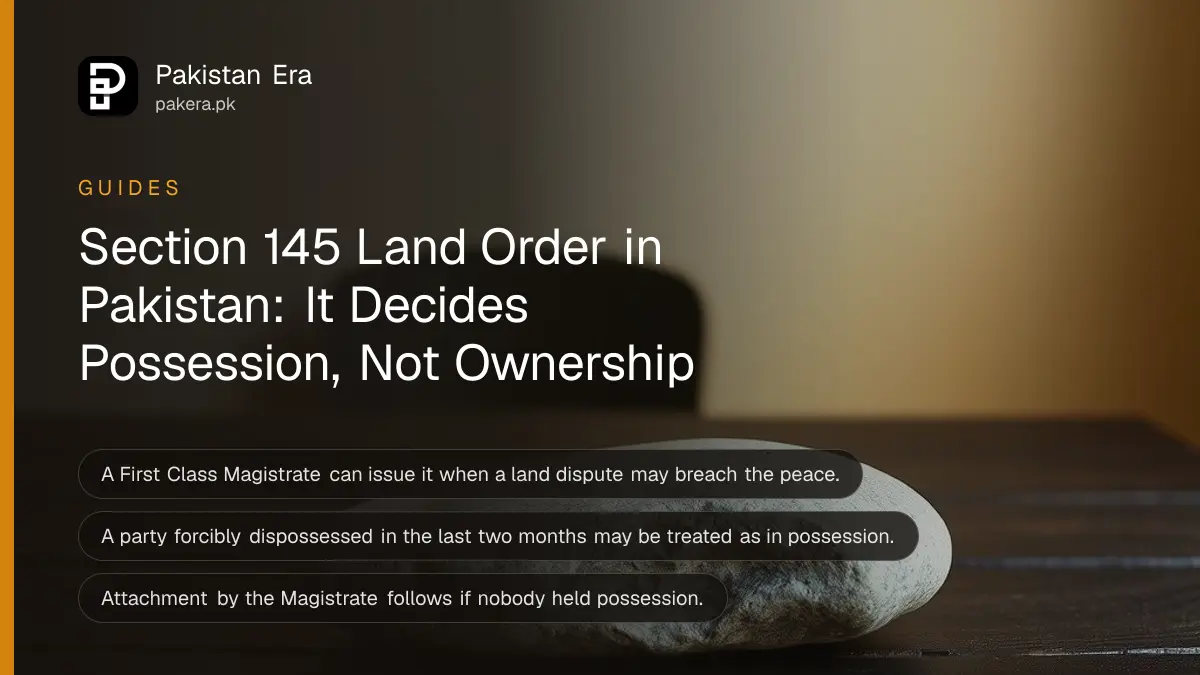
A Section 145 order is made by a First Class Magistrate who fears that a land dispute may cause a breach of the peace. It calls both sides to court to state who was in possession, and it decides possession only, not ownership. The party found in possession keeps it until removed by due course of law.
The notice usually arrives as a paper nailed or pasted near the plot, and the first reaction is panic. It is not an eviction. It is a short inquiry about one fact: who held the land on the date of the order. We read Sections 145 to 147 of the Code of Criminal Procedure (CrPC) on the Pakistan Code website on 15 October 2026. This is general information, not legal advice, and the dates in the order are what you must act on.
A First Class Magistrate can issue the order on a police report
Section 145 applies when a First Class Magistrate is satisfied from a police report or other information that a land or water dispute is likely to cause a breach of the peace. He must record the grounds in writing.
The order requires the parties to attend in person or through a lawyer by a fixed date and to file written statements of their claims about actual possession. The Magistrate does not wait for a civil case. This is a fast, local step meant to keep the peace while the real ownership fight goes elsewhere.
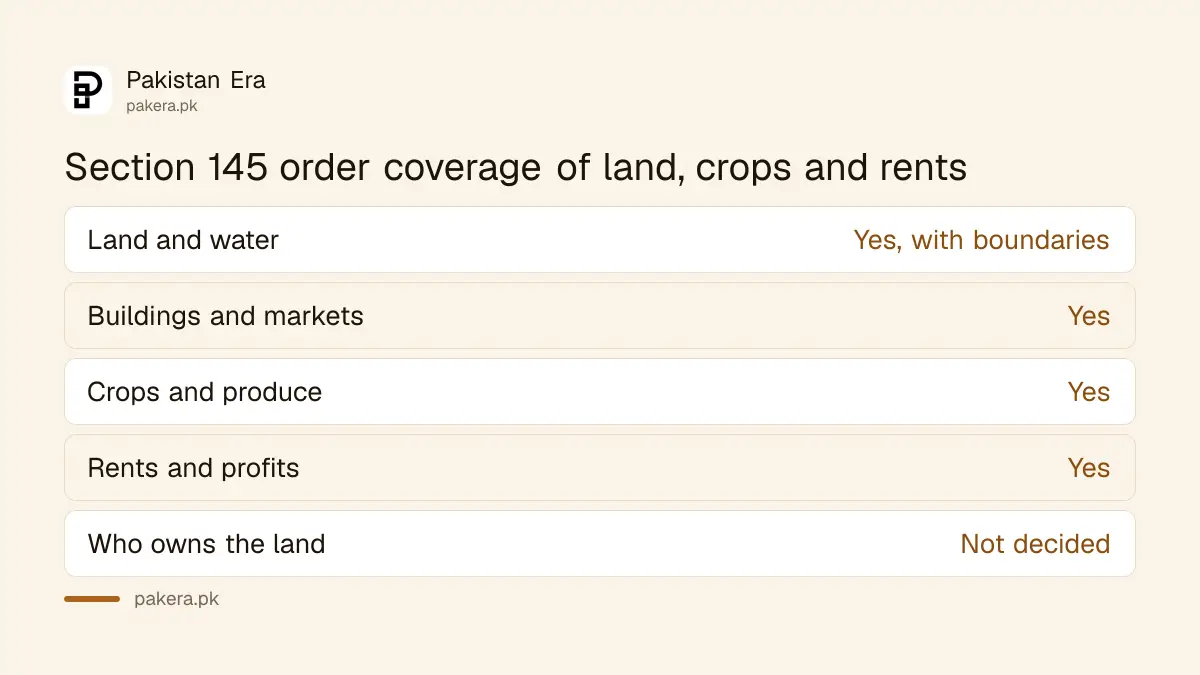
The order covers more than bare land
The Code says "land or water" includes buildings, markets, fisheries, crops or other produce of land, and the rents or profits of such property. A shop, a farm crop or the rent from a building can therefore be the subject of a Section 145 order.
A copy of the order is served on the persons the Magistrate names, as a summons would be, and at least one copy must be published by affixing it at a conspicuous place at or near the subject of dispute. If you rent out a property or live elsewhere, ask a neighbour or caretaker to watch for it, and take a photo of any notice you find.
The Magistrate decides who was in possession, not who owns the land
Under Section 145(4), the Magistrate reads the written statements, hears the parties, receives their evidence and decides, if possible, which party was in possession on the date of the order. He acts without reference to the merits of any claim to a right to possess.
That means a sale deed or a fard alone does not decide the inquiry. Bring proof of actual possession: utility bills in your name, crop sale receipts, rent receipts, photographs with dates, and the names of neighbours who saw you use the land. For ownership papers, see how to get a fard of your land in Punjab and verify a property's title.
| Evidence of possession | Example |
|---|---|
| Use of the land | Crop sale receipts, seed or fertiliser bills |
| Occupation | Electricity or gas bills at the address |
| Income from the property | Rent receipts or tenant statements |
| Dated photographs | Phone pictures with date and location |
| Witnesses | Neighbours and caretakers, with their CNICs |
Anyone dispossessed in the last two months is treated as in possession
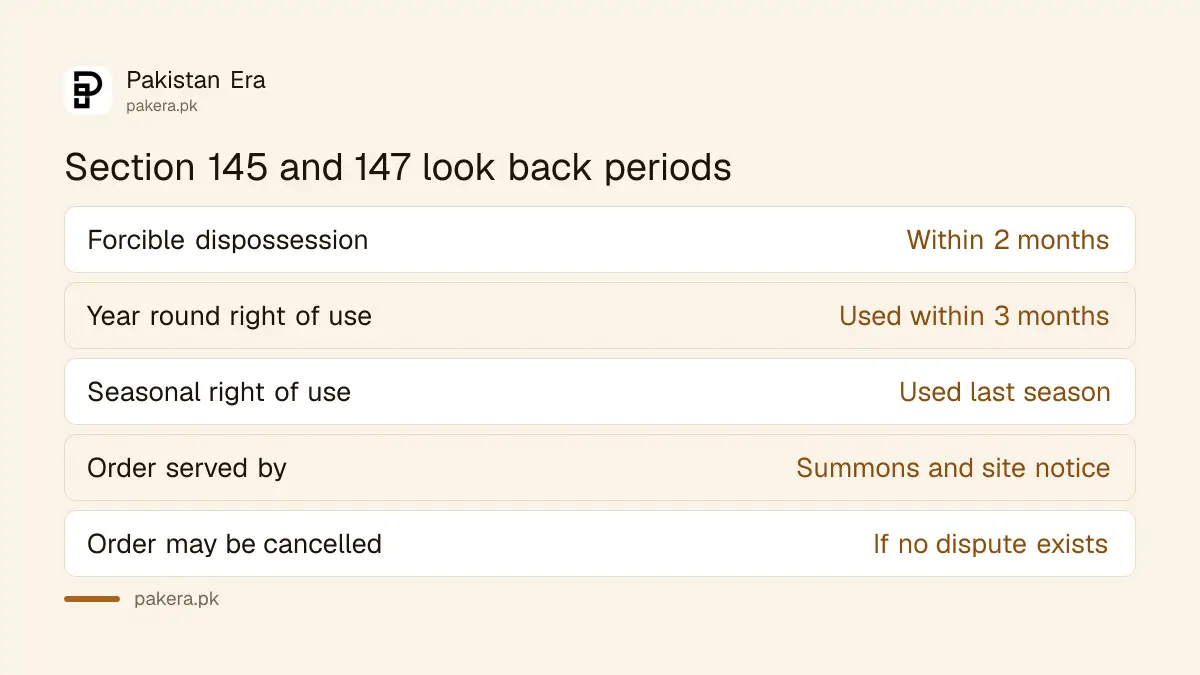
The first proviso to Section 145(4) says that if any party has been forcibly and wrongfully dispossessed within two months before the date of the order, the Magistrate may treat that party as if he had been in possession on that date.
That is why timing matters. If someone took the plot by force a few weeks ago, say so in your written statement and give the date. The second proviso lets the Magistrate attach the property in an emergency while he decides. Move quickly, since an attachment changes who can use the land.
You can show that no real dispute exists
Section 145(5) says any party or other interested person may show that no such dispute exists or ever existed. If the Magistrate accepts it, he cancels the order and all further proceedings are stayed. Otherwise, the order is final subject to that cancellation.
If you and the other side have settled, say so by a joint application with signed statements. A court that sees no risk to the peace has no reason to continue. If the other side has threatened you, report it, and use the Punjab police complaint line on 1787 where it applies.
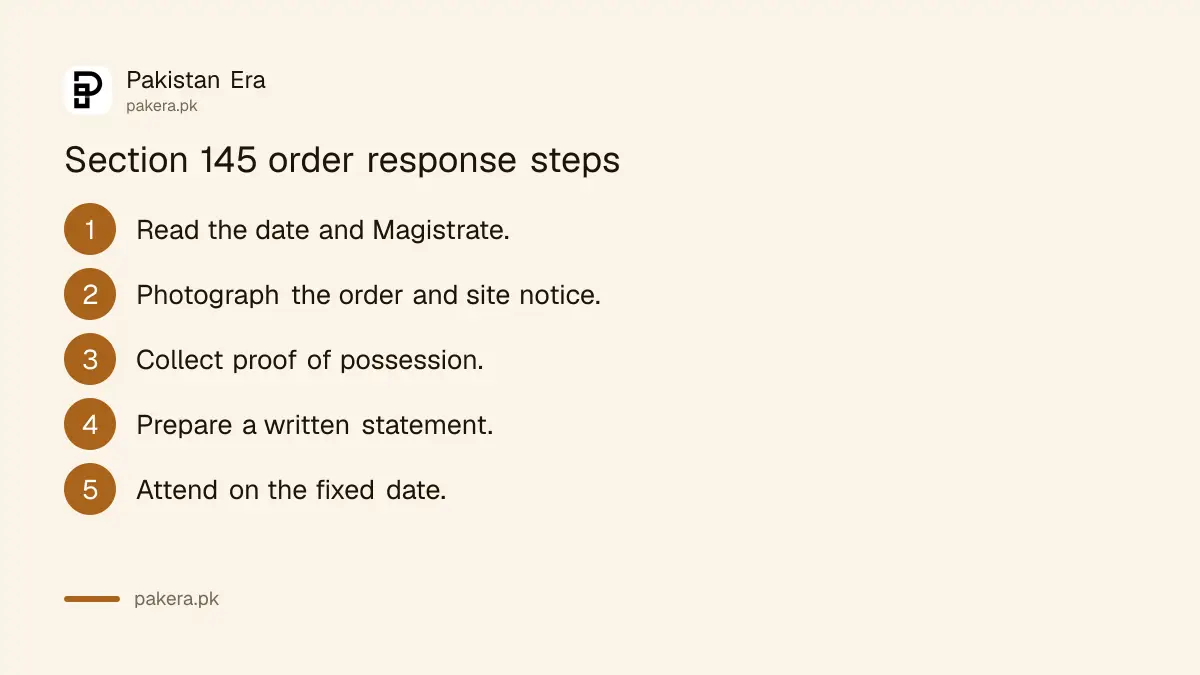
- Read the order for the date you must attend and the name of the Magistrate.
- Photograph the order and any notice pasted at the site, with the date.
- Collect proof of possession on the date of the order, not only ownership papers.
- Ask a lawyer to prepare your written statement of claim about actual possession.
- Attend in person or through your lawyer on the fixed date, with witnesses ready.
- Obey the Magistrate's final order, and file your civil suit for ownership separately.
The party found in possession stays until removed by law
If the Magistrate finds that one party was in possession, he declares that party entitled to possession until evicted in due course of law and forbids all disturbance. Where the other side forcibly dispossessed a party, he may restore possession to that party.
If he decides that none of the parties was in possession, or he cannot satisfy himself, Section 146 lets him attach the property until a competent court decides who has the right. He may appoint a receiver to manage it, unless a civil court has already appointed one.
A Section 145 order never replaces a civil suit. If you lose, the order does not take your title. If you win, you still need the ownership case. A suit to recover possession has its own deadline, and how to record a court order in your land record shows how to put a later order into the record.
Right of way disputes follow Section 147
Section 147 applies the same method to a dispute over a right of use of land or water, such as a path or a water channel. The Magistrate may prohibit interference with a right that appears to exist.
The proviso sets a test: where the right is exercisable all the year, it must have been used within three months before the inquiry began. For a seasonal right, it must have been used in the last season. Keep proof of recent use, such as photographs or witness statements.
Common questions about Section 145 orders in Pakistan
Does a Section 145 order decide who owns the land?
No. It decides who was in possession on the date of the order. Ownership is decided in a civil court.
Who issues the order?
A First Class Magistrate, on a police report or other information that a land dispute may cause a breach of the peace.
Do I have to attend in person?
The order requires the parties to attend in person or by pleader, meaning a lawyer, on the fixed date.
What if I was thrown out last month?
If you were forcibly and wrongfully dispossessed within two months before the order, the Magistrate may treat you as being in possession.
Can the order be cancelled?
Yes. If you show that no dispute exists or ever existed, Section 145(5) says the Magistrate shall cancel it.
What happens if nobody is found in possession?
Section 146 lets the Magistrate attach the property until a competent court decides the right, and he may appoint a receiver.
How we verified this
What we checked, where we read it, and what we could not confirm.
Last checked 15 October 2026. We read Sections 145, 146 and 147 in the text of the Code of Criminal Procedure, 1898 on the Pakistan Code website. We did not attend a hearing. Some printed wording in the Code dates from older amendments, so ask a lawyer to confirm the current text.
About the author

Senior Writer, Public Services and Technology
Shahid joined us in 2024 as an author. He is a senior contributor to Pakistan's leading technology websites. He writes detailed articles, mostly covering his expertise in the latest tech, mobiles, apps, gadgets, and step-by-step guides. His ideology is to help people understand the latest trends and explain complex methods through very easy-to-understand guides.