Qabza Complaint in Punjab: File at the Punjab Property Tribunal, Every Step and Deadline (2026)
Qabza complaints in Punjab now go to the Punjab Property Tribunal, not the DC. See the papers, the 30 day committee report, penalties and how to get land back.
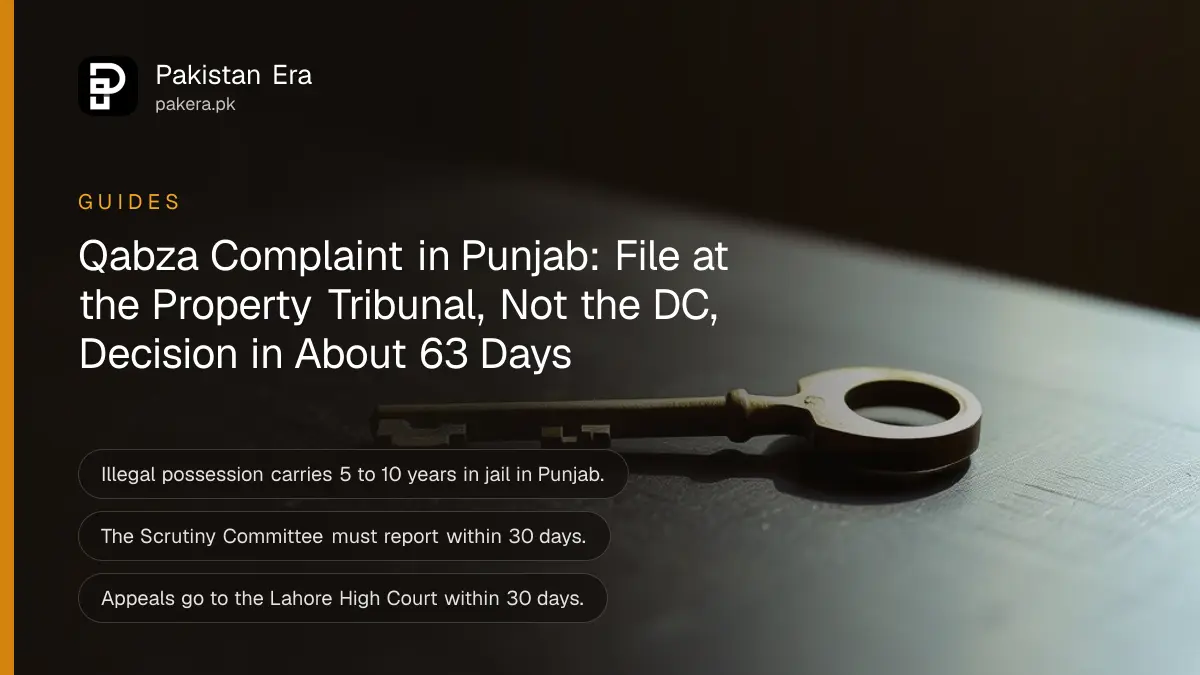
If someone has taken over your land, house or plot in Punjab, you file a qabza complaint at the Punjab Property Tribunal for your district, run by an Additional Sessions Judge, under the Punjab Protection of Ownership of Immovable Property Act 2025. The Tribunal sends it to a district Scrutiny Committee within three days, the committee reports within 30 days, and the Tribunal must then decide within another 30.
Many people still go to the Deputy Commissioner's office first, because that is how the 2025 Ordinance worked. That changed in May 2026. We read the amended Act on the Punjab Government's Punjab Code page for the Act on 28 October 2026, and the steps below follow its text.
Qabza is now a crime with 5 to 10 years in jail in Punjab
Section 4 of the Act makes it an offence to take or keep possession of someone's immovable property by fraud, forgery, force, threats or any other illegal means. The punishment is jail of five to ten years, a fine of up to Rs 10 million, or both.
Immovable property here means land, buildings and things fixed to the earth. It does not include standing crops, trees or machinery dealt with separately from the land. The word "accused" is wide: it covers a person, a company, a housing society, a trust and the people who run them.
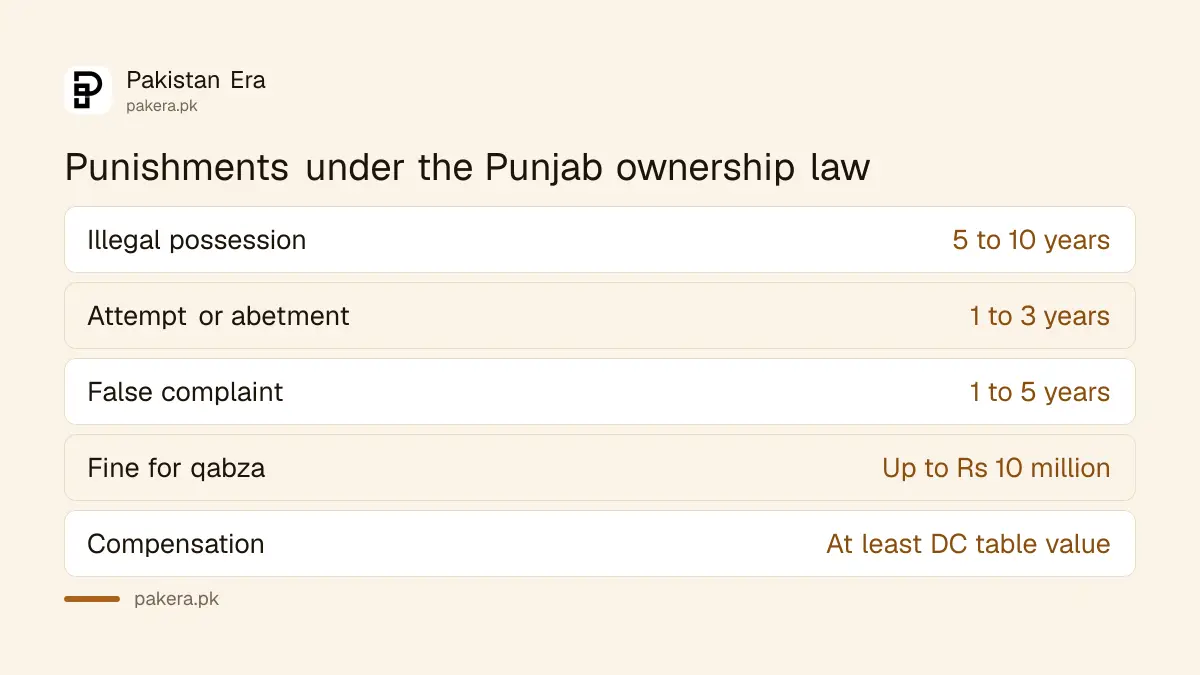
| What the Act punishes | Section | Punishment |
|---|---|---|
| Taking or keeping illegal possession | 4 | 5 to 10 years, fine up to Rs 10 million, or both |
| Attempting, helping or plotting a qabza | 5 | 1 to 3 years, fine up to Rs 1 million, or both |
| Filing a false or vexatious complaint | 16(3) | 1 to 5 years and fine up to Rs 500,000 |
| Compensation to the owner | 16(7) | At least the property's value on the DC valuation table, plus profits |
The complaint goes to the Punjab Property Tribunal, not the DC
Under section 7, only the lawful owner files the complaint, and it goes to the Property Tribunal for the district where the property is. The Tribunal is an Additional Sessions Judge designated by the Punjab Government with the Lahore High Court Chief Justice.
The Deputy Commissioner still has a role. He chairs the district Scrutiny Committee, which checks the record and tries to settle the dispute. But the case starts and ends with a judge. The Amendment Act of 2026, published in the Punjab Gazette on 14 May 2026, made that change.
Ask at the district Sessions Court which Additional Sessions Judge is the designated Tribunal. We could not find a published list of the designated judges for each district.
Your complaint must prove you are the lawful owner
Section 7(2) says the complaint must identify the property, state the facts of the qabza, give evidence of lawful title, and name the people in possession as far as you know them. Without proof of title, the complaint is weak from day one.
Get your documents ready before you file. A current fard from the land record centre is the usual proof, and you can get a fard of your land in Punjab online. Add the registered sale deed or mutation, a site plan, and any photos or police reports showing when the occupation began.
- Collect proof of title: fard, registered deed, mutation and any inheritance papers.
- Write the complaint with the khasra or plot number, location and boundaries.
- Describe the qabza: who entered, when, how, and what they built or changed.
- Name the people in possession and anyone helping them.
- File it at the Property Tribunal of your district and keep the receipt or case number.
Check your own record first. If the fard is not in your name, fix that before filing. Section 16(3) punishes a false or frivolous complaint with one to five years in jail, so a weak claim can turn on you.
The Scrutiny Committee has 30 days, then the Tribunal has 30
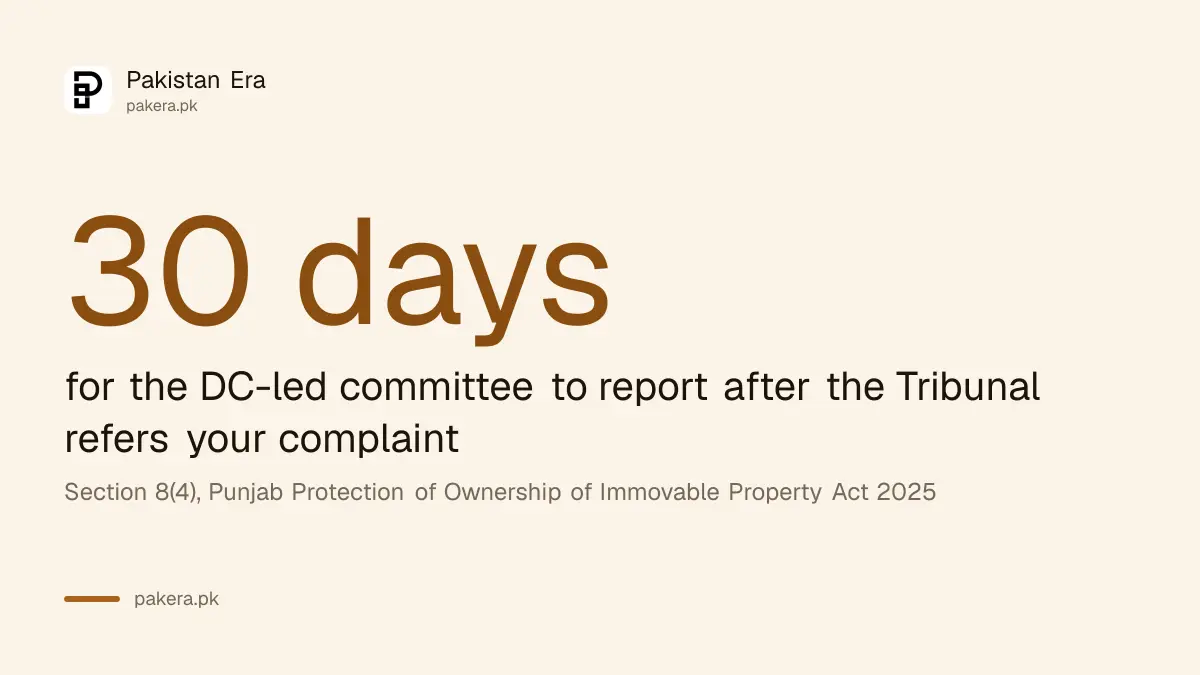
Within three days of receiving your complaint, the Tribunal refers it to the district Scrutiny Committee. The committee must send its report within 30 days. After that, the Tribunal hears the case day to day and must decide within 30 days of the report.
The committee has eight members, led by the Deputy Commissioner, with the District Police Officer, the Additional Deputy Commissioner (Revenue), the Assistant Commissioner, the Sub-Divisional Police Officer, the Circle Revenue Officer and the local SHO. It can call people, demand records from any office and record statements. Both sides must appear in person, or by video link with biometric verification if the committee agrees in writing.
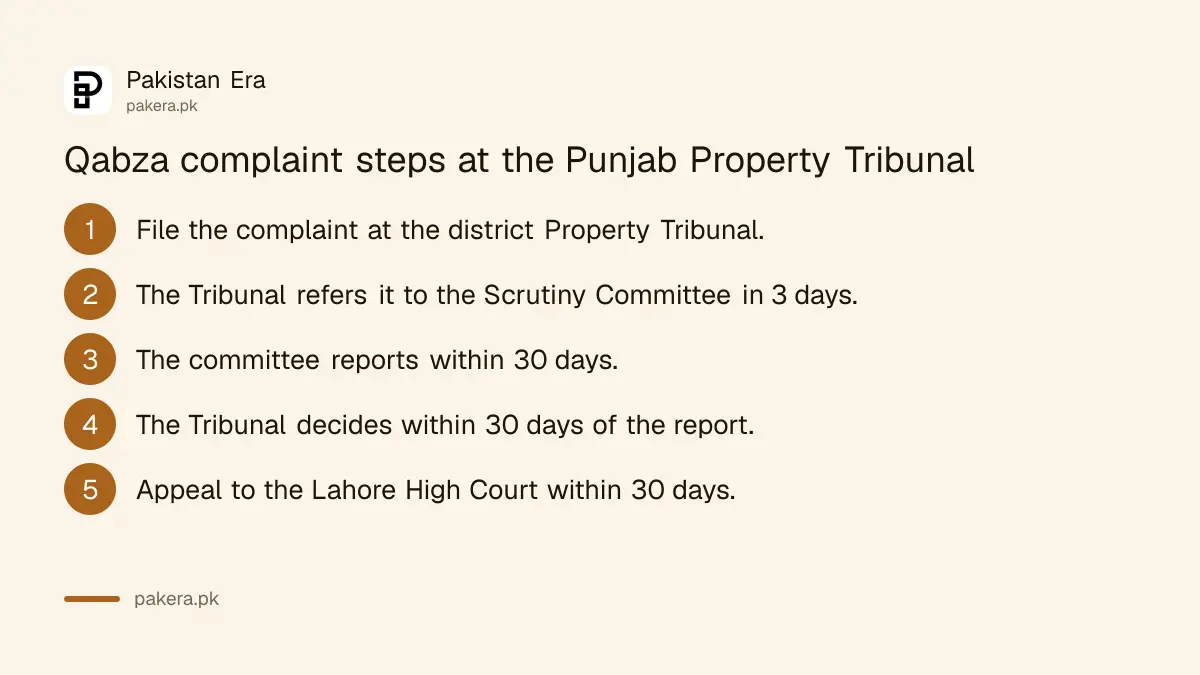
If the parties settle before the committee, it writes up the compromise and sends it to the Tribunal for a decree. No appeal lies against that decree, so read any settlement carefully before you sign.
The Tribunal can seal the property and restore your possession
The Tribunal does more than punish. It can order interim steps to protect the property while the case runs, decide who holds title, award compensation, order arrests, and finally hand possession back to you with police help.
- Before a qabza: under section 9, if you fear someone is about to occupy your property, you can ask the Tribunal for preventive measures, such as a surety from the other side or sealing the property.
- During the case: section 10 lets it regulate possession and direct the SHO to enforce its orders.
- Frozen sales: section 20 makes any sale, gift, lease or partition of the property after the complaint void, unless the Tribunal allows it.
- Compensation: section 16(7) sets it at no less than the property's value on the stamp duty valuation table, plus profit made from it.
- Arrest and bail: the Tribunal can order an arrest, and only the Lahore High Court can grant bail to someone so arrested.
Already fighting in a civil court? Section 16(11) lets you ask that court to transfer a pending qabza case to the Tribunal, and the court must decide within 15 days.
Appeals go to the Lahore High Court within 30 days
Under section 19, the convicted person, the complainant, or the Public Prosecutor can appeal the final judgment to the Lahore High Court within 30 days. The High Court must decide the appeal within 30 days of filing. Interim orders cannot be appealed.
Outside Punjab, or for an older case, the federal route still exists. You can file an illegal dispossession complaint at the Court of Session under the 2005 Act, or sue for possession within six months under section 9 of the Specific Relief Act. In Punjab, the 2025 Act overrides other laws where they conflict.
Common questions
Where do I file a qabza complaint in Punjab?
At the Punjab Property Tribunal for the district where the property is. It is an Additional Sessions Judge designated under section 11 of the Act.
Can I still complain to the Deputy Commissioner?
Not to start the case. Since the May 2026 amendment, the complaint goes to the Tribunal, and the DC's committee only investigates and mediates after the Tribunal refers it.
How long does a qabza case take under the new law?
On paper about 63 days: 3 days to refer, 30 days for the committee report and 30 days for the decision. Real cases can take longer.
What is the punishment for qabza in Punjab?
Five to ten years in jail, a fine of up to Rs 10 million, or both, under section 4. Helping a qabza carries one to three years.
Can a tenant who stops paying rent be charged under this Act?
The Act covers anyone keeping possession by illegal means. A tenancy dispute usually goes to the Punjab Rent Tribunal first, so get legal advice before filing a qabza complaint against a tenant.
Does the Act apply to overseas Pakistanis?
Yes, any lawful owner can file. Overseas Pakistanis in Punjab also have special courts under a separate 2025 Act for property disputes.
How we verified this
What we checked, where we read it, and what we could not confirm.
We read the Punjab Protection of Ownership of Immovable Property Act 2025 (Act CI of 2025) on the Punjab Code portal of the Law and Parliamentary Affairs Department on 28 October 2026. The text there includes the changes made by the Amendment Act XXXVII of 2026, published in the Punjab Gazette on 14 May 2026. We could not find a published list of the Additional Sessions Judges designated as Property Tribunals, any rules under section 25, or a court fee for the complaint, so ask at your district Sessions Court before filing.
About the author

Tax, Bills and Technology Writer
Ali Akhtar is a young and curious voice here at Pakistan Era. He is currently pursuing his A-Levels and has a growing interest in Pakistan’s changing industrial landscape and educational trends. Ali likes to write in a way that helps him explain and explore the world around him. His writing reflects the perspective of the new generation navigating the evolving trends of Pakistan where technology, youth innovation, and shifting opportunities are reshaping the country’s future.