How to File an Illegal Dispossession Complaint in Pakistan: Court of Session, 60 Days
Land or house taken by force in Pakistan? The Illegal Dispossession Act lets you file in the Court of Session: police report in 15 days, trial in 60 days.
Short answer: If someone has taken your land, house or shop by force, you can file an illegal dispossession complaint straight in the Court of Session. The Illegal Dispossession Act, 2005 sets up to 10 years in prison for grabbing property, asks the police to report within 15 days, and tells the court to decide within 60 days. You do not need an FIR first.
A family comes back from a wedding and finds a stranger's lock on its plot. The police say it is a civil matter. The civil court gives a date six months away. That gap is what this Act was written for, and many owners never use it.
We read the Act on 12 October 2026, in the 2024 compilation published by the Sindh Judicial Academy, which includes the 2017 amendment. The law extends to the whole of Pakistan. We are not lawyers, and this is not legal advice. Take your own papers to a lawyer before you file.
You file a complaint in the Court of Session, not a police station
The Act makes the Court of Session the court for this offence, and the case starts on a complaint. The offence is non-cognizable, which means the police cannot start the case on their own. You go to the court, usually through a lawyer.
Section 4 says the court may direct the police to arrest the accused at any stage. So the police do act, but on the court's order. An FIR is not the starting point here.
The Act calls a person an "owner" if they actually owned the property when they were dispossessed, and an "occupier" if they were in lawful possession. Both can complain. "Property" means immovable property, that is, land and buildings.
The penalties are up to 10 years, or up to 3 years for forcible dispossession
Entering a property without lawful authority to grab or control it carries imprisonment up to 10 years and a fine, under section 3(2). The victim must also be compensated. A forcible dispossession that does not fit that offence carries up to 3 years, or a fine, or both.
| Act | Section | Punishment |
|---|---|---|
| Entering to grab, control or occupy without lawful authority | 3(2) | Up to 10 years and a fine, plus compensation |
| Forcible and wrongful dispossession outside section 3(1) | 3(3) | Up to 3 years, or a fine, or both, plus compensation |
| False, frivolous or vexatious complaint | 5(4) | Costs of up to Rs 500,000 to the person complained against |
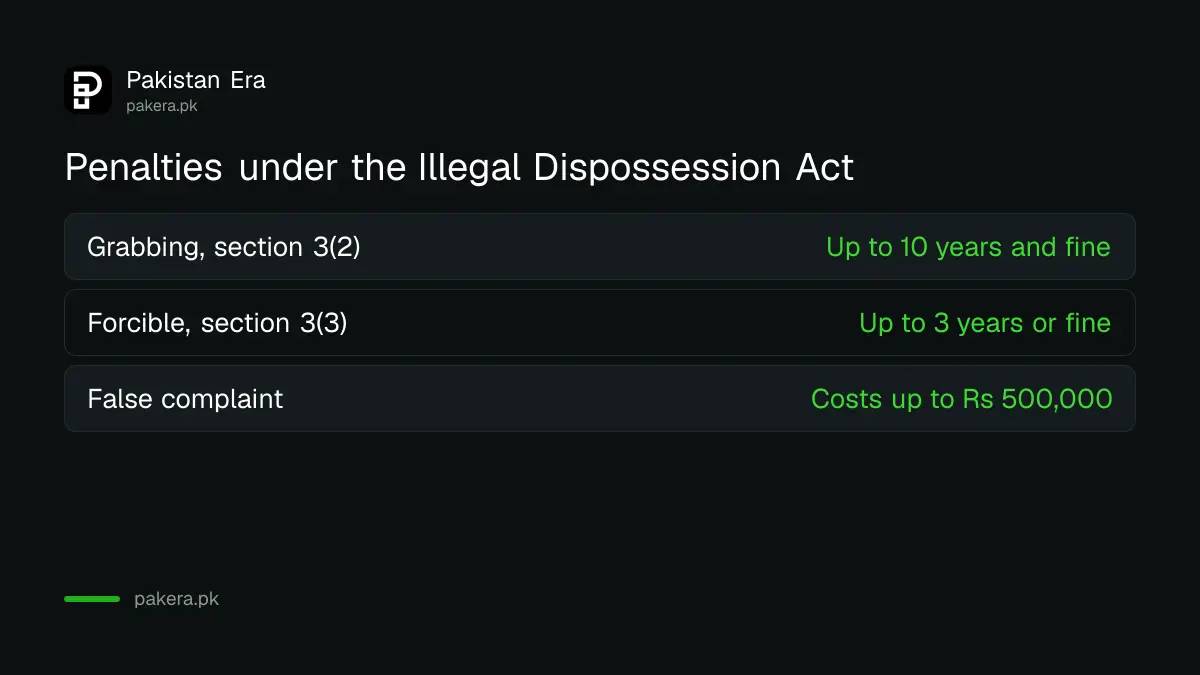
The last row matters. A weak or invented complaint can cost you up to Rs 500,000. Do not file one to pressure a tenant or a relative.
The Act sets short limits for the police and the court
After a complaint, the court may direct the police to investigate and report within 15 days. The court may extend that for good reasons. The trial runs from day to day and must finish within 60 days, with reasons recorded for any delay.
No adjournment may be longer than 7 days. The court may not adjourn at all unless it thinks it is necessary in the interest of justice. If the property was empty just before the offence, the court may attach it until the final decision.
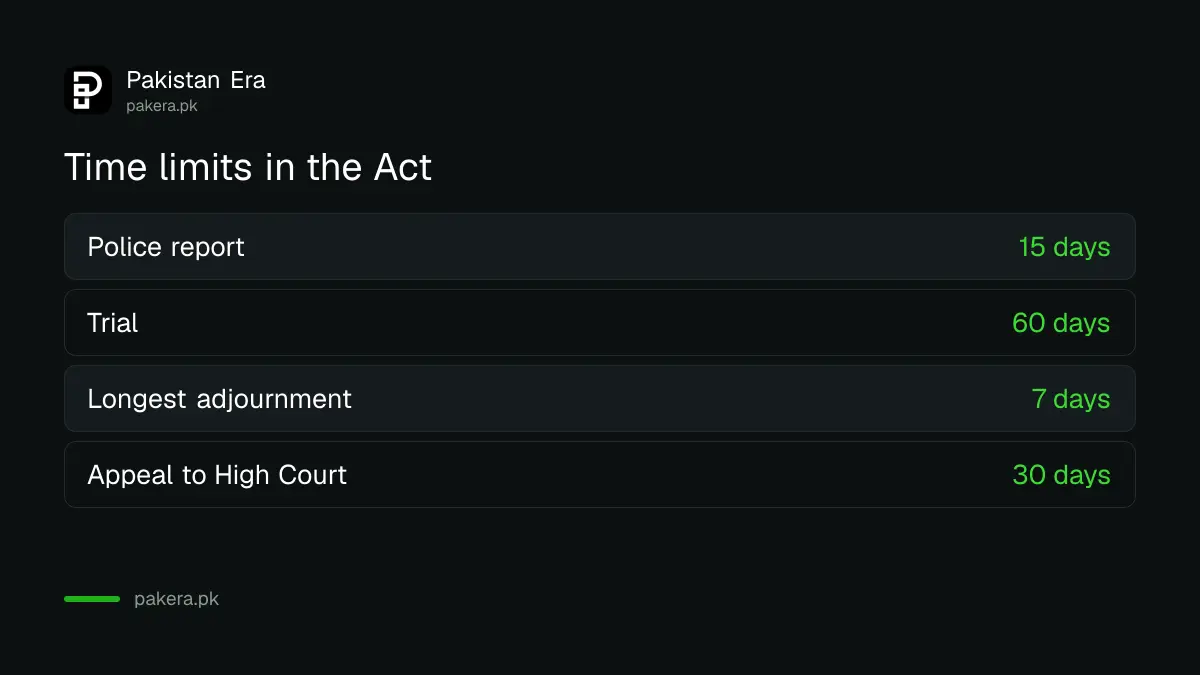
These are the Act's own numbers. In practice, courts miss them. A June 2026 Supreme Court judgment, as reported, told trial courts to treat 60 working days as the limit and to give written reasons for any delay. We did not read that judgment's full text, so check the date and wording before you rely on it in court.
The court can put you back in possession during the trial
Section 7 lets the court order, as interim relief, that the accused hand the property back to the owner or occupier if the accused is prima facie not in lawful possession. Prima facie means "on the first look at the evidence". The court may use an officer and police help to enforce it.
If a police officer refuses to help carry out the court's order, the Act says it is misconduct, and the court may direct departmental action. At the end of the trial the court may also direct restoration of possession under section 8.
Either side can appeal certain orders to the High Court within 30 days of the order. That covers the order on punishment under section 3(2) and 3(3), and the order on possession under section 8(1).
How to file the complaint
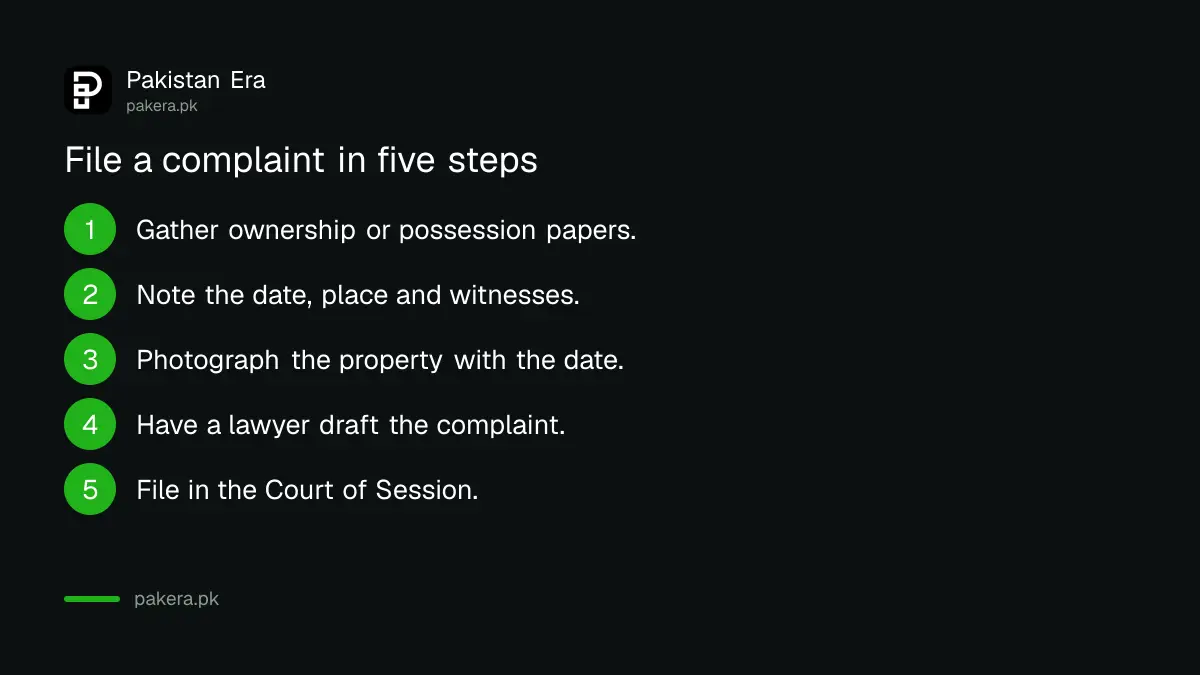
Collect proof that you owned the property or lawfully held it, and proof of when and how you lost it. Then ask a lawyer to draft the complaint to the Court of Session of your district. Keep every paper in two sets.
- Gather your ownership or possession papers, such as the sale deed, the registry, the allotment letter or a rent agreement, and your CNIC.
- Write down the date, the place and the names of the people who entered, and list witnesses who saw it.
- Take photographs of the property as it is now, with the date.
- Get a lawyer to draft and sign the complaint, naming the accused and asking for possession back and compensation.
- File it in the Court of Session of the district where the property lies.
- Attend every date. The Act allows very few adjournments, and a missed date can hurt you.
If you cannot afford a lawyer, see how to get a free lawyer in Punjab, or call the Supreme Court helpline described in Call 1818 for Free Legal Aid. Papers for your own ownership can be pulled from the Registry of Deeds portal in Punjab.
This Act is not the only route, and Punjab has its own law
A civil suit for possession or injunction is a separate remedy, and the Act does not replace it. Punjab also passed its own property ownership law in 2025, which the Lahore High Court suspended in December 2025. We could not confirm its present status on an official page, so ask your lawyer which route applies to you.
If your dispute is with a tenant rather than a stranger, read Pakistan's rent laws first, because a tenant in lawful possession is not a grabber under the Act. Once a court orders possession back, recording a court order in your land record in Punjab is the next step.
Common questions
Do I need an FIR before filing an illegal dispossession complaint?
No. The Act makes the offence triable by the Court of Session on a complaint, and it is non-cognizable. You go to the court, and the court may then direct the police.
How long does the case take?
The Act says the trial must be decided within 60 days of the court taking cognizance, with reasons recorded for any delay. In practice courts can take longer.
Can a tenant be charged under this Act?
Only if the person has no lawful possession. The Act protects owners and occupiers in lawful possession. A tenant who stays after the lease ends is usually a rent law question, so ask a lawyer.
What if the other side says it is a civil dispute?
That is a defence the court will weigh. The Act sits beside civil remedies. The court decides whether the accused had lawful authority.
Where can I appeal?
Certain orders under section 3 and section 8 can be appealed to the High Court within 30 days of the order.
What if my complaint is found false?
The court may order you to pay the other side costs of up to Rs 500,000. File only with documents and witnesses.
How we verified this
What we checked, where we read it, and what we could not confirm.
We read the Illegal Dispossession Act, 2005 on 12 October 2026 in the Sindh Judicial Academy 2024 compilation, which shows the 2017 amendments. We did not read the 2026 Supreme Court judgment itself, so its details are marked as reported. Court practice varies by district, and laws can be amended.
About the author

Senior Writer, Public Services and Technology
Shahid joined us in 2024 as an author. He is a senior contributor to Pakistan's leading technology websites. He writes detailed articles, mostly covering his expertise in the latest tech, mobiles, apps, gadgets, and step-by-step guides. His ideology is to help people understand the latest trends and explain complex methods through very easy-to-understand guides.