Pakistan's Rent Laws: How Much Can a Landlord Raise Rent
Punjab, Sindh and KP each run their own rent law. See what actually controls a rent increase and eviction in your province, and where illegal evictions go.
Pakistan has no single rent control law. Punjab, Sindh, Khyber Pakhtunkhwa, Balochistan and Islamabad each run their own statute, their own forum, and their own version of what happens when a landlord raises the rent. We went looking for one clean percentage cap that applies everywhere, and we did not find one we could verify at the source. What we did find is a clear structure worth knowing before you argue with a landlord.
This is not the same question as registering a tenant with the police, which some provinces also require within days of moving in. That is a separate administrative step. What we cover here is money, the increase itself, and what protects you if a landlord tries to push you out instead of negotiating.
Rent law in Pakistan is provincial, not national
There is no federal rent control act. Each province passed its own statute after land and tenancy became a provincial subject, so the law that governs your tenancy depends entirely on where the property sits.
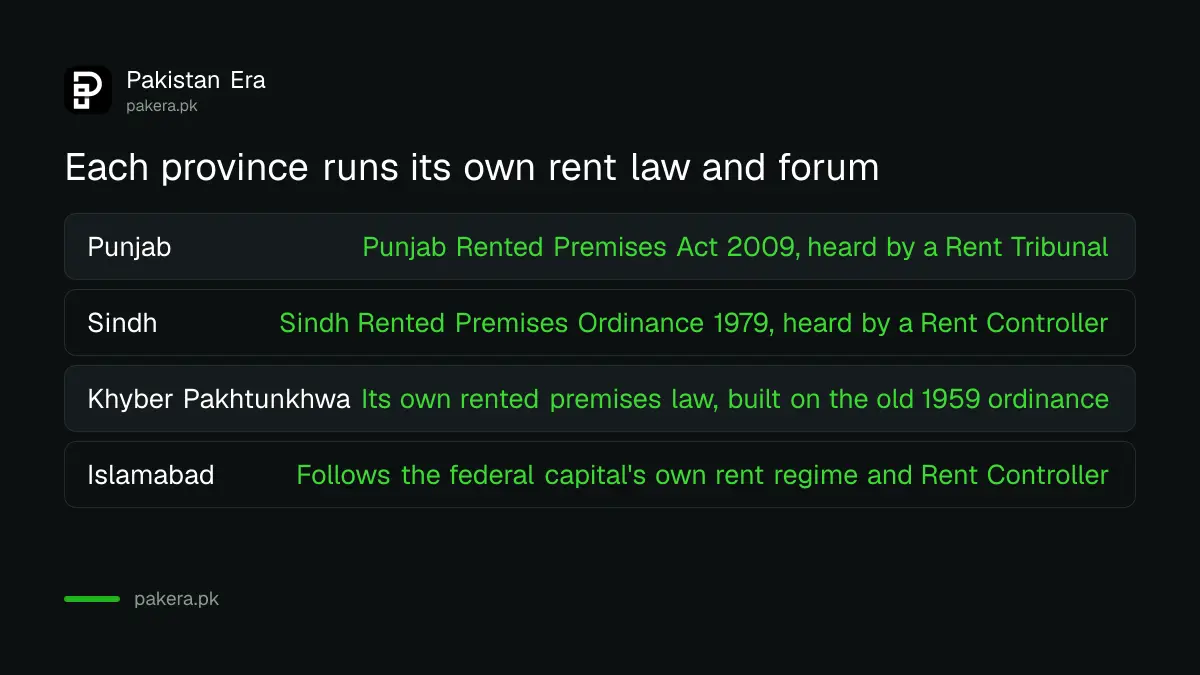
| Where you rent | Governing law and forum |
|---|---|
| Punjab | Punjab Rented Premises Act 2009, heard by a Rent Tribunal with exclusive jurisdiction |
| Sindh | Sindh Rented Premises Ordinance 1979, heard by a Rent Controller |
| Khyber Pakhtunkhwa | Its own rented premises law, built on the older West Pakistan Urban Rent Restriction Ordinance 1959 |
| Islamabad | The federal capital's own rent regime, also run through a Rent Controller |
A tenant in Lahore and a tenant in Karachi are not covered by the same rules, even though both read articles that casually say "Pakistan's rent law." Always check which statute applies to your specific city before you quote a rule to your landlord.
What Punjab's Rented Premises Act actually controls
Punjab's Act sets up a Rent Tribunal and a Rent Registrar, and it bars a landlord from ejecting a tenant except through the process the Act itself lays out. That much is settled and consistent across every source we checked.
Where sources disagree is on whether the Act fixes a specific percentage cap on rent increases with a fixed notice period. One summary we found claimed a 10 percent annual limit with 3 months' notice; another, closer reading of the same Act claimed it sets no fixed increase limit at all, and instead requires any agreed rate of increase to be written into the tenancy agreement and registered with the Rent Registrar. We tried to read the Act's own text directly to settle this and could not get a readable copy through our tools, so we are not stating a percentage cap here as fact. What holds either way: the increase a landlord can actually enforce is the one written into your registered agreement, not a number quoted verbally.
What Sindh's Rented Premises Ordinance actually controls
Sindh's 1979 Ordinance runs on a Rent Controller rather than a tribunal. Its ejectment grounds sit in Section 15, and commonly reported grounds include non-payment of rent, subletting without consent, and the landlord's own need of the property, though we mark these as reported since we did not read the Ordinance's text directly ourselves.
Two parts of the Ordinance are more solidly corroborated. Section 14 gives a landlord who is a widow, a minor whose parents have both died, or someone nearing or past retirement age, a narrower extra path to seek eviction by written notice. Section 18 protects a tenant specifically when a property changes hands: the new owner has to send written notice of the transfer, and the tenant is not treated as in default if rent reaches the new owner within 30 days of when that notice would normally have arrived.
Why there is no fixed cap you can quote with confidence
We went looking for one number, a percentage you could put in a WhatsApp message to a landlord, and we did not find one we trust. Different legal summaries contradict each other even about the same province's same Act.
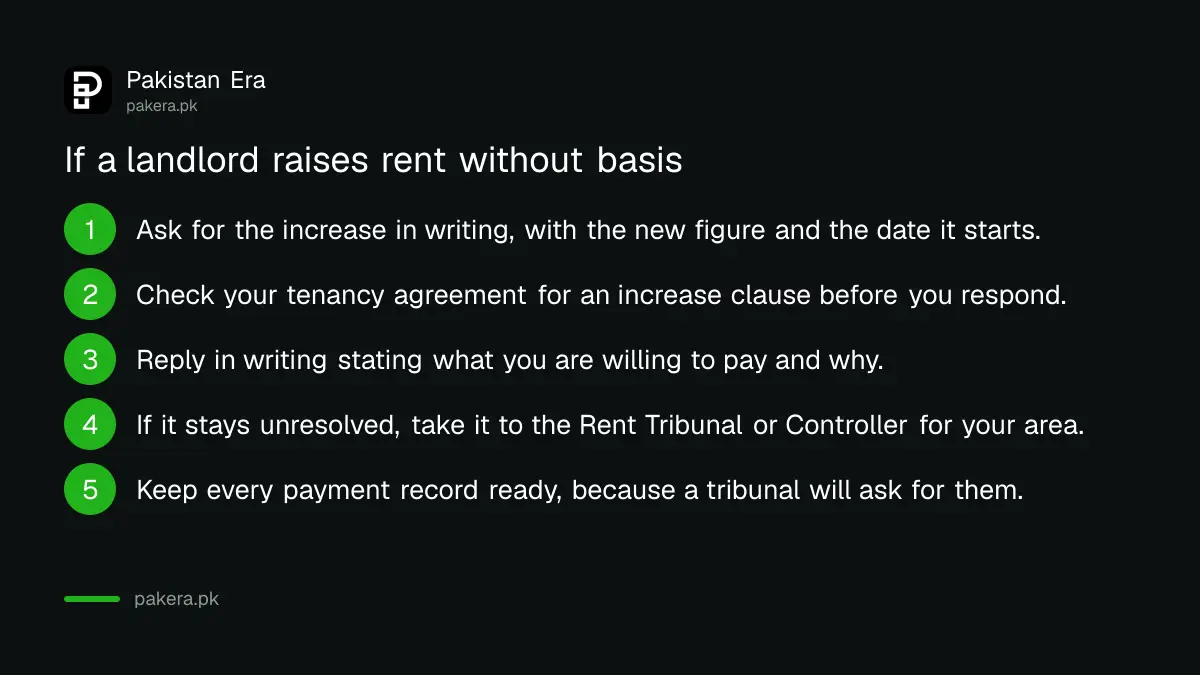
What is consistent is this: the increase a landlord can actually hold you to is the one in your written, registered tenancy agreement. An increase outside that clause is a demand, open to negotiation, not an automatic right. That is exactly why the house advice on documenting a tenancy properly, covered in our piece on what to do when your landlord raises the rent, matters more day to day than any cap you might read online.
- Ask for the increase in writing, with the new figure and the start date.
- Check your tenancy agreement for an increase clause before you respond to anything.
- Reply in writing stating what you are willing to pay and from when.
- If it stays unresolved, take it to the Rent Tribunal or Controller for your area.
- Keep every payment record ready, because a tribunal will ask you to prove what you paid.
Eviction has to go through a tribunal, not the landlord alone
Across every province we checked, one rule holds without exception: a landlord cannot physically evict a tenant by cutting utilities, changing locks or removing belongings. That has to go through the Rent Tribunal or Controller, whichever your province runs.
A Lahore High Court ruling that drew wide attention, which we cover separately in our piece on the tenant rights ruling and what it actually decided, is a reminder that courts read these protections narrowly and fact-specifically, not as a blanket win for every tenant in every case. If a landlord cuts your water or power to force you out, record it with dates and photographs, and take it to the tribunal rather than responding by refusing to leave without any paper trail of your own.
Common questions about rent increases and eviction in Pakistan
Is there a maximum percentage a landlord can raise rent by in Pakistan?
We could not verify one fixed percentage cap at the source for any province. The enforceable figure is whatever your written, registered tenancy agreement states.
Which law applies to my rent increase, federal or provincial?
Provincial. Punjab, Sindh, Khyber Pakhtunkhwa and Islamabad each run their own rent statute and their own forum.
Can my landlord cut my electricity to make me pay a higher rent?
No. That is not part of any lawful process in any province. Record it and take it to the Rent Tribunal or Controller for your area.
Where do I take a rent dispute in Punjab?
To the Rent Tribunal, which holds exclusive jurisdiction under the Punjab Rented Premises Act 2009.
Is registering a tenant with the police the same as a rent dispute process?
No. Police tenant registration is a separate administrative requirement in some provinces. A rent increase or eviction dispute goes to the Rent Tribunal or Controller, not a police station.
How we verified this
What we checked, where we read it, and what we could not confirm.
Last checked on 5 October 2026. We tried to read the Punjab Rented Premises Act 2009 and the Sindh Rented Premises Ordinance 1979 directly from official PDF sources and could not extract readable text through our tools. Where secondary legal summaries conflicted with each other, most notably on whether Punjab sets a fixed rent increase percentage, we did not state either version as fact. What this article states as settled, the existence of a Rent Tribunal in Punjab, a Rent Controller in Sindh, Sindh's Section 14 and Section 18 provisions, and the general bar on self-help eviction, is corroborated across multiple independent sources, though we have not read the primary statutory text ourselves. This is general information, not legal advice, and the remedy available to you depends on your province and your specific facts.
About the author

Public Services and Education Journalist
Fajr Riaz is a journalist and content writer at Pakistan Era, based in Lahore. She covers the questions people meet in everyday life in Pakistan: how a public service works, what a change in the rules means, and where to find a reliable answer.