How to Recover Your Land After Being Thrown Out: File a Section 9 Suit in Pakistan Within 6 Months
Dispossessed without a court order? A section 9 suit gets possession back without proving title. See the 6 month limit, the evidence and the no appeal rule.
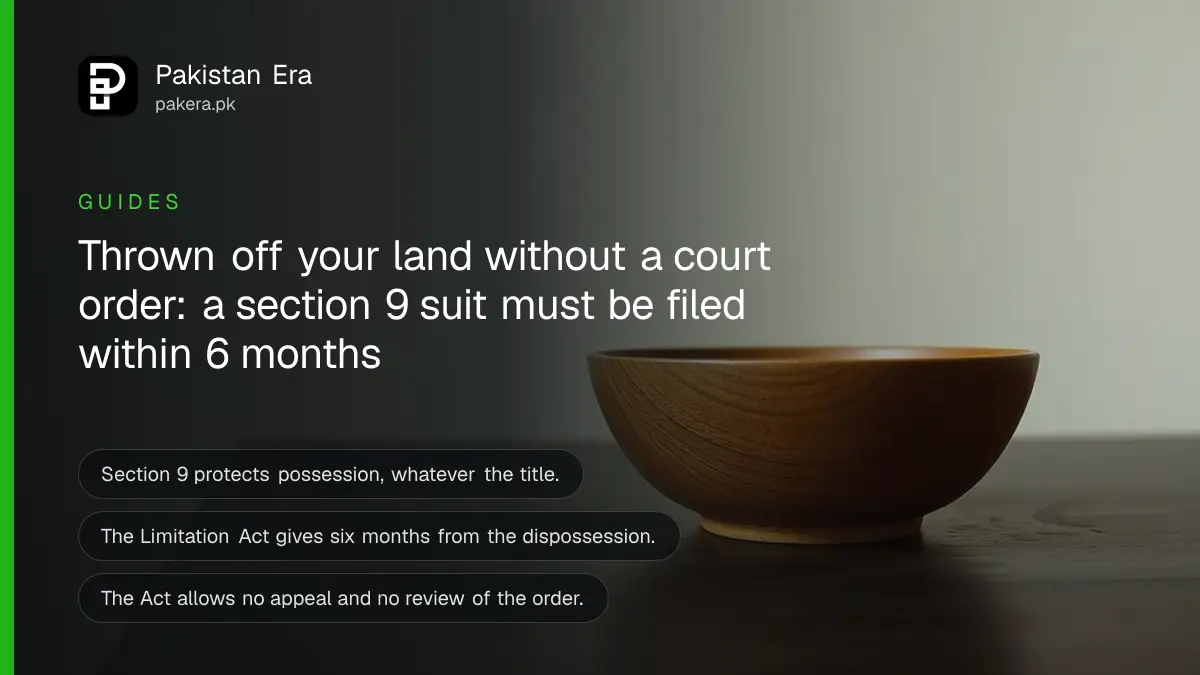
Short answer: If someone has pushed you out of your land, house or shop without a court order, section 9 of the Specific Relief Act 1877 lets you file a civil suit to get possession back. The court does not decide who owns the property in that suit. The Limitation Act gives you six months from the day you were dispossessed. The Act says no appeal and no review lie against the order or decree.
A farmer in Multan returns from a funeral in his village and finds that his cousin has locked the tubewell room and ploughed two acres. There is no court order. The cousin says the land is his. Under section 9 the farmer does not have to prove who owns the land first. He only has to prove that he was in possession and was thrown out, and he must do it in time.
We read the Specific Relief Act 1877 on the Punjab Code, the provincial law database, and the Limitation Act on Pakistan Code, on 12 October 2026.
Section 9 protects possession, whatever the title
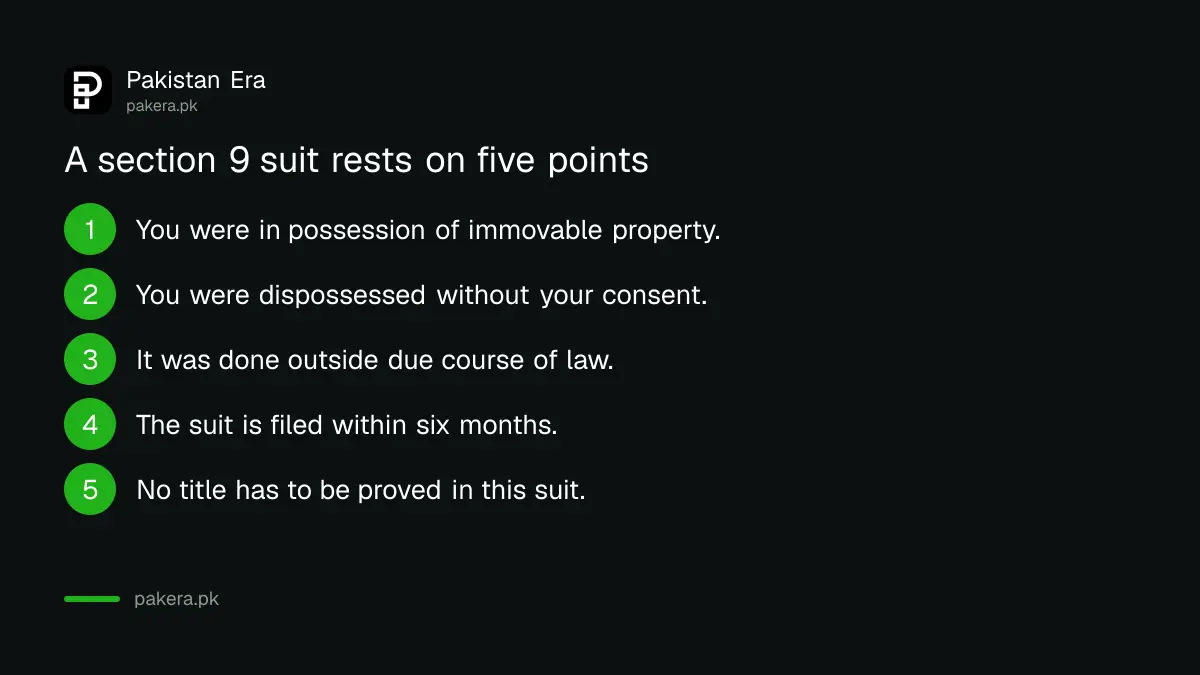
The section says that a person dispossessed of immovable property without his consent, otherwise than in due course of law, may recover possession by suit, notwithstanding any other title that may be set up in the suit. In plain words, the court looks at who was in possession and how he lost it. Who owns the land is a separate question.
That makes the suit fast and narrow. It does not end the ownership dispute. The section itself says nothing in it bars a person from suing to establish his title and recover possession. So the other side can still file a full title suit later, and you can too.
Three words in the section matter. "Immovable property" means land, buildings and things attached to the earth. "Without his consent" excludes cases where you agreed to leave. "Otherwise than in due course of law" excludes a lawful eviction, such as one carried out under a court's decree.
The six month limit comes from the Limitation Act
An old footnote in the Punjab Code text shows that the words "instituted within six months from the date of the dispossession" were repealed from the Act itself in 1891. The six months now sit in the Limitation Act 1908, Article 3, which gives six months for a suit under section 9 of the Specific Relief Act. The period runs from the date the dispossession occurs.
The six months is short. After that, your right to the quick suit is lost. You would have to bring a title suit, where the periods are much longer. Twelve years is the figure for a suit for possession when you were in possession and lost it, as set out in the note on how long you have to sue in Pakistan.
Four routes exist when someone takes your property
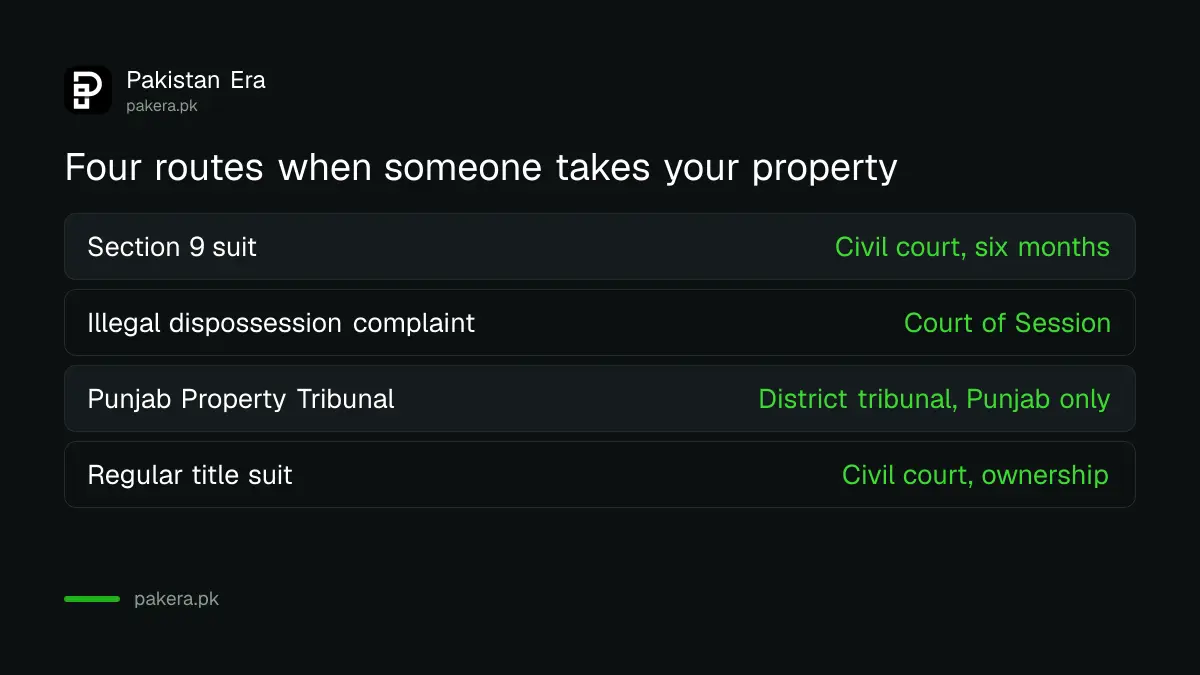
Section 9 is one of several remedies, and they run side by side. The comparison below shows what each one asks of you.
| Route | Court or body | What you must show | Key time point |
|---|---|---|---|
| Section 9 suit | Civil court | You were in possession and were thrown out without due process | Six months from dispossession |
| Illegal Dispossession complaint | Court of Session | You were an owner or lawful occupier and were dispossessed | Court to decide within 60 days, per the Act |
| Property Tribunal complaint, Punjab | District Property Tribunal | Proof of lawful title and the facts of the illegal possession | Committee report in 30 days, then 30 days |
| Regular title suit | Civil court | Ownership by title | Longer period, set by the Limitation Act article for your claim |
The second and third routes are criminal or quasi-criminal. They are explained in the notes on filing an illegal dispossession complaint in the Court of Session and on getting illegally occupied property back in Punjab through the Property Tribunal.
The Punjab Tribunal law of 2025 says it overrides other laws, and it gives the tribunal sole power to try illegal possession cases under that Act. We did not test how Punjab courts now treat a section 9 suit alongside it. A Punjab owner should ask a lawyer which route fits the facts and the evidence.
How a section 9 suit is built
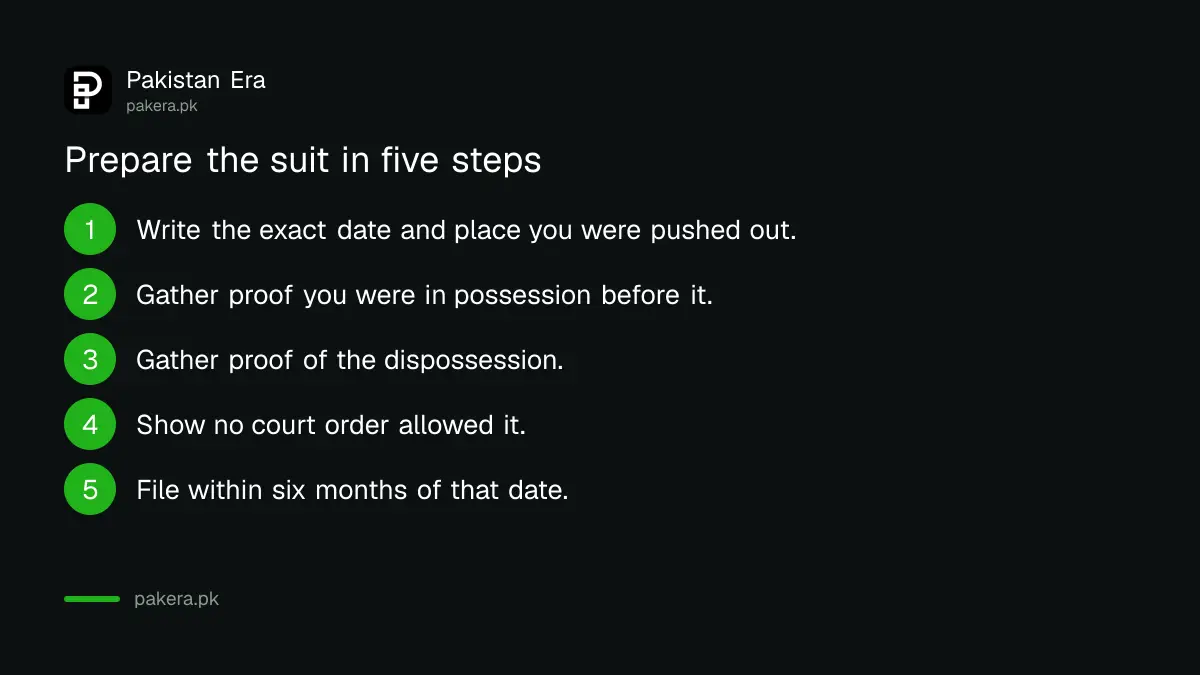
You file a plaint in the civil court of the district where the land lies. Under section 8, recovery follows the Code of Civil Procedure. The plaint must be short and exact about the date. These steps cover what to prepare.
- Write down the exact date, time and place you were pushed out, and who did it.
- Collect proof that you were in possession just before that date: a current fard, utility bills, crop or tubewell receipts, letters addressed to you at the property.
- Collect proof of the dispossession: witnesses, photographs, and a police application or a report made on the day.
- Show that no court order or legal process allowed the eviction.
- File the suit within six months of that date, and count the days from the date of dispossession itself.
A current fard is simple to get and shows who the record names. See the steps in the note on getting a fard of land in Punjab. A fard, though, shows the record owner and not always the person in possession, so bring other proof of possession as well.
What the order cannot be appealed to correct
The section ends with a firm rule. No appeal shall lie from any order or decree passed in a suit under this section, and no review is allowed. That is a double-edged rule. You cannot be dragged through a chain of appeals, but a flawed order is hard to undo.
Two other limits exist. No section 9 suit may be brought against the Federal Government or a Provincial Government. And a footnote on the Punjab Code text says tenancies in Punjab are governed by section 51 of the Punjab Tenancy Act 1887, so a tenant on agricultural land should check that law.
Common questions
Do I have to prove I own the land in a section 9 suit?
No. The court looks at your possession and how you lost it, notwithstanding any other title. The ownership question is left for a separate suit.
How long do I have to file a section 9 suit?
Six months from the date of dispossession, under Article 3 of the Limitation Act 1908.
Can the other side appeal the order?
No. The section says no appeal and no review lie from an order or decree passed in a suit under it. A title suit remains open to both sides.
Does this work if I was a tenant and my landlord threw me out?
It can, if you were dispossessed without consent and without due process. Tenancy rules differ by province and by the kind of property, so see a lawyer.
Can I use section 9 against the government?
No. The section bars such a suit against the Federal Government or a Provincial Government.
Should I file an FIR as well?
A police report made on the day helps as evidence of the date. Whether it becomes a criminal case depends on the facts and the Illegal Dispossession Act route described above.
How we verified this
What we checked, where we read it, and what we could not confirm.
We read the Specific Relief Act 1877 on the Punjab Code and the Limitation Act 1908 on Pakistan Code on 12 October 2026. We did not read court judgments on how section 9 operates beside Punjab's 2025 property law, and we state no court fee. This is general information, not legal advice.
About the author

Senior Writer, Public Services and Technology
Shahid joined us in 2024 as an author. He is a senior contributor to Pakistan's leading technology websites. He writes detailed articles, mostly covering his expertise in the latest tech, mobiles, apps, gadgets, and step-by-step guides. His ideology is to help people understand the latest trends and explain complex methods through very easy-to-understand guides.