Check How Long You Have to Sue in Pakistan: Limitation Act Periods From 6 Months to 12 Years
Check the time limit for your civil claim in Pakistan under the Limitation Act 1908: 6 months, 3 years or 12 years, and when each clock starts to run.
Short answer: Most civil claims in Pakistan have a fixed time limit set by the Limitation Act 1908. Three years covers wages, dower, a contract to be performed and a document to be cancelled. Twelve years covers a suit for possession of land. Six months covers a quick suit after you are thrown off your land. A civil appeal has 30 days to a District Judge and 90 days to the High Court. A court must dismiss a late suit even if the other side never raised the point.
A buyer in Rawalpindi paid a deposit on a plot in 2022. The seller never transferred it. He is still waiting and still "negotiating". Under the Act, the clock started when the seller refused to perform, and it does not wait for talks to end.
We read the Limitation Act 1908 in the federal law database, Pakistan Code, on 12 October 2026. The article numbers below come from its First Schedule. Always check the exact date your clock started, because the starting point differs for each kind of claim.
A late suit is dismissed even if nobody objects
Section 3 says a suit filed after the period in the schedule must be dismissed, although limitation was not set up as a defence. The judge raises it himself. So a strong case on the facts can still fail on the calendar.
Section 4 gives one relief. If the last day falls when the court is closed, you may file on the day the court reopens. Nothing else extends a suit's period by itself, except the disability rules in section 6, covered below.
Common civil claims and their periods
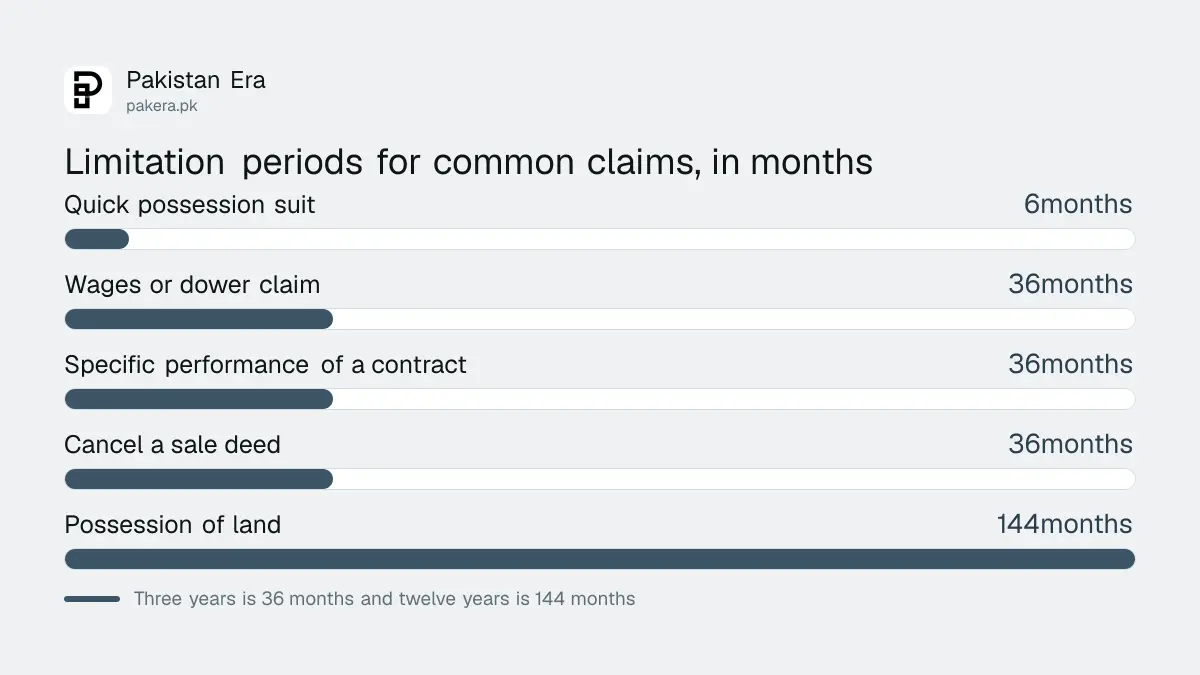
The table lists claims that arise often in property, family and work disputes. The third column shows when the period starts to run, as the schedule states it.
| Claim | Article | Period | Runs from |
|---|---|---|---|
| Recover land after being dispossessed, by the quick suit of section 9, Specific Relief Act | 3 | 6 months | When the dispossession occurs |
| Wages not otherwise provided for | 102 | 3 years | When the wages fall due |
| Exigible (prompt) dower claimed by a Muslim wife | 103 | 3 years | When dower is demanded and refused, or on death or divorce if never demanded |
| Deferred dower | 104 | 3 years | When the marriage ends by death or divorce |
| Specific performance of a contract, such as a sale agreement | 113 | 3 years | The date fixed for performance, or when refusal is known |
| Cancel an instrument, such as a sale deed | 91 | 3 years | When the facts that entitle you to cancel become known |
| Declare a forgery in an instrument registered or issued | 92 | 3 years | When the issue or registration becomes known to you |
| A suit with no period given elsewhere | 120 | 6 years | When the right to sue accrues |
| Possession of land after you lost it, when you were in possession | 142 | 12 years | The dispossession or discontinuance of possession |
| Landlord recovering possession from a tenant | 139 | 12 years | When the tenancy ends |
Three of these have their own detailed notes. A quick possession suit is explained in the note on recovering land by a section 9 suit, and a dower claim in the note on recovering haq mehr and dowry in a Punjab family court.
Appeals have shorter limits than suits
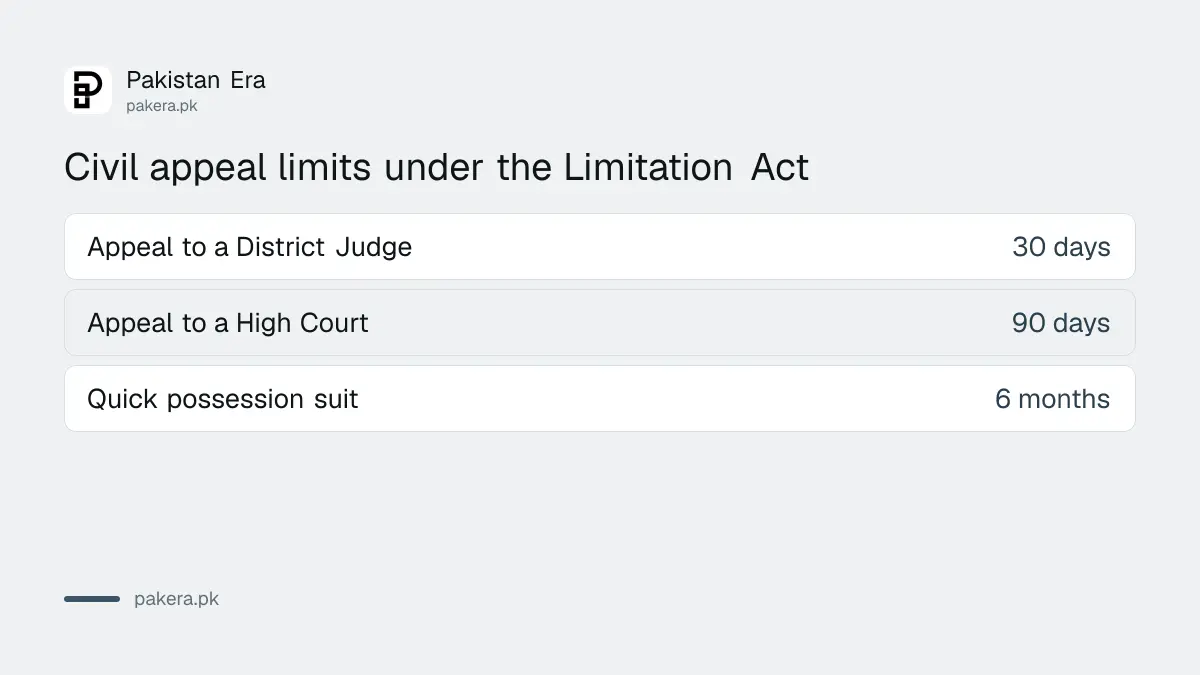
For appeals under the Code of Civil Procedure, Article 152 gives 30 days from the date of the decree to a District Judge. Article 156 gives 90 days from the date of the decree to a High Court. These are different from criminal appeals, which have their own articles.
The Supreme Court's limits are separate and set by its own rules, and are covered in the note on appealing to the Supreme Court of Pakistan. Appeals under special laws, such as a rent or family law, can carry their own days. For example, the Punjab rent law gives 30 days to the District Judge.
Section 5 helps only with appeals and applications. A court may admit an appeal late if the appellant shows sufficient cause for the delay. It does not rescue a late suit.
How to work out your own deadline
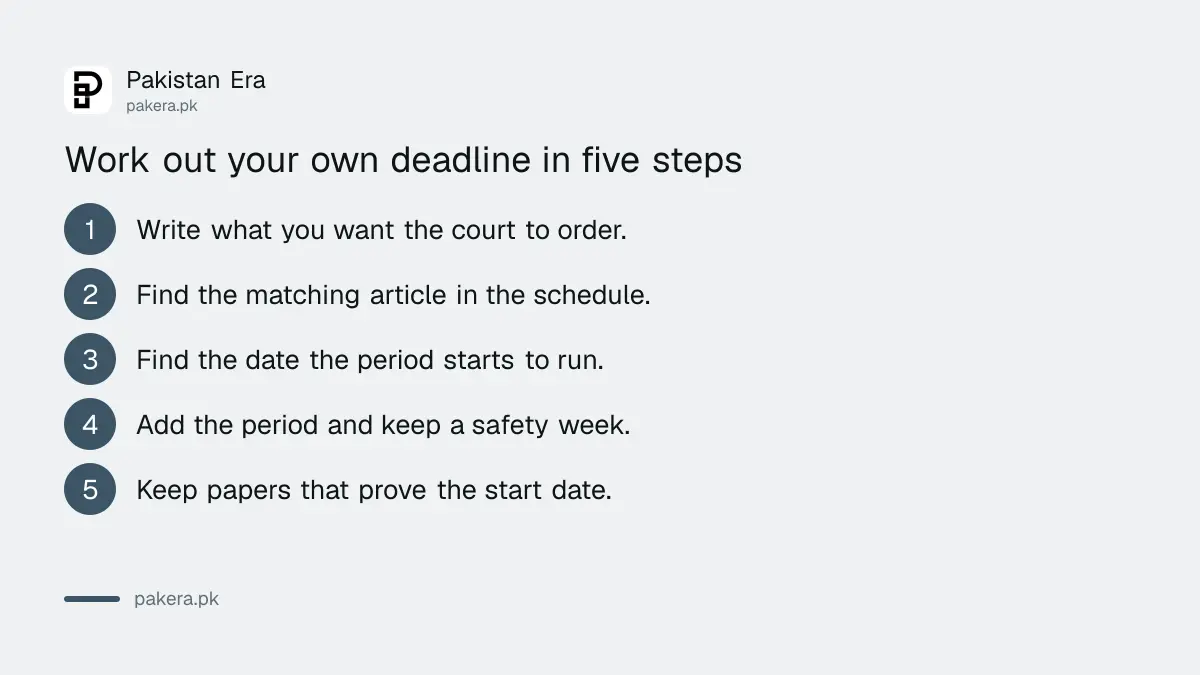
Do the count before you pay any lawyer. The steps are short.
- Write one line saying what you want from the court, such as land back, unpaid wages or a deed cancelled.
- Find the matching article in the table, or in the First Schedule if yours is not listed.
- Find the date the period starts, as the "runs from" column states it. This is often a date of refusal or knowledge, and not the date of the deal.
- Add the period to that date. Then subtract a safety week, because documents take time to prepare.
- Keep papers that prove the start date: the demand letter, the refusal, the registered notice, the receipt.
Disability can pause the clock, but only for some people
Section 6 helps a person who was a minor or of unsound mind when the right to sue arose. He may sue within the same period after the disability ends. If he dies while disabled, his legal representative gets the period from the death.
Section 6 does not help someone who was simply abroad, ill for a while or waiting for a negotiation. Heirs of land who were minors when a sale was made behind their backs often rely on this section, and the facts need a lawyer.
Disability also does not stretch time without limit. Section 8 caps the extension at three years from the end of the disability or the death of the person affected. The same section says the disability rules do not apply at all to suits to enforce a right of pre-emption.
Some claims run on a different law, so check before you rely on a number
The federal text carries a footnote pointing to the Punjab Loans Limitation Act 1904 for certain money suits in Punjab. The Punjab Code lists a repealing Act of 1923 in the same family of laws. We could not settle from the text alone which period governs a money-lending suit in Punjab today, so we do not give a number for loan recovery. A lawyer should confirm that one. Cheque cases follow criminal rules too, as described in the note on what to do when a cheque bounces.
Common questions
What happens if I file a suit one day late?
The court must dismiss it under section 3, even if the other side did not object. Only the extension for a court closure in section 4 and the disability rules in section 6 can help.
Does a notice or negotiation stop the clock?
No. The Act has no rule that stops time because the parties are talking. The clock starts from the date set in the schedule, such as a refusal.
How long do I have to claim unpaid wages through a civil suit?
Three years from when the wages fell due, under Article 102. Labour law has its own forums and time limits as well, so check both.
Can a court accept a late appeal?
Yes, under section 5, if you show sufficient cause for the delay. This helps appeals and applications, and not suits.
Does the 12 year rule mean I lose land after 12 years of someone's possession?
Possession suits have a 12 year period, so an owner who waits too long can lose the right to sue. That is a serious claim, so see a lawyer before relying on or fighting it.
How we verified this
What we checked, where we read it, and what we could not confirm.
We read the Limitation Act 1908 on Pakistan Code on 12 October 2026, including the First Schedule. Where the extracted text of the schedule was unclear, we left the claim out. This is general information, not legal advice. Periods under special laws, and later amendments, can differ.
About the author

Senior Writer, Public Services and Technology
Shahid joined us in 2024 as an author. He is a senior contributor to Pakistan's leading technology websites. He writes detailed articles, mostly covering his expertise in the latest tech, mobiles, apps, gadgets, and step-by-step guides. His ideology is to help people understand the latest trends and explain complex methods through very easy-to-understand guides.