Get Illegally Occupied Property Back in Punjab Through the Property Tribunal
Get illegally occupied property back in Punjab. File with the district Property Tribunal: what the complaint needs, the 30-day committee, and the penalties.
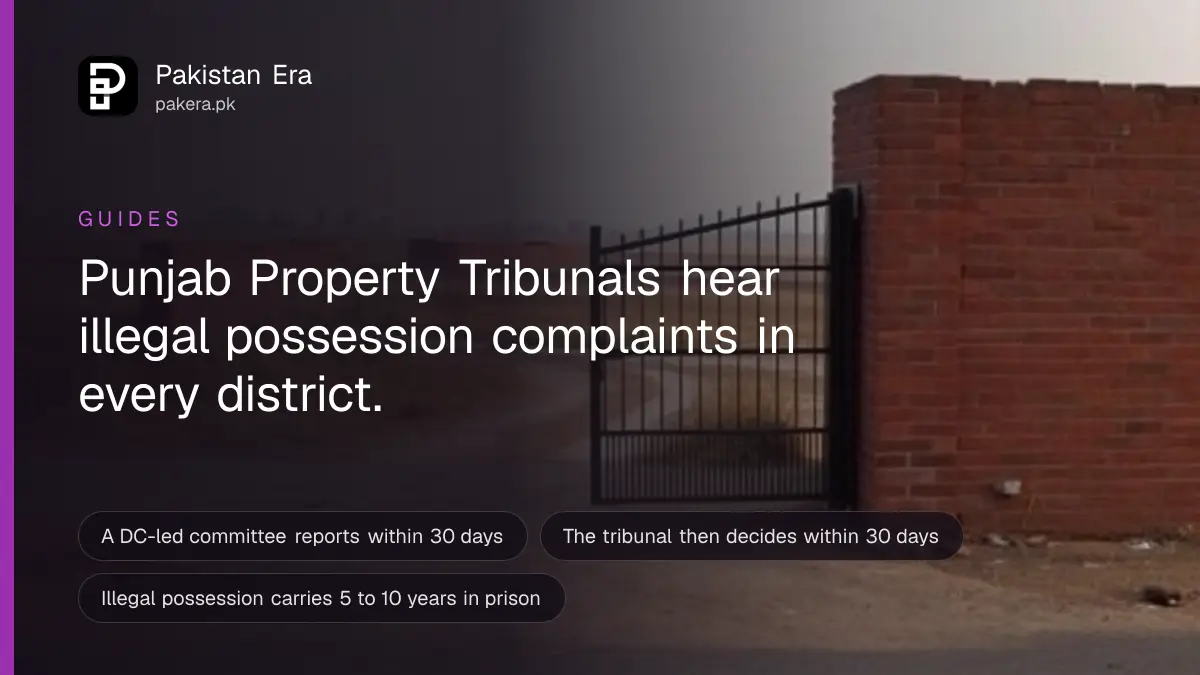
If someone has taken or is holding your property in Punjab without right, you can file a complaint with the Punjab Property Tribunal for your district. A committee led by the Deputy Commissioner reports within 30 days, then the tribunal must decide within 30 days.
This route comes from the Punjab Protection of Ownership of Immovable Property Act 2025. The Punjab Gazette published it on 18 December 2025. It was then largely rewritten by an amending Act published on 14 May 2026. We read the amended text on the Punjab Code on 2 October 2026. Several older press explainers describe the first version, which no longer applies.
The law is strict on both sides. Illegal possession can mean five to ten years in prison. A false complaint can mean one to five years.

The Property Tribunal hears illegal possession cases in Punjab
Each district has a Punjab Property Tribunal run by a designated Additional Sessions Judge. It has sole power to try illegal possession cases under the 2025 Act, and it can also decide who owns the property.
Section 4 makes it an offence to get or keep possession of property without lawful authority. Fraud, forgery, cheating, threats and force are all named. That covers a tenant who refuses to leave after his right ends, a relative who has taken over a share, and a qabza group on an empty plot.
The Act overrides other laws, under section 3. Under section 16(11), an owner with a possession case pending in another court, below the Lahore High Court, can ask for it to be moved to the tribunal. That court must decide the request within 15 days.
| Offence | Prison | Fine |
|---|---|---|
| Illegal possession, section 4 | 5 to 10 years | Up to Rs 10 million |
| Attempt, help or conspiracy, section 5 | 1 to 3 years | Up to Rs 1 million |
| False or vexatious complaint, section 16(3) | 1 to 5 years | Up to Rs 500,000 |
What to put in your complaint
Section 7 asks for four things: details that identify the property, the facts of the offence, proof of your lawful title, and what you know about the people holding it. Missing title proof is the commonest weak point.
Gather the papers before you file. For agricultural or rural land, a current fard from the land record shows whose name the land is in. For a house in a scheme, bring the registered deed, the allotment or transfer letter and the mutation.
- Property details: khasra or plot number, mauza or scheme, area and a sketch if you have one.
- The facts: when you lost possession, how, and who did it. Dates matter.
- Title proof: fard, registry, mutation, inheritance papers or allotment letter.
- The accused: names, CNIC numbers and addresses as far as you know them.
- Supporting proof: photos, earlier police complaints, utility bills in your name, witnesses.
The complaint is filed by the lawful owner before the tribunal for the area where the property is. Anyone who has an earlier case on the same land should say so in the complaint.
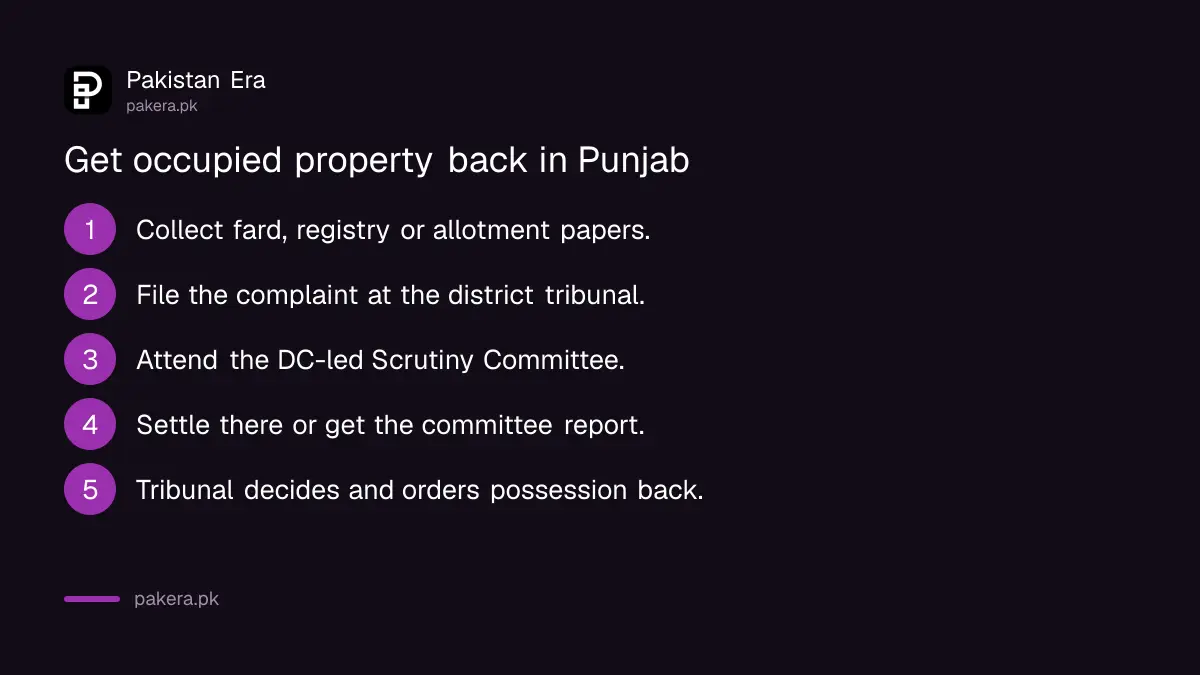
How the complaint moves, step by step
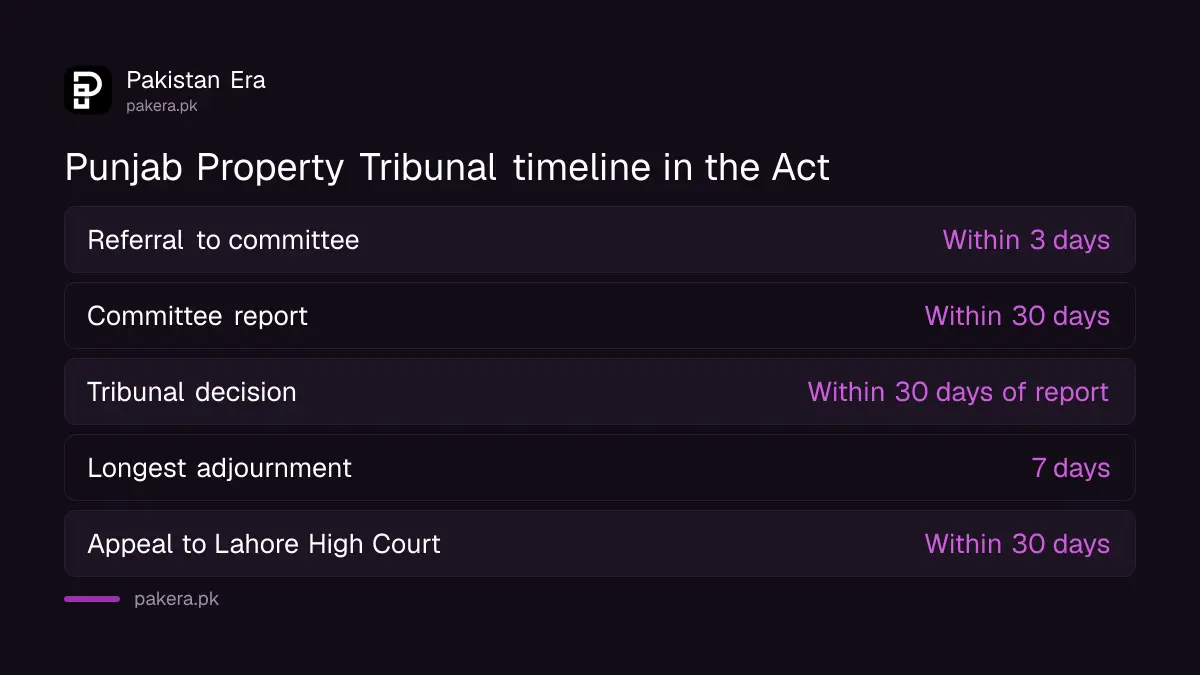
The tribunal sends your complaint to the district Scrutiny Committee within three days. The committee checks records, hears both sides and tries for a settlement, then reports within 30 days. The tribunal then decides within 30 days.
- File the complaint at the tribunal. It sits in the district courts, with an Additional Sessions Judge as its judge.
- Referral within three days. The tribunal sends the case to the Scrutiny Committee.
- Committee inquiry within 30 days. The Deputy Commissioner leads it, with the District Police Officer, the revenue officers and the local police station in charge. It can call any record from any government office.
- Settlement or report. If the parties agree, the committee writes it down and the tribunal turns it into a decree. If not, it sends a report.
- Decision within 30 days. The tribunal hears the case day to day. No single adjournment may be longer than seven days.
- Possession restored. The tribunal orders the property handed back and can direct the police to help.
You must attend the committee in person. If you cannot, it can allow you to join electronically after biometric verification, which matters for owners living abroad.
Compensation, interim orders and appeals
The tribunal can order compensation of at least the property's value under the Stamp Act valuation table, plus any profit the occupier made. It can also make interim orders, seal property, and order arrests. Appeals go to the Lahore High Court within 30 days.
The compensation floor uses the same DC valuation that sets stamp duty, measured on the date of judgment. Compensation and costs are recovered like unpaid land revenue.
Two other powers protect the owner during the case. Under section 20, any sale, gift or lease of the property after the complaint is filed is void unless the tribunal allows it. Under section 9, an owner who fears a takeover can apply before it happens, and the tribunal can take surety or seal the property.
Only the Lahore High Court can grant bail to a person the tribunal has had arrested. A settlement decree made through the committee cannot be appealed. Nor can an interim order.
Other routes that may suit you better
Women have a separate ombudsperson route, and overseas Pakistanis have their own commission. If you cannot pay a lawyer, Punjab's legal aid rules now cover tribunal complainants. Pick the route that matches who you are.
A woman kept from her inherited share can use the Punjab ombudsperson for women's property, which is built for that problem. An owner living abroad can complain to the Overseas Pakistanis Commission as well. And a complainant under section 7 of the 2025 Act can ask for a free lawyer in Punjab.
A tenant whose lease has ended is a closer call. The rent tribunal under the Punjab Rented Premises Act 2009 already deals with eviction. Ask a lawyer which forum fits before you file, because a complaint the tribunal finds vexatious carries a prison term.
Common questions
Where is the Punjab Property Tribunal?
In each district, in the sessions courts. The government designates serving Additional Sessions Judges as tribunal judges, in consultation with the Chief Justice of the Lahore High Court.
How long does a property tribunal case take?
On paper, about 63 days: 3 days to refer, 30 for the committee and 30 for the decision. Real cases can take longer.
Can I file if I live abroad?
Yes. The committee can let you appear electronically after biometric verification.
Can the occupier sell my property while the case runs?
No. Any sale, gift, lease or partition after the complaint is filed is void unless the tribunal allows it.
What happens if my complaint is false?
The tribunal can try you. A false or vexatious complaint carries one to five years in prison and a fine of up to Rs 500,000.
Is there a fee to file?
The Act does not set one, and we found no notified fee. Ask the tribunal's reader or a lawyer at your district courts.
How we verified this
What we checked, where we read it, and what we could not confirm.
Last checked on 2 October 2026. We read the Punjab Protection of Ownership of Immovable Property Act 2025, as amended by the amending Act XXXVII of 2026, on the Punjab Code. The number of tribunals and the transfer of pending cases to them have been reported, not published by the Lahore High Court or the Punjab government on a page we could read. Parts of the first version were challenged in the Lahore High Court in December 2025, as reported. We could not find a court order on the amended Act.
About the author

Tax, Bills and Technology Writer
Ali Akhtar is a young and curious voice here at Pakistan Era. He is currently pursuing his A-Levels and has a growing interest in Pakistan’s changing industrial landscape and educational trends. Ali likes to write in a way that helps him explain and explore the world around him. His writing reflects the perspective of the new generation navigating the evolving trends of Pakistan where technology, youth innovation, and shifting opportunities are reshaping the country’s future.