How a Woman Gets Her Property Back in Punjab
An Ombudsperson route instead of a civil suit, with orders aimed at sixty days and rent payable for the whole period she was kept out.
A woman kept out of her own property in Punjab can go to an Ombudsperson instead of a civil suit, and the order can include the market rent for every month she was kept out of it.
The Ombudsperson aims to pass orders within sixty days. A civil suit over property in Pakistan does not usually finish in sixty months.
We read the Punjab Enforcement of Women's Property Rights Act 2021 on 9 September 2026, in the text published by the Law and Parliamentary Affairs Department.
What the route looks like
| Stage | What the Act provides |
|---|---|
| Who decides | The Ombudsperson under the 2010 workplace harassment law |
| Who can complain | Any woman deprived of ownership or possession, by any means |
| Enquiry | Referred to the Deputy Commissioner, who reports in fifteen days |
| Orders | Preferably within sixty days of the complaint |
| Compliance report | Deputy Commissioner reports back within seven days |
| Rent for the lost period | At the prevalent market rate |
Property is defined widely, covering both moveable and immoveable property.
The rent provision is the part that changes the sum
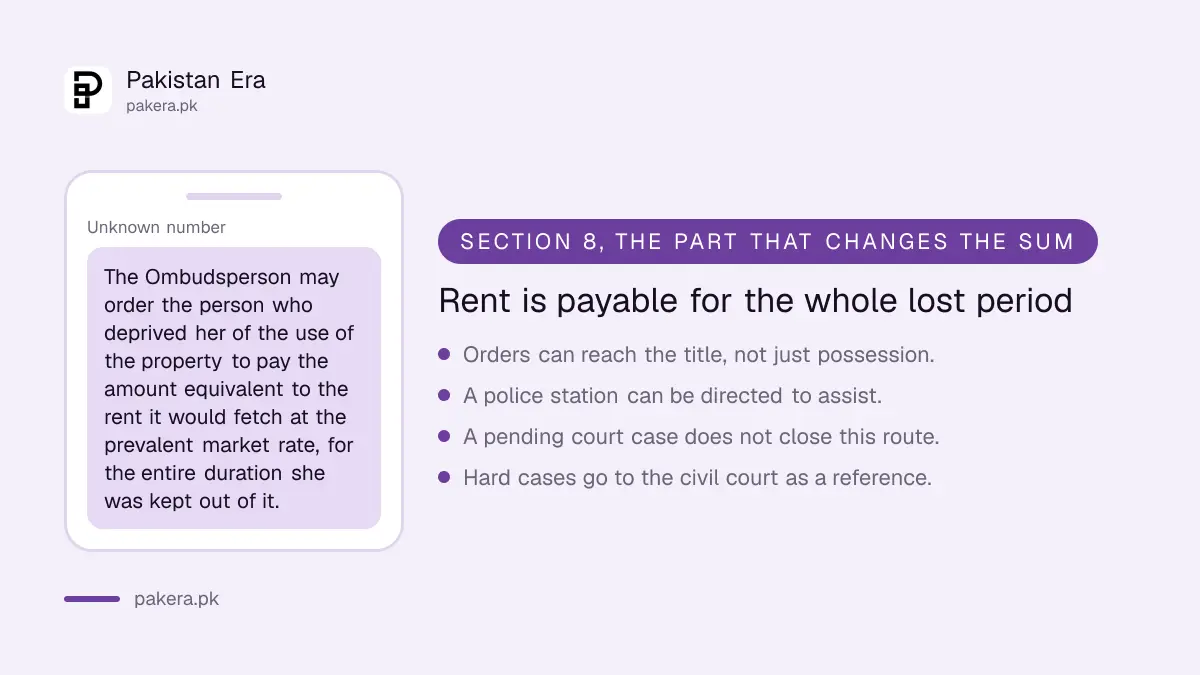
Most people think of a property dispute as a fight over the property itself. Section 8 adds the years.
On concluding proceedings, the Ombudsperson may direct the person who deprived her of the use of the property to pay her an amount equivalent to the rent the property would fetch at the prevalent market rate, for the whole duration she was deprived of its use.
A plot or a house held from a woman for a decade therefore carries a decade of market rent alongside the restoration of possession. That is a different order of magnitude from simply getting the property back.
What the Ombudsperson can order
If the Ombudsperson finds she has been illegally deprived of ownership or possession, section 5 allows a direction to the Deputy Commissioner, to a state functionary, or to any private person to take steps to restore or confer possession or title, including measures to perfect that title.
The phrase including measures to perfect such title is worth noticing. The order is not limited to physical possession. It can reach the paperwork that makes ownership stick.
The Ombudsperson may direct the officer in charge of a police station to give whatever assistance implementation needs, and the Deputy Commissioner must submit a compliance report within seven days.
Section 9 allows the Ombudsperson to direct any executive state functionary, including the Deputy Commissioner for the district where the property sits, to execute the orders in letter and spirit.
It works even when a case is already in court
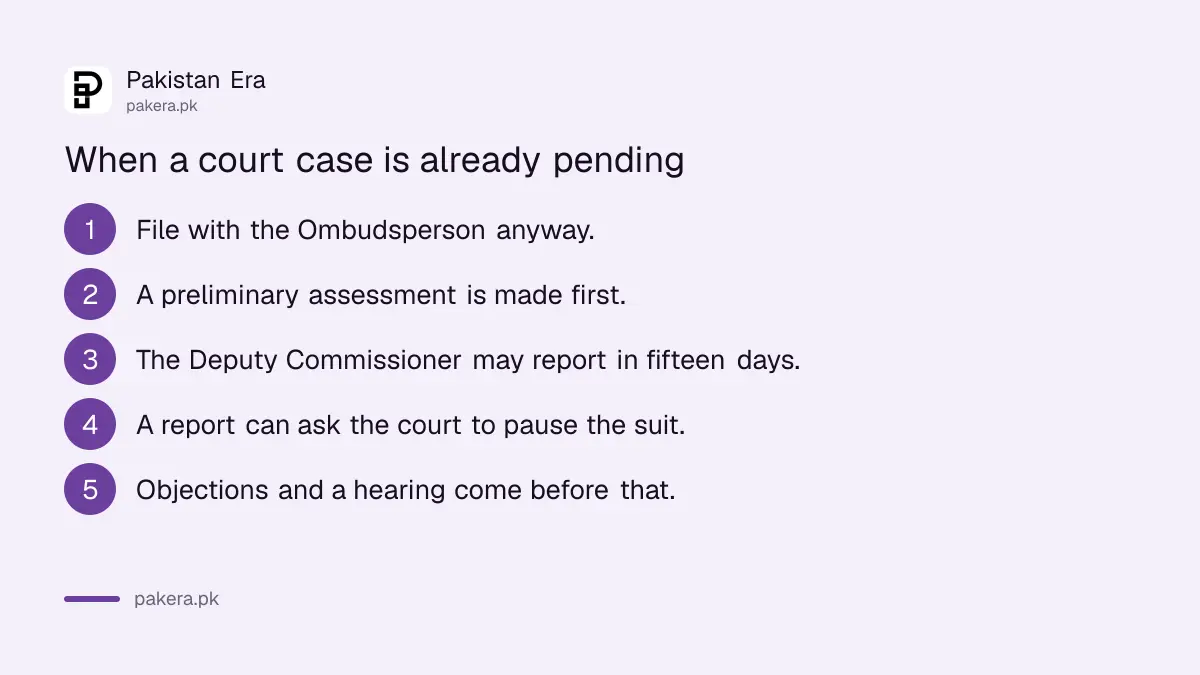
This is the provision that surprises people, because a pending suit normally closes off every other door.
Section 4 covers the case where no court proceedings are pending. Section 7 covers the case where they are, and it lets her file anyway.
Where a case is pending, the Ombudsperson makes a preliminary assessment, may refer the matter to the Deputy Commissioner for a summary enquiry reported within fifteen days, and where no detailed evidence is needed may file a report in the court recommending that the proceedings be terminated or held in abeyance so that the Ombudsperson can take the matter forward under this Act.
Before filing that report the Ombudsperson must call for objections from both sides and hold a hearing, passing orders preferably within thirty days of it. If the decision is not to file the report, she is advised to pursue the court case and the complaint ends.
So a long running suit is not a reason to assume this route is closed. It is a reason to ask.
Someone else can start it for her
Both sections carry the same proviso, and it matters where a woman is under pressure not to complain.
The Ombudsperson may initiate action on its own motion, or on a complaint filed by any person including a non-governmental organisation, whether or not proceedings are pending in a court.
- A relative or neighbour can bring the matter to the Ombudsperson.
- An organisation can file on her behalf.
- The Ombudsperson can act without any complaint at all.
- The property may be moveable as well as immoveable.
- No court may grant an injunction or stay against the Ombudsperson's proceedings.
That last point is section 11. No court or other authority may question the validity of an action taken under the Act, or grant an injunction, stay or interim order against proceedings before the Ombudsperson.
When it goes to court instead
The Act does not pretend to handle everything. Section 6 says that if the matter needs in depth enquiry, investigation, detailed recording of evidence or intricate adjudication, the Ombudsperson formulates a reference with all the reports and material collected and sends it to the civil court, preferably within sixty days of the complaint.
The civil court then entertains that reference as a civil suit under the Code of Civil Procedure.
That is still worth something. A reference arrives with an enquiry already done and a Deputy Commissioner's report attached, which is not how an ordinary suit begins.
What this connects to
Inheritance is the usual origin of these disputes, and the share is often the thing in question. Our guide to inheritance shares in Pakistan covers who is entitled to what.
The land record is where a claim is proved or lost. Our guide to getting a fard online in Punjab covers obtaining it, and our guide to checking a housing scheme before buying a plot covers the approval side of a property.
Legal help may be free. Our guide to getting a free lawyer in Punjab covers the Legal Aid Agency, whose definition of an indigent person was extended to include any person who filed a complaint under section 7 of this very Act.
Where the dispute sits alongside violence or threats, our guide to getting a protection order in Punjab covers the separate orders a court can make.
Common questions
Who hears a woman's property complaint in Punjab?
The Ombudsperson appointed under the Protection against Harassment of Women at the Workplace Act 2010.
How long does it take?
Orders are to be passed preferably within sixty days of the complaint, with a Deputy Commissioner's enquiry report due in fifteen days.
Can I get compensation as well as the property?
The Ombudsperson may order the market rate rent for the entire period you were deprived of the use of the property.
What if a court case is already going on?
You may still file. The Ombudsperson can recommend that the court proceedings be terminated or held in abeyance.
Can someone else file for me?
Yes. Any person, including a non-governmental organisation, and the Ombudsperson may also act on its own motion.
Does it cover only land and houses?
No. Property is defined to include moveable and immoveable property.
How we verified this
What we checked, where we read it, and what we could not confirm.
Last checked 9 September 2026. We downloaded the Punjab Enforcement of Women's Property Rights Act 2021 from the Punjab Code portal at punjablaws.punjab.gov.pk, in the text published by the Law and Parliamentary Affairs Department, Government of the Punjab, and read it. The Act was passed and assented to on 17 May 2021 and published in the Punjab Gazette (Extraordinary) of the same date. The definition of the Ombudsperson as the person appointed under section 7 of the Protection against Harassment of Women at the Workplace Act 2010, and of property as including moveable and immoveable property; section 4 allowing a complaint where no court proceedings are pending, with the proviso permitting the Ombudsperson to act on its own motion or on a complaint by any person including a non-governmental organisation, referral to the Deputy Commissioner for a summary enquiry reported within fifteen days, and orders under section 5 preferably within sixty days of the complaint; section 5 empowering a direction to the Deputy Commissioner, a state functionary or any private person to restore or confer possession or title including measures to perfect such title, a direction to the officer in charge of a police station for assistance, and a compliance report from the Deputy Commissioner within seven days; section 6 on formulating a reference to the civil court where in depth enquiry or intricate adjudication is required, preferably within sixty days, to be entertained as a civil suit under the Code of Civil Procedure 1908; section 7 allowing a complaint where court proceedings are pending, the report recommending termination or abeyance of those proceedings, the requirement to call for objections and hold a hearing with orders preferably within thirty days, and the advice to pursue the court case where no report is filed; section 8 allowing a direction that the complainant be paid the amount equivalent to the rent the property would fetch at the prevalent market rate for the duration she was deprived of its use; section 9 on execution through any executive state functionary including the relevant Deputy Commissioner; and section 11 barring any court or authority from questioning the validity of action under the Act or granting an injunction, stay or interim order in relation to proceedings before the Ombudsperson, are all taken from that text. This is the Punjab Act and applies in the Punjab. Nothing here is legal advice.
About the author

Tax, Bills and Technology Writer
Ali Akhtar is a young and curious voice here at Pakistan Era. He is currently pursuing his A-Levels and has a growing interest in Pakistan’s changing industrial landscape and educational trends. Ali likes to write in a way that helps him explain and explore the world around him. His writing reflects the perspective of the new generation navigating the evolving trends of Pakistan where technology, youth innovation, and shifting opportunities are reshaping the country’s future.