Section 234 Advance Tax on Trucks and Buses in Pakistan: Rs 2.50 a Kg and Up to Rs 1,500 a Seat in 2026-27
Section 234 advance tax for 2026-27: trucks Rs 2.50 per kg of laden weight, buses and vans Rs 200 to Rs 1,500 a seat, the ten year rule and how to adjust it.
Advance income tax on a goods truck in Pakistan is Rs 2.50 per kg of laden weight a year under section 234 of the Income Tax Ordinance 2001, and a truck of 8,120 kg or more pays a flat Rs 1,200 a year once it is ten years past first registration. Passenger vehicles pay per seat: Rs 200, Rs 500 or Rs 1,000 a seat for filers on the Active Taxpayer List, and Rs 375, Rs 750 or Rs 1,500 for others. The excise office collects it with the motor vehicle tax.
These figures come from FBR's Withholding Tax Rate Card for tax year 2027, updated for the Finance Act 2026. A transporter who pays this tax every year can count it against income tax in the return, so keeping the receipts matters as much as paying on time.
Section 234 is income tax collected with your token
Section 234 makes the provincial or Islamabad excise office collect advance income tax when it collects motor vehicle tax, the yearly token. The tax goes to FBR, not to the province. It applies to goods transport, passenger transport and private vehicles alike, at different rates.
So when a transporter in Faisalabad pays the token tax on a truck, two taxes sit on the same challan. One is the Punjab motor vehicle tax. The other is federal advance income tax under section 234. Only the second can be adjusted against your income tax.
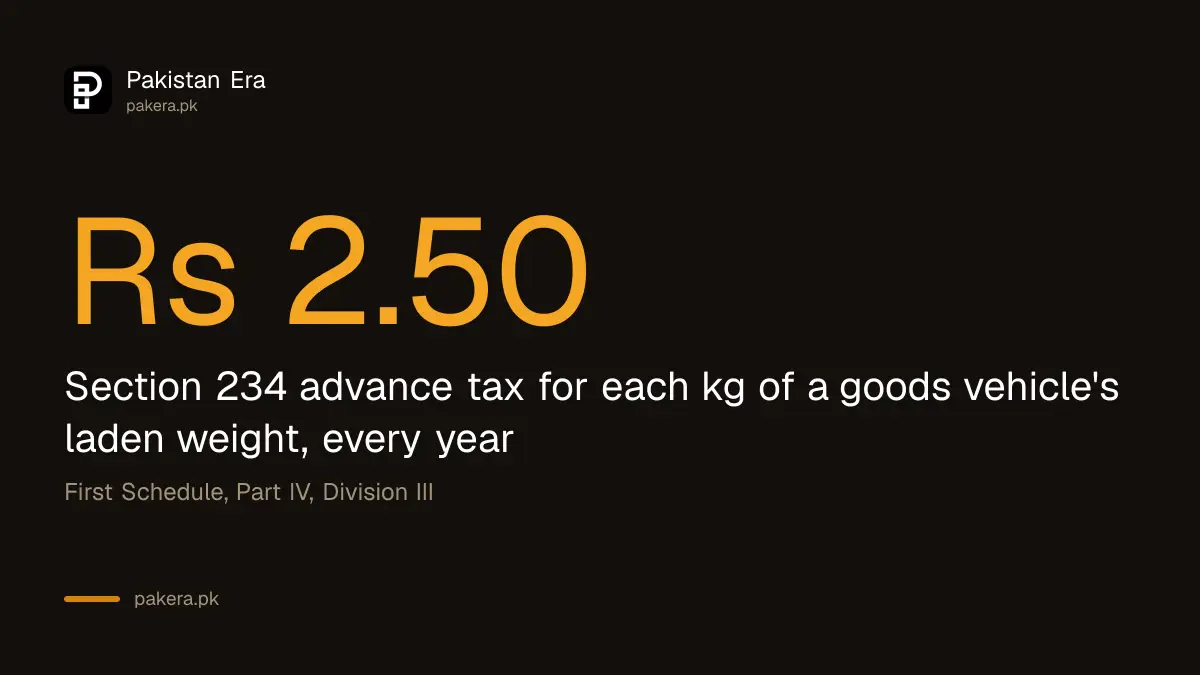
Goods vehicles pay Rs 2.50 per kg of laden weight
FBR's card sets advance tax on goods transport vehicles at Rs 2.50 for each kg of laden weight, the maximum loaded weight on the registration. A truck with a laden weight of 6,000 kg pays Rs 15,000 a year. The First Schedule has had a single rate since 2019, when the separate non-filer rate for goods vehicles was removed.
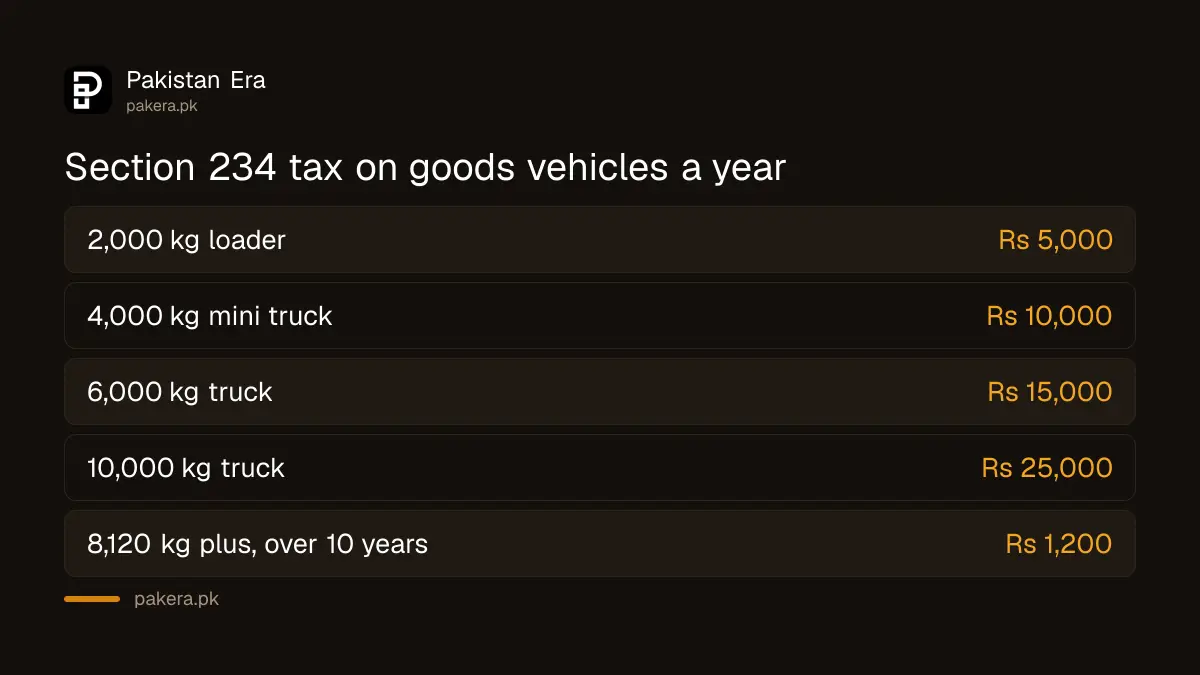
| Laden weight | Working | Section 234 tax a year |
|---|---|---|
| 1,250 kg (small pickup) | 1,250 x Rs 2.50 | Rs 3,125 |
| 2,000 kg (loader) | 2,000 x Rs 2.50 | Rs 5,000 |
| 4,000 kg (mini truck) | 4,000 x Rs 2.50 | Rs 10,000 |
| 6,000 kg (truck) | 6,000 x Rs 2.50 | Rs 15,000 |
| 8,000 kg (truck) | 8,000 x Rs 2.50 | Rs 20,000 |
| 10,000 kg (heavy truck) | 10,000 x Rs 2.50 | Rs 25,000 |
| 8,120 kg or more, over 10 years old | Flat amount | Rs 1,200 |
Old vehicles pay less or nothing after ten years
Section 234 stops or cuts the tax on older vehicles. A goods vehicle under 8,120 kg pays nothing after ten years from first registration in Pakistan. A heavier one pays Rs 1,200 a year after ten years. Buses of 10 seats or more stop paying ten years after 1 July of their year of make.
- Goods vehicle under 8,120 kg: no section 234 tax after ten years from first registration.
- Goods vehicle of 8,120 kg or more: Rs 1,200 a year after ten years, instead of Rs 2.50 a kg.
- Passenger vehicle with 10 or more seats: no tax after ten years from 1 July of the year of make.
- Motor car used in Pakistan for more than ten years: no tax after ten years.
Check the year of first registration on the registration book before paying. If the excise challan still shows section 234 tax on a vehicle past its ten years, ask the counter to remove it.
Buses and vans pay by the number of seats
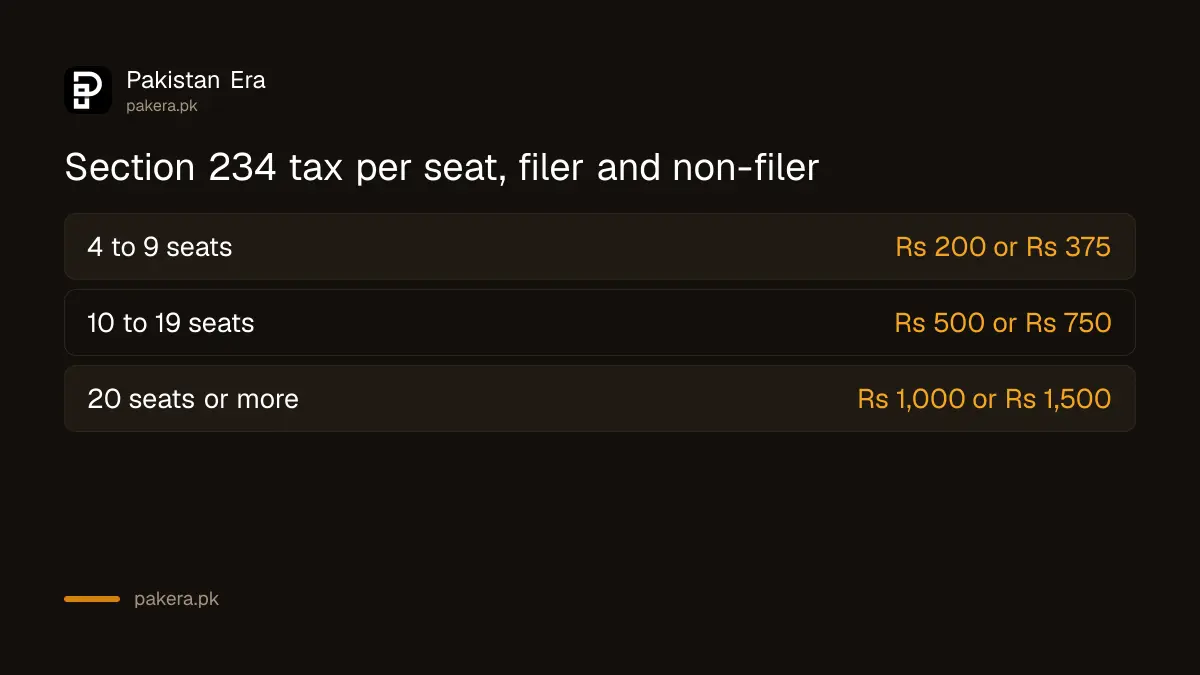
Passenger transport vehicles pay a fixed amount for each seat a year, and the rate depends on seating capacity and filer status. A van seating 4 to 9 people pays Rs 200 a seat for filers. A coaster seating 10 to 19 pays Rs 500 a seat. A bus seating 20 or more pays Rs 1,000 a seat.
| Seating capacity | On the ATL, per seat | Not on the ATL, per seat | Example |
|---|---|---|---|
| 4 to 9 persons | Rs 200 | Rs 375 | 8 seat van: Rs 1,600 or Rs 3,000 |
| 10 to 19 persons | Rs 500 | Rs 750 | 15 seat coaster: Rs 7,500 or Rs 11,250 |
| 20 or more persons | Rs 1,000 | Rs 1,500 | 52 seat bus: Rs 52,000 or Rs 78,000 |
For a fleet owner the gap adds up fast. Ten 52 seat buses cost Rs 520,000 a year in section 234 tax for a filer and Rs 780,000 for a non-filer. Getting onto the ATL saves Rs 260,000 on that fleet alone.
Private cars pay by engine size
Private motor cars also pay section 234 tax, by engine capacity: from Rs 800 a year up to 1000cc to Rs 10,000 for 2000cc and above, for filers. Non-filers pay double. Where the province collects motor vehicle tax as a lifetime lump sum, the advance tax is also taken at once, from Rs 10,000 to Rs 120,000.
Car owners have more to think about than this line, including advance tax on registration and transfer. All of that is in car tax for filers and non-filers in 2026-27.
How to pay and claim it in your return
Pay at the excise office or through the province's online token tax channel, which adds the section 234 amount to the challan. Keep the receipt, enter the tax in your income tax return as tax collected, and FBR counts it against the tax you owe for the year.
- Check your ATL status before the token falls due, so you pay the filer rate.
- Pay the token tax and the section 234 tax together at excise or online.
- Keep the paid challan for each vehicle, showing the section 234 amount.
- In your yearly return on IRIS, enter the amount as advance tax under section 234.
- Keep the challans for at least six years in case of an audit.
Use FBR's Active Taxpayer List check before paying. For the provincial token itself, the steps are in commercial vehicle token tax rates in Punjab, KP vehicle token tax and Balochistan token tax online. The full table of other deductions is on the FBR withholding rate card.
Common questions
What is section 234 tax on a truck in Pakistan?
Rs 2.50 per kg of laden weight a year, collected with the token tax. A truck of 8,120 kg or more pays Rs 1,200 a year after ten years.
How much advance tax does a bus owner pay?
Rs 1,000 a seat a year for a bus with 20 or more seats if the owner is on the ATL, and Rs 1,500 a seat if not.
Who collects section 234 tax?
The provincial or Islamabad excise office, together with the motor vehicle tax. The money goes to FBR as income tax.
Can I adjust section 234 tax against my income tax?
Yes. Section 234(5) says the advance tax is adjustable. Enter it in your return as tax collected under section 234, with the challan as proof.
Do non-filers pay more for goods vehicles?
No. Goods vehicles have one rate, Rs 2.50 per kg, since the non-filer rate was removed in 2019. The higher non-ATL rates are for passenger and private vehicles.
How we verified this
What we checked and where we read it.
Last checked 17 November 2026. Rates come from FBR's Withholding Tax Rate Card for tax year 2027, updated up to 30 June 2026 as per the Finance Act 2026, published on FBR's rate card page. We read both the spreadsheet and the PDF version, and checked section 234 and Division III of Part IV of the First Schedule in the Income Tax Ordinance 2001 as amended up to 30 June 2026. The card's own note says the Income Tax Ordinance 2001 prevails over the card where they differ. The worked examples are our own arithmetic.
About the author

Global Affairs & Political Economy Writer
Muhammad Hatim is a book lover who started writing because he enjoys it. At Pakistan Era he writes about international relations, geopolitics and the global economy, with a particular interest in South Asia and the forces behind current events.