Car Tax for Filers and Non-Filers in Pakistan 2026-27: Registration, Transfer and Token Tax by CC (Full List)
Car tax for filers and non-filers in Pakistan 2026-27: registration 0.5% to 36%, transfer Rs 5,000 to Rs 187,500, token income tax by cc. Every rate and case.
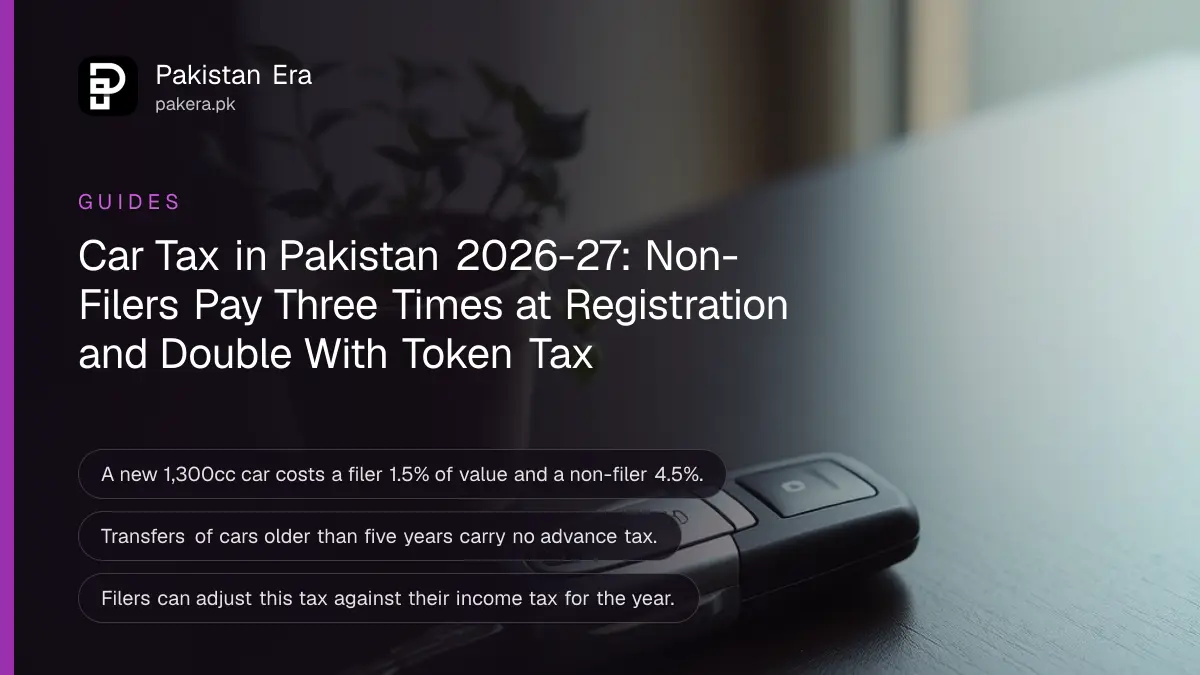
In 2026-27 a non-filer pays three times a filer's advance tax when registering or transferring a car in Pakistan, and twice a filer's income tax with the yearly token tax. On a new 1,300cc car that is 4.5% of the value instead of 1.5%, and Rs 5,000 a year instead of Rs 2,500 with the token tax.
Below is every rate from FBR's withholding tax rate card for tax year 2027, updated to the Finance Act 2026, set out by engine size: buying new, transferring a used car, reselling before registration, and the token tax. We also worked out four real cases and the rules that make the tax drop to zero.
A non-filer pays three times the advance tax at registration
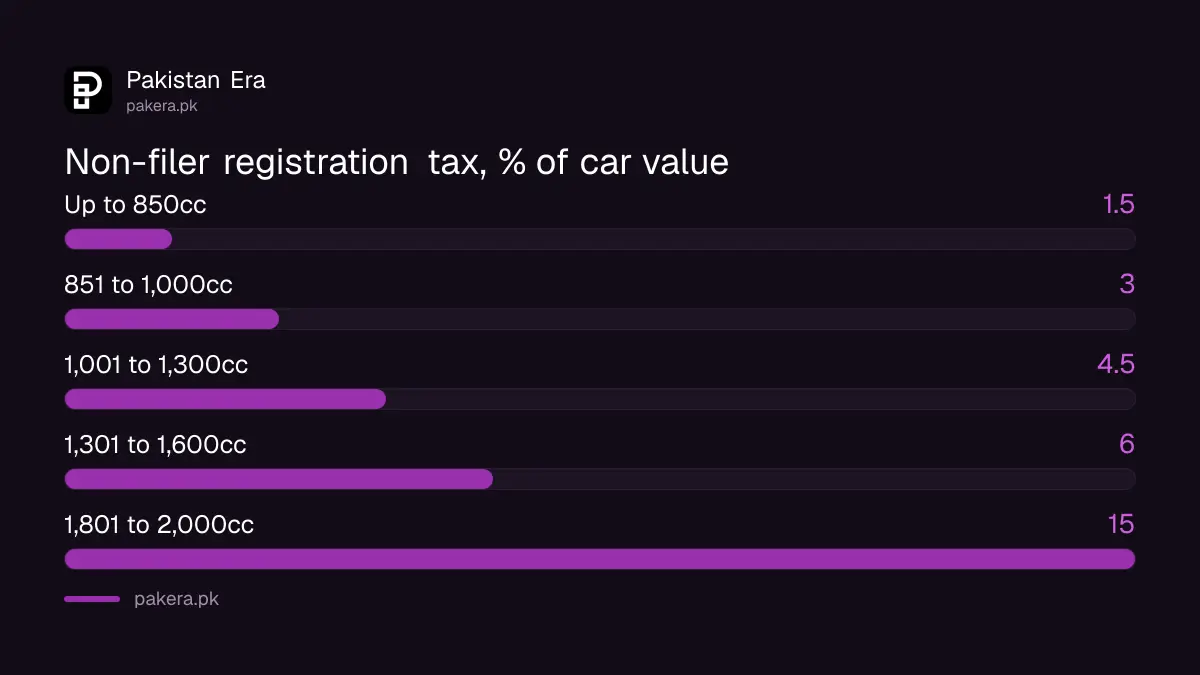
When the Excise and Taxation office registers a new locally made car, it collects advance tax under section 231B as a share of the car's value. A filer, meaning a person on FBR's Active Taxpayers List (ATL), pays 0.5% to 12% by engine size. A non-filer pays 1.5% to 36%.
| Engine size | Filer | Non-filer |
|---|---|---|
| Up to 850cc | 0.5% of value | 1.5% of value |
| 851cc to 1,000cc | 1% of value | 3% of value |
| 1,001cc to 1,300cc | 1.5% of value | 4.5% of value |
| 1,301cc to 1,600cc | 2% of value | 6% of value |
| 1,601cc to 1,800cc | 3% of value | 9% of value |
| 1,801cc to 2,000cc | 5% of value | 15% of value |
| 2,001cc to 2,500cc | 7% of value | 21% of value |
| 2,501cc to 3,000cc | 9% of value | 27% of value |
| Above 3,000cc | 12% of value | 36% of value |
The same rates apply when the manufacturer collects the tax at the time of sale. Section 231B(4) says you should not pay twice: if the maker already collected it from you, show that invoice at registration. The rules on who collects vehicle advance tax explain that step.
Transferring a used car costs a filer Rs 5,000 to Rs 62,500
On transfer of a car's registration, section 231B(2) charges a fixed amount by engine size: nothing up to 850cc, then Rs 5,000 to Rs 62,500 for a filer and Rs 15,000 to Rs 187,500 for a non-filer. No tax is collected on a car first registered in Pakistan more than five years ago.
| Engine size | Filer | Non-filer |
|---|---|---|
| Up to 850cc | Nil | Nil |
| 851cc to 1,000cc | Rs 5,000 | Rs 15,000 |
| 1,001cc to 1,300cc | Rs 7,500 | Rs 22,500 |
| 1,301cc to 1,600cc | Rs 12,500 | Rs 37,500 |
| 1,601cc to 1,800cc | Rs 18,750 | Rs 56,250 |
| 1,801cc to 2,000cc | Rs 25,000 | Rs 75,000 |
| 2,001cc to 2,500cc | Rs 37,500 | Rs 112,500 |
| 2,501cc to 3,000cc | Rs 50,000 | Rs 150,000 |
| Above 3,000cc | Rs 62,500 | Rs 187,500 |
The First Schedule also says this transfer tax falls by 10% for each year since the car was first registered in Pakistan. So a car in its third year should pay less than the table shows. Ask the Excise desk to apply that cut before you pay.
Reselling a new car before registration costs Rs 100,000 or more
If the person who bought a new car from the maker sells it on before it is registered, section 231B(2A) adds a flat tax at registration. For a filer it is Rs 100,000 up to 1,000cc, Rs 200,000 for 1,001cc to 2,000cc and Rs 400,000 above. A non-filer pays Rs 300,000, Rs 600,000 or Rs 1.2 million.
This is the tax on what the market calls "own money", the premium paid to jump a delivery queue. It is collected from whoever registers the car, so the final buyer usually bears it.
The token tax carries Rs 800 to Rs 10,000 of income tax a year
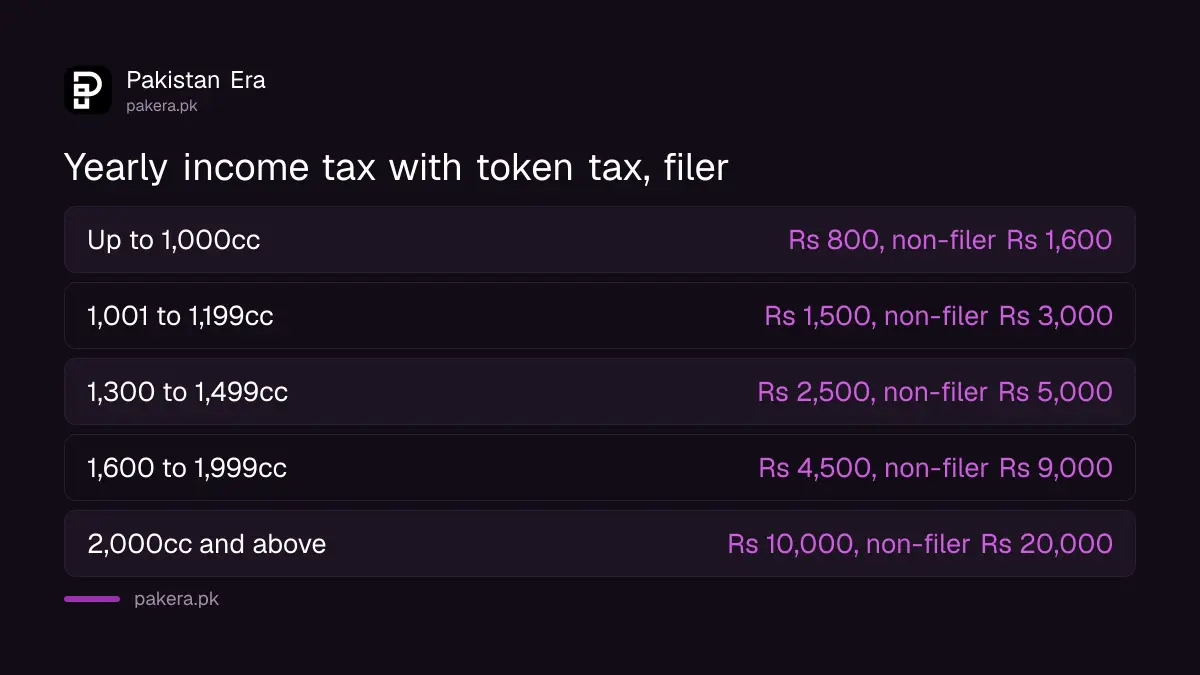
Whenever a province collects motor vehicle tax, section 234 makes it collect income tax as well. For a private car a filer pays Rs 800 to Rs 10,000 a year by engine size, and a non-filer pays double. Where the token tax is paid in one lump sum, the income tax is Rs 10,000 to Rs 120,000 for a filer.
| Engine size | Yearly, filer | Yearly, non-filer | Lump sum, filer | Lump sum, non-filer |
|---|---|---|---|---|
| Up to 1,000cc | Rs 800 | Rs 1,600 | Rs 10,000 | Rs 20,000 |
| 1,001cc to 1,199cc | Rs 1,500 | Rs 3,000 | Rs 18,000 | Rs 36,000 |
| 1,200cc to 1,299cc | Rs 1,750 | Rs 3,500 | Rs 20,000 | Rs 40,000 |
| 1,300cc to 1,499cc | Rs 2,500 | Rs 5,000 | Rs 30,000 | Rs 60,000 |
| 1,500cc to 1,599cc | Rs 3,750 | Rs 7,500 | Rs 45,000 | Rs 90,000 |
| 1,600cc to 1,999cc | Rs 4,500 | Rs 9,000 | Rs 60,000 | Rs 120,000 |
| 2,000cc and above | Rs 10,000 | Rs 20,000 | Rs 120,000 | Rs 240,000 |
Watch the bands. A 1,300cc car is in the 1,001cc to 1,300cc band for registration tax, but in the 1,300cc to 1,499cc band for token tax. Section 234(2A) stops this tax on a car used in Pakistan for more than ten years. Passenger vehicles pay per seat instead: Rs 200 to Rs 1,000 a seat for a filer and Rs 375 to Rs 1,500 for a non-filer.
Four cases, worked out
We used the rates above on round values. Your Excise office uses the value it assesses, so the real bill can differ.
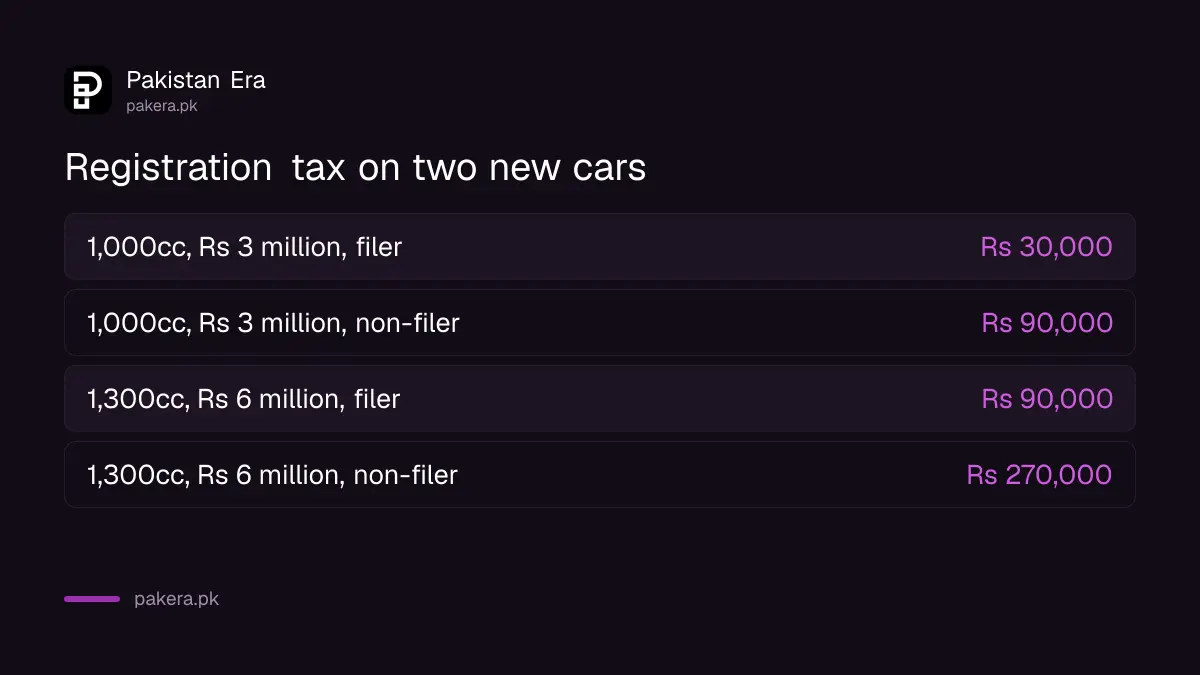
- New 1,000cc car worth Rs 3,000,000: a filer pays Rs 30,000 at registration, a non-filer Rs 90,000.
- New 1,300cc car worth Rs 6,000,000: a filer pays Rs 90,000, a non-filer Rs 270,000.
- Used 1,300cc car first registered two years ago: a filer pays up to Rs 7,500 on transfer before the 10% yearly cut, a non-filer up to Rs 22,500.
- Yearly token tax on that 1,300cc car: Rs 2,500 of income tax for a filer, Rs 5,000 for a non-filer.
On the Rs 6 million car, the gap between filer and non-filer is Rs 180,000 on one form. Filing a return is usually cheaper than that, and the late filing surcharge to rejoin the list is Rs 25,000 for an individual.
Filers can claim this tax back in their return
Sections 231B(5) and 234(5) both say the tax collected is adjustable. That means it counts as tax you have already paid, and you set it against your income tax for the year in your return. A non-filer gets no such credit unless they file.
Keep every Excise receipt and token tax challan with your tax papers. Before you visit the Excise office, check your filer status on the ATL, because the office uses the list on the day of payment. For the full cost of a new car in Punjab, the Punjab registration fee breakdown adds the provincial charges.
Common questions
How much tax does a non-filer pay on a new car in 2026-27?
1.5% to 36% of the car's value at registration, by engine size, under section 231B. That is three times the filer rate.
Is there tax on transferring an old car?
No advance tax is collected on transfer if the car was first registered in Pakistan more than five years ago.
What is the income tax with token tax for a 1,000cc car?
Rs 800 a year for a filer and Rs 1,600 for a non-filer, or Rs 10,000 and Rs 20,000 if paid as a lump sum.
Do motorcycles pay section 231B tax?
Section 231B(7) excludes any motor vehicle up to 200cc, as well as rickshaws and vehicles used for public transport, goods or farm work.
Can I get the car tax back?
Yes, if you file a return. Both sections say the tax is adjustable against your income tax for the year.
What does "own money" cost in tax?
Rs 100,000 to Rs 400,000 for a filer and Rs 300,000 to Rs 1.2 million for a non-filer, when a new car is resold before registration.
How we verified this
What we checked, where we read it, and what we could not confirm.
We read FBR's withholding tax rate card for tax year 2027, updated to 30 June 2026, and sections 231B and 234 with Division VII of Part IV of the First Schedule in FBR's consolidated Income Tax Ordinance on 28 October 2026. The worked cases are our arithmetic on round values. We could not confirm how each province's Excise office applies the 10% yearly cut on transfers, or the values they use to assess a car.
About the author

Tax, Bills and Technology Writer
Ali Akhtar is a young and curious voice here at Pakistan Era. He is currently pursuing his A-Levels and has a growing interest in Pakistan’s changing industrial landscape and educational trends. Ali likes to write in a way that helps him explain and explore the world around him. His writing reflects the perspective of the new generation navigating the evolving trends of Pakistan where technology, youth innovation, and shifting opportunities are reshaping the country’s future.