How to Apply for Partition (Taqseem) of Joint Land in Punjab: No Fee, 30 to 60 Days
Divide jointly owned farmland in Punjab through taqseem. See who can apply, the papers, the two maps, the 30 to 60 day timeline and the paused portal. Read on.
Short answer: To partition joint agricultural land in Punjab, a co-owner whose name is in the khewat applies for taqseem. PLRA lists two routes: a written application to the Tehsildar with CNIC and fard copies, or its online partition portal. There is no fee. PLRA says the process usually takes 30 to 60 days.
Say four brothers inherit 16 kanals. The record shows them as joint owners of one big khasra. None of them can sell, mortgage or build on a specific corner without the others. Partition, called taqseem, turns that shared block into four named parcels with four fards.
We read the Punjab Land Records Authority (PLRA) pages on partition and its FAQ text, and we opened the online partition portal it points to. We did not file a partition case, because that needs a real khewat and consenting co-owners.
Partition turns joint land into separate parcels
PLRA says partition allows co-owners, or joint landholders, to divide shared property into individual portions. Each shareholder gets a legally recognised and clearly marked share. After approval, each owner receives a separate parcel and a fard showing an independent share.
PLRA states that partition is carried out under Sections 135, 135-A and 147 of the Land Revenue Act, 1967. Any joint landholder whose name exists in the khewat record can apply. One or more owners may apply, and all owners are notified and their consent is recorded.
The step before partition is usually inheritance. If the shared record came from a death in the family, transferring inherited land in Punjab shows how the heirs' names get into the khewat.
The online portal was suspended when we checked
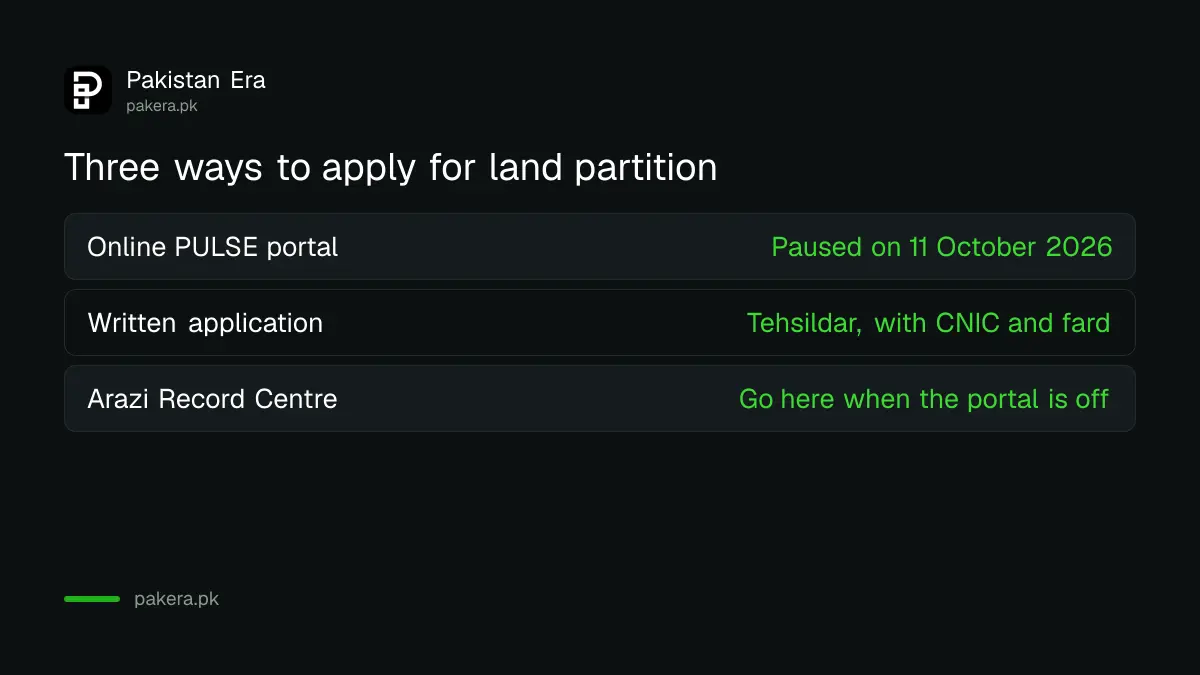
PLRA's page says you can apply through a service centre or an online portal, and its FAQ names the PULSE portal. When we opened that portal on 11 October 2026, it displayed a notice that the online application system is temporarily unavailable and told users to visit the nearest Arazi Record Centre.
So today the safe route is in person. Go to your Arazi Record Centre or submit a written application to the Tehsildar. Check again before you travel, because the notice may be lifted.
| Route | What PLRA says | Status on 11 October 2026 |
|---|---|---|
| Online PULSE portal | Select Taqseem, district, tehsil, mouza, enter khewat, name, CNIC, mobile, attach fard | Portal showed online applications temporarily unavailable |
| Written application to Tehsildar | Submit with CNIC and fard copies | Listed as available |
| Arazi Record Centre | Visit for assistance, biometric check if needed later | The portal told users to go here |
What to bring and what happens next
Bring your original CNIC and a fard for every khewat where the land lies. If the land sits in several khewats, PLRA says you must attach a fard for each one. A representative can file for you with an authorised power of attorney.
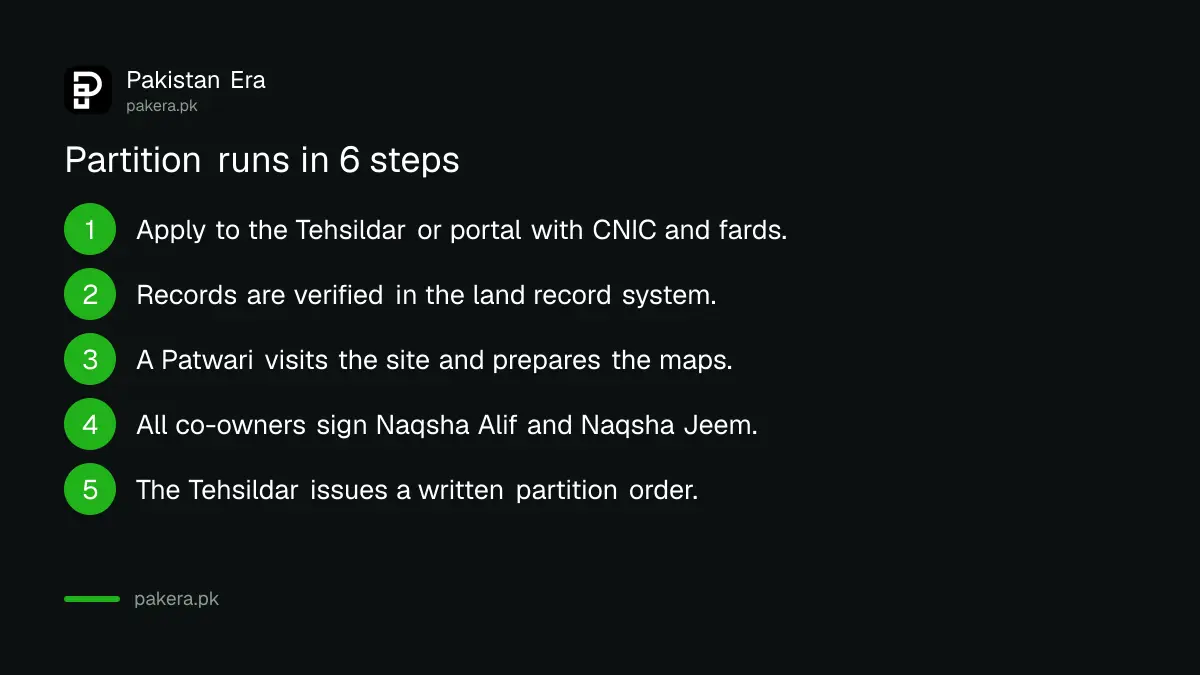
- Apply to the Tehsildar or the online portal with your CNIC and fard copies.
- Record verification through the Land Record Management Information System.
- A Patwari contacts you for a site visit and partition map.
- All co-owners sign or thumb-mark the two maps, called Naqsha Alif and Naqsha Jeem.
- The Tehsildar or Revenue Officer issues a written partition order.
- The order goes to the Arazi Record Centre, and each owner receives a separate fard.
If you file online, PLRA says you get an application ID and can track the request with it. Biometric verification is not required at filing, but it may be required later at the Arazi Record Centre for the final record update.
Two maps decide who gets which parcel
Naqsha Alif is the ownership map that shows each owner's total share. Naqsha Jeem is the division map that shows the physical parcels given to each owner. The Patwari prepares both under the Revenue Officer's supervision, and all co-owners sign or thumb-mark them.
PLRA lists the factors used in preparing the maps: possession, land value, road access, water channels and the owners' mutual consent. Normally one consolidated parcel is allotted to each owner unless that is physically unavoidable. Roads and public passages are mapped separately.
Two totals must match: the Khewat Mizaan, the total joint area, and the Wandaajaat Mizaan, the total divided area. The Qanoongo and Tehsildar verify the maps and figures before approval.
The same step helps if one co-owner wants a Green Property Certificate. PLRA says partition must come first when you lack other co-owners' consent, as in getting a Green Property Certificate in Punjab.
You can appeal if you disagree with the order
If you disagree with the partition order, PLRA says you can appeal before the District Collector within the legal time frame. If the partition was wrongly entered in the record, a correction is a separate step, covered in how to correct a mistake in your land record.
A practical note. PLRA lists mutual consent among the factors, so it helps if all co-owners agree on who gets which corner before the Patwari arrives. Keep the fards, the application ID and the signed maps in one folder. You will need them to sell, build or mortgage a parcel later.
Common questions
Is there a fee for partition in Punjab?
PLRA's FAQ says no fee is applicable for filing partition. Ask at the counter in case a separate charge arises for copies.
How long does land partition take?
PLRA says usually 30 to 60 days, depending on verification and the consent of owners.
Can one co-owner apply without the others?
Yes. One or more co-owners may apply. All owners are then notified and their consent is recorded.
Where do I apply if the online portal is suspended?
Submit a written application to the Tehsildar with your CNIC and fard copies, or visit your Arazi Record Centre.
Can I send my representative to apply?
Yes, through an authorised power of attorney.
What law covers land partition in Punjab?
PLRA names Sections 135, 135-A and 147 of the Land Revenue Act, 1967.
How we verified this
What we checked, where we read it, and what we could not confirm.
Last checked on Sunday 11 October 2026. We read the Apply for Partition page and the FAQ text on the Punjab Land Records Authority website, and opened the online partition portal, which showed its suspension notice. Timings and fees are as PLRA states them and may change.
About the author

Senior Writer, Public Services and Technology
Shahid joined us in 2024 as an author. He is a senior contributor to Pakistan's leading technology websites. He writes detailed articles, mostly covering his expertise in the latest tech, mobiles, apps, gadgets, and step-by-step guides. His ideology is to help people understand the latest trends and explain complex methods through very easy-to-understand guides.