SSGC Gas Connection Name Change: Documents for Buyers, Tenants and Heirs, Done in 2 Billing Cycles
Change the name on an SSGC gas connection in Karachi, Sindh or Balochistan: documents for buyers, tenants and heirs, the Rs 50 stamp, deposit rules and timing.
To change the name on an SSGC gas connection, take proof of ownership, a copy of your CNIC and an up to date paid gas bill to an SSGC Customer Facilitation Centre, and sign a fresh gas supply contract with a Rs 50 adhesive stamp. Under OGRA's service standards, SSGC must make the change within two billing cycles of getting a complete application.
This applies to Sui Southern Gas Company (SSGC) customers in Karachi, the rest of Sindh and Balochistan. A buyer, a tenant, the heirs of a customer who has died, or a business that changed its name each need slightly different papers. The sections below list them case by case.
SSGC changes the name in five situations
SSGC's Consumer Service Manual lists five cases for a change of name, which it calls a change of tenancy: a change of ownership, a change in favour of a tenant or third party, a new name for an existing business, the death of the registered customer, and an order from a competent authority.
The most common case is a house sale. The gas account stays in the old owner's name until the buyer applies, and every bill, deposit and notice keeps going to that name. Heirs face the same problem when a parent dies and the connection is still in the parent's name.
The documents depend on who is applying
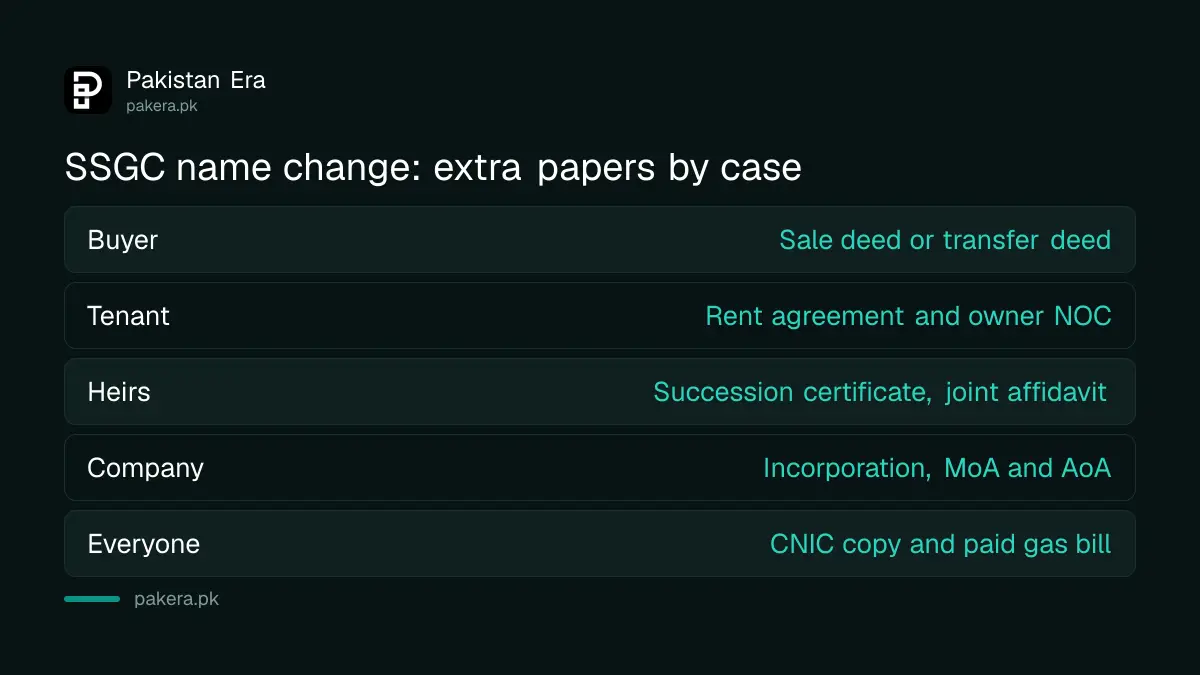
Every applicant gives SSGC three things: proof of ownership or right to the premises, a copy of the CNIC, and a copy of the latest paid gas bill. Tenants, heirs and companies then add their own papers, set out in the table below.
| Who applies | Extra papers SSGC asks for |
|---|---|
| New owner (buyer) | Transfer deed, sale deed, allotment letter or power of attorney that proves ownership |
| Tenant | Rent agreement, plus an NOC from the owner on stamp paper agreeing to the transfer |
| Heirs of a customer who died | Succession certificate, plus an affidavit on stamp paper signed by all the beneficiaries |
| Limited company | Certificate of incorporation, Memorandum of Association and Articles of Association |
| Industrial premises | NOC from the industrial estate; a tenant also needs the owner's written undertaking to clear any dues the tenant leaves |
For heirs, the succession certificate is the court document that names who inherits. SSGC wants every beneficiary to sign the affidavit, not just the one who applies, so agree within the family first. The same rule exists in other utilities, and the SNGPL gas connection name transfer follows a similar list for Punjab and Khyber Pakhtunkhwa.
Apply at an SSGC Customer Facilitation Centre in six steps
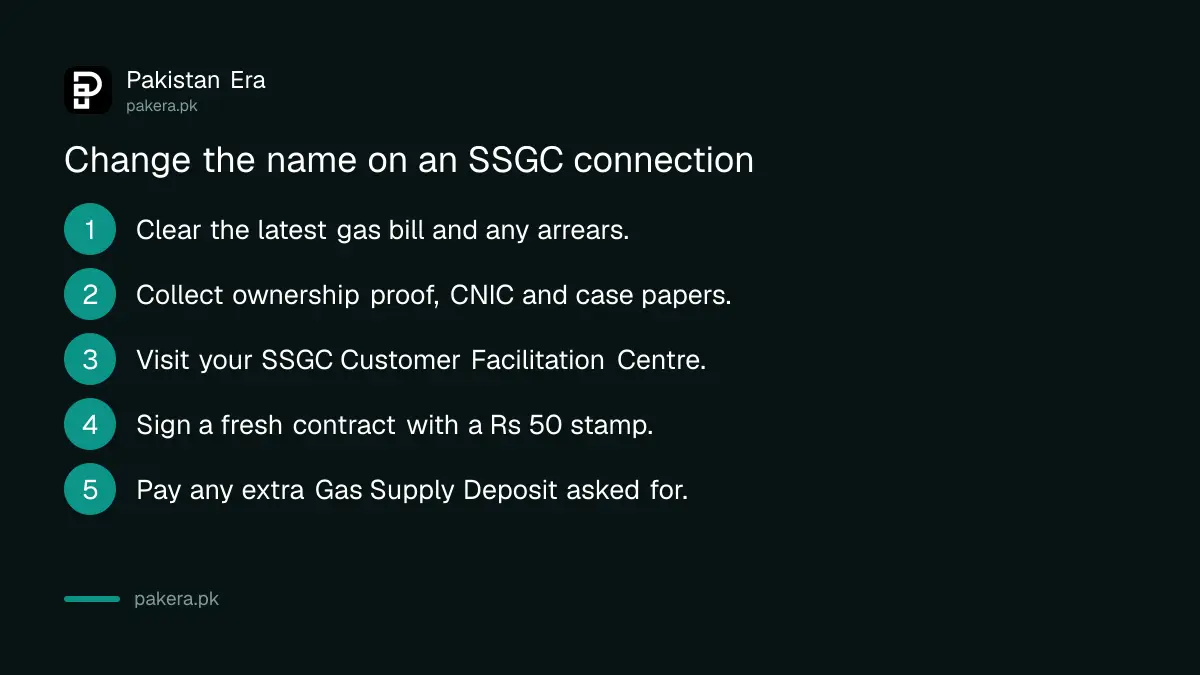
The application goes to an SSGC Customer Facilitation Centre, known as a CFC. Clear all dues first, collect your papers, then visit the CFC for your area with originals and copies. You sign a new contract there and the change is made after dues are cleared to that date.
- Pay the latest gas bill and any arrears, and keep the paid copy.
- Collect proof of ownership, your CNIC copy, and the extra papers for your case.
- Visit your nearest SSGC Customer Facilitation Centre with originals and copies.
- Fill the change of name request and hand over the documents.
- Sign the fresh gas supply contract, which carries a Rs 50 adhesive stamp.
- Pay any extra Gas Supply Deposit SSGC asks for, then keep the receipt.
SSGC has 23 facilitation centres across Karachi, Hyderabad, Sukkur, Quetta and other cities. Find the right one in the list of SSGC Customer Facilitation Centres. The Rs 50 stamp rate is set by the Sindh government and can change, so ask at the counter.
Domestic customers keep the old deposit, businesses pay fresh
For a home, SSGC carries the existing Gas Supply Deposit over and may ask for an additional amount if one applies. For commercial and industrial connections, the new owner or tenant pays a fresh deposit, and the old owner must give an NOC to move the existing deposit.
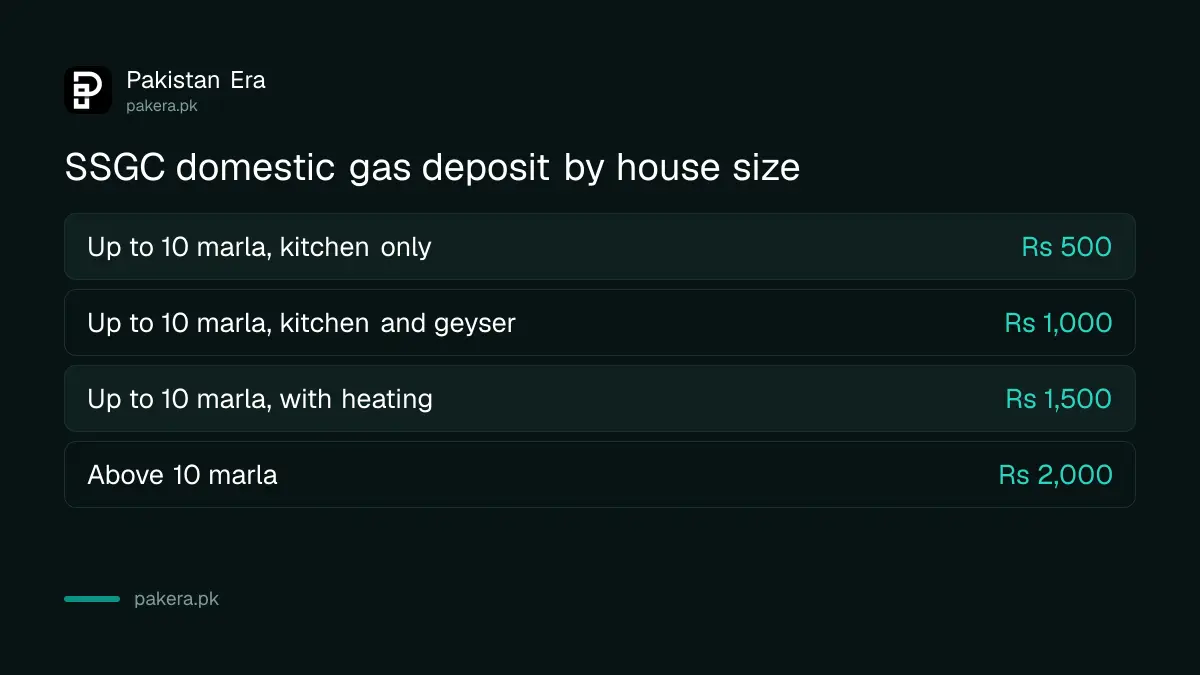
The Gas Supply Deposit, or GSD, is the security amount SSGC holds against each connection. SSGC's manual lists domestic deposits by plot size and use:
- House up to 10 marla or 300 square yards, one kitchen only: Rs 500.
- Same house, one kitchen and a geyser: Rs 1,000.
- Same house, kitchen, geyser and space heating: Rs 1,500.
- House on more than 10 marla or 300 square yards: Rs 2,000.
Where a commercial deposit is held as a bank guarantee, the guarantee cannot move to the new name. A fresh guarantee is needed. The deposit is refunded after the connection is finally billed and closed, so the old owner does not get it back at the name change itself.
SSGC must finish within two billing cycles
OGRA's performance and service standards, published in the Gazette of Pakistan on 19 March 2019, say a change of name must be made within two billing cycles after the customer gives a complete application and documents. SSGC's own complaint timeline lists the same two billing cycles.
A billing cycle is about one month, so expect the new name on the bill within roughly two months. Watch the name printed on the next two bills. If it has not changed by then, register a complaint on 1199 and quote the date you applied. The SSGC complaint timelines show what other requests should take.
Once the bill is in your name, add your own CNIC to the gas account as well. SSGC asks customers to keep CNIC details updated to avoid disconnection, and the steps to update the CNIC on a gas account take one visit.
Unpaid bills block the change
SSGC makes the change only after dues are cleared up to the date of the change. If the seller left arrears, the account cannot move to the buyer until someone pays them. Check the bill before you buy or rent.
Ask the seller for the last few paid bills, and check the consumer number on the latest one. A large arrear on a house means either the price should come down or the seller should clear it before transfer. A disconnected meter is also a warning sign, since restoration costs extra.
Common questions
How long does an SSGC name change take?
OGRA's standard is two billing cycles after SSGC receives a complete application and all documents. That is roughly two months.
Can a tenant get the SSGC gas connection in their own name?
Yes. A tenant gives a rent agreement and an NOC from the owner on stamp paper agreeing to the transfer, along with the usual CNIC and paid bill.
What do heirs need after the gas customer dies?
A succession certificate from the court, an affidavit on stamp paper signed by all beneficiaries, CNIC copies, the paid bill and a fresh contract.
Do I have to pay a new gas deposit for my house?
Not a full new one. For domestic connections SSGC keeps the existing deposit and may ask for an additional amount if one applies.
Can I change the name if the old owner left unpaid bills?
No. SSGC changes the name only after all dues up to the date of change are cleared.
How we verified this
What we checked and where we read it.
We checked SSGC's rules on 15 November 2026. The change of name procedure, the document list, the Rs 50 adhesive stamp and the deposit rules come from SSGC's Consumer Service Manual, in the section "Procedure for change of name, tenancy or ownership" and the Gas Supply Deposit options. The two billing cycle standard is item 33 of OGRA's performance and service standards printed in the same manual, from the Gazette of 19 March 2019, and is repeated on SSGC's complaint timelines page. The manual is a scanned document and a few words are hard to read, but the lists above were legible.
About the author

Tax, Bills and Technology Writer
Ali Akhtar is a young and curious voice here at Pakistan Era. He is currently pursuing his A-Levels and has a growing interest in Pakistan’s changing industrial landscape and educational trends. Ali likes to write in a way that helps him explain and explore the world around him. His writing reflects the perspective of the new generation navigating the evolving trends of Pakistan where technology, youth innovation, and shifting opportunities are reshaping the country’s future.