Lahore Wants Unpaid Challans to Block Your CNIC and Passport
Lahore's traffic chief has asked for unpaid challans to block CNICs and passports. It is a letter, not a rule, and a court has already ruled.
Nothing has changed yet. No CNIC, passport or licence is being refused today because of an unpaid traffic challan.
What exists is a letter. Lahore's chief traffic officer has written to a provincial police officer asking for a system to be built. That is a proposal, and a proposal carries no legal force on its own.
Here is what was asked for, and why it is harder than it sounds.
What the letter proposes
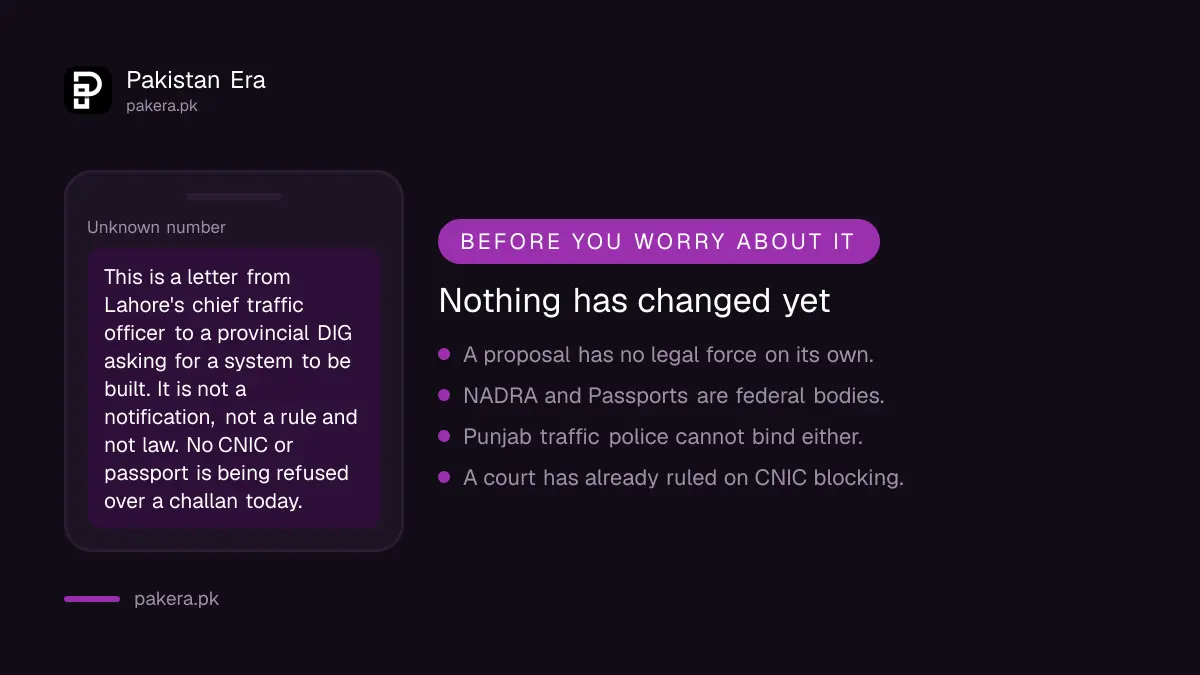
As reported, Chief Traffic Officer Lahore Abdul Rahim Sherazi wrote to the DIG Traffic Punjab asking that pending digital challan records be added to the One App, and that people with unpaid challans be refused services at service centres.
The services named are:
| Service | What was proposed |
|---|---|
| CNIC | Issue, renewal, modification and duplicate all tied to clearing fines |
| Passport | Issue and renewal made conditional on clearing fines |
| Driving licence | Withheld until fines are cleared |
| Character certificate | Withheld until fines are cleared |
| Tenant registration | Withheld until fines are cleared |
| Method | Link challan records with NADRA |
The reason given is to increase government revenue and strengthen enforcement of traffic law.
We have not read the letter itself. It has not been published, so the contents above are as reported rather than read at source.
A letter is not a rule
This distinction gets lost quickly, so it is worth stating plainly.
A measure in Pakistan usually travels through several stages. Somebody proposes it. A department approves it. It is notified, meaning published as a formal order or rule. Then it commences, meaning it actually applies to you.
This is at the first stage. One officer has asked another officer to consider building something. There is no approval, no notification, no date and no system.
So if you read that your CNIC will be blocked over a challan, the accurate version is that somebody has suggested it should be.
Two of those documents are not Punjab's to withhold
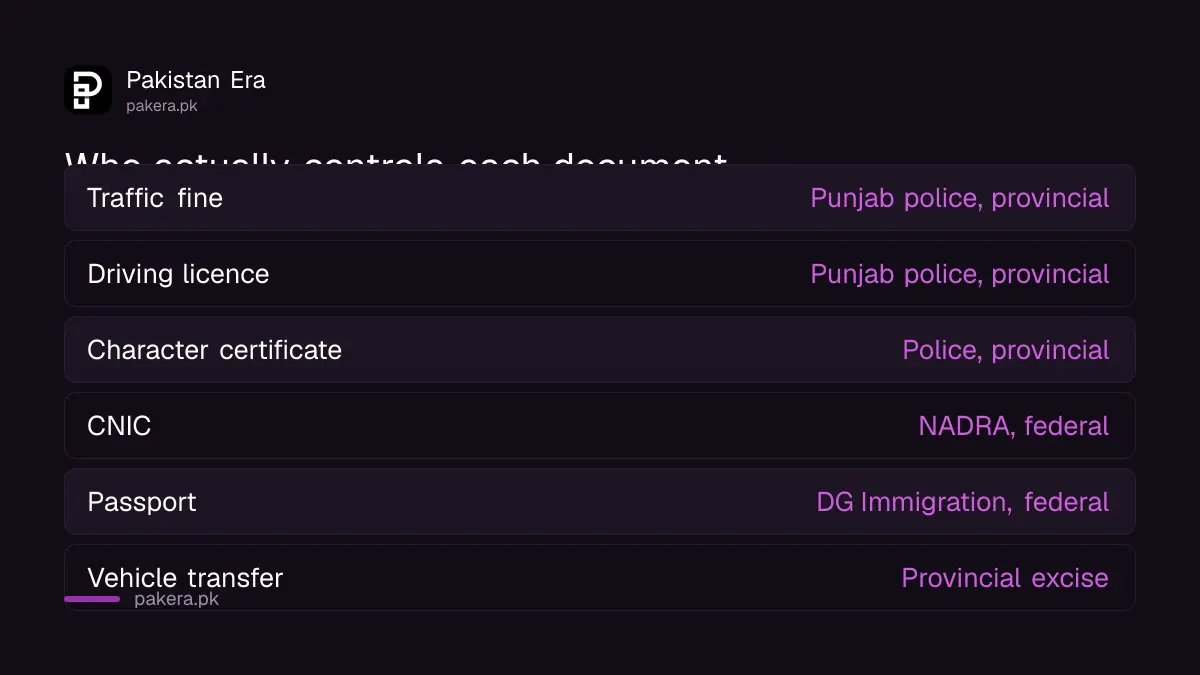
This is the structural problem, and it explains why the proposal is more complicated than a software change.
Traffic enforcement is provincial. So are driving licences and police character certificates. Punjab traffic police have a real say over those.
The CNIC is federal. It belongs to NADRA. The passport is federal too, issued by the Directorate General of Immigration and Passports.
A letter from a city traffic officer to a provincial DIG does not reach either of them. For the CNIC and passport parts to happen at all, federal bodies would have to agree, and something would have to be notified that gives them the power to refuse on that ground.
None of that has happened.
This is a distinction worth carrying generally. Licensing, policing and vehicle registration are provincial subjects in Pakistan, while identity and travel documents are federal. It is the same split that decides which office you go to when a CNIC expires.
A court has already ruled on blocking a CNIC
This is the part worth knowing, and we are quoting a judgment rather than offering an opinion.
In April 2026 the Lahore High Court, Multan Bench, decided a petition against NADRA over a blocked CNIC. Justice Tanveer Ahmad Sheikh held that the card issued by NADRA cannot be treated as movable property of its holder, and so cannot be attached, impounded, cancelled or blocked by civil courts in civil proceedings.
The judgment went further on who may do it at all. Such action, it held, can only be taken by NADRA itself, strictly under Section 18 of the NADRA Ordinance, and in specific circumstances such as fraud, duplication or ineligibility. NADRA was directed to unblock the card within 15 days.
Be careful with what that does and does not settle. That case was about civil courts, not traffic police, so it does not decide this proposal.
What it does establish is who may block a CNIC and on what grounds. An unpaid traffic fine is not among the grounds the court listed. Dawn reported on 24 August that a legal expert has questioned the legality of the proposal, and a challenge would surprise nobody.
Sindh already does part of this
Something we found after publishing, which changes how novel the Lahore idea looks.
Sindh's own e-challan system already lists CNIC impounding as a consequence. Its ticket timeline sets out temporary suspension of the driving licence three months after a ticket is issued, and CNIC digitally impounded, under Section 116, at six months. That is printed in the system itself, not proposed.
Be careful with the comparison, because the two are not the same thing.
Sindh's sits inside a traffic statute, the Motor Vehicle Ordinance 1965, and operates within the challan system. The Lahore proposal would condition NADRA services, which is a federal matter and a different power entirely, and it reaches passports too.
So Sindh is not a precedent that settles the Lahore question. It does show the idea is already operating somewhere in Pakistan, which nobody covering the proposal has mentioned. We have set out the full Sindh timeline, including the 14 day discount and the point at which the fine doubles, in checking a Karachi e-challan.
Whether Sindh's practice would survive the kind of challenge the Lahore proposal is likely to face, we do not know, and we have found nobody who has tested it.
What is actually worth doing today
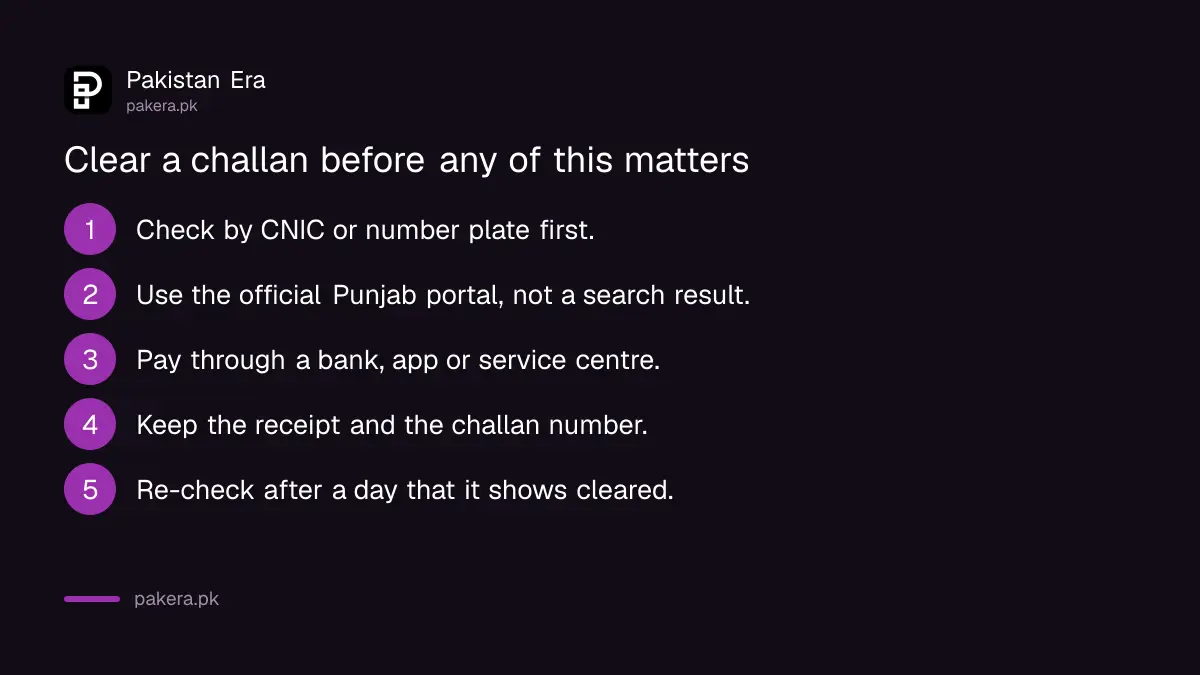
None of the above is a reason to ignore a challan. An unpaid fine is a debt whatever happens to this proposal, and it is easier to clear now than to argue about later.
- Check what is outstanding against your CNIC and your number plate. Both, because a challan can attach to either.
- Use the official Punjab route, not a link from a search result. Our guide to checking a Punjab e-challan by CNIC or number plate has the working portal.
- Pay through a bank, an app or a service centre, so there is a record with your name on it.
- Keep the receipt and the challan number. If a system like this is ever built, the receipt is what fixes a wrong entry.
- Check again a day later that it shows as cleared, because payment and record update are not always the same moment.
Expect the scam messages to follow
Every announcement about challans produces a wave of fake SMS within days, and this one is written to frighten people into clicking.
The pattern is always the same. A message says your CNIC is about to be blocked, gives a short deadline, and links to a page that takes a payment or a one time code.
Two things make it easy to spot. No government body collects a fine through a link in an SMS, and no real service asks for an OTP. We covered the current wave in the fake e-challan SMS scam, including the genuine portals.
If you get a message like that this week, the safe assumption is that it is fake, because as of today there is no rule for it to be enforcing.
What we could not confirm
The letter has not been published, so its contents are reported rather than read at source.
We have no comment from NADRA, the Directorate General of Immigration and Passports, Punjab traffic police or the chief traffic officer, and none of them has said publicly whether they support it.
There is no timeline, approval or notification that we could find, because there does not appear to be one yet.
We are not taking a position on whether the proposal is a good idea. Unpaid fines are a real problem and recovery is a fair aim. This piece is about what stage the thing is at and who would have to agree.
If it does get notified, that becomes a different article and we will write it.
Questions readers are asking
Will my CNIC be blocked over an unpaid challan?
Not today. It is a proposal in a letter, with no approval and no notification behind it.
Can Punjab traffic police stop NADRA issuing my card?
Not on their own. The CNIC is federal and belongs to NADRA. A provincial police letter does not give NADRA that power.
What did the court actually say?
The Lahore High Court held in April 2026 that a CNIC is not movable property and cannot be blocked by civil courts, and that only NADRA may do so under Section 18, for reasons such as fraud, duplication or ineligibility.
Does that ruling kill this proposal?
No. That case concerned civil courts rather than traffic police. It sets out who may block a CNIC and why, and unpaid fines are not on that list.
Should I still pay my challan?
Yes. It is a debt regardless, and clearing it now is simpler than disputing it later.
Where do I check what I owe?
Through the official Punjab portal, by CNIC or number plate. Check both, because a challan can be attached to either.
I got an SMS saying my CNIC will be blocked. Is it real?
Almost certainly not. There is no rule in force for it to enforce, and no government body takes a fine through a link in a message.
About the author

Senior Writer, Public Services and Technology
Shahid joined us in 2024 as an author. He is a senior contributor to Pakistan's leading technology websites. He writes detailed articles, mostly covering his expertise in the latest tech, mobiles, apps, gadgets, and step-by-step guides. His ideology is to help people understand the latest trends and explain complex methods through very easy-to-understand guides.