ECP Says Parties Alone Decide Where Women Contest, 5% Ticket Rule Needs a Law Change in Pakistan
The ECP said on 27 November 2026 that parties alone choose where women contest under the 5% ticket rule of Section 206. A law change by Parliament is needed.
Short answer: The Election Commission of Pakistan (ECP) said on 27 November 2026 that only political parties decide which constituencies their women candidates contest. The law, Section 206 of the Elections Act 2017, makes parties give at least 5% of their general seat tickets to women, but it does not say where. The ECP said making parties field women in winnable seats would need Parliament to change the law.
The ECP also said 563 local government seats are still empty because no woman filed nomination papers for them, even after it issued election schedules several times. Both points were in a clarification from the ECP spokesperson, answering a newspaper report about directions from a parliamentary committee.
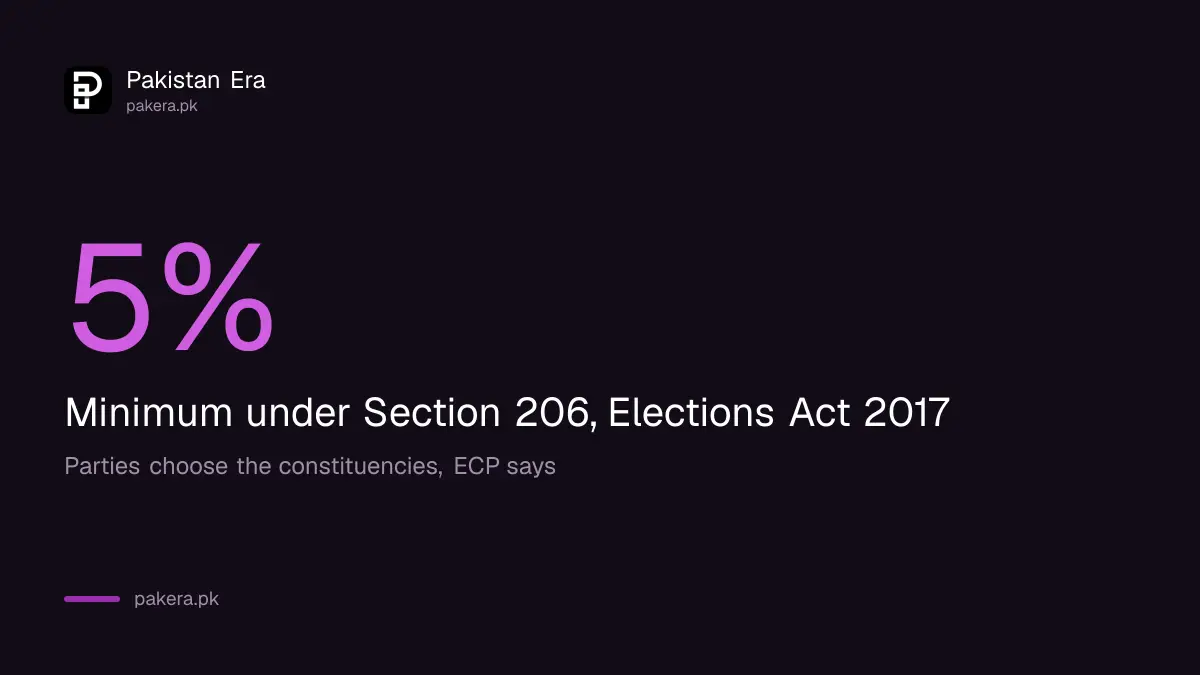
The ECP says parties alone decide where women contest
The ECP spokesperson said on Friday 27 November 2026 that choosing candidates and constituencies is an internal matter of political parties. The ECP has no power to tell a party to give women tickets in seats where they are more likely to win, and it cannot interfere in that choice.
The clarification came after a newspaper reported that a parliamentary committee had asked the ECP to make sure parties place their 5% women's quota in general constituencies where women can win. The spokesperson said the ECP had already told the committee that, under the current law, ticket allocation rests only with the parties.
If the committee wants women fielded in stronger seats, the spokesperson said, the Elections Act would have to be amended. Only Parliament can do that.
Section 206 sets a 5% floor, not a seat list
Section 206 of the Elections Act 2017 requires every political party, when it picks candidates for general seats, to ensure at least 5% of them are women. These are the open seats any candidate can contest. They are separate from the seats reserved for women in the assemblies.
| Question | What the law and the ECP say |
|---|---|
| How many tickets must go to women? | At least 5% of a party's general seat candidates |
| Which law? | Section 206, Elections Act 2017 |
| Who picks the constituencies? | The political party only |
| Can the ECP order women into winnable seats? | No, says the ECP |
| What would change that? | An amendment to the Elections Act by Parliament |
| Does it cover reserved seats? | No. Reserved seats are filled from party lists |
The rule is checked after tickets are issued. Before the 2024 general election, the ECP told every party that held an election symbol to send it the list of male and female candidates on general seats within 5 days, so it could check the 5% share.
Why the 5% rule has not put more women in the assemblies
A party can meet the 5% rule by fielding women in seats where it expects to lose. Nothing in Section 206 stops that, because the law counts tickets, not winnable tickets. That is the gap the parliamentary committee wanted closed, and the ECP says only Parliament can close it.
Here is how the rule works today, in order:
- Each party picks its candidates for National Assembly and provincial assembly general seats.
- At least 5% of those candidates must be women.
- The party chooses which constituencies those women contest.
- The party sends the ECP its list of candidates, by gender, so the share can be checked.
- Voters decide the result. The law guarantees tickets for women, not seats.
A change would need a bill amending the Elections Act, passed by both houses. How a private member's bill reaches the floor is explained in the National Assembly private member's bill rules.
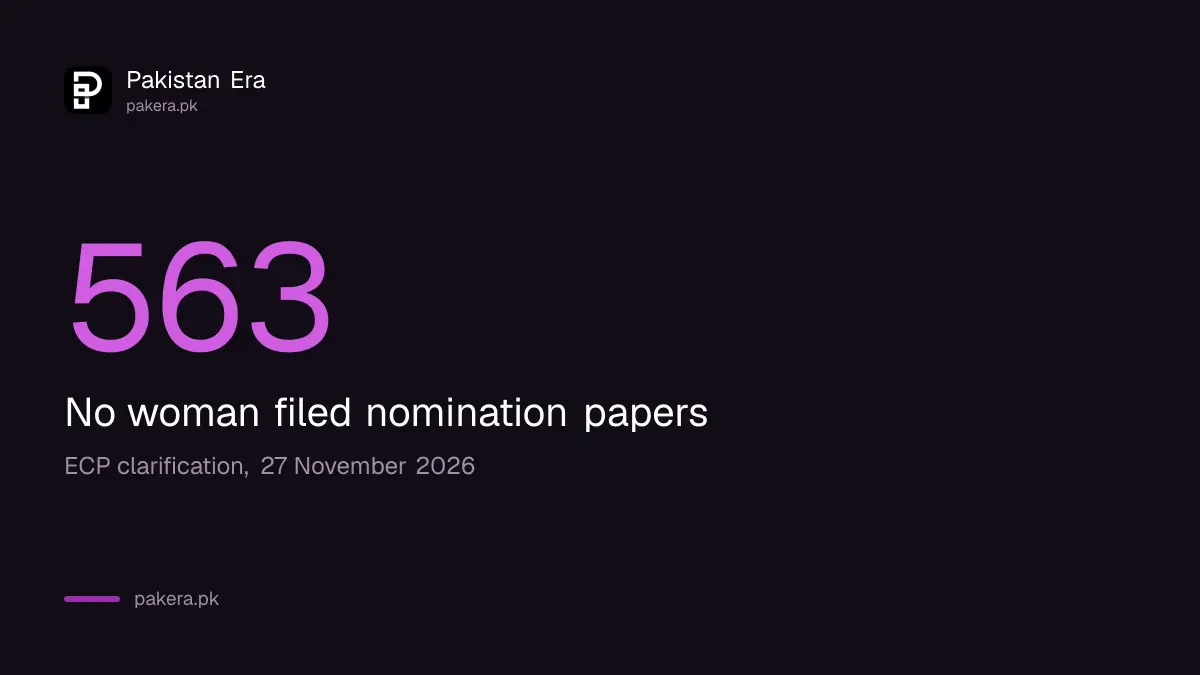
563 local government seats remain empty
The ECP said 563 seats in various local governments are still vacant. It has issued election schedules for these seats several times, but no woman candidate filed nomination papers. The committee had also asked the ECP to arrange polls for these seats.
The ECP did not list the councils or districts where the 563 seats are. The spokesperson's point was that the ECP has done its part by calling the elections; the seats stay empty because nobody came forward to contest.
Local government elections are also due elsewhere. Punjab's first phase is set for 7 February 2027, as our report on the Punjab local government election date explains. In Islamabad, 110 of the 3,505 candidates who filed papers were women, as listed in the Islamabad local government candidates report.
What women who want to contest can do
If you are a woman thinking of standing, the 5% rule means parties need women candidates on general seats. Ask your party early, before tickets are decided. For local government, watch for ECP schedules for vacant seats in your area and file papers within the dates given.
- Party candidates: apply to your party's parliamentary board when it invites applications for tickets.
- Independent candidates: you can contest any general seat without a party ticket, under the same nomination rules as men.
- Local government seats: check your district election commissioner's office for any schedule for vacant seats.
Common questions
What does Section 206 of the Elections Act say?
It requires every political party to ensure that at least 5% of its candidates for general seats are women. It does not say which constituencies they must contest.
Can the ECP force parties to give women winnable seats?
No. The ECP said on 27 November 2026 that constituency choice is an internal party matter. A change would need Parliament to amend the law.
Are the 5% tickets the same as women's reserved seats?
No. Reserved seats are filled from party priority lists, in proportion to the general seats each party wins. The 5% rule is about women contesting open general seats.
How many local government seats are vacant?
The ECP says 563 seats in various local governments are vacant because no woman filed nomination papers, despite several election schedules.
Who asked the ECP to act on women's tickets?
A parliamentary committee, according to a newspaper report the ECP was answering. The ECP said it had already explained the legal position to that committee.
How we verified this
What we checked and where we read it.
We checked this report on 29 November 2026 against the ECP spokesperson's clarification of 27 November 2026, carried by the Associated Press of Pakistan the same day. The 2024 compliance notice on Section 206 is the ECP press release of 14 January 2024 on the ECP press releases page. Local government figures for Punjab and Islamabad are from our earlier reports based on ECP schedules and candidate lists.
Free on WhatsApp
Get the next change first on WhatsApp
Price changes, new rules and deadlines that affect your money, in a few short posts a day.
Follow Pakera on WhatsAppOther followers cannot see your number.
About the author

Global Affairs & Political Economy Writer
Muhammad Hatim is a book lover who started writing because he enjoys it. At Pakistan Era he writes about international relations, geopolitics and the global economy, with a particular interest in South Asia and the forces behind current events.