Private Member's Bill in Pakistan: National Assembly Notice Is Now 30 Days, Up From 10, and Tuesday Is the Day
A private member's bill in Pakistan's National Assembly now needs 30 clear days' notice, up from 10 since August 2026. Steps, the Tuesday rule and bills passed.

A private member's bill is a bill moved by an MNA who is not a minister. In the National Assembly the member must now give 30 clear days' written notice, up from 10, under a rule change dated 24 August 2026. It is taken up on Tuesdays, the Assembly's private members' day, and needs leave of the House to be introduced.
Most laws in Pakistan start as government bills. But private members' bills do become law. The Islamabad ban on plastic book covers and the Provincial Motor Vehicles amendment of 2026 both began as private members' bills, according to the Assembly's own lists. If you want a law changed, this is the route your MNA can use.
What a private member's bill is
The Assembly's rules split business into two classes: government business, moved by a minister, and private members' business, moved by any other member. A private member's bill follows the same stages as a government bill once introduced, but the notice and the day are different.
A senator can move one in the Senate too, under the Senate's own rules. The steps below follow the National Assembly's Rules of Procedure, 2007, as modified up to 18 August 2026.
The notice period is now 30 clear days
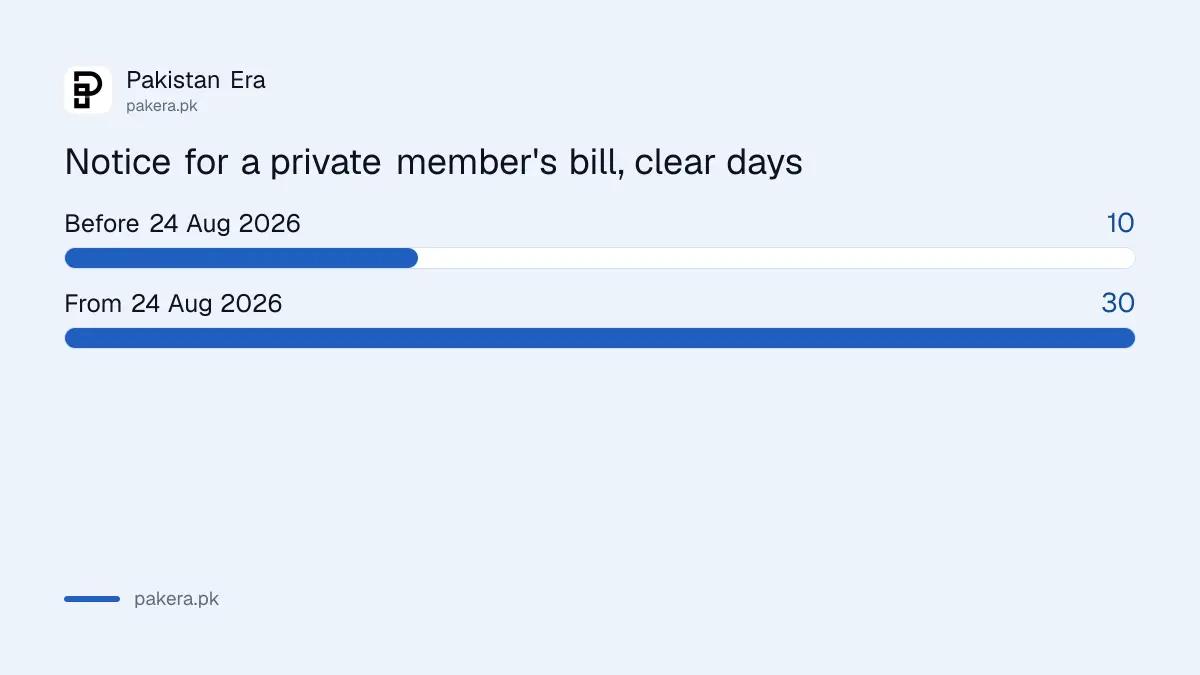
Rule 118 requires 30 clear days' written notice to the Assembly Secretary before a member can move for leave to introduce the bill. The March 2026 edition of the rules said ten days. The change was made by SRO 1425(I)/2026, dated 24 August 2026.
| Rule 118 requirement | Before August 2026 | Now |
|---|---|---|
| Written notice to the Secretary | 10 clear days | 30 clear days |
| Copies of the bill with the notice | Three, with signed Statement of Objects and Reasons | Same |
| Government consent, where the Constitution needs it | Requested through the Ministries of Parliamentary Affairs and Law | Same |
| Copy of admitted bill sent to President's Secretariat, PM Office, Cabinet Division and ministries | Not in the rule | Required (new sub-rule 6) |
The Assembly Secretariat must also help members so that a bill is not rejected merely on technical grounds. That help is in Rule 118(5).
How a private member's bill moves, step by step
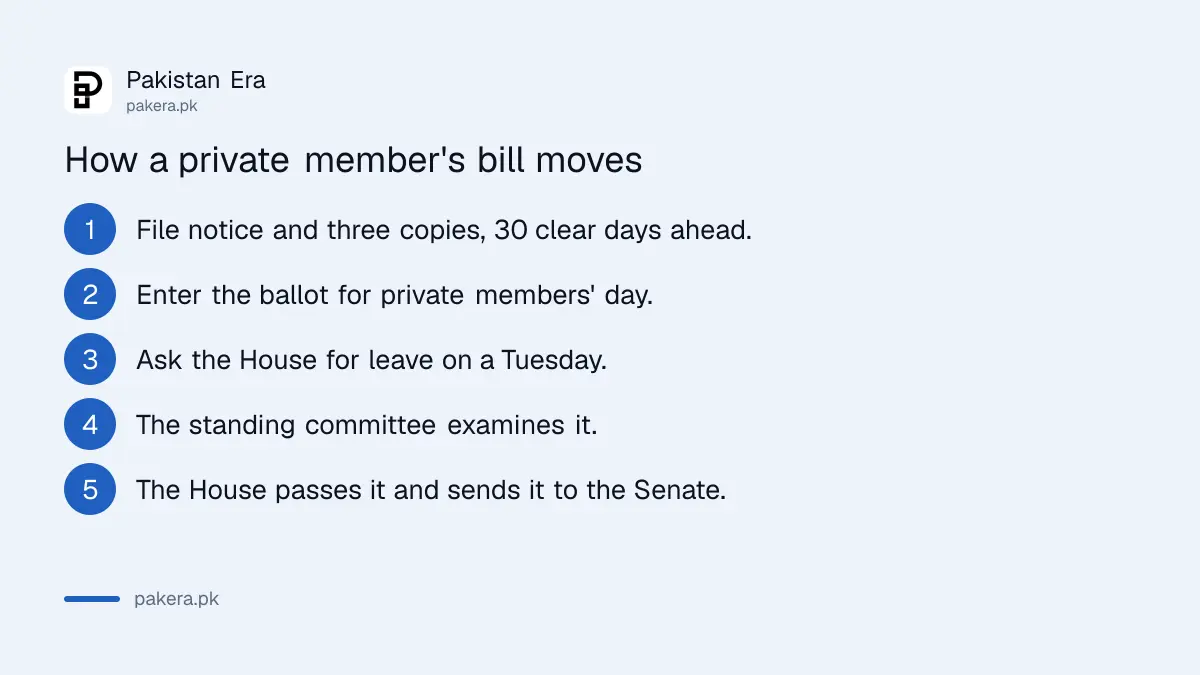
The member files the notice and three copies, waits 30 clear days, and enters the ballot. On a Tuesday the member asks for leave to introduce it. Once introduced, the bill goes to the standing committee, then back to the House for consideration and passage.
- Draft and file. Give written notice to the Secretary with three copies of the bill and a signed Statement of Objects and Reasons.
- Consent, if needed. If the bill spends public money or touches taxes, Article 74 requires the Federal Government's consent, which the Secretariat requests through the ministries.
- Ballot. The order of private members' bills is set by ballot. A list opens in the Notice Office at least five days before the day, for two days, and a member can enter up to three bills (Third Schedule).
- Leave to introduce. On private members' day the member moves for leave. If it is opposed, the Speaker can put the question without debate, after a brief statement from the mover and the minister (Rule 119).
- Committee. The bill stands referred to the standing committee. The Secretary asks the ministry concerned for its views (Rules 122 and 231).
- Committee report. The report is due within 30 days of reference, not counting days when the Assembly is not in session, unless the House extends the time (Rule 235).
- Passage and the Senate. The House considers and passes it, and it goes to the Senate like any other bill.
Tuesday is private members' day
Under Rule 51, private members' business has precedence on Tuesdays. On every other day, only government business is taken unless the Leader of the House agrees. There is also no Question Hour on Tuesdays, which leaves more time for members' bills.
- If there is no sitting on a Tuesday, private members' business moves to the next working day.
- If a Tuesday is given to the budget, the Speaker sets another day for private members' business.
- An urgent government bill can still be introduced on a Tuesday as the last item.
The Assembly's list of private members' bills passed bears this out. Almost every date on it is a Tuesday, such as 27 October, 12 May and 10 March 2026.
Private members' bills passed in 2026
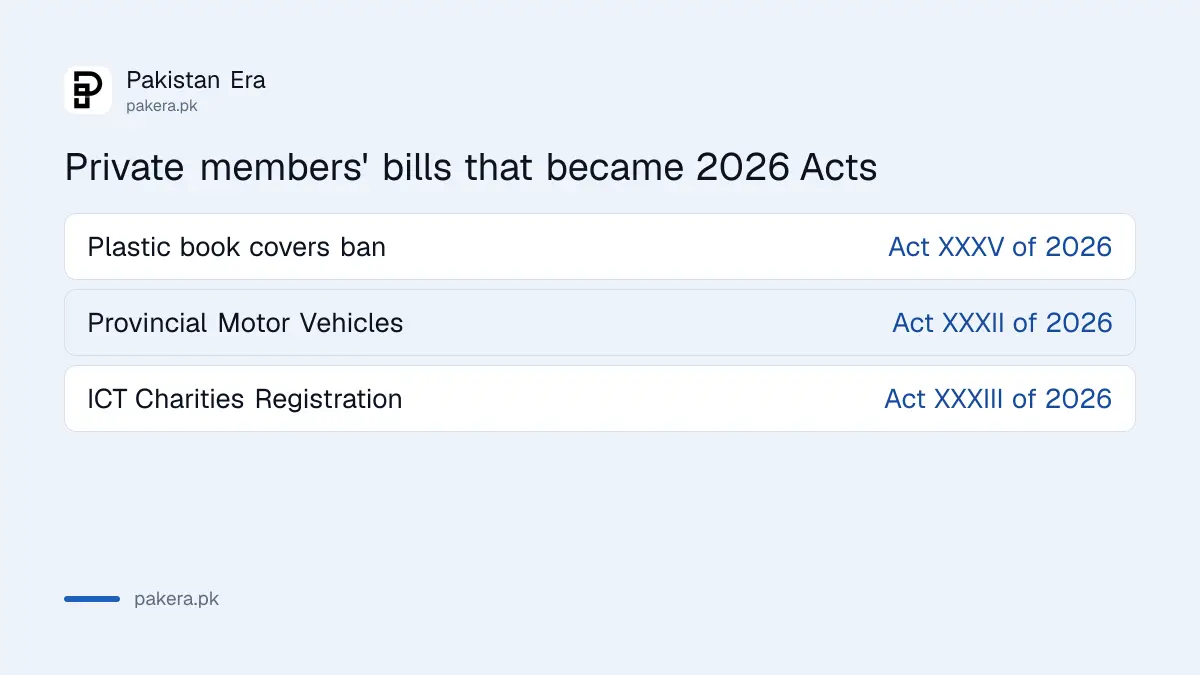
The National Assembly's list shows 14 private members' bills passed in its third parliamentary year, which began on 1 March 2026. Five were passed on 27 October 2026 alone. Some earlier ones have since become Acts of Parliament.
| Bill | Passed by NA | Now |
|---|---|---|
| Qanun-e-Shahadat (Amendment) Bill, 2026 | 27 October 2026 | Passed by NA |
| National Commission on the Rights of Child (Amendment) Bill, 2026 | 27 October 2026 | Passed by NA |
| Criminal Law (Amendment) Bill, 2026 | 27 October 2026 | Passed by NA |
| ICT (Prohibition of Plastic Book Covers) Bill, 2026 | 12 May 2026 | Act XXXV of 2026 |
| Provincial Motor Vehicles (Amendment) Bill, 2026 | 10 March 2026 | Act XXXII of 2026 |
| ICT Charities Registration (Amendment) Bill, 2026 | 10 March 2026 | Act XXXIII of 2026 |
We matched bills to Acts by title on the Assembly's Acts of Parliament list. The other bills of 27 October 2026 were amendments to the Islamabad Senior Citizens law and to Schedule II of the Code of Criminal Procedure. A bill passed by the Assembly still needs the Senate and the President before it becomes law.
How a citizen can get a bill moved
A citizen cannot introduce a bill. You need a member to take it up. Write to your MNA with a short draft, the problem it fixes and the law it changes. The member files it in their name. The Senate route works the same way through a senator.
- Find your member through the guide to your MNA's constituency and contact details.
- For a grievance rather than a new law, the Senate accepts public petitions.
- Track the bill on Tuesdays in the National Assembly session agenda.
Plan for the new timeline. With 30 clear days of notice, a bill filed now cannot be moved for leave until at least a month later, and only on a private members' day while the Assembly is sitting.
Common questions about private members' bills
What is a private member's bill in Pakistan?
A bill moved by a member of the National Assembly or Senate who is not a minister. Government bills are moved by ministers.
How many days' notice is needed for a private member's bill?
Thirty clear days' written notice to the National Assembly Secretary, under Rule 118 as changed on 24 August 2026. It was ten days before.
On which day are private members' bills taken up?
Tuesday. If there is no sitting that Tuesday, they move to the next working day.
Can a private member's bill raise a tax?
Only with the Federal Government's consent. Article 74 bars money bills and spending bills without it.
Can an ordinary citizen introduce a bill in Parliament?
No. A citizen must ask an MNA or senator to move it. Only members can give notice of a bill.
How we verified this
What we checked and where we read it.
Last checked 15 November 2026. Rules 50, 51, 53, 69, 118, 119, 122, 231 and 235 and the Third Schedule are from the National Assembly Rules of Procedure, 2007, as modified up to 18 August 2026, which footnotes SRO 1425(I)/2026 of 24 August 2026 for the change to Rule 118. We compared Rule 118 with the edition modified up to 9 March 2026 on the same downloads page, which reads "ten clear days". The bills list is the Assembly's Private Members' Bills Passed page, matched against its Acts of Parliament page. Article 74 is from the Constitution on Pakistan Code. The newer edition's cover date (18 August) is earlier than the SRO date it footnotes (24 August).
About the author

Global Affairs & Political Economy Writer
Muhammad Hatim is a book lover who started writing because he enjoys it. At Pakistan Era he writes about international relations, geopolitics and the global economy, with a particular interest in South Asia and the forces behind current events.