Senate of Pakistan Public Petition: How to File by Post or by Hand While the Online Portal Is Down
How to file a public petition with the Senate of Pakistan under Rule 277: what it can cover, how to send it by post or by hand, and the 30 day committee rule.

Short answer: Any person can send a public petition to the Chairman of the Senate of Pakistan under Rule 277 of the Senate's rules. The rule allows three ways to file: online on the Senate website, by post, or by hand at the Senate Secretariat in Parliament House, Islamabad. On 10 and 11 November 2026 the online petition address showed an "Account Suspended" page, so post or hand delivery is the working route this week. Every petition gets a tracking number.
We read Rule 277 and the definition of a public petition in the Rules of Procedure and Conduct of Business in the Senate 2012, in the version dated 6 June 2026 on senate.gov.pk. We also tried the "File a Petition" and "Track a Petition" links on the Senate home page on 11 November 2026. Below is what a petition can be about, how to write and send one, and what happens to it after that.
A Senate public petition is a written request to the Chairman
A public petition is a written prayer from a citizen or a group of citizens on a matter of public importance, according to the Senate's rules. It can include a personal grievance, but only where the case shows a public interest, a wider problem in the system, a need for regulatory oversight or a question of rights.
Rule 277 says the petition must carry a "clear suggestion" about one of three things:
- Business already before the Senate, such as a bill under debate.
- Business before a Senate committee.
- An issue of public importance that concerns the federal government.
The Senate home page adds one limit. A petition cannot be about a matter that is before a court, a tribunal or any authority acting in a judicial or quasi-judicial role. So if your case is already in court, a Senate petition is the wrong door.
The petitioner is also responsible for the accuracy of what the petition says. Keep it to facts you can show.
Three ways to file a Senate petition, and which one works now
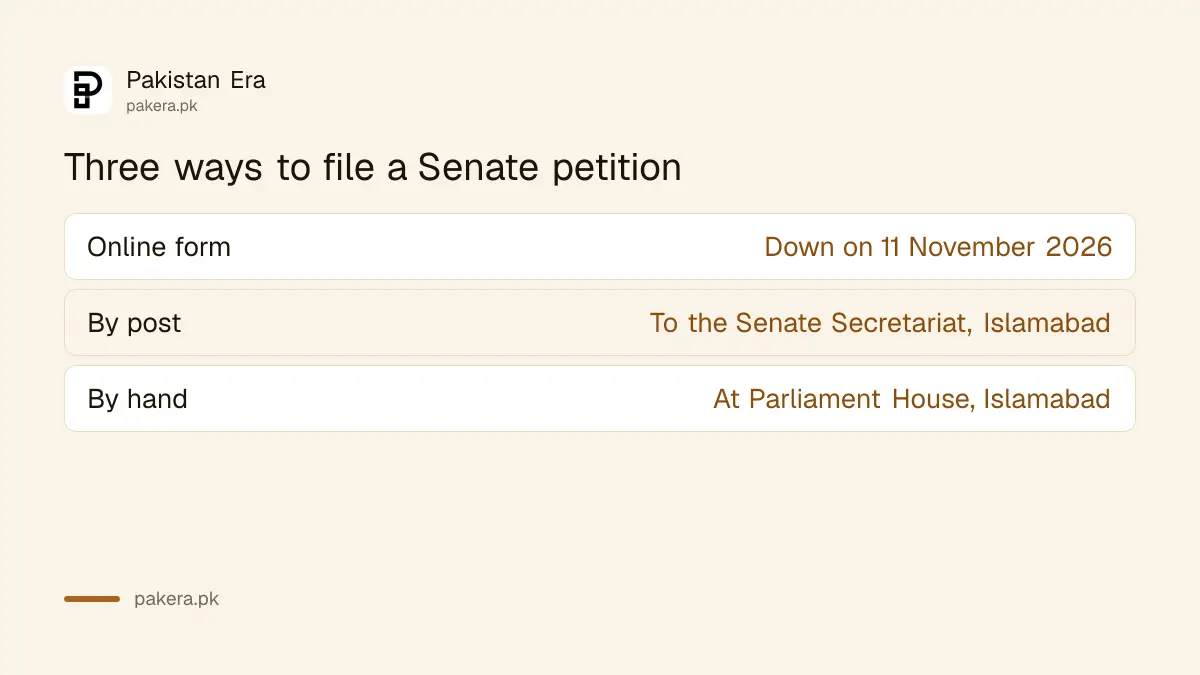
Rule 277(1) allows a petition to be filed online through the form on the Senate website, by post, or by hand at the Senate Secretariat. Online filing is not working this week: the Senate's "File a Petition" link went to a hosting "Account Suspended" page when we tried it on 10 and 11 November 2026.
| Route under Rule 277 | Status when we checked, 11 November 2026 | What you keep as proof |
|---|---|---|
| Online form on the Senate website | Not working: the petition address showed "Account Suspended" | Nothing, until it returns |
| By post to the Senate Secretariat | Available under the rule | Your courier or registered post receipt |
| By hand at the Senate Secretariat | Available under the rule | A stamped copy, if the counter will stamp one |
The "Track a Petition" link failed the same way, so you cannot check a tracking number online for now either. Ask for your number in writing when you file.
How to write and send a Senate petition by post or by hand
The rules do not prescribe a paper form, so a clear letter to the Chairman works. These are the steps we suggest, based on what Rule 277 asks for:
- Address it to "The Chairman, Senate of Pakistan, Senate Secretariat, Parliament House, Islamabad".
- Write "Public Petition under Rule 277" as the subject line.
- In the first paragraph, say which of the three things it is about: a bill, a committee's business, or a federal issue of public importance.
- Set out the facts in short numbered points, with dates, and attach copies of the papers that back them.
- Write your clear suggestion: what you want the Senate, a committee or a ministry to do.
- State that the matter is not before any court or tribunal.
- Sign it, and add your name, CNIC number, postal address, phone number and email for replies.
- Send it by registered post or courier, or hand it in at the Secretariat, and keep a full copy.
Our honest view: one page is better than five. The Chairman's office sees every petition that arrived in the past few days at each sitting, twice a week, so a petition that states its ask in the first five lines has the best chance.
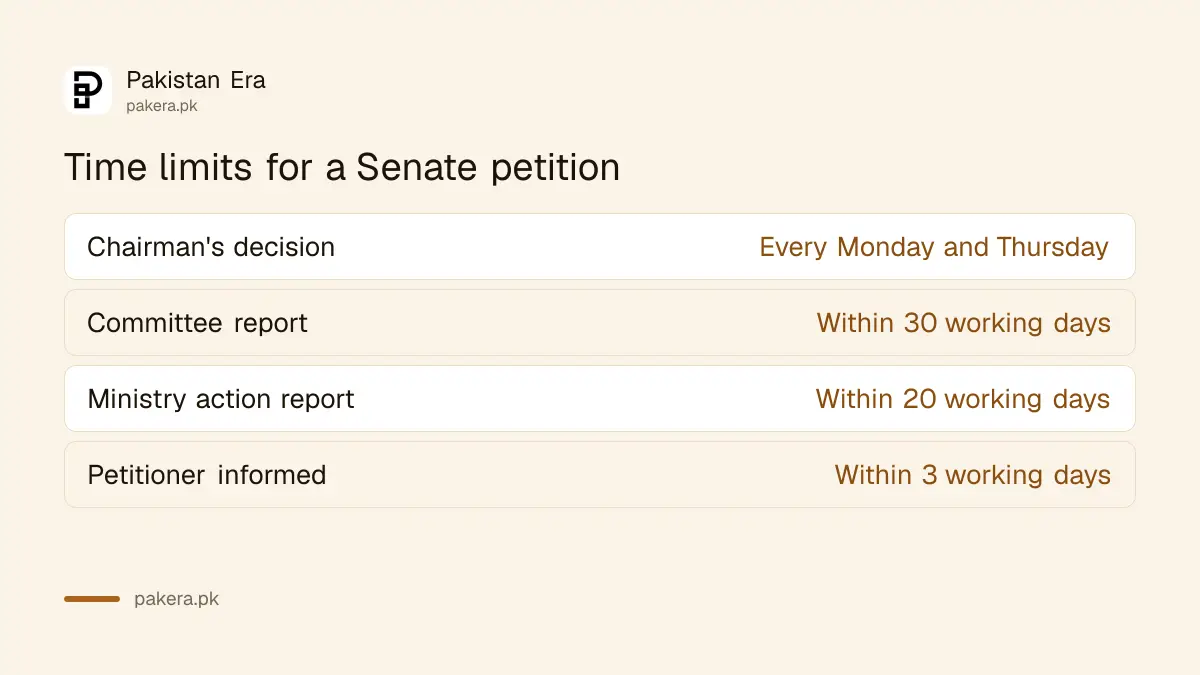
The Chairman decides every Monday and Thursday
Petitions received are put before the Chairman of the Senate every Monday and Thursday, under Rule 277(2). The Chairman decides whether each one is admissible and how it will be dealt with. The rules also let the Chairman decline or hold any petition he thinks is frivolous, vexatious or inappropriate.
Here is what can happen next, with the time limits the rule sets:
| Step | Time limit in Rule 277 |
|---|---|
| Chairman decides admissibility | Next Monday or Thursday after it arrives |
| Committee reports on a petition sent to it | Within 30 working days |
| Petition taken up in the House | In the next Senate session |
| Ministry reports action on a recommendation | Within 20 working days |
| Petitioner told of the action taken | Within 3 working days of completion |
A committee that considers a petition can issue observations or recommendations for changes in a system or regulation, and guidance for resolving the grievance in line with the law. The Secretary of the Senate also reads out a statement of petitions received and disposed of in each session.
Timing matters this month
The Senate was prorogued on 30 October 2026, so a petition meant for the floor of the House waits for the next session. Committees keep meeting between sessions, as several did on 10 November, listed in our report on the Senate committees of 10 November. A petition referred to a committee can move during the break.
When a petition is the wrong tool
A Senate petition is for public matters and wider problems. For a personal complaint against a federal department, the Wafaqi Mohtasib is usually faster and has its own deadlines, as set out in Wafaqi Mohtasib complaint status. For a complaint to almost any ministry, the Pakistan Citizen Portal is the routine route, covered in the Pakistan Citizen Portal complaint steps.
If your point is about a bill, it helps to know where that bill sits. Bills move from the National Assembly to the Senate and back, as set out in how a bill becomes law in Pakistan, and a petition is most useful while the bill is still in committee.
Common questions
Who can file a public petition in the Senate of Pakistan?
Any person, under Rule 277 of the Senate's rules. The petition goes to the Chairman of the Senate.
Can I file a Senate petition online?
The rule allows it, but on 10 and 11 November 2026 the Senate's petition address showed an "Account Suspended" page. File by post or by hand until it returns.
How long does a Senate committee take on a petition?
A committee must report on a petition sent to it within 30 working days, under Rule 277(2)(b).
Is there a fee for a Senate public petition?
Rule 277 does not mention any fee. Your only cost is postage or the trip to the Secretariat.
Can I petition the Senate about a case in court?
No. The Senate says a petition cannot be about a matter pending before a court, tribunal or quasi-judicial authority.
How will I know what happened to my petition?
The Secretariat gives each petition a tracking number, and the rule says the petitioner is told of the action within 3 working days of its completion.
Sources: Rules of Procedure and Conduct of Business in the Senate 2012 (version dated 6 June 2026, senate.gov.pk), Rule 277 and the public petition definition; Senate of Pakistan home page, public petitions box. Last checked 11 November 2026.
About the author

Global Affairs & Political Economy Writer
Muhammad Hatim is a book lover who started writing because he enjoys it. At Pakistan Era he writes about international relations, geopolitics and the global economy, with a particular interest in South Asia and the forces behind current events.