Electrical Fire at Home in Pakistan: What to Do When a Heater, Socket or Extension Board Catches Fire
Heater, socket or extension board on fire in Pakistan: switch off the main breaker, use CO2 or dry powder, never water. NDMA, LESCO and K-Electric rules.
If a heater, socket, extension board or wiring catches fire: switch off the main breaker, then use a CO2 or dry powder extinguisher. Never use water. That is the order NDMA's fire guidelines set for electrical (Class C) fires. If the fire spreads, or you cannot reach the breaker safely, get everyone out and call 1122 or 16.
Winter is when Pakistani homes run their heaviest loads on the thinnest wiring: an oil heater, a fan heater, an electric geyser and a kettle, often from one extension board. NDMA's Urban Fire Safety Guidelines of 16 March 2026 say overloaded wiring and loose connections cause fires. LESCO and K-Electric publish the habits that prevent them, which are set out below.
Switch off the mains first, then fight the fire
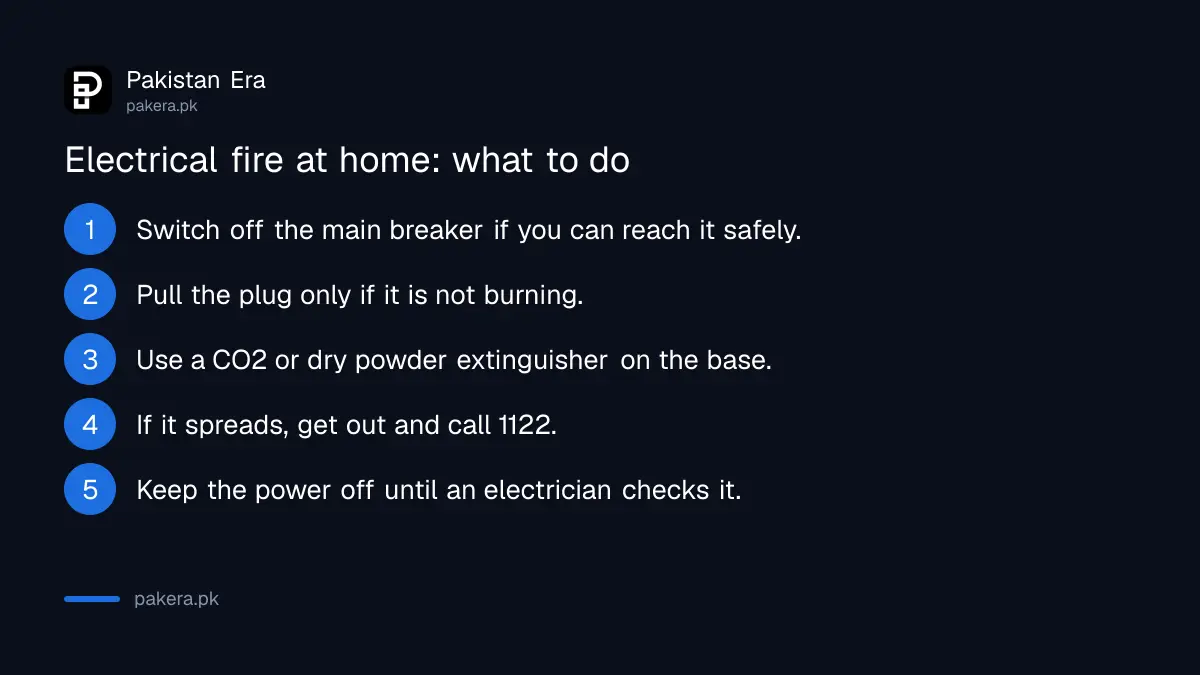
NDMA's first step for an electrical fire is to switch off the main electricity. With the power off, the fire becomes an ordinary fire and the risk of shock drops. Then use a CO2 or dry powder extinguisher on the base of the flames.
- Switch off the main breaker at the distribution board. If the board is next to the fire, do not reach past the flames.
- Pull the plug only if the plug and socket are not burning and your hands are dry. Otherwise leave it.
- Use a CO2 or dry powder extinguisher. Aim at the base of the flames and sweep side to side.
- Get out and call 1122 if the fire spreads to curtains, furniture or the wall.
- Keep the power off until an electrician has checked the circuit.
K-Electric's safety page tells households to know where the panel and circuit breakers are in case of an emergency, to label each breaker, and never to block access to the board. Find your main switch today, before you need it in the dark.
Water on an electrical fire can electrocute you
NDMA's Class C chart says "Never use water" and lists water and foam extinguishers as dangerous on electrical fires. Water conducts electricity, so a bucket thrown at a live heater can carry current straight back to the person holding it.
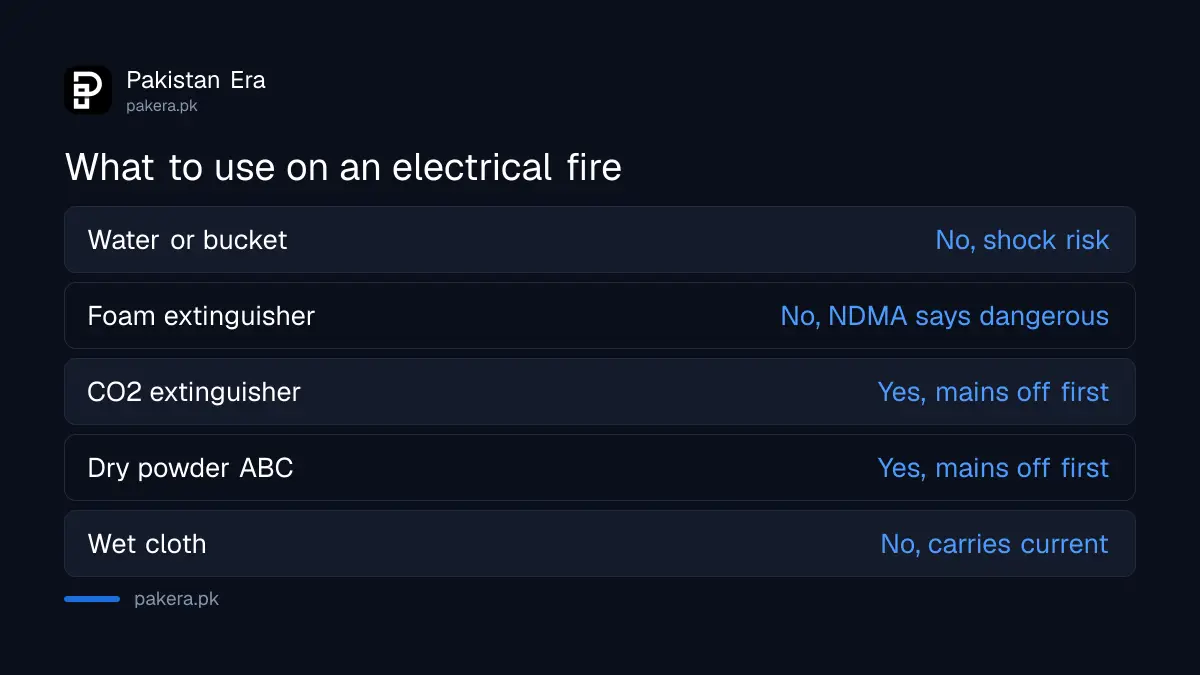
| Tool | On an electrical fire |
|---|---|
| Water or a bucket | No. Risk of electric shock |
| Foam extinguisher | No. NDMA lists foam as dangerous for Class C |
| CO2 extinguisher | Yes, after switching off the mains |
| Dry powder (ABC) | Yes, after switching off the mains |
| Wet cloth or blanket | No. It carries current while the power is on |
Once the breaker is off and the item is unplugged, a small fire in the casing behaves like an ordinary fire. Even then, NDMA's chart sticks to CO2 or dry powder for Class C, and that is the safer choice. If the fire grows, the escape plan is in NDMA's house fire rules.
Overloaded extension boards and heaters start most winter electrical fires
NDMA names overloaded wiring and loose connections as fire causes, and says not to overload sockets. A 2,000 watt heater and a kettle on one cheap extension board can heat its wires and plug until the plastic melts and sparks.
The warning signs come before the flames. Unplug and stop using the board if you see any of these:
- The plug, socket or board feels hot to the touch.
- A burning plastic smell near a socket.
- Brown or black marks around a socket hole.
- Sparks or crackling when you plug something in.
- Lights dim or flicker when the heater switches on.
- The breaker or fuse trips again and again.
K-Electric's guidance is to use extension cords rated for the amperage or wattage you are running, and to inspect cords and boards for damage before each use. It also warns that replacing a fuse with a larger one lets too much current through the wiring and can start a fire. A tripping breaker is a warning, not a fault to bypass.
For heater loads in watts, see which electric heater uses the least electricity.
LESCO and K-Electric set out the habits that prevent electrical fires
LESCO's safety guide tells consumers never to use bare wires for extensions, to always use proper plugs and switches, and to use the proper size fuse at each stage. K-Electric adds rules on halogen heaters, nails in cords and wet hands.
| Rule | Source |
|---|---|
| Never use bare wires for extensions; use proper plugs and switches | LESCO |
| Do not hang clothes on electricity cables | LESCO |
| Use the correct size fuse; a bigger one can start a fire | K-Electric, LESCO |
| Keep halogen heaters and lights away from curtains and cloth | K-Electric |
| Do not nail or staple cords; tape them instead | K-Electric |
| Never touch a switch board with wet hands | K-Electric |
| Do not overload sockets; switch off unused appliances | NDMA |
Drying clothes on a heater is the winter version of the LESCO rule. Keep a clear gap between any heater and curtains, quilts or clothes, and switch heaters off before sleeping. When buying a heater or cable, check the PSQCA mark, explained in checking a PSQCA licence for heaters and cables.
After an electrical fire, keep the circuit off until it is checked
Do not switch the breaker back on just because the flames are out. Heat may have damaged wires inside the wall. Get a qualified electrician to test the circuit, and replace the burnt socket, plug and board.
- Leave the main switch off for the affected circuit.
- Throw away the burnt extension board; do not repair it with tape.
- Ask the electrician to check the earth wire and breaker size.
- If the fire started at the meter or the pole, report it to your power company, as covered in reporting sparking wires and poles.
A bigger fire may need full rewiring and a test report. That process is set out in rewiring a house after a fire.
Common questions
Can I throw water on a burning heater or socket?
No. NDMA says never use water on an electrical fire. Water conducts electricity and can give you a shock. Switch off the mains and use a CO2 or dry powder extinguisher.
What do I do if the extension board is sparking?
Switch off the main breaker, then unplug the board once it is safe. Do not use it again. Sparks mean overload, a loose connection or damage.
Why does my breaker keep tripping when the heater is on?
The circuit is carrying more current than it is rated for, or there is a fault. Do not fit a bigger breaker or fuse; K-Electric warns that can start a fire. Ask an electrician to check it.
Is it safe to run a heater from an extension board?
Only if the board is rated for the heater's wattage, is undamaged, and has nothing else heavy plugged in. A wall socket is safer for a heater.
Which extinguisher works on an electrical fire?
NDMA names CO2 or dry powder for Class C fires, used after switching off the main electricity.
Who do I call for an electrical fire?
Call 1122 or 16 for the fire. For a fault at the meter, pole or service cable, call your electricity company's complaint line.
How we verified this
What we checked and where we read it.
We checked the NDMA Urban Fire Safety Guidelines, dated 16 March 2026, on the NDMA guidelines page on 25 November 2026 (Class C: switch off main electricity, never use water, use CO2 or dry powder, maintain safe wiring, do not overload sockets, overloaded wiring and loose connections cause fires). Household rules come from the K-Electric electrical safety page and the LESCO safety guide on lesco.gov.pk, both read on 25 November 2026. Last checked 25 November 2026.
Free on WhatsApp
Get last dates and rule changes on WhatsApp
We post new last dates, fee changes and fixes for common problems, a few short posts a day.
Follow Pakera on WhatsAppOther followers cannot see your number.
Pakera Solves It
Which online process wasted your time this week?
A portal that will not load, a form nobody explains, a complaint that went nowhere. Tell us. Every week we pick one, solve it step by step and publish the answer.
About the author

Lifestyle & Clothing Writer
Mahnoor Siddiqui is a lifestyle and clothing writer at Pakistan Era, joining the new lifestyle desk in November 2026.