Languages Spoken in Pakistan: Mother Tongue by Province, Census 2023
Punjabi is the mother tongue of 36.98% of Pakistanis, Pashto 18.15%, Urdu 9.25%. See every language in the 2023 census, each province, Karachi and Lahore.
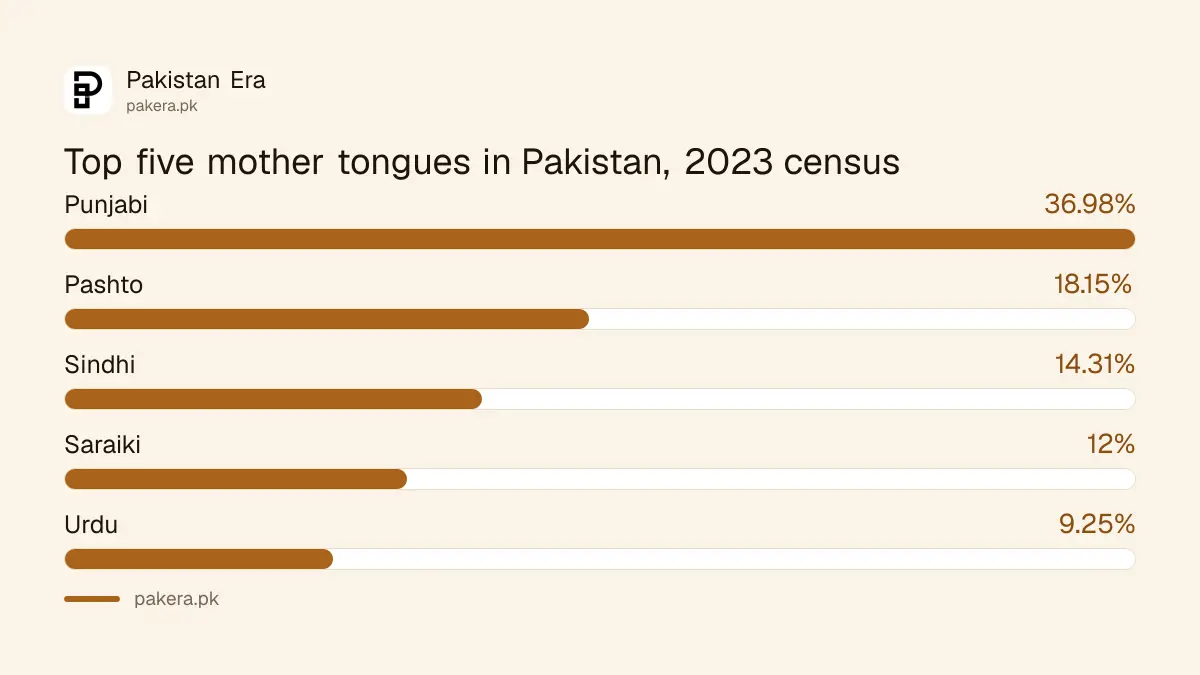
Punjabi is the most common mother tongue in Pakistan, spoken at home by 88.92 million people, or 36.98 per cent, in the 2023 census. Pashto is second at 18.15 per cent, then Sindhi at 14.31, Saraiki at 12.00 and Urdu at 9.25. Urdu grew fastest: 22.25 million people gave it as their mother tongue, up from 14.71 million in 2017.
We went through the Pakistan Bureau of Statistics (PBS) mother tongue tables for every province, plus the district tables for Karachi and Lahore. Below is the national list, each province, the two biggest cities and where each language is spoken.
| Mother tongue | Speakers, 2023 | Share 2023 | Share 2017 |
|---|---|---|---|
| Punjabi | 88,915,544 | 36.98% | 38.78% |
| Pashto | 43,633,946 | 18.15% | 18.24% |
| Sindhi | 34,401,564 | 14.31% | 14.57% |
| Saraiki | 28,849,579 | 12.00% | 12.19% |
| Urdu | 22,249,307 | 9.25% | 7.08% |
| Balochi | 8,117,795 | 3.38% | 3.02% |
| Hindko | 5,590,559 | 2.32% | 2.44% |
| Brahvi | 2,778,670 | 1.16% | 1.24% |
| Mewati | 1,094,219 | 0.46% | Not asked |
| Kohistani | 1,039,007 | 0.43% | Not asked |
| Kashmiri | 274,080 | 0.11% | 0.17% |
| Shina | 116,951 | 0.05% | Not asked |
| Balti | 52,134 | 0.02% | Not asked |
| Kalasha | 7,466 | 0.003% | Not asked |
| Others | 3,337,268 | 1.39% | 2.26% |
Punjabi, Pashto and Sindhi are the top three mother tongues
Punjabi, Pashto and Sindhi together are the mother tongue of 69 per cent of Pakistanis. Punjabi's share fell from 38.78 per cent in 2017 to 36.98 per cent, even though the number of speakers rose by 8.4 million. Pashto and Sindhi held almost steady.
The census asks for mother tongue, the language a person speaks at home. Urdu is the national language and most people understand it, but only 9.25 per cent named it as their own first language.
Urdu speakers rose by 51 per cent in six years
The number of people giving Urdu as their mother tongue went from 14.71 million in 2017 to 22.25 million in 2023. That is a rise of 51 per cent, by our arithmetic, against about 16 per cent growth for the population as a whole. Urdu's share rose from 7.08 to 9.25 per cent.
Urdu is mainly a city language. It is the mother tongue of 21.50 per cent of people in urban areas and only 1.51 per cent in villages. More than half of all Urdu speakers, 55.8 per cent, live in Sindh, and most of those are in Karachi.
Each province has one main language, with big minorities
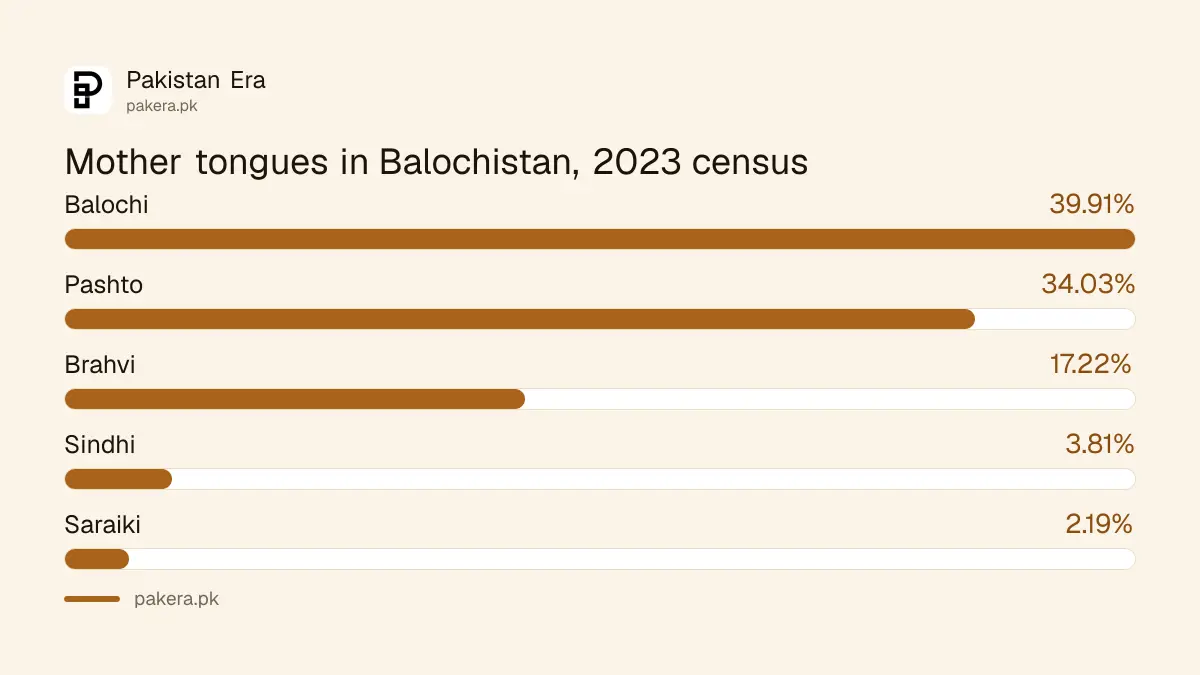
Every province has a clear majority language, but each also has a large second one. In Punjab, one in five people speaks Saraiki. In Sindh, more than one in five speaks Urdu. Balochistan is the most evenly split: Balochi 39.91 per cent, Pashto 34.03 and Brahvi 17.22.
| Area | First language | Second | Third |
|---|---|---|---|
| Punjab | Punjabi 67.00% | Saraiki 20.64% | Urdu 7.18% |
| Sindh | Sindhi 60.14% | Urdu 22.30% | Pashto 5.31% |
| Khyber Pakhtunkhwa | Pashto 81.00% | Hindko 9.39% | Saraiki 3.17% |
| Balochistan | Balochi 39.91% | Pashto 34.03% | Brahvi 17.22% |
| Islamabad | Punjabi 50.57% | Pashto 18.21% | Urdu 15.72% |
Half of Karachi speaks Urdu at home, three quarters of Lahore speaks Punjabi
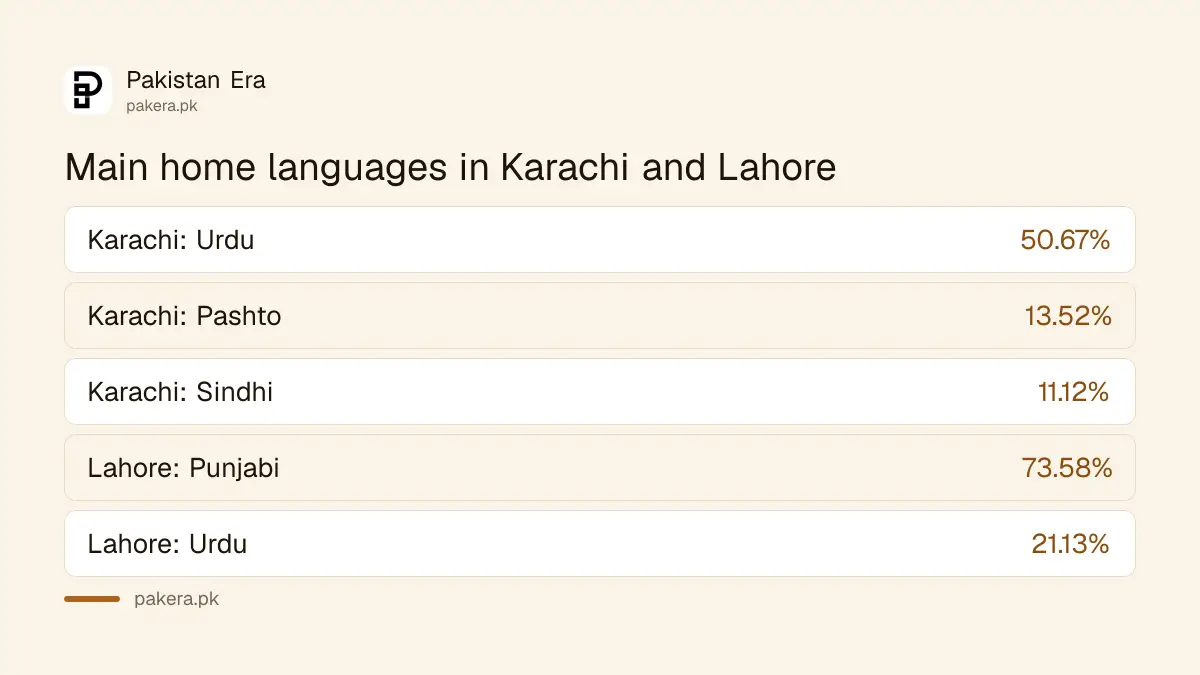
We added up Karachi's seven districts. Of 20.36 million people, 10.32 million, or 50.67 per cent, gave Urdu as their mother tongue. Pashto is second at 13.52 per cent, ahead of Sindhi at 11.12 per cent. Karachi has 2.75 million Pashto speakers, more than the whole of Punjab (2.39 million).
| Mother tongue | Karachi (7 districts) | Lahore district |
|---|---|---|
| Urdu | 50.67% | 21.13% |
| Punjabi | 8.08% | 73.58% |
| Pashto | 13.52% | 2.06% |
| Sindhi | 11.12% | 0.21% |
| Balochi | 3.97% | 0.03% |
| Saraiki | 3.70% | 0.48% |
| Hindko | 3.21% | 0.25% |
| Mewati | 0.15% | 2.01% |
In Lahore, 73.58 per cent speak Punjabi at home and 21.13 per cent Urdu. Lahore also has 260,544 Mewati speakers, a language counted for the first time in 2023.
Five languages were counted for the first time
The 2023 census added Mewati, Kohistani, Shina, Balti and Kalasha to the form. Before that, their speakers were counted under "Others", which is why "Others" fell from 2.26 to 1.39 per cent.
- Mewati, 1.09 million speakers, almost all in Punjab (94.7 per cent).
- Kohistani, 1.04 million, 95.9 per cent in Khyber Pakhtunkhwa.
- Shina, 116,951, 60 per cent of them in Khyber Pakhtunkhwa.
- Balti, 52,134, with the largest groups in Sindh and Punjab.
- Kalasha, 7,466, most of them in Khyber Pakhtunkhwa.
Gilgit-Baltistan and Azad Kashmir are not part of these census tables, so the counts of Shina, Balti and Kashmiri speakers cover only people living in the four provinces and Islamabad.
For typing in Urdu on a phone, the Urdu keyboard setup and free Urdu voice typing pages cover the steps. To read other languages, you can download Google Translate languages for offline use.
Common questions
What is the most spoken language in Pakistan?
Punjabi, the mother tongue of 88.92 million people, or 36.98 per cent, in the 2023 census.
What percentage of Pakistanis speak Urdu as their mother tongue?
9.25 per cent, or 22.25 million people. Urdu is the national language and is widely understood as a second language.
How many people speak Pashto in Pakistan?
43.63 million, or 18.15 per cent. About 75 per cent of them live in Khyber Pakhtunkhwa.
How many people speak Saraiki?
28.85 million, or 12.00 per cent. 91 per cent of Saraiki speakers live in Punjab.
What languages are spoken in Balochistan?
Balochi (39.91 per cent), Pashto (34.03), Brahvi (17.22), Sindhi (3.81) and Saraiki (2.19) are the five largest.
What language do most people speak in Karachi?
Urdu, for 50.67 per cent of people in Karachi's seven districts. Pashto (13.52 per cent) and Sindhi (11.12) come next.
How we verified this
What we checked and where we read it.
We checked these figures on 25 November 2026 in the PBS census page: the National Census Report 2023, section 4.3.2 and Table 4.14 (2017 and 2023 national figures), and census Table 11 (population by mother tongue, sex and rural/urban) for each province, Islamabad and the Sindh and Punjab districts. Our provincial figures add up exactly to the national totals in Table 4.14.
Provincial shares, Karachi's combined figures and each language's share by province are our own arithmetic. The report text gives Hindko as 2.69 per cent, but its own table gives 2.32 per cent for all areas (2.69 is the rural figure), so we use 2.32. The population growth figure compares the 2023 total with the 2017 total in the same report.
Free on WhatsApp
Get last dates and rule changes on WhatsApp
We post new last dates, fee changes and fixes for common problems, a few short posts a day.
Follow Pakera on WhatsAppOther followers cannot see your number.
Pakera Solves It
Which online process wasted your time this week?
A portal that will not load, a form nobody explains, a complaint that went nowhere. Tell us. Every week we pick one, solve it step by step and publish the answer.
About the author
Senior Writer, Public Services and Technology
Shahid joined us in 2024 as an author. He is a senior contributor to Pakistan's leading technology websites. He writes detailed articles, mostly covering his expertise in the latest tech, mobiles, apps, gadgets, and step-by-step guides. His ideology is to help people understand the latest trends and explain complex methods through very easy-to-understand guides.