How to Report a Fallen Wire, Sparking Pole or Low Voltage in Pakistan
Fallen wire, sparking pole or low voltage in Pakistan? NEPRA says leakage is fixed first and complaint offices run 24 hours. See which faults to report and how.
If a wire is down, a pole is sparking or current is leaking from a pole, report it to your electricity company at once. NEPRA's Consumer Service Manual puts current leakage first in the order of repair. The company's complaint centre must work round the clock, even on holidays.
Low voltage, a leaning pole or a branch on a live line looks like an ordinary nuisance. Some of them kill. The manual that every distribution company in Pakistan must follow lists exactly which faults to report and in what order the company must fix them.
We read chapters 10 and 12 of NEPRA's revised Consumer Service Manual on 7 October 2026. This is what a power company owes you when the fault is on its network, and what you owe in return.
Report these faults the moment you see them
Clause 12.4.1 lists hazards that must be reported to the company immediately. Any neighbour can report them, not only the person whose meter is nearest. The list is longer than most people expect.
| What you see | Clause |
|---|---|
| Broken strands, fallen wires or a wire hanging low | 12.4.1(c) |
| A leaning or damaged pole, or a loose stay wire | 12.4.1(e), (g) |
| Wires sagging unevenly or too close to the ground | 12.4.1(d) |
| Tree branches touching overhead wires | 12.4.1(f) |
| A damaged transformer structure, including oil leaking | 12.4.1(i) |
| A tingle or shock when you touch a pole or its structure | 12.4.1(j) |
| New roads, buildings or balconies close to or under a line | 12.4.1(h) |
Clause 12.4.1(j) calls the shock case "leakage of currents in poles and other structures". If you feel a tingle from a pole, a shutter or a metal gate near it, stay away and call.
Current leakage gets fixed first
Clause 10.4.2 gives the order in which the company must attend complaints. Leakage of current comes first and is to be dealt with immediately. Collective complaints from many consumers come next, then individual ones.
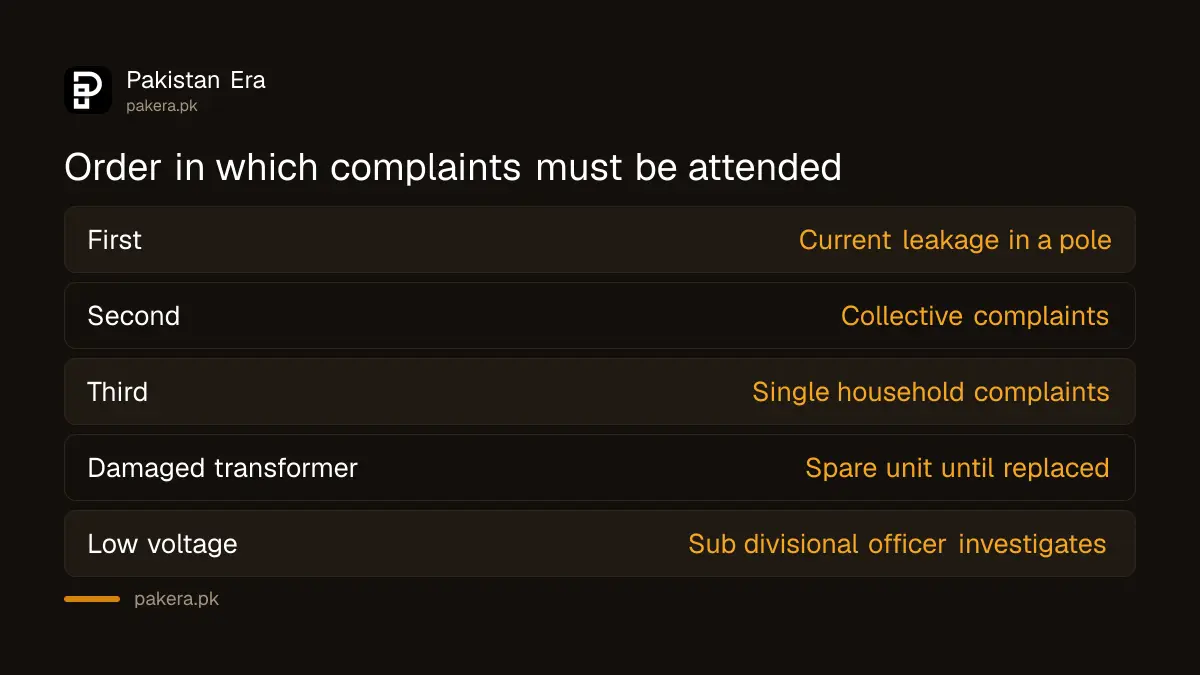
That order explains a common frustration. A single house with a tripping fuse waits behind a pole that shocks people. It is a safety order, not a favour. You can still ask for the time limits that apply to your fault, and those are the service deadlines NEPRA set for every electricity company. They are separate from this order, so use both.
Clause 10.4.2(d) adds a rule for a damaged transformer. The company must restore supply through a trolley mounted or spare transformer until the damaged one is replaced, and try to feed the affected homes from another source.
Low voltage is a complaint the company must investigate
Low voltage and poor quality supply are named in clause 10.4.1 as complaints the company must take. Clause 10.4.2(g) says the sub divisional officer investigates them and takes steps to improve the voltage. The stated reason is to reduce the chance of damage to your appliances.
Fridges, air conditioners and pumps suffer most. A compressor that hums and fails to start is a typical sign. Write down the dates and times, and the readings if you own a plug in voltage meter. Voltage that stays low across a whole lane points to the transformer or the feeder, not to your wiring.
The 2026 performance regulations also set a clock for voltage fluctuation, which is 24 hours when no network work is needed. The compensation part of those regulations does not start for two years, as the deadlines page explains.
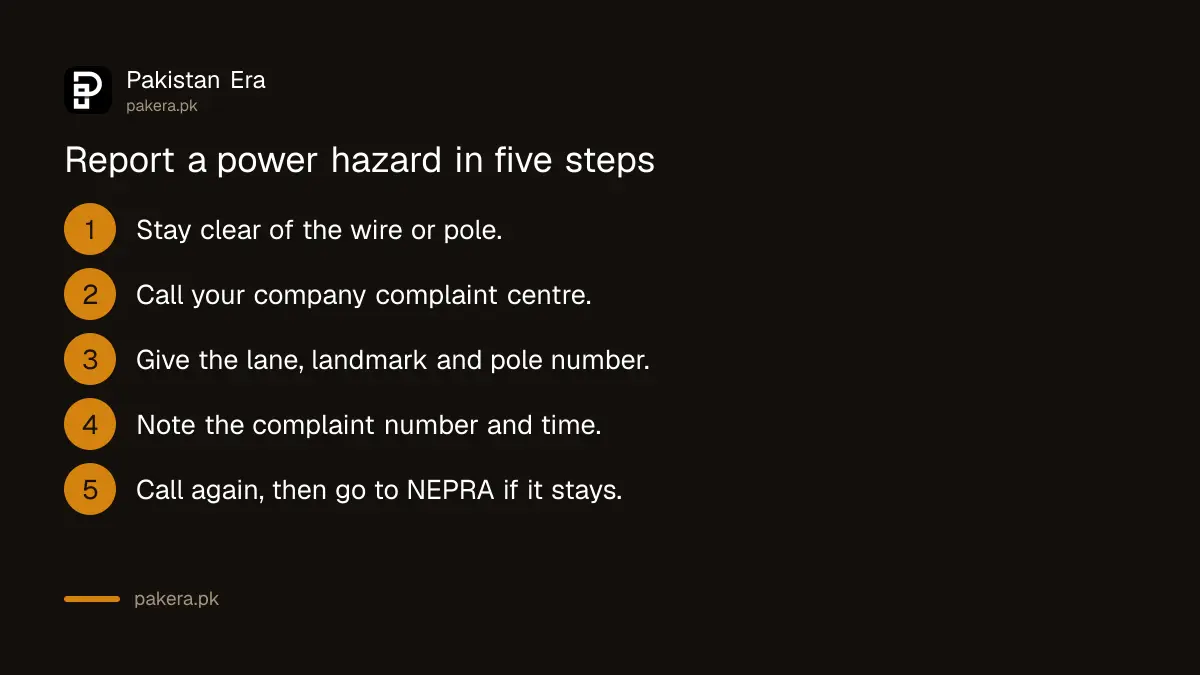
Report a power hazard in five steps
- Stay clear. Keep people and animals away from any fallen wire or leaking pole. Do not touch it, even with a dry stick.
- Call your company's complaint centre. The manual says complaint offices must work 24 hours, including holidays (clause 10.4.4). The common helpline for a complaint to your electricity company or NEPRA is 118. In Karachi the steps for a K-Electric complaint through 118 are the same.
- Give the exact place. Name the lane, a landmark and the number on the pole or transformer if you can read it. This is our own advice, not a manual rule, but it saves the crew time.
- Write down the complaint number. Note the time of the call and the name of the person who took it.
- Call again if no one comes. Then take the complaint number to the sub division office and to NEPRA if the fault is dangerous and still there.
Your own wiring is your responsibility
The manual puts safety inside your boundary wall on you. Clause 12.3 says even small installations must be done by competent engineers or authorised wiring contractors, and inspected and certified by an Electric Inspector. Clause 12.3.4 bars other repairs, apart from changing lamps, fans, fuses and switches.
- After a fire or short circuit you must give the company a fresh wiring test report before rewiring (12.3.8).
- You may not build or extend a building under or near a line (12.3.7). The company can issue a notice, and the local building authority is the one that demolishes (12.4.9).
- Metal or chemical kite string is dangerous and the manual says it must not be used (12.4.5).
- Do not tie animals to poles, structures or stay wires (12.4.8).
- Use RCDs, also called earth leakage breakers, in wet places and for wedding or event wiring (12.4.2 and 12.4.3). A temporary connection for a wedding needs the same care.
If a person dies in an electrical accident, clause 12.3.5 requires an immediate report to the nearest police station and to the company's complaint centre. Breaking these rules can lead to disconnection and legal action (12.3.6).
If the fault stays, go above the sub division
The manual does not give a separate appeal for supply faults. Clause 15.1.3 lets any consumer send NEPRA a written complaint when a company breaks the Act or a NEPRA instruction. Clause 15.1.4 covers billing and disconnection. For service faults, keep the company complaint number and take it to NEPRA. A complaint to the Wafaqi Mohtasib is the other option.
If a billing problem follows the fault, such as a jump after a long outage, you can check your meter reading against the bill snapshot.
Common questions
Who do I call about a fallen electricity wire in Pakistan?
Call your company's complaint centre, which must work 24 hours a day. The common helpline is 118, and keep the complaint number.
Which electricity complaint is fixed first?
Leakage of current in a pole or structure. Clause 10.4.2 puts it first, then collective complaints, then individual ones.
Can I complain about low voltage?
Yes. Clause 10.4.1(j) lists low voltage as a supply complaint, and the sub divisional officer must investigate and improve the voltage.
What if a transformer burns out?
The company must restore supply through a trolley mounted or spare transformer until it replaces the damaged one, under clause 10.4.2(d).
Can I trim a tree touching electric wires myself?
No. Report it. The manual lists tree branches on lines as a hazard for the company to handle, and trimming near a live wire is dangerous.
Do I report a fatal electric shock to the police?
Yes. Clause 12.3.5 says to report it at once to the nearest police station and to the company's complaint centre.
How we verified this
What we checked, where we read it, and what we could not confirm.
Last checked on 7 October 2026. We read NEPRA's revised Consumer Service Manual, issued to all distribution companies on 26 November 2025, as published on GEPCO's website: clauses 10.4, 12.2 to 12.4 and 15.1. The 24 hour voltage figure comes from our reading of NEPRA's 2026 performance regulations, explained in the deadlines page linked above. We did not call any helpline or report a hazard ourselves, and response times in practice vary by company and area. In an emergency, keep away from the hazard and call your company at once.
About the author

Tax, Bills and Technology Writer
Ali Akhtar is a young and curious voice here at Pakistan Era. He is currently pursuing his A-Levels and has a growing interest in Pakistan’s changing industrial landscape and educational trends. Ali likes to write in a way that helps him explain and explore the world around him. His writing reflects the perspective of the new generation navigating the evolving trends of Pakistan where technology, youth innovation, and shifting opportunities are reshaping the country’s future.