Electricity Bill Instalments in Pakistan: NEPRA's 14% Markup Rule, the Free First Instalment and Due Date Extension
Can you pay an electricity bill in instalments in Pakistan? NEPRA's rule: no markup on the first part paid on time, 14% a year after. Steps and an example.
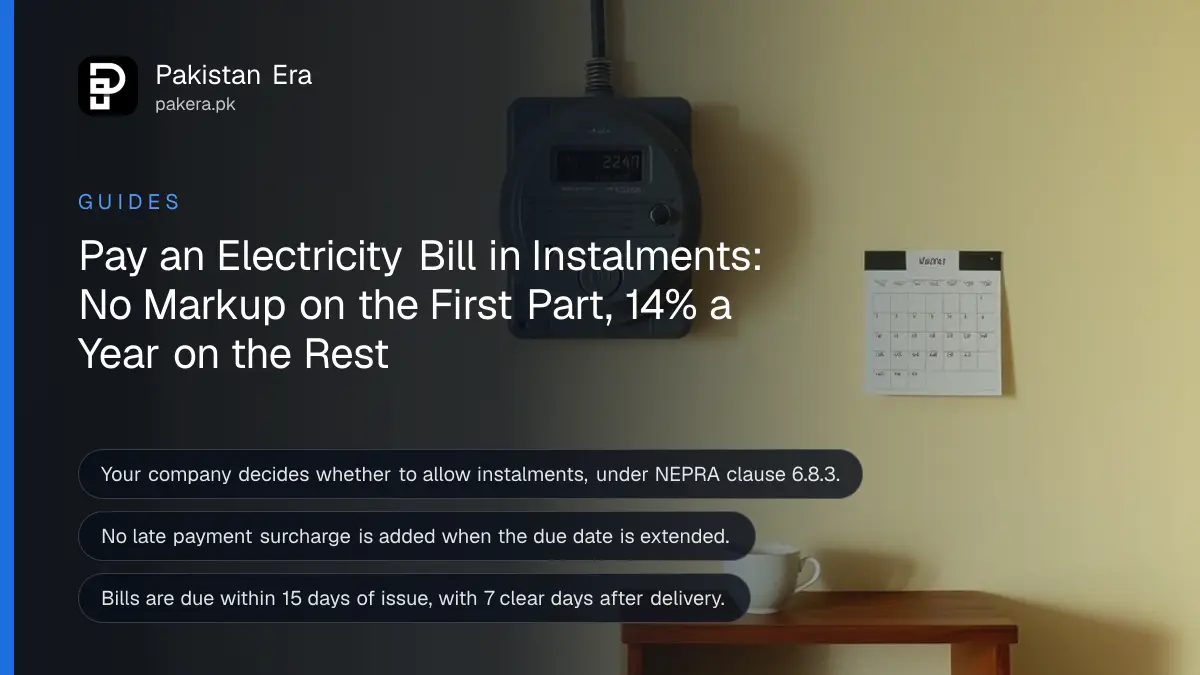
Yes, you can ask to pay an electricity bill in instalments in Pakistan, but your company decides whether to allow it. If it agrees, NEPRA's rule is simple: no markup and no late payment surcharge on the first instalment if you pay it by the due date, then 14% a year markup, worked out pro rata, on the rest. A due date extension also stops the late payment surcharge.
These rules are in the Consumer Service Manual, the rule book NEPRA (the power regulator) sent to all 11 government power companies and K-Electric on 26 November 2025. We read the manual's billing chapter on 12 November 2026. Below are the exact rules, a worked example, the steps to ask, and what the manual does not promise.
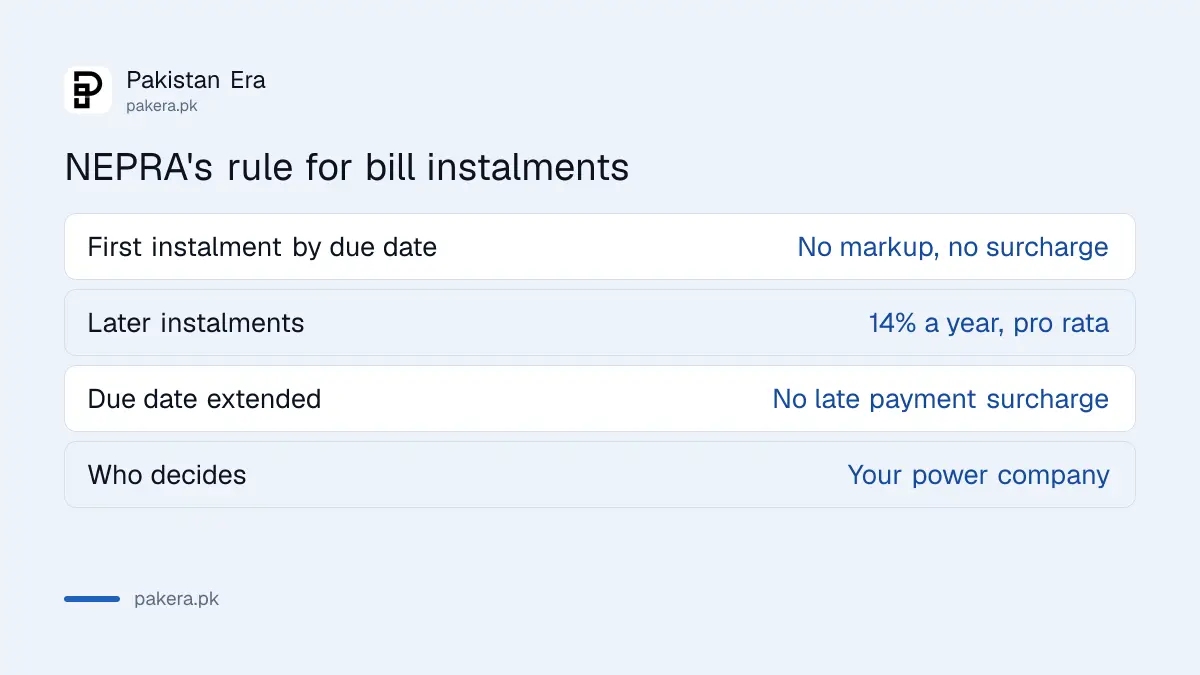
NEPRA lets companies split a bill, with 14% markup after the first part
Clause 6.8.2 of the manual covers a request to split the current month's bill. The first instalment carries no markup and no surcharge if you pay it within the due date. The remaining instalments carry markup at 14% a year, charged pro rata, which means only for the time each part is outstanding.
| Clause | What it says, in plain words |
|---|---|
| 6.8.1 | No late payment surcharge where the due date is extended. |
| 6.8.2 (a) | No markup or surcharge if the first instalment is paid by the due date. |
| 6.8.2 (b) | Remaining instalments carry 14% a year markup, pro rata. |
| 6.8.3 | Companies may offer instalments and extensions "as per their business requirements". |
| 6.8.4 | The company must issue computerised bills for the instalments. |
Clause 6.8.3 is the catch. It says companies "may" offer instalments and extensions. So an instalment is something you request, not something you can demand. Ask early, before the due date, and keep the bill clean of old arrears if you can.
A Rs 30,000 bill in three parts costs about Rs 350 extra
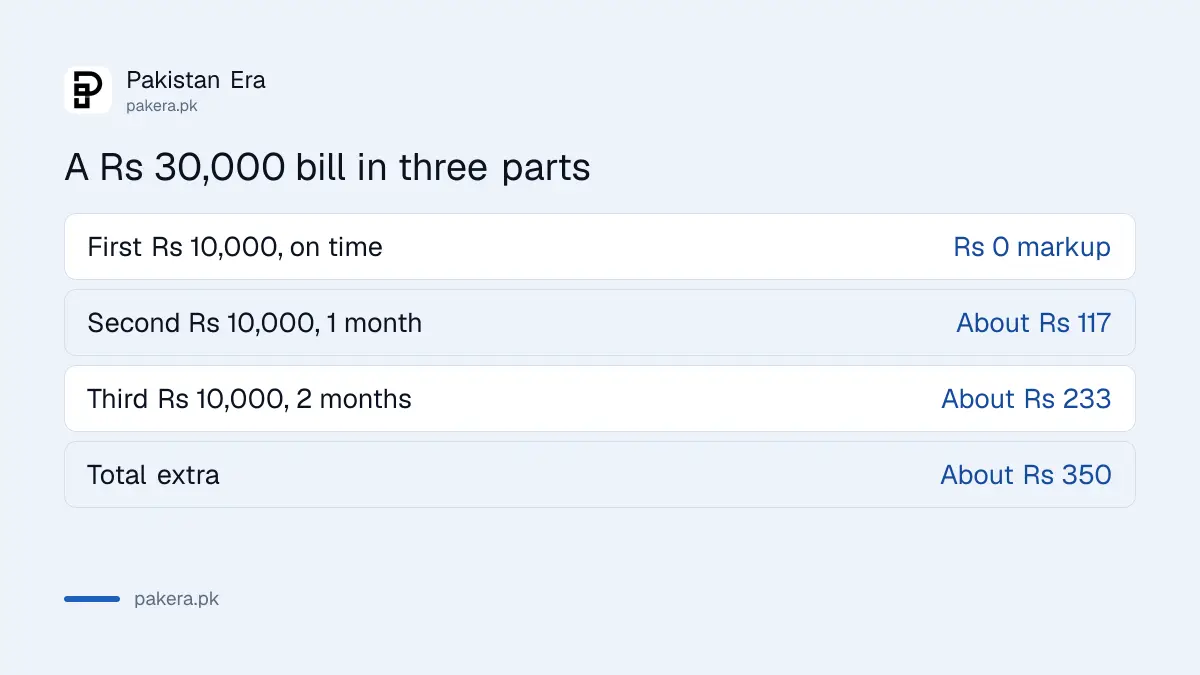
Take a Rs 30,000 bill split into three equal monthly parts of Rs 10,000. The first Rs 10,000 is paid by the due date, so it costs nothing extra. The second part is outstanding for about one month and the third for about two, at 14% a year.
| Part | Amount | Time outstanding | Markup at 14% a year |
|---|---|---|---|
| First instalment | Rs 10,000 | Paid by due date | Rs 0 |
| Second instalment | Rs 10,000 | About 1 month | About Rs 117 |
| Third instalment | Rs 10,000 | About 2 months | About Rs 233 |
| Total | Rs 30,000 | About Rs 350 |
That is our arithmetic, not a company quote. Your company sets the number of parts and the dates on the computerised instalment bills. The late payment surcharge, by contrast, is a percentage of the whole bill, printed on the bill itself. Check that line on your own bill: on a large bill it is usually far more than this markup.
Your bill is due 15 days after issue, with 7 clear days
The manual sets the due date within 15 days of the bill's issue date. You also get at least 7 clear days from the day the bill actually reaches you. If the due date falls on a holiday, it moves to the next working day.
That 7 day rule matters when a bill arrives late. If the bill reaches you two days before the printed due date, you can point to the 7 clear days when you ask for an extension. Paying by cheque, pay order or bank draft? The manual says to deposit it at least three days before the due date so it clears in time.
Want to know when your next bill is due? Our LESCO billing schedule for November lists reading and due dates by batch, and you can check any bill online with our bill check guide for every company.
How to ask for instalments or a due date extension
Ask before the due date at the revenue office named on your bill, or through your company's app if it offers the service. MEPCO's app, for example, lists both "Request for installment" and "Due Date Extension". Take your bill and CNIC.
- Do it before the due date. After it passes, the surcharge is already on the bill.
- Take the original bill and your CNIC to the revenue office of your sub-division.
- Ask either for an extension of the due date or for instalments, and write a short application if the office asks.
- If instalments are allowed, collect the computerised instalment bills (clause 6.8.4) and pay the first one by the due date.
- Pay the later instalments by the dates printed on them. Keep every paid receipt.
For MEPCO customers, our MEPCO Smart app guide shows the app route. If the office refuses and you think the bill is wrong rather than just high, file a bill complaint instead, inside the deadlines in our bill complaint deadlines page.
Instalments also appear in three other places
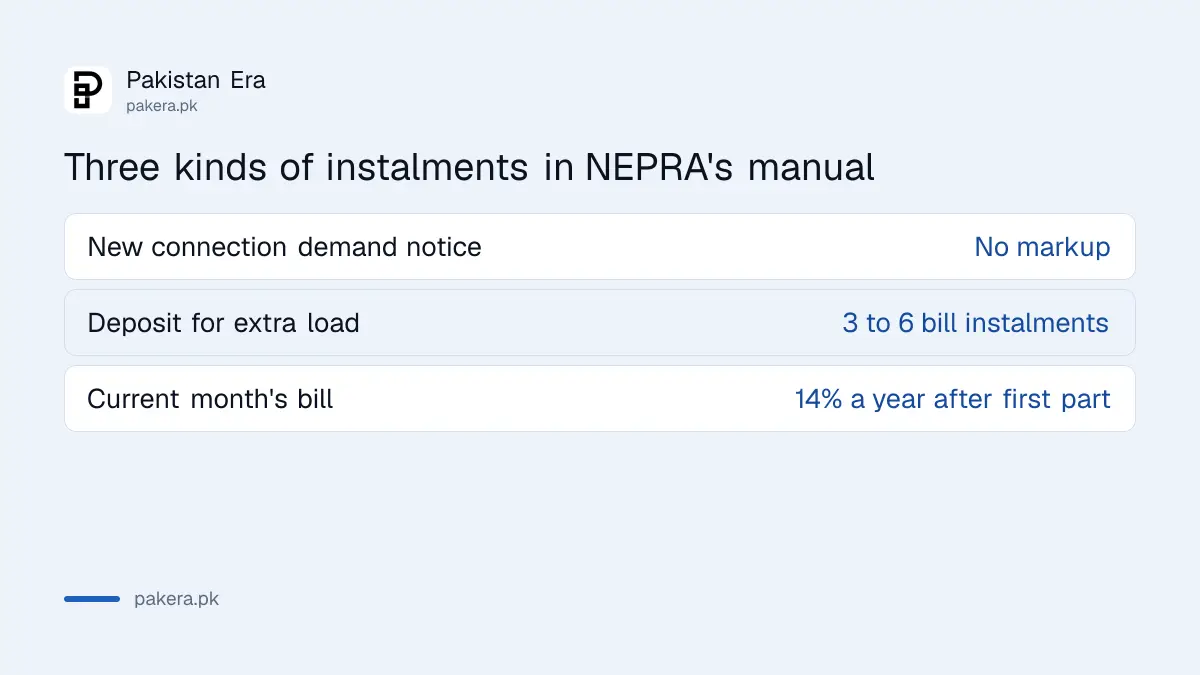
The word instalment shows up elsewhere in the manual, and each has its own terms. Do not mix them up with a bill split.
| Situation | Clause | Terms |
|---|---|---|
| New connection demand notice | 2.4 | May be paid in instalments on request, with no markup. |
| Security deposit for extra load found on your meter | 2.14 and 5.2.3 | Recovered through bills in 3 to 6 instalments. |
| Current month's bill | 6.8.2 | First part free of markup, rest at 14% a year. |
One more link: several applications, such as a load change or a change of tariff, ask for your last paid bill "with no arrears, deferred amount or instalments pending". So an open instalment plan can hold up other paperwork until it is cleared.
Unpaid bills still lead to disconnection notices
An instalment plan protects you only while you keep to it. If a bill stays unpaid, the company can move to disconnection after a notice, and reconnection then needs the dues cleared. Our page on the seven day disconnection notice explains the steps the company must follow first.
Common questions
Can I pay my electricity bill in instalments in Pakistan?
You can ask. NEPRA's manual lets companies allow instalments "as per their business requirements", so the company decides. If it agrees, the first instalment paid by the due date carries no markup.
How much markup is charged on electricity bill instalments?
14% a year, charged pro rata on the instalments after the first. On a Rs 30,000 bill split into three monthly parts, that works out to about Rs 350.
Is a late payment surcharge added if my due date is extended?
No. Clause 6.8.1 says the surcharge is not imposed where the due date is extended.
How many days do I get to pay an electricity bill?
The due date is within 15 days of the issue date, and you get at least 7 clear days from the day the bill reaches you.
Where do I apply for electricity bill instalments?
At the revenue office of your sub-division, shown on your bill, or in your company's app if it has the option, as MEPCO's does.
Does this apply to K-Electric?
NEPRA sent the same manual to K-Electric and told it to publish it. K-Electric may word its own process differently, so ask at its customer centre.
What we checked and sources
We read NEPRA's updated Consumer Service Manual, sent under a NEPRA letter dated 26 November 2025, on 12 November 2026: clauses 2.4, 2.14, 5.2.3, 6.5, 6.7.2 and 6.8. The Rs 30,000 example is our arithmetic. We did not apply for instalments ourselves, and no company page we read lists its own limits on the number of parts. Last checked 12 November 2026.
About the author

Tax, Bills and Technology Writer
Ali Akhtar is a young and curious voice here at Pakistan Era. He is currently pursuing his A-Levels and has a growing interest in Pakistan’s changing industrial landscape and educational trends. Ali likes to write in a way that helps him explain and explore the world around him. His writing reflects the perspective of the new generation navigating the evolving trends of Pakistan where technology, youth innovation, and shifting opportunities are reshaping the country’s future.