Pakistan Proposes Capping Electricity Fuel Charge Rise at Rs 0.83 a Unit for October to December 2026
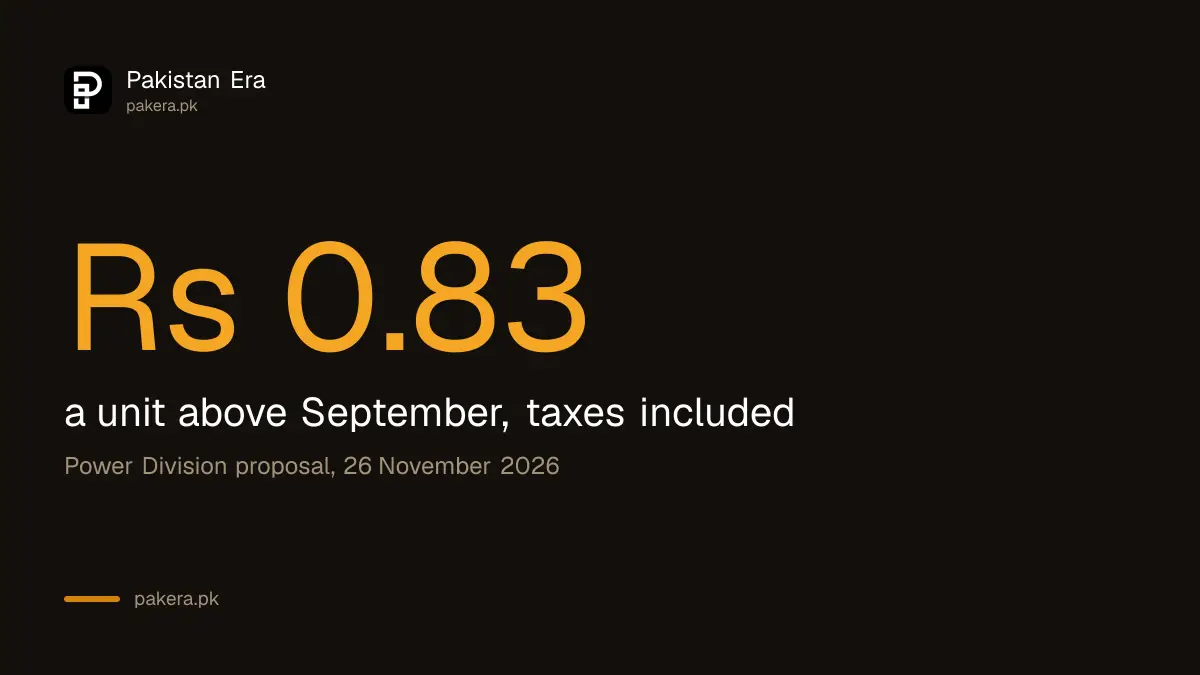
Pakistan plans to hold the electricity fuel charge rise to about Rs 0.83 a unit, taxes included, for October to December 2026. What it adds to 100 to 500 units.
یہ صفحہ اردو میں پڑھیں
Short answer: The federal Power Division has proposed holding the rise in the fuel charge on electricity bills to about Rs 0.83 a unit, taxes included, for October, November and December 2026. The cap is measured against the September 2026 fuel charge. It is a proposal: it needs government approval, and then policy guidelines to NEPRA, before it changes any bill.
The Power Division announced the plan in a statement on Thursday 26 November 2026. The same afternoon, NEPRA held its hearing on a request for a fuel charge of Rs 2.8819 a unit for October, which would show on December bills.
The Power Division wants a forward-looking fuel charge
The Power Division calls the plan a Forward-Looking Fuel Cost Adjustment, or FFCA. Instead of a fresh, unpredictable fuel charge every month, the rise for October to December 2026 would be held to about Rs 0.83 a unit above September's level.
The fuel charge adjustment (FCA) is the gap between what fuel for power plants really cost in a month and what the tariff assumed. NEPRA, the National Electric Power Regulatory Authority, decides it every month, and it shows as a separate line on the bill two months later. Our explainer on how NEPRA sets the fuel charge walks through the steps.
The Power Division gave two reasons for the plan. Winter cuts hydropower, so thermal plants, which burn fuel, can make more than 80% of the power in some winter months. And fuel prices, mainly RLNG and coal, rose sharply after the Iran-US war. Both push the monthly fuel charge up.
Three steps are left before bills change
The cap is not yet in force. The government must approve it, the Power Division must then send policy guidelines to NEPRA, and NEPRA must apply them in its fuel charge decisions. Until then, the usual monthly system applies.
- Government approval. The statement says the Power Division will act "following the requisite approvals". It does not say which body will approve it or when.
- Policy guidelines to NEPRA. After approval, the Power Division issues guidelines to NEPRA to put the FFCA in place.
- NEPRA decision and notification. NEPRA sets the actual charge and the government notifies it in the Gazette as an SRO. Only then do the distribution companies bill it.
| Item | Where it stands on 27 November 2026 |
|---|---|
| September 2026 fuel charge | Rs 2.3673 a unit, decided by NEPRA, on November bills |
| October 2026 fuel charge | Rs 2.8819 a unit requested by CPPA-G, heard by NEPRA on 26 November |
| Proposed cap, October to December | About Rs 0.83 a unit above September, taxes included |
| Status of the cap | Proposal, awaiting approval and guidelines to NEPRA |
| Bills it would affect | Fuel charges for October, November and December 2026 |
October's request of Rs 2.8819 was heard on 26 November
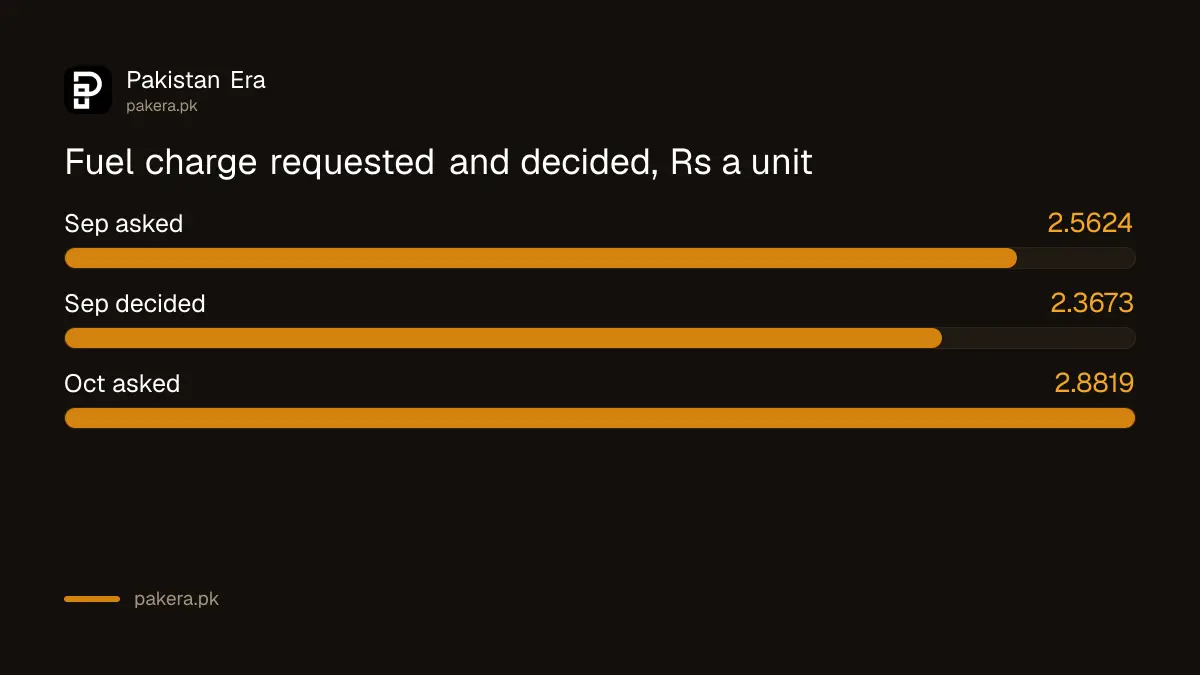
The Central Power Purchasing Agency (CPPA-G), which buys power for the ex-WAPDA distribution companies, asked for Rs 2.8819 a unit for October. NEPRA's notice set the hearing for 26 November at 2:00 pm. NEPRA's notice says the same rate will apply to K-Electric customers in Karachi.
That request is the highest since at least May 2026. It is Rs 0.5146 a unit above September's approved Rs 2.3673. The full breakdown of the October request, by fuel, is on our page about the Rs 2.88 October fuel charge request.
NEPRA had not published a decision on the October request by the morning of 27 November. The September request was heard on 29 October and decided on 6 November, eight days later.
What Rs 0.83 a unit means on your bill
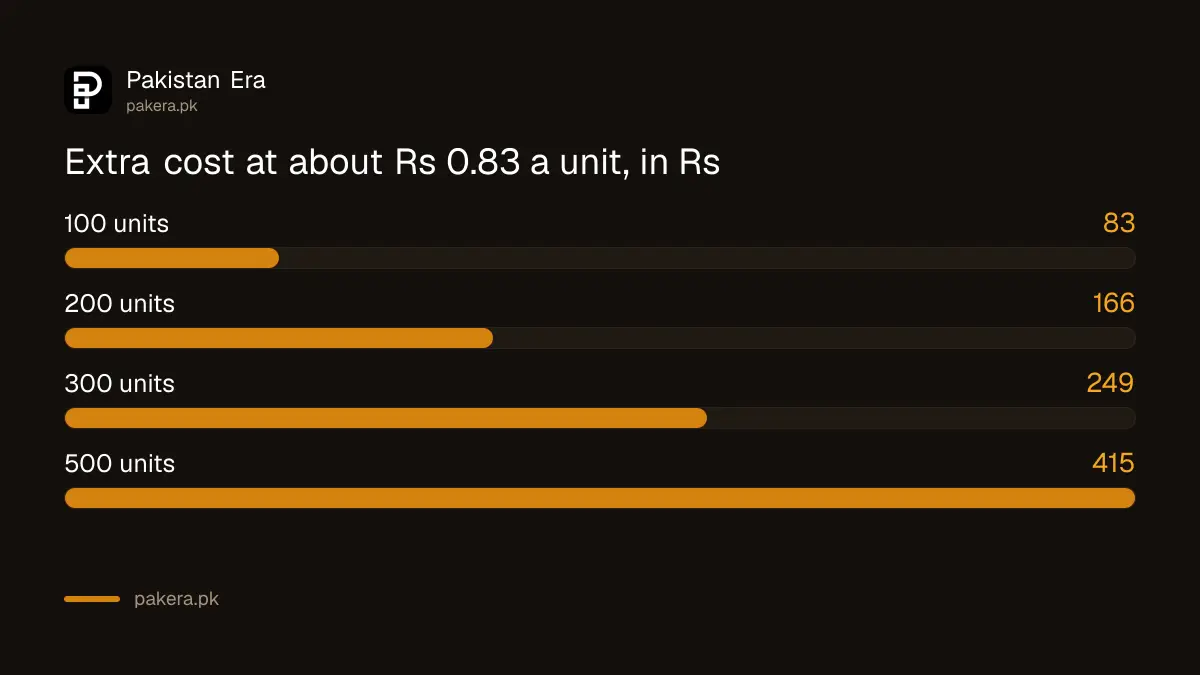
At about Rs 0.83 a unit, taxes included, the cap works out to roughly Rs 83 more for every 100 units, compared with a bill charged at September's fuel charge. A home using 300 units would pay about Rs 249 more. These are our own sums from the Power Division's figure.
| Units on your bill | Extra at about Rs 0.83 a unit, taxes included |
|---|---|
| 100 | About Rs 83 |
| 200 | About Rs 166 |
| 300 | About Rs 249 |
| 500 | About Rs 415 |
In September's decision, NEPRA kept lifeline consumers, prepaid consumers on the prepaid tariff and electric vehicle charging stations out of the fuel charge. The statement on the cap does not say whether the same groups stay exempt. The September fuel charge decision lists the exemptions in full.
To see your own fuel charge, look for the line marked FCA or "fuel price adjustment" on the bill. The steps for checking your electricity bill online cover LESCO, IESCO, MEPCO, FESCO, GEPCO and the other companies.
The government says tariffs fell before the war
The Power Division says the national average tariff, taxes included, fell from Rs 53.04 a unit in March 2024 to Rs 44.28 by March 2026. Industrial tariffs fell from Rs 62.99 to Rs 44.50. Fuel prices then rose after the Iran-US war.
| Tariff, taxes included | March 2024 | March 2026 | Change |
|---|---|---|---|
| National average | Rs 53.04 a unit | Rs 44.28 a unit | -Rs 8.76 |
| Industrial | Rs 62.99 a unit | Rs 44.50 a unit | -Rs 18.49 |
For April to September 2026, the Power Division says the fuel charge and the quarterly tariff adjustment (QTA) together added an average of Rs 2.38 a unit, taxes included. It says consumers were protected from a possible further fuel charge of Rs 6 to Rs 7 a unit. The QTA is a separate quarterly charge, explained in our QTA list for 2026.
Common questions
Is the Rs 0.83 fuel charge cap already on my bill?
No. It is a Power Division proposal from 26 November 2026. It needs approval, guidelines to NEPRA and a NEPRA decision before it reaches any bill.
What is the FFCA?
FFCA stands for Forward-Looking Fuel Cost Adjustment. It would hold the fuel charge rise for October to December 2026 to about Rs 0.83 a unit above September, instead of a new charge each month.
Will K-Electric customers get the same cap?
The statement does not single out Karachi. NEPRA's notice for October says the uniform fuel charge also applies to K-Electric customers under federal policy guidelines.
When will NEPRA decide the October fuel charge?
NEPRA heard the request on 26 November 2026. It had not announced a decision by the morning of 27 November. The September request was decided on 6 November, eight days after its hearing.
Does Rs 0.83 include taxes?
Yes. The Power Division gives the figure as inclusive of taxes and as an approximate amount.
Are lifeline consumers exempt from the fuel charge?
They were exempt in NEPRA's September decision, together with prepaid tariff consumers and EV charging stations. The cap statement does not change or repeat that.
How we verified this
What we checked and where we read it.
We checked this on 27 November 2026 at about 04:00 PKT. The cap, the FFCA name, the October to December period, the March 2024 and March 2026 tariffs and the April to September figures are from the Power Division's statement of Thursday 26 November 2026, carried in full by the state news agency. The October request of Rs 2.8819 and the hearing time are from NEPRA's hearing notice and the CPPA-G data file for October 2026. The September charge and its exemptions are from NEPRA's September 2026 decision, notified as SRO 2094(I)/2026. The per-bill sums are our own arithmetic.
Free on WhatsApp
Get the next change first on WhatsApp
Price changes, new rules and deadlines that affect your money, in a few short posts a day.
Follow Pakera on WhatsAppOther followers cannot see your number.
About the author

Tax, Bills and Technology Writer
Ali Akhtar is a young and curious voice here at Pakistan Era. He is currently pursuing his A-Levels and has a growing interest in Pakistan’s changing industrial landscape and educational trends. Ali likes to write in a way that helps him explain and explore the world around him. His writing reflects the perspective of the new generation navigating the evolving trends of Pakistan where technology, youth innovation, and shifting opportunities are reshaping the country’s future.