Enrol Your Child in a Free Bunyad Early Class in 13 Punjab Districts, Ages 3 to 5
Bunyad early childhood classes in 13 Punjab districts are free for children aged 3 to 5. See where, when admissions run and why official school counts differ.
Short answer: Under the Bunyad programme, government schools in 13 Punjab districts have early childhood classrooms for children aged 3 to 5. Education in these classes is free, says the project FAQ. Admission campaigns run in March to April and September to October, so now is the time to ask the head teacher of your nearest government school.
Bunyad sets up play-based classrooms for ages 3 to 5
Bunyad is the school part of the Punjab Human Capital Investment Project, run by the Punjab Social Protection Authority (PSPA) with the School Education Department. It improves Early Childhood Care and Education (ECCE) classes, the first classes of a government primary school, for children aged 3 to 5.
It is not a new school system. It upgrades one classroom in a selected school: repairs, paint, furniture, learning material and teacher training. Children learn through play and activity corners, not only from books. The PSPA page says it focuses on children of poorer households.
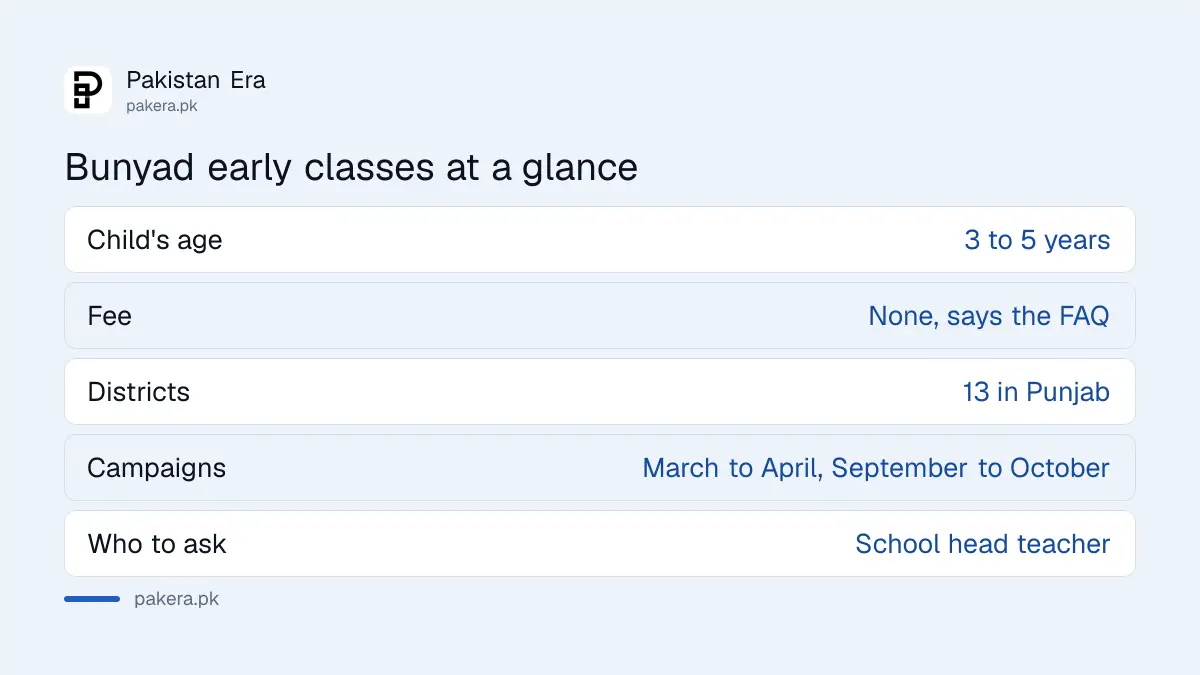
| Question | Answer on the official pages |
|---|---|
| Age of child | 3 to 5 years |
| Fee | None, education is free in ECCE classes |
| Where | Selected government schools in 13 districts |
| Admission campaign | March to April and September to October |
| Who to ask | The school's head teacher |
Thirteen districts are covered
The districts are Bahawalnagar, Bahawalpur, Bhakkar, Dera Ghazi Khan, Taunsa, Khushab, Mianwali, Rahim Yar Khan, Muzaffargarh, Kot Addu, Layyah, Lodhran and Rajanpur. A child in another district may still have an ECCE class, because it is a wider Punjab policy, but not through Bunyad.
The FAQ says more than 13,000 government schools across 41 districts of Punjab have ECCE classrooms. Under Bunyad, one selected classroom in each chosen school was upgraded. Schools were chosen using the number of classrooms, number of teachers, the state of the ECCE room and its size.
The official school counts do not match
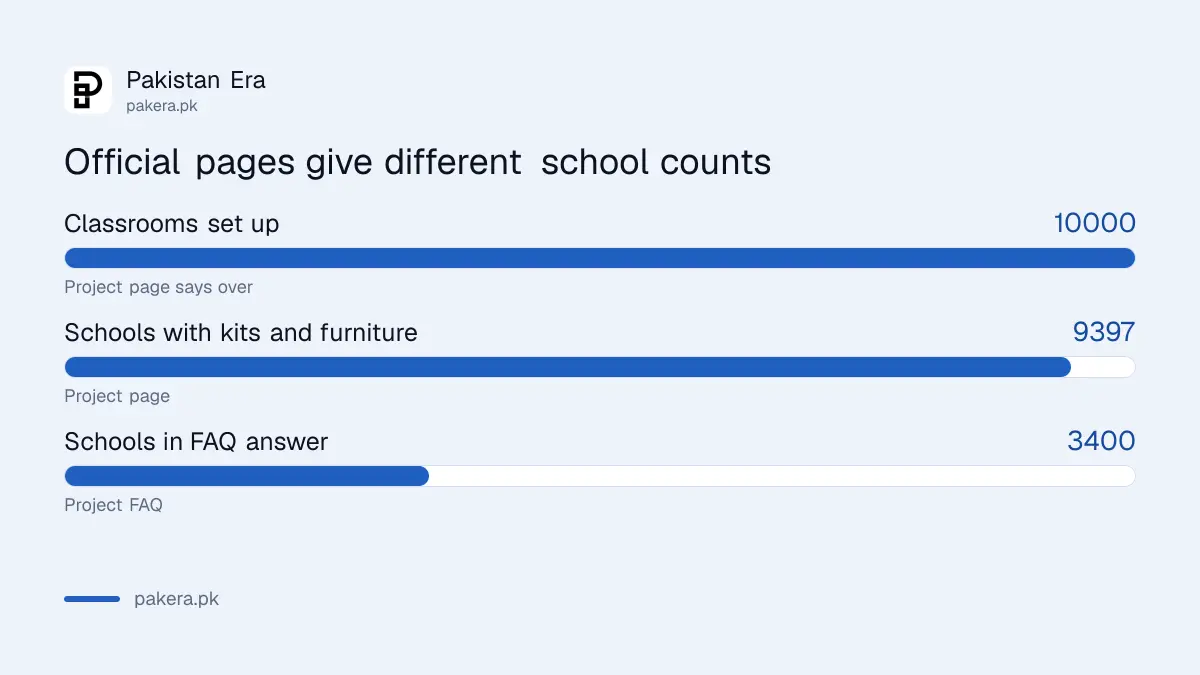
The pages give three different figures. The FAQ says ECCE facilities will reach 3,400 schools. The project's Bunyad page says furniture and kits reached 9,397 schools and that over 10,000 ECCE classrooms were set up. The PSPA page gives no number.
We cannot tell which is current, and the pages carry no date. The difference does not change what a parent should do: the school's head teacher knows whether your school has the room.
| Source | Figure given |
|---|---|
| Project FAQ | 3,400 schools will get ECCE facilities |
| Project Bunyad page | Kits and furniture in 9,397 schools |
| Project Bunyad page | 10,000+ ECCE classrooms |
| Project Bunyad page | 20,329 staff trained, 1.16 million children |
How to enrol your child
Go to the government school nearest to you and ask for the head teacher. Enrolment in the ECCE class follows the school's own admission process. The FAQ says information about ECCE schools is available from the School Education Department.
- Check that your child is 3 to 5 years old.
- Take the child's birth certificate or B-Form and a copy of the parent's CNIC.
- Visit the head teacher in March to April or September to October, when campaigns run.
- Ask if the school has an ECCE class and if there is a seat.
- Ask about the date classes start and the school timings.
- Keep the admission slip, if one is given.
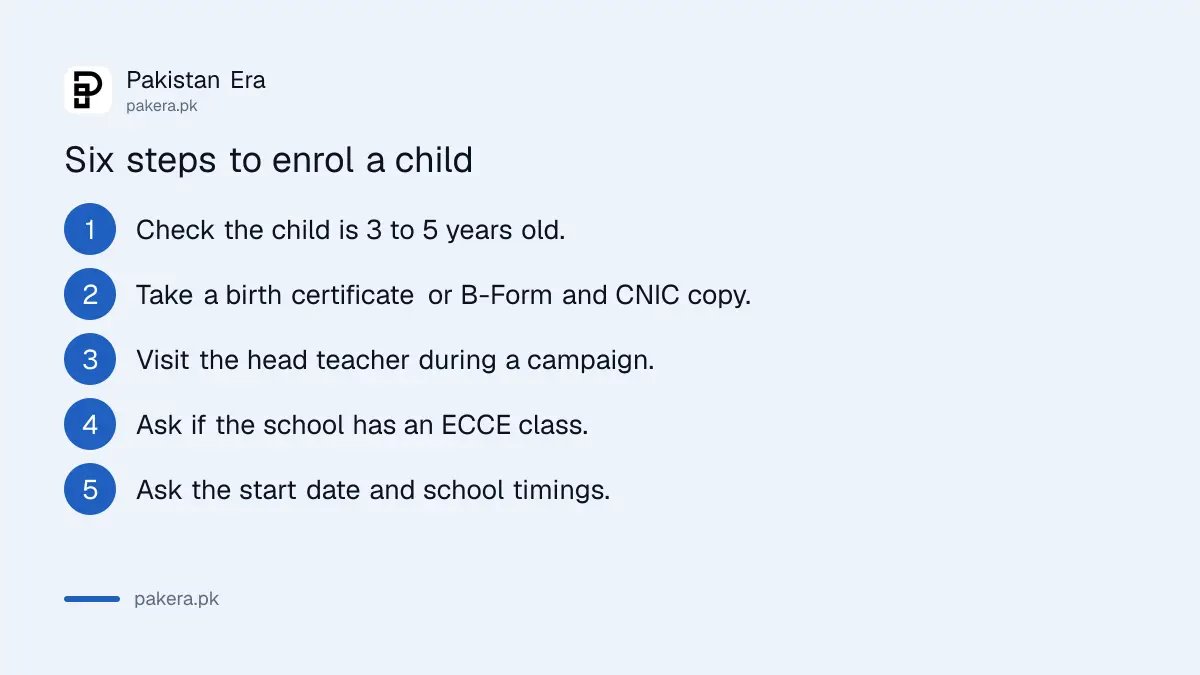
The pages do not list the papers needed, so these are sensible ones to carry, not an official list. If your child has no birth certificate, read how to get a birth certificate in Pakistan and how to register a child for a B-Form.
What the child will find in the classroom
The FAQ describes activity corners: health and hygiene, science, mathematics, language and literacy, geography and art. Teachers receive tablets and teaching material. Classes from ECCE to Grade 3 get reading corners with books and cupboards.
The project says over 2.4 million books were provided and more than 1.16 million children benefit from the work. Those are the project's own figures and we could not check them. The programme also runs awareness on child safeguarding, gender equality in education, hygiene and clean and green habits.
Complaints and where to ask
The project's Bunyad page lists a School Education Department hotline at 042-111-112020 and a complaint portal, sedcomplaints.punjab.gov.pk. Our connection could not open the portal on 11 October 2026, so we cannot describe it. Complaints about Bunyad can also go to the Social Protection Helpline 1221.
Ask the school for a written receipt of any fee demand. The FAQ says ECCE classes are free. If a school asks for money for admission to the class itself, call the hotline. For related admission help, see the Daanish School admission guide.
Common questions
Is Bunyad ECCE schooling free?
Yes. The project FAQ says education is free for children in the ECCE classes.
What age can my child join?
Children aged 3 to 5 are eligible for the ECCE classroom.
Which districts are included?
Thirteen: Bahawalnagar, Bahawalpur, Bhakkar, Dera Ghazi Khan, Taunsa, Khushab, Mianwali, Rahim Yar Khan, Muzaffargarh, Kot Addu, Layyah, Lodhran and Rajanpur.
When does admission open?
The FAQ says campaigns run each year from March to April and from September to October.
Do I apply to the PSPA?
No. You ask the head teacher of the government school. The PSPA does not enrol children itself.
How we verified this
What we checked, where we read it, and what we could not confirm.
Last checked on Sunday 11 October 2026. We read the PSPA's Bunyad Program page, the Punjab Human Capital Investment Project's Bunyad page and its FAQ page. None carries a date. We did not call the hotline or visit a school.
About the author

Senior Writer, Public Services and Technology
Shahid joined us in 2024 as an author. He is a senior contributor to Pakistan's leading technology websites. He writes detailed articles, mostly covering his expertise in the latest tech, mobiles, apps, gadgets, and step-by-step guides. His ideology is to help people understand the latest trends and explain complex methods through very easy-to-understand guides.