FBR E-Auction of Seized Goods: Bidders Pay at Least Rs 25,000
FBR notified S.R.O. 1889 on 22 October 2026: seized goods go to an online auction. Bidders pay at least Rs 25,000 to register and bidding lasts 72 hours.
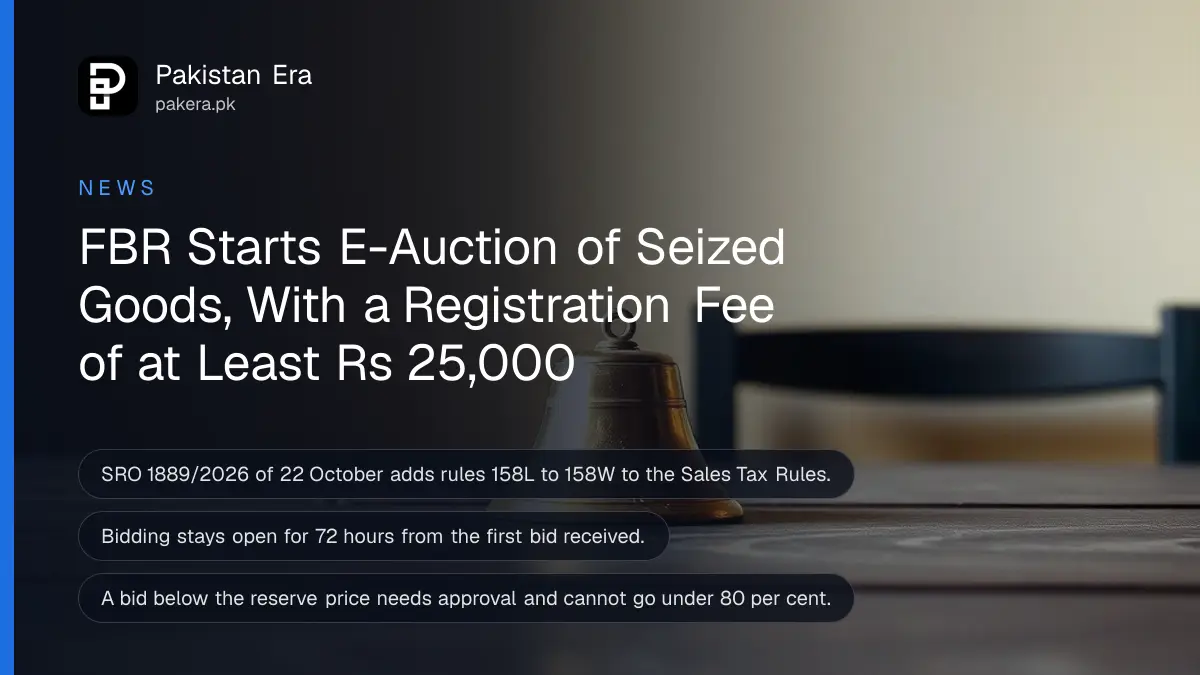
Short answer: On 22 October 2026 the Federal Board of Revenue (FBR) notified S.R.O. 1889(I)/2026, which moves the sale of seized and confiscated goods under the sales tax law onto an online e-auction module. A bidder registers with a CNIC or NICOP and a one-time fee of not less than Rs 25,000. Bidding stays open for 72 hours.
The notification adds a new Chapter XVII-C, rules 158L to 158W, to the Sales Tax Rules, 2006. We opened the signed notification on the FBR website. It is a scanned image, so we read each page by eye. It covers goods that Inland Revenue officers hold, not goods held by Customs. For the Customs side, see our note on how to bid in a customs auction.
The e-auction replaces manual sales of seized goods
The new rules say goods that have become available for public auction are listed, bid on, paid for and delivered through one FBR platform, called the e-auction module. Confiscated goods, and seized goods finalised for disposal under an adjudication order, are the two kinds the rules name.
A custodian, an Inland Revenue officer or office holding the goods, uploads them with a description, photographs and documents. The module hands each auction to an authorised officer. That officer is an Inland Revenue officer picked by the Commissioner to run the sale.
The notification gives no go-live date for the module and no web address. It is dated 22 October 2026 and says nothing about a later start. We could not confirm when the first auction will open.
A bidder needs a CNIC or NICOP and a fee of at least Rs 25,000
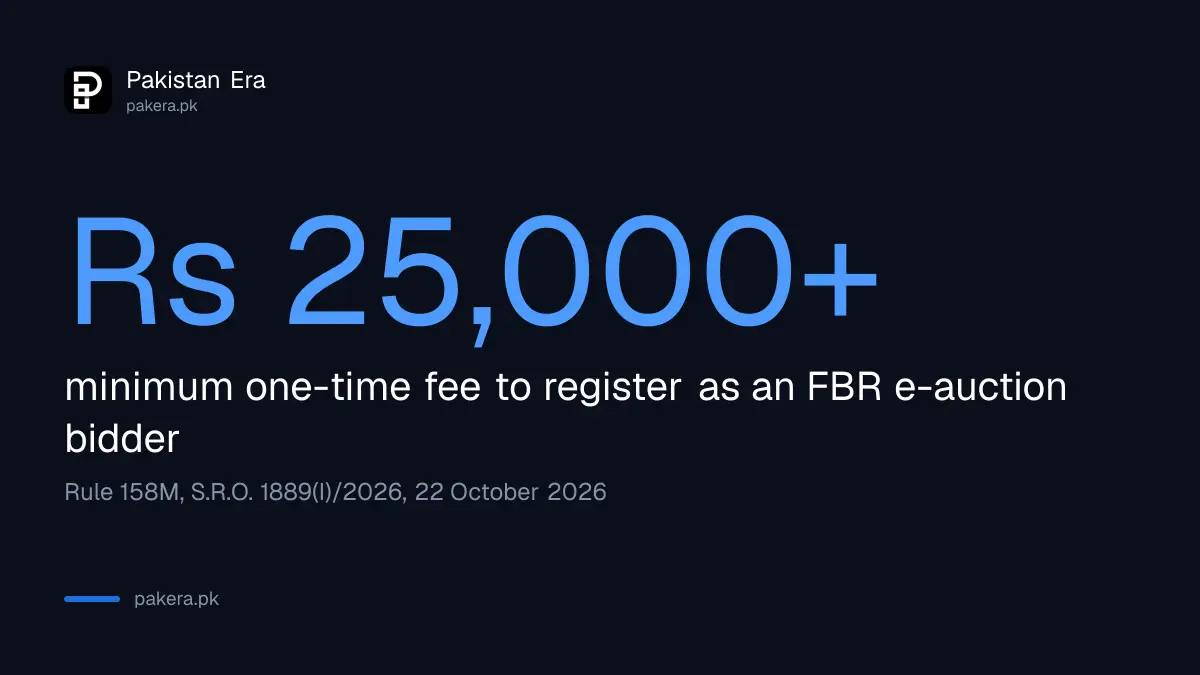
Rule 158M lets anyone with a valid CNIC or NICOP register as a bidder online. The one-time fee is "not less than twenty-five thousand rupees". The module then issues a unique number by email or mobile. An officer can reject a registration in writing, including for breaking Public Procurement Authority Rules, 2004.
The text sets a floor, not a fixed fee. FBR may set a higher figure in practice, and we could not see one. A person holding a Pakistan Origin Card should check whether it counts, because the rule names only the CNIC and NICOP.
The reserve price comes from invoices, retail prices and customs values
A valuation committee of an Additional Commissioner, a Deputy Commissioner and an Assistant Commissioner fixes a reserve price for each lot before bidding. The reserve price is the lowest price the officer may normally accept. The committee may add an outside valuation expert from the market.
| Kind of goods | How the committee prices them |
|---|---|
| Goods sold in the market | Average unit price in sales tax invoices for the last three tax periods |
| Goods with a printed retail price | That price less a dealer or wholesaler margin |
| Imported goods | Customs assessed value plus duties and taxes of like goods |
| Nothing to compare | Average of two written quotations from dealers |
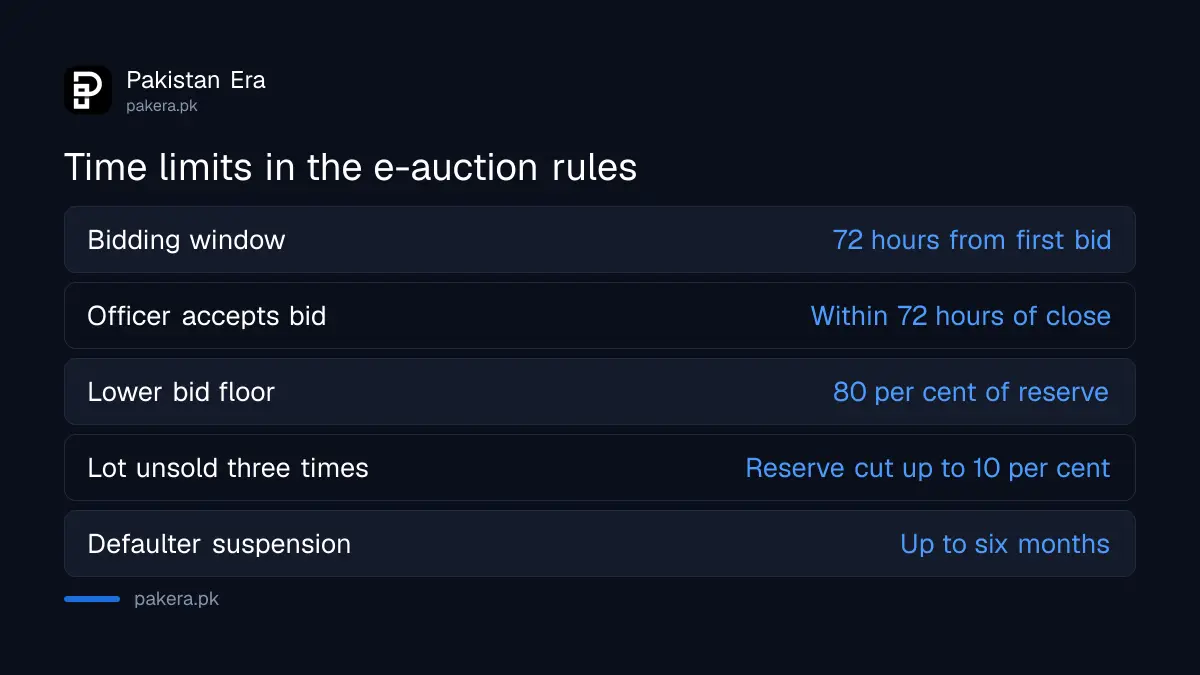
The committee also allows for age, condition and remaining shelf life. If a lot does not sell in three auctions in a row, the committee may cut the reserve price by up to ten per cent of the original figure at a time. Vehicles follow separate instructions from the Board.
Bidding runs 72 hours and the officer then has 72 hours to accept
Goods stay open for online bids for 72 hours from the first bid received. The module shows the highest bid as each higher bid arrives. After the window closes, the authorised officer has 72 hours to accept the highest bid, which must not be below the reserve price.
A bid below the reserve needs the Commissioner Inland Revenue to approve it in writing, and it may not go under 80 per cent of the reserve. For a lower bid the Chief Commissioner decides. The printed text says "eight percent" in that last sentence. We read it as a typing slip for 80, but we could not confirm it, so ask before you rely on it.
The winner pays in full and collects only against a release order
The winning bidder pays 100 per cent of the accepted bid plus taxes, duties, fees and charges through a challan with a payment slip number. No goods leave until the full amount is verified. Section 236A of the Income Tax Ordinance, 2001 also applies, which is the advance tax on auction purchases.
The text on the payment deadline reads badly. It says "within seven days of electronic communication of acceptance within seventy-two hours". We cannot tell if the limit is seven days or 72 hours, so read the deadline on your own auction notice.
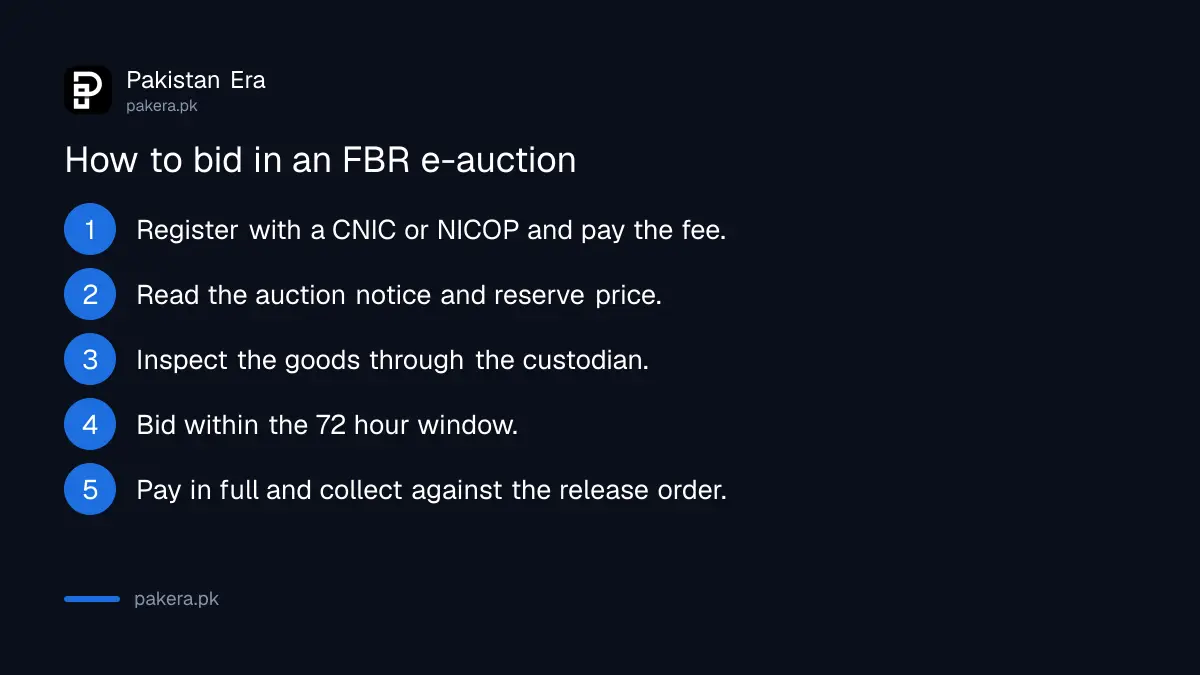
- Register on the e-auction module with your CNIC or NICOP and pay the registration fee.
- Read the auction notice: reserve price, inspection arrangements, bid security, taxes, NOCs and delivery terms.
- Inspect the goods through the custodian before you bid.
- Bid within the 72 hour window and watch for the acceptance message by email or phone.
- Pay the challan in full, then collect the goods with the release order and your original CNIC or NICOP.
If a winner does not pay in time, the officer may cancel the sale, forfeit the bid security, offer the lot to the next highest bidder or order a new auction. A defaulter can be suspended from future auctions for up to six months after a hearing.
The Commissioner can cancel a sale and recover goods after delivery
Rule 158V lets the Commissioner Inland Revenue cancel an auction in writing, hold it in the public interest, disallow a bidder, remove a bidder's credentials or hold a sale when a court orders it. The Commissioner can also recover goods after delivery where fraud, misrepresentation or loss of revenue is established.
Owners have rights too. The authorised officer must check for any court stay and for a release or redemption option before an auction starts, and goods under a stay are not offered. Sale money first pays sale costs, then taxes, penalties and dues. Any balance goes to the owner under section 40F. See our guide on getting seized property back.
Arms, narcotics and counterfeit goods are not auctioned
Rule 158W says arms and ammunition, narcotics, obscene or prohibited material, counterfeit goods and anything banned by law are not ordinarily put to auction, except as the Board directs. Electronic records kept on the module count as valid records under the Act and the rules.
Common questions
What is S.R.O. 1889(I)/2026?
It is an FBR notification of 22 October 2026 that adds Chapter XVII-C to the Sales Tax Rules, 2006, creating an electronic auction for seized and confiscated goods.
How much does it cost to register as a bidder?
The rule sets a one-time fee of not less than Rs 25,000. We found no higher fixed figure in the text.
Who can register?
A person with a valid CNIC or NICOP. An entity can bid through an authorised person registered on the module.
How long does bidding last?
Bidding stays open for 72 hours from the first bid. The officer then has 72 hours to accept the highest bid.
Can goods sell below the reserve price?
Only with written approval of the Commissioner, and not below 80 per cent of the reserve. A lower price needs the Chief Commissioner.
Does this cover customs auctions?
No. It amends the Sales Tax Rules and covers goods held by Inland Revenue. Customs auctions follow the customs rules.
How we verified this
What we checked, where we read it, and what we could not confirm.
Last checked 23 October 2026. We opened FBR's SRO pages and read the full text of S.R.O. 1889(I)/2026, dated 22 October 2026, signed by the Second Secretary (ST and FE Policy). We could not confirm the go-live date, the web address of the module, the fee actually charged, or the payment deadline, because the text is unclear. FBR's list shows the notification under 21 October while the document is dated 22 October.
About the author

Tax, Bills and Technology Writer
Ali Akhtar is a young and curious voice here at Pakistan Era. He is currently pursuing his A-Levels and has a growing interest in Pakistan’s changing industrial landscape and educational trends. Ali likes to write in a way that helps him explain and explore the world around him. His writing reflects the perspective of the new generation navigating the evolving trends of Pakistan where technology, youth innovation, and shifting opportunities are reshaping the country’s future.