How to Get Seized Property Back From Police and Court in Pakistan
Police seized your vehicle, animal or goods? Sections 523, 516A and 517 say who holds them and when a court can hand them back. See the steps and time limits.
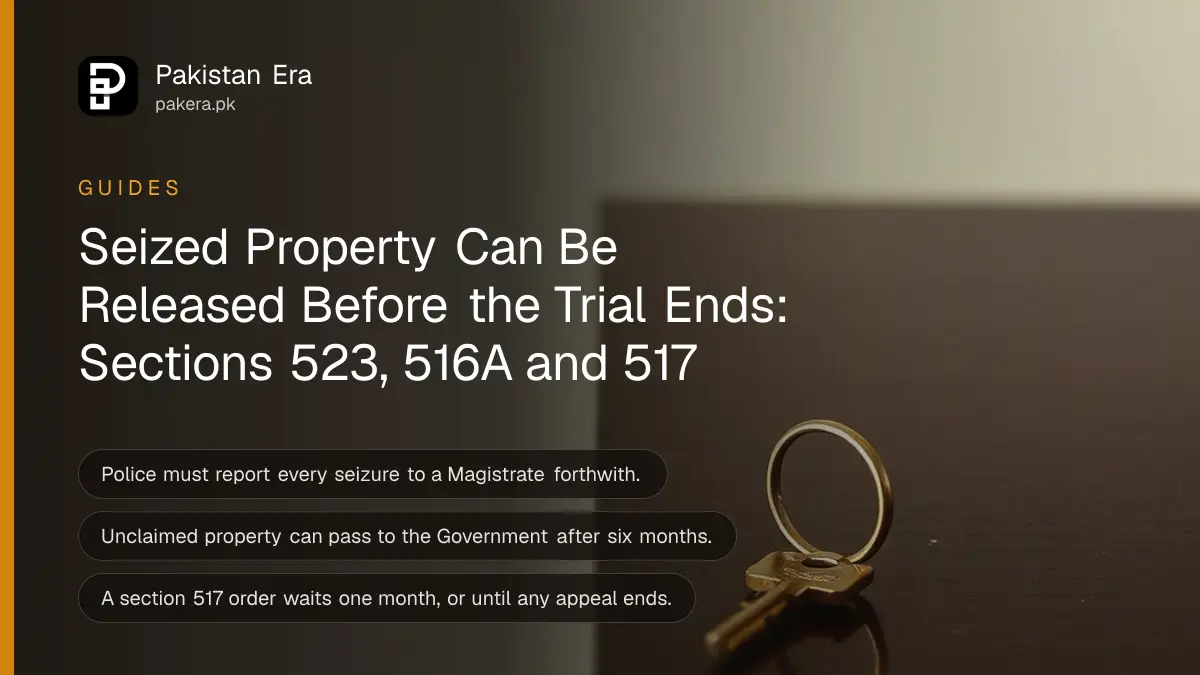
When police seize your property, the Magistrate must be told at once, and a court can hand the item back to you before the trial ends. Sections 523 and 516A of the Code of Criminal Procedure decide who holds it in the meantime, and section 517 decides who gets it at the end.
A seized motorcycle, tractor, buffalo or stack of cash is a daily loss for a family. We read these sections in the Code of Criminal Procedure, 1898, on 21 October 2026, and set out the steps below. The Code names no form and no fee, so a lawyer's application is the usual way in. If you are also the accused, the bail rules for bailable and non-bailable offences run on a separate track.
Police must report every seizure to a Magistrate
Section 550 lets a police officer seize property that is suspected to be stolen or found in suspicious circumstances. Section 523 then says the seizure must be reported "forthwith" to a Magistrate, who decides who should hold the property or receive it.
If the person entitled to the property is known, the Magistrate may order it delivered to that person on conditions he sets. This is the first door to knock on, before any trial starts. Take proof of ownership with you: the registration book, a purchase receipt, a cattle sale slip or a village record.
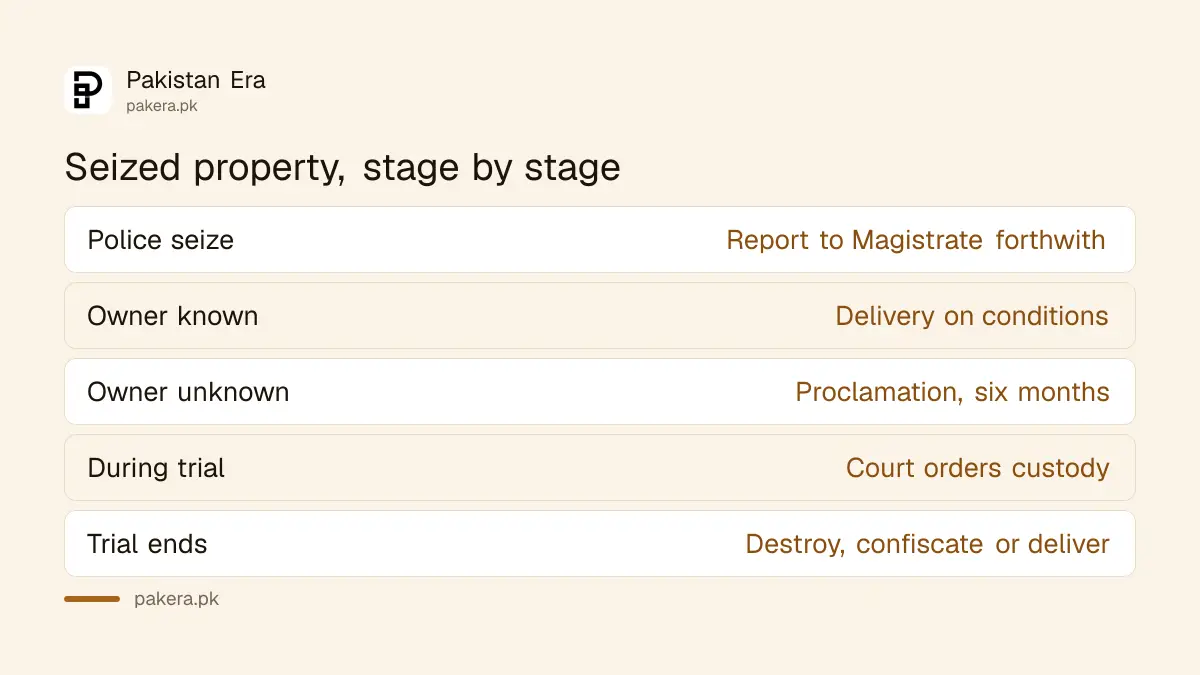
| Stage | Section | What the Code says |
|---|---|---|
| Police seize the item | 550, 523 | Seizure reported forthwith to a Magistrate |
| Owner is known | 523(2) | Magistrate may deliver it on conditions |
| Owner is unknown | 523(2), 524 | Proclamation, then six months to claim |
| Item is before a court in a trial | 516A | Court orders proper custody until the trial ends |
| Trial ends | 517 | Destroy, confiscate or deliver to the person entitled |
An unclaimed item can pass to the Provincial Government after six months
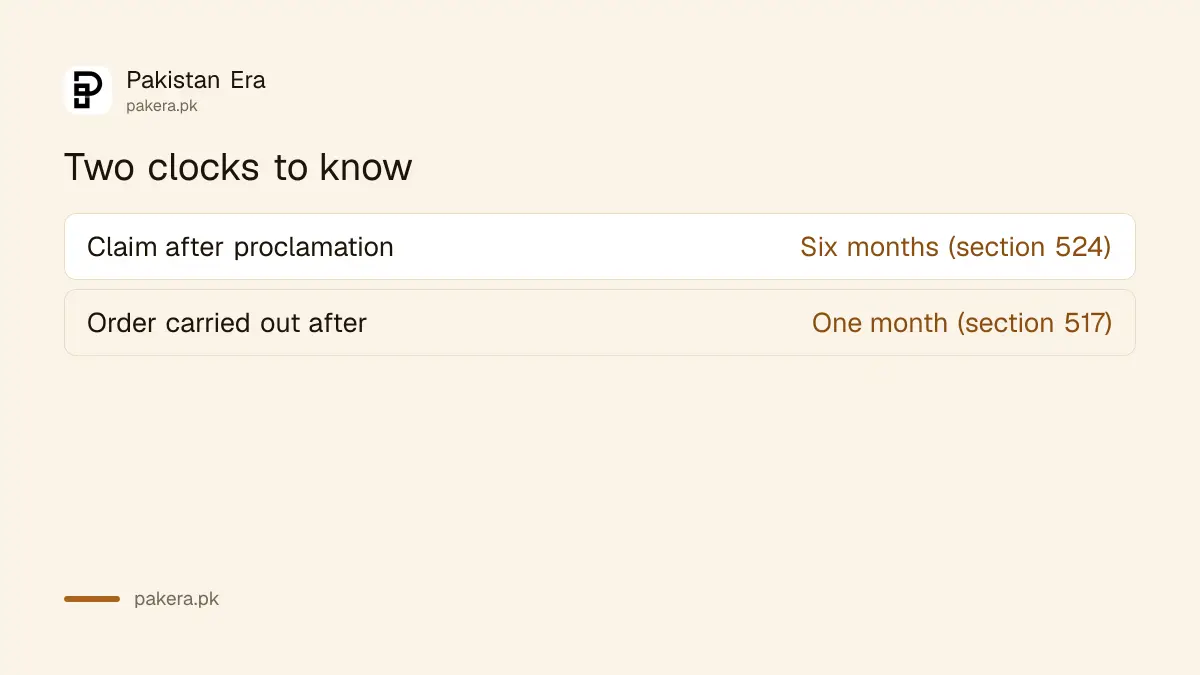
If no owner is known, the Magistrate issues a proclamation. Anyone with a claim must appear and prove it within six months of that date. After that, section 524 lets the item go to the Provincial Government and be sold, if its holder cannot show he got it lawfully.
An order under section 524 can be appealed to the court that hears appeals against sentences of the court that passed it. Perishable goods are treated differently. Under section 525 the Magistrate may sell them at once, and the sale money follows sections 523 and 524.
Section 516A lets a trial court keep or release property during the case
Once the property is produced before a criminal court, section 516A applies. The court may pass whatever order it thinks fit for its proper custody until the inquiry or trial ends. If the item decays quickly, it may be sold after the court records evidence.
This is the section lawyers use when asking the court to release a vehicle or animal to its owner while the case runs. In practice this is often called release on superdari. That word is common usage, and the Code itself does not use it. The section sets no list of conditions, so the court decides them. Explosives and narcotics have special limits in the same section.
Section 517 decides who gets the item when the trial ends
At the end of the inquiry or trial, the court may order the property destroyed, confiscated or delivered to anyone who claims to be entitled to it. Section 517(3) says that order cannot be carried out for one month, or until any appeal is decided.
Livestock and fast decaying goods are exempt from that wait. Section 517(4) lets the court hand over the property earlier if the claimant signs a bond, with or without sureties, promising to return it if the order is changed on appeal. Section 520 lets an appeal or revision court stay such an order.
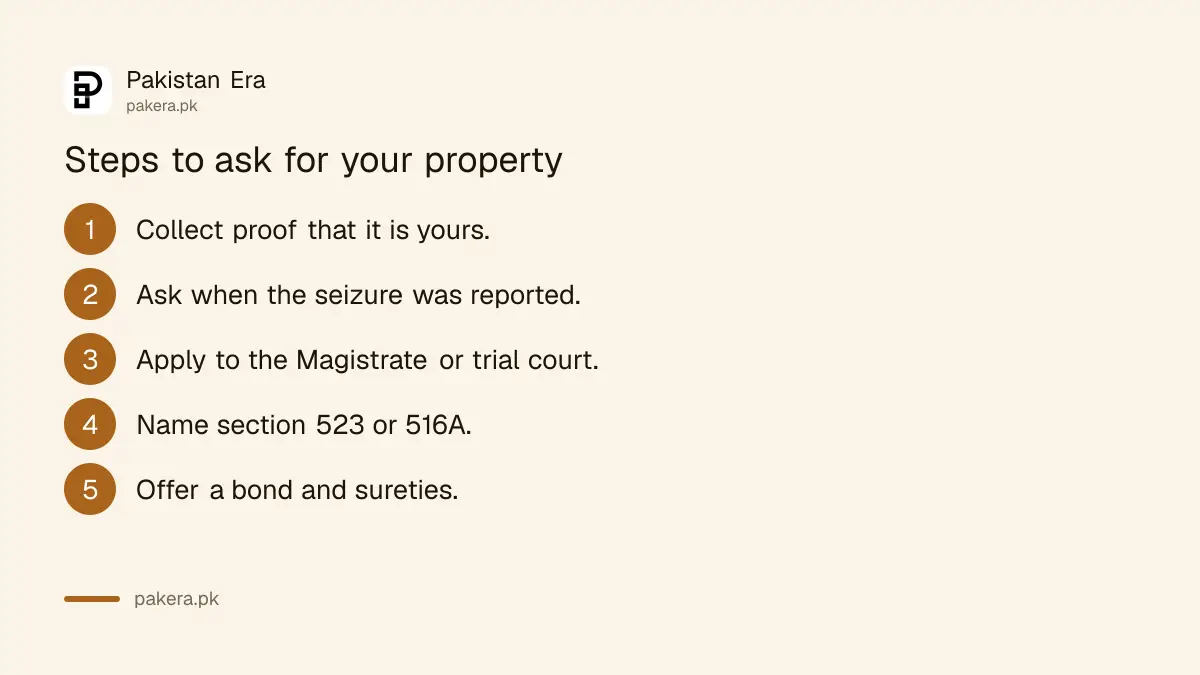
- Collect proof that the item is yours.
- Ask the police station for the date the seizure was reported to the Magistrate.
- Write an application to that Magistrate, or to the trial court if the case has started.
- State plainly that you ask for custody under section 523 or 516A.
- Offer a bond and sureties, and keep the item in good condition.
- Ask for a certified copy of the order.
A bond protects the court if the order changes on appeal
A bond is a signed promise to produce or return the item when the court asks. Sureties are people who guarantee that promise. Our guide to standing surety in court explains what a surety risks.
Keep photographs and a list of the item's condition on the day you take it. If the order is later set aside, you must return the same item. Do not sell it, repair it beyond need or move it out of the district without telling the court.
Common questions
Can police keep my seized vehicle for as long as they like?
No. Section 523 requires the seizure to be reported to a Magistrate straight away, and the Magistrate decides who holds it.
Do I have to wait for the trial to end?
No. Section 523 lets a Magistrate deliver property to the person entitled, and section 516A lets a trial court order its custody during the trial.
What if nobody claims the item?
After a proclamation and six months, section 524 can place it at the Provincial Government's disposal, if the holder cannot show lawful acquisition.
Can I appeal a refusal?
The Code expressly gives an appeal against a section 524 order. For other orders, ask a lawyer whether appeal or revision applies. We did not read court rulings on this.
Is there a court fee for the application?
The Code names none. We could not check the current court fee schedule, so ask the court's reader or your lawyer.
How we verified this
What we checked, where we read it, and what we could not confirm.
Last checked 21 October 2026. We read sections 523, 524, 525, 516A, 517 and 520 and 550 of the Code of Criminal Procedure, 1898, in the Pakistan Code PDF marked as last amended on 16 February 2017, from a copy saved earlier this week. The Pakistan Code portal did not open for us on the day, so we could not check for later amendments. Punjab applies a local version of section 523. We did not read court rulings or rules on fees and forms.
About the author

Senior Writer, Public Services and Technology
Shahid joined us in 2024 as an author. He is a senior contributor to Pakistan's leading technology websites. He writes detailed articles, mostly covering his expertise in the latest tech, mobiles, apps, gadgets, and step-by-step guides. His ideology is to help people understand the latest trends and explain complex methods through very easy-to-understand guides.