Federal Constitutional Court Tells IIUI to Reconsider a PhD Scholar's Thesis Extension Under the HEC Policy
The Federal Constitutional Court told IIUI to decide a PhD scholar's extension again under HEC policy clause 3.12(iv). See what the ruling does and does not do.
Short answer: On 1 October 2026 the Federal Constitutional Court (FCC) set aside a refusal by International Islamic University Islamabad (IIUI) to extend a PhD scholar's time limit. It told the university to look again at her request under clause 3.12(iv) of the HEC Graduate Education Policy, 2023, and to decide with a reasoned order, preferably within 30 days.
A thesis can be finished, checked for plagiarism and approved by a supervisor, and still be refused because a deadline passed. That is what happened here. The judgment is now on the FCC website, and it matters to any scholar who has been told "your time has expired".
We read the full judgment (F.C.P.L.A. No. 59 of 2025) on the court's judgments page on 13 October 2026. This article describes what the court decided. It is a judgment, not a petition, and it does not give anyone a PhD or an automatic extension.
The court sent the extension request back for a fresh decision
The FCC allowed the appeal, set aside the Islamabad High Court's judgment and also set aside IIUI's regret letter of 6 May 2025. The university must now reconsider the request, hear the scholar, and pass a reasoned order. The court asked for this preferably within 30 days of receiving a certified copy.
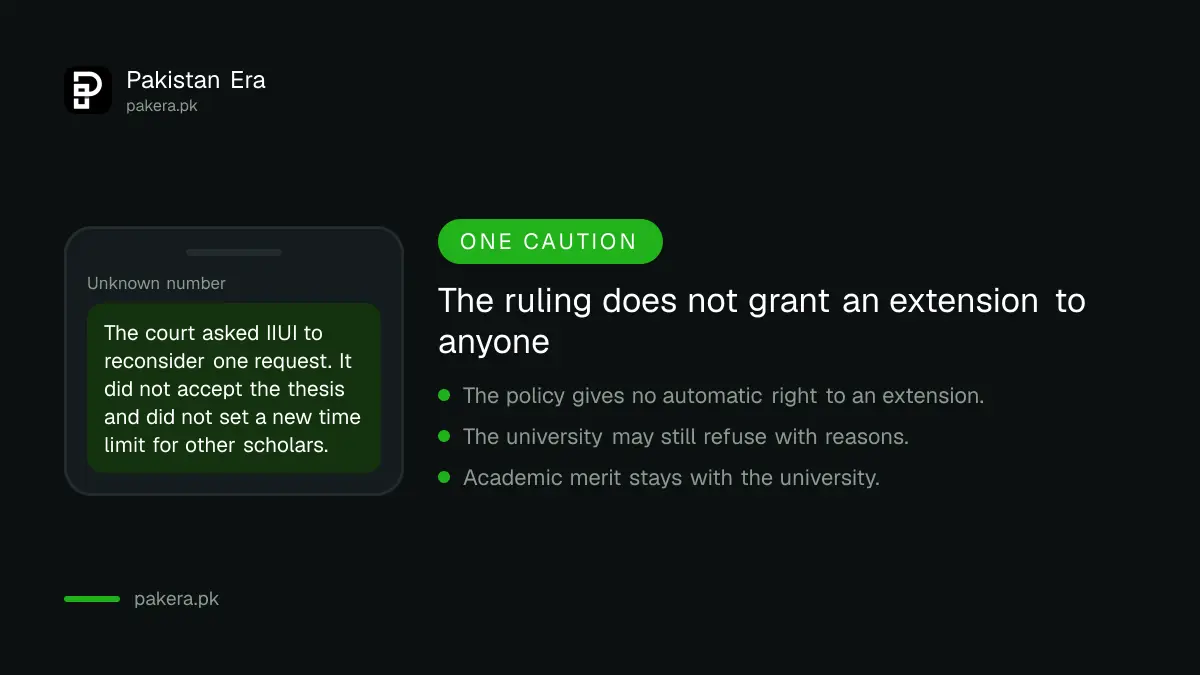
The decision is addressed to one scholar and one university. It does not order IIUI to accept her thesis. The court said the policy gives no automatic right to an extension, and that the university may still say no, as long as it decides in the right way and gives reasons.
The bench was Justice Syed Hasan Azhar Rizvi and Justice Muhammad Karim Khan Agha. The decision is to be reported to the court through its Registrar.
The dispute was about an eight year limit and who caused the delay
The scholar joined the PhD (Law) programme at IIUI in Fall 2015. The university's rules gave an ordinary eight year period, which the university said ended on 31 August 2023. She went to submit a finished thesis on 29 August 2024 and was told her case was time barred.
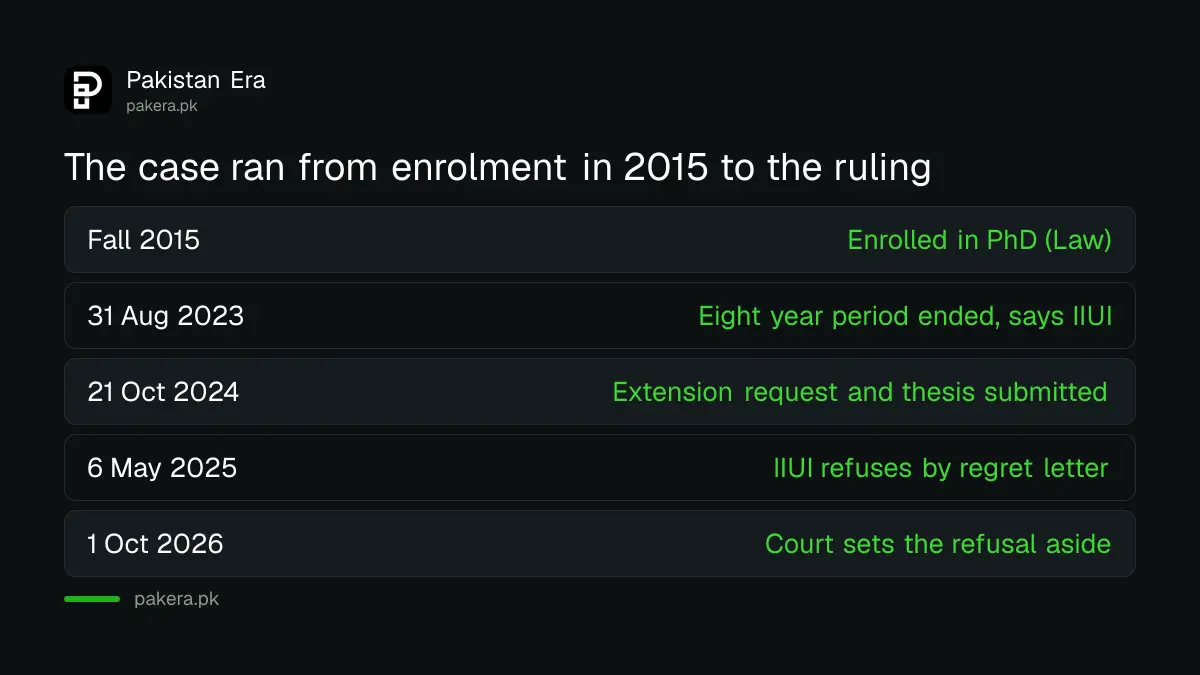
| Date | What the judgment records |
|---|---|
| Fall 2015 | Enrolled in PhD (Law) at IIUI |
| 26 and 30 December 2016 | Comprehensive exam held, though the rules said within 90 days of coursework |
| 26 July 2017 | Comprehensive exam result notified |
| 7 February 2019 | Synopsis approved, about eight months after the Board of Faculty met |
| 31 August 2023 | Ordinary eight year period ended, according to IIUI |
| 21 October 2024 | Her request for extension, with the thesis, reached IIUI |
| 6 May 2025 | IIUI refused through a regret letter |
| 1 October 2026 | FCC sets the refusal aside |
She said part of the delay came from the university's own slow processing, and part from her move to a remote district after marriage, two young children and the COVID-19 closures. The university said the period had ended and no right to a further extension existed.
Clause 3.12(iv) of the HEC policy was the deciding provision
The court held that clause 3.12(iv) of the HEC Graduate Education Policy, 2023 applies to this scholar. A footnote says students enrolled before the policy must also be dealt with under it. So the university could not treat the end of eight years as the final answer.
The clause lets a university set up an appropriate authority to find the causes of delay. If the delay was beyond the student's control, called force majeure, the university may grant an extension. It must also take corrective steps where the delay came from process or administrative reasons.
The court was careful about academic autonomy. It said judges do not assess whether a thesis is good enough. The question was only whether the university used the mechanism the policy sets out. It had not, so the matter went back.
The court also said family duties deserve due consideration
The judgment says Article 25 of the Constitution allows special provision for women and children. It adds that marriage, relocation, pregnancy, health and childcare can reasonably be weighed within the flexibility an existing policy already gives.
This is a statement of approach, not a new rule with a number attached. It does not set a fixed extra period. It applies where an accommodation is already allowed by the policy and does not harm another person's accrued right.
What a scholar in a similar position can do
The judgment binds the parties before it. A scholar facing a similar refusal can still use its reasoning. The steps below follow the logic of the court and are not legal advice. A lawyer should read the full judgment before any filing.
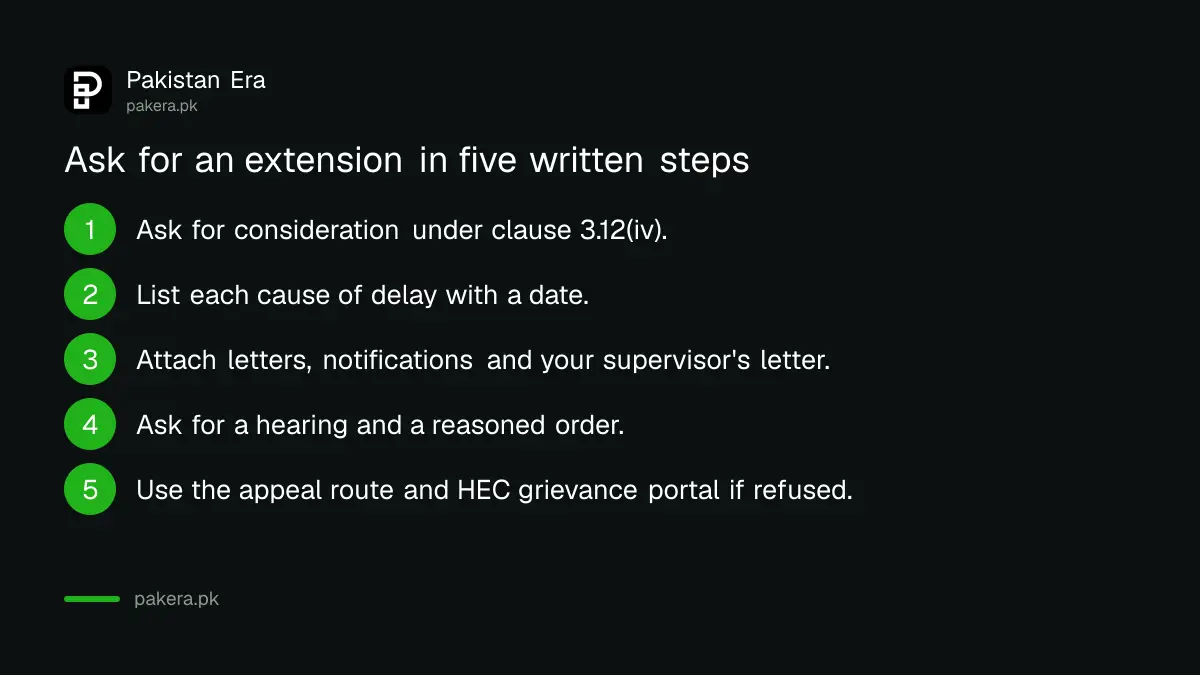
- Write to the university and ask for your request to be considered under clause 3.12(iv) of the HEC policy.
- List each cause of delay with a date, such as late exams, late synopsis approval or closures.
- Attach proof: letters, notifications, medical papers, posting orders and your supervisor's completion letter.
- Ask for a hearing and a reasoned order, in writing.
- If the answer is a bare refusal, use the university's own appeal route and the HEC's student grievance portal.
Court deadlines are separate and short. The court's own rules set time limits for appeals and reviews, so count days from the date of the order you are challenging.
What the ruling does not decide
The judgment does not say the thesis is acceptable. It does not say IIUI must grant an extension. It does not extend the policy's eight year limit for anyone else. It also does not decide whether every university's internal rules can be enforced in a High Court.
Whether IIUI has since reconsidered the case was not stated on the court's pages when we checked. Hearings and orders are posted on the court's case and cause list pages.
Common questions
Does this ruling give every PhD scholar an extension?
No. It applies to the scholar and the university in this case. The court said clause 3.12(iv) gives no automatic right, only a right to proper consideration.
What is clause 3.12(iv) of the HEC policy?
It is the part of the HEC Graduate Education Policy, 2023 that lets a university decide an extension request after the normal PhD period. It looks at causes of delay and at force majeure, meaning events beyond the student's control.
Did the court judge the quality of the thesis?
No. The court said it would not replace the university's academic judgment. It only checked that the extension request was decided under the correct policy.
Does the policy cover students who enrolled before 2023?
Yes, according to the footnote to clause 3.12 as quoted in the judgment. Students enrolled before the policy are to be dealt with by the same procedure.
How long does the university have to decide again?
The court said preferably within 30 days of receiving a certified copy of the judgment. The decision is to be communicated to the court through its Registrar.
How we verified this
What we checked, where we read it, and what we could not confirm.
Last checked on 13 October 2026, Pakistan time. We read the judgment in F.C.P.L.A. No. 59 of 2025 on the Federal Constitutional Court judgments page, where it is listed with the date 12 October 2026. The judgment itself is signed 1 October 2026. We did not read the full text of the HEC Graduate Education Policy, 2023 on the HEC website for this page, so the wording of clause 3.12 is as quoted in the judgment. We could not confirm whether IIUI has acted since.
About the author

Tax, Bills and Technology Writer
Ali Akhtar is a young and curious voice here at Pakistan Era. He is currently pursuing his A-Levels and has a growing interest in Pakistan’s changing industrial landscape and educational trends. Ali likes to write in a way that helps him explain and explore the world around him. His writing reflects the perspective of the new generation navigating the evolving trends of Pakistan where technology, youth innovation, and shifting opportunities are reshaping the country’s future.