Feed a Milking Cow or Buffalo in Punjab: 1 kg Wanda per 3 kg Milk and 10 Per Cent Green Fodder
Punjab says give 1 kg of wanda for every 3 kg of milk and green fodder equal to 10 per cent of body weight. See worked examples for 6 to 15 kg of milk a day.
Punjab's Livestock Department says to give a milking cow or buffalo 1 kg of wanda for every 3 kg of milk, plus green fodder equal to 10 per cent of her live weight each day. Wanda is the ready-made animal feed concentrate sold in sacks. A 500 kg buffalo giving 9 kg of milk therefore needs about 3 kg of wanda and 50 kg of green fodder a day.
We read the department's FAQs page on feeding, space and fodder at livestock.punjab.gov.pk on 21 October 2026. The numbers are the department's. The worked examples are our own arithmetic, and we did not test them on a farm.
The wanda rule is 1 kg for every 3 kg of milk
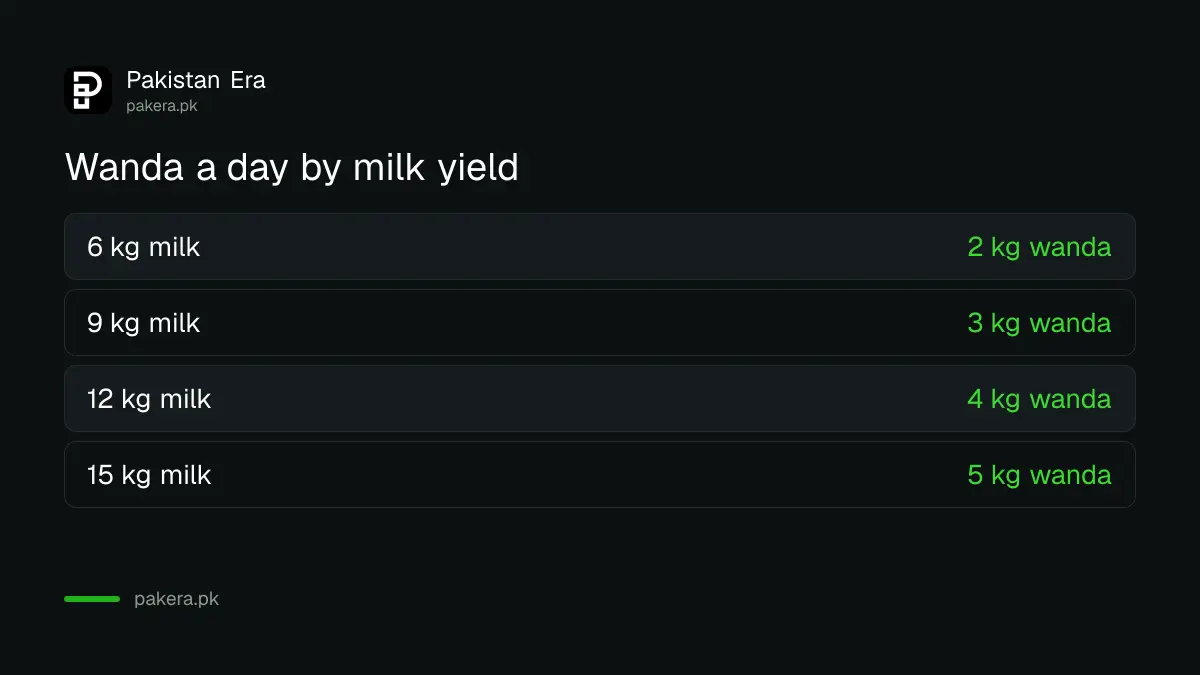
The department's answer on lactating animals is short: give 1 kg of wanda for 3 kg of milk. So the amount follows the daily yield. A buffalo giving 6 kg gets 2 kg of wanda, and one giving 12 kg gets 4 kg.
| Milk a day | Wanda a day (1 kg per 3 kg) |
|---|---|
| 6 kg | 2 kg |
| 9 kg | 3 kg |
| 12 kg | 4 kg |
| 15 kg | 5 kg |
The department says wanda is sold at Sahulat Centers in every tehsil. That is the government's own service centre, not a private shop. It does not publish a price on the page we read, so we give none.
Green fodder should be 10 per cent of live weight
The department says a lactating animal should get green fodder equal to 10 per cent of her live weight every day. For a 400 kg cow that is 40 kg. For a 600 kg buffalo it is 60 kg of fresh fodder.
Weigh your animal if you can, or ask the vet to estimate. A guess that is 100 kg off changes the fodder by 10 kg, which is a lot of berseem. For the summer and winter crops themselves, see the next section.
The bulk of the diet is green fodder, and wanda is matched to the milk. That split comes straight from the two rules above.
Grow berseem in winter and maize or mott grass in summer
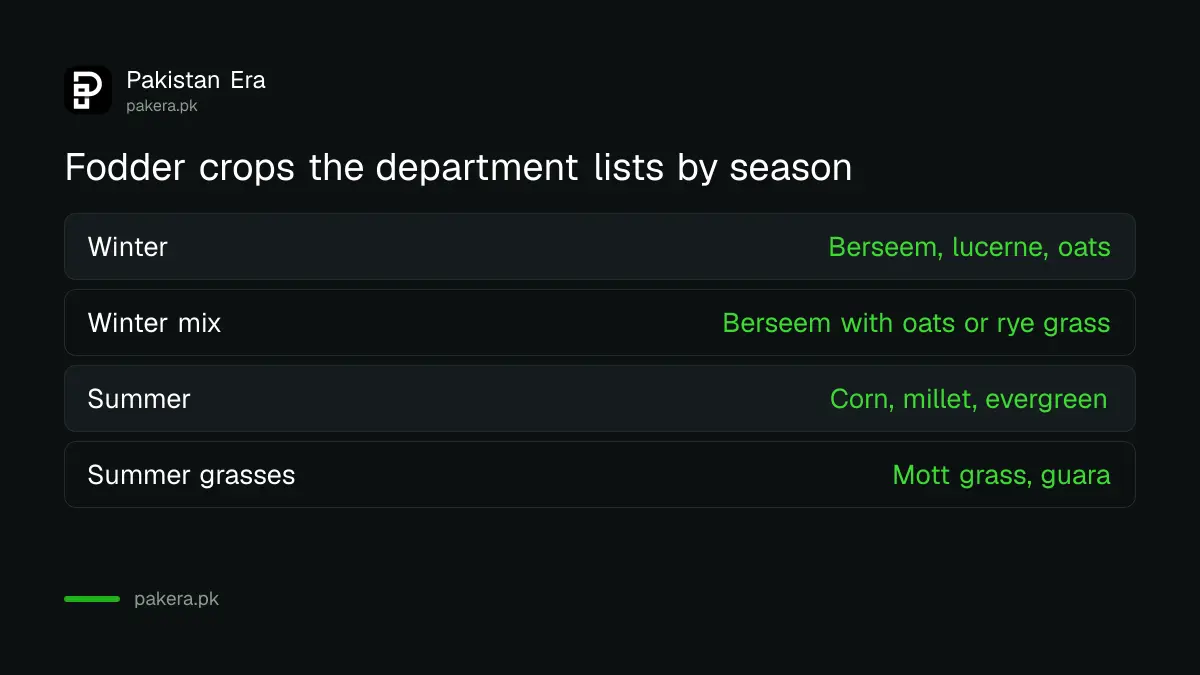
The department lists berseem, lucerne, oats and rye grass for winter, and berseem mixed with oats or with rye grass. For summer it lists corn, millet, evergreen, mott grass and guara. It also says mott grass stems and roots are available at the Agricultural University Faisalabad and LPRI Bahadurnagar, Okara.
Winter sowing is on now. The berseem, oats and lucerne sowing dates for Khyber Pakhtunkhwa give seed rates for that province. For Punjab, ask your local extension office for the date in your district, because the department's FAQ page does not give seed rates.
A suckling calf gets 10 per cent of its body weight in milk
The department says a suckling calf should be fed milk at 10 per cent of its body weight daily. A 40 kg calf therefore gets 4 kg of milk. That number is the department's, and it is spread over the day.
Keep this separate from the dam's milk sale. If you sell all the milk, the calf starves. Plan the 4 kg before you plan the market.
A milking animal needs 40 square feet under a roof and 80 in the open
The department gives space numbers for the farm. A milch animal needs 40 square feet of covered space and 80 square feet of open space. A broiler bird needs 1 square foot and a layer bird 2 square feet.
If you keep six buffaloes, that is 240 square feet of shed and 480 square feet of open yard by the department's figure. Check your own shed against these figures before you add another animal.
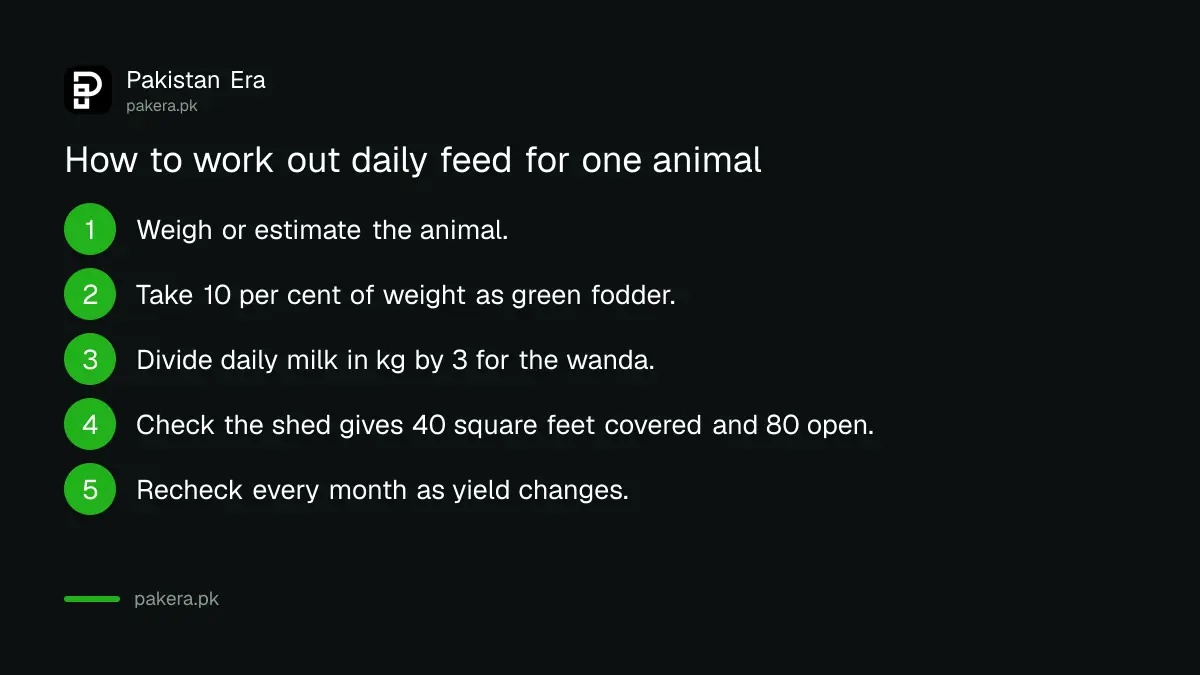
- Weigh or estimate each milking animal.
- Work out 10 per cent as the daily green fodder.
- Note her milk in kg and divide by 3 for the wanda.
- Check the shed gives 40 square feet covered and 80 open.
- Recheck every month as her yield changes.
If the loan side worries you, the ZTBL dairy loan sets out its own terms. The feed figures above do not depend on it.
The department's general advice on dairy animals is three lines: give a balanced diet and fresh water, keep the environment clean and calm, and vaccinate against infectious diseases as scheduled. Feed numbers help only if those three are in place. A buffalo that gets the right wanda but dirty water will still lose milk.
Write the numbers on a card on the shed wall: the animal, her weight, the milk yield, the wanda and the fodder. When the yield changes, change the card. It takes two minutes a week and it stops guesswork.
Common questions about feeding dairy animals
How much wanda for a buffalo giving 10 kg of milk?
About 3.3 kg a day by the department's 1 kg per 3 kg rule. Round to what the bag allows and watch her condition.
How much green fodder does a cow need each day?
Ten per cent of live weight, so 40 kg for a 400 kg cow.
Where do I buy wanda in Punjab?
The department says at Sahulat Centers in every tehsil.
How long can silage be stored?
The department says cut green fodder when it begins to flower, press it into a pit, keep it closed without air for a month, then feed. It says it can be stored for a long time.
Is there a ready ration formula?
The department says ration formulas are in its printed literature and available from the department. We did not read the printed sheet.
Which breeds does the department list for semen?
Nili Ravi buffalo, Sahiwal, Cholistani, Dhanni, Friesian and Jersey.
How we verified this
What we checked, where we read it, and what we could not confirm.
Last checked 21 October 2026. We read the Punjab Livestock and Dairy Development Department's FAQs page for the wanda ratio, green fodder share, calf feeding, space needs and fodder crops. The kilogram examples are our own arithmetic. We did not read the department's printed ration charts, find a wanda price, or test the ratios on animals. Ask a local veterinary officer before changing a diet.
About the author

Global Affairs & Political Economy Writer
Muhammad Hatim is a book lover who started writing because he enjoys it. At Pakistan Era he writes about international relations, geopolitics and the global economy, with a particular interest in South Asia and the forces behind current events.