Pakistan Expects November 2026 Inflation of 9% to 10%, Finance Division Says, as FBR Trails Target by Rs 94 Billion
Pakistan's Finance Division expects 9% to 10% inflation in November 2026 after 9.6% in October. FBR is Rs 94.2 billion behind its July to October tax target.
یہ صفحہ اردو میں پڑھیں
Short answer: Pakistan's Finance Division expects inflation of 9.0% to 10.0% for November 2026, and says the cuts in petrol and diesel prices during the month tilt it towards the lower end. The forecast is in its Monthly Economic Update and Outlook for November, published on 27 November 2026. October's inflation was 9.6%.
The Pakistan Bureau of Statistics (PBS) publishes the actual November figure in the first days of December. Until then, this is the government's own best guess. The same report shows tax collection Rs 94.2 billion behind target, a current account deficit narrowing, and bank lending to households and firms picking up.
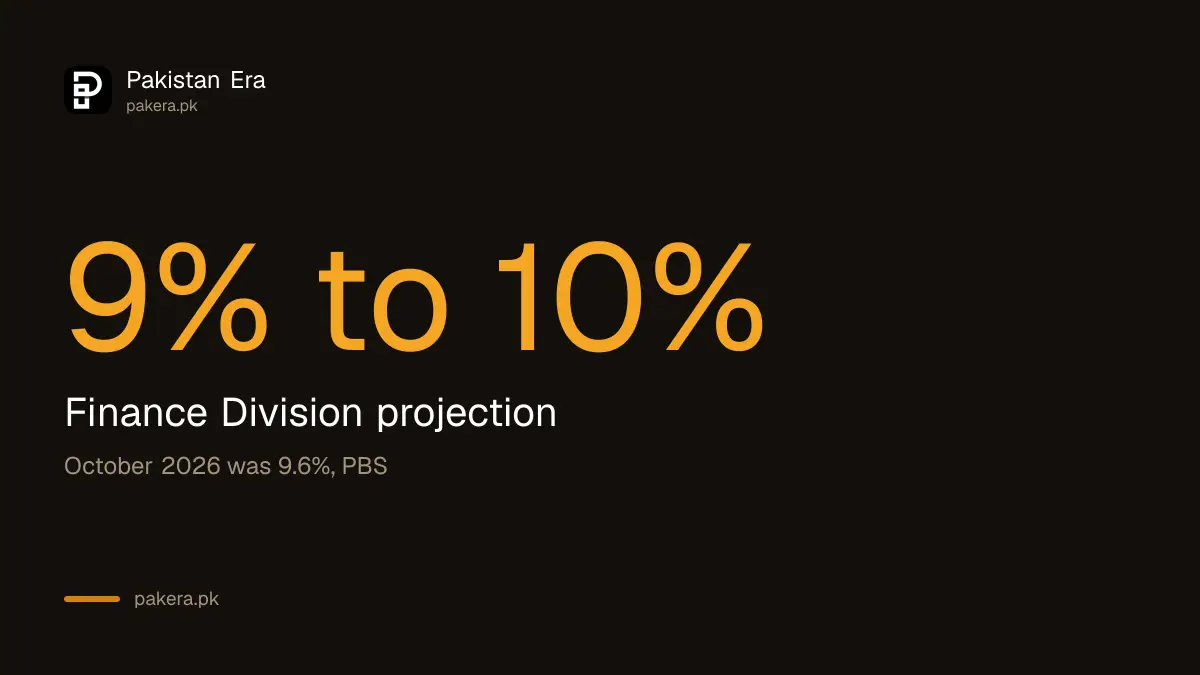
The Finance Division expects November inflation of 9% to 10%
The Finance Division projects headline consumer price inflation of 9.0% to 10.0% for November 2026. It says lower domestic fuel prices during the month push the risk towards 9%. After that, the path depends on world energy prices, food supplies and base effects.
Base effects mean the comparison with the same month last year. Inflation was low in late 2025, so any price rise this year looks larger in the yearly rate. October 2025 inflation was only 6.2%.
| Month | CPI inflation, year on year |
|---|---|
| October 2025 | 6.2% |
| September 2026 | 10.3% |
| October 2026 | 9.6% |
| November 2026 (Finance Division forecast) | 9.0% to 10.0% |
| Average, July to October 2026 | 10.1% |
| Average, July to October 2025 | 4.8% |
The full October breakdown, item by item, is in the October 2026 inflation figures, and every month of the year sits in the 2026 monthly inflation list.
Energy is still the main source of price pressure
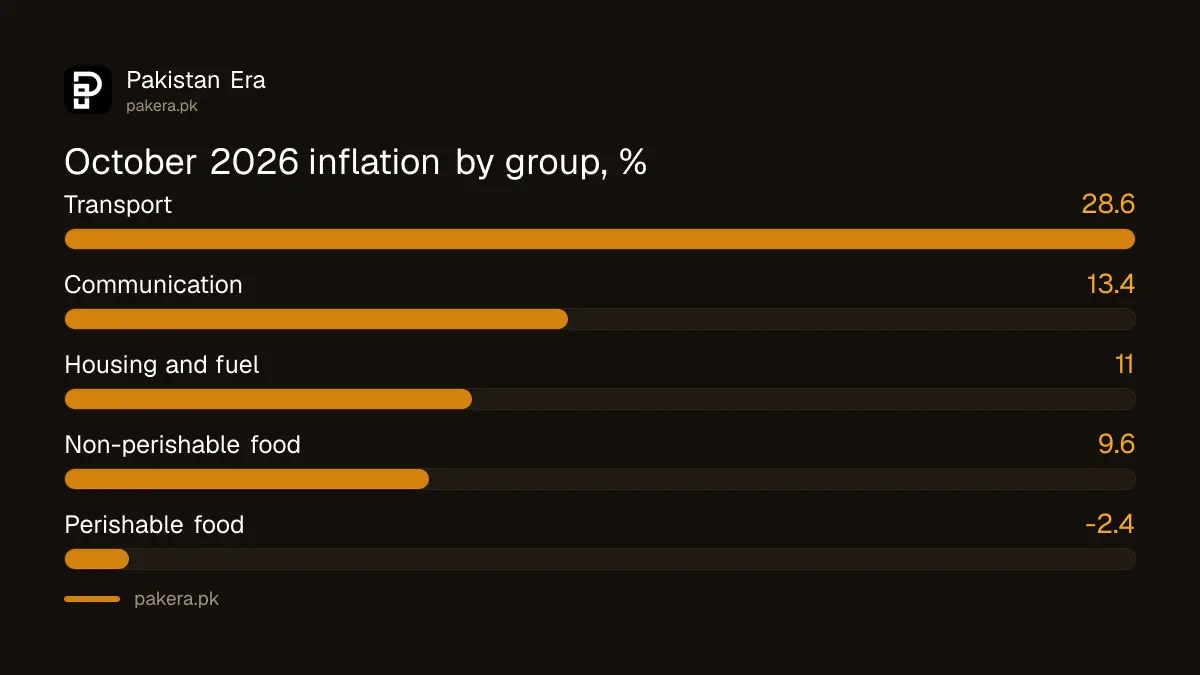
Energy-linked prices drive most of today's inflation. In October, transport prices were 28.6% higher than a year earlier, communication 13.4% and housing, water, electricity, gas and fuels 11.0%. Perishable food was 2.4% cheaper, which held the headline rate down.
- Non-perishable food: 9.6% up on a year earlier.
- Clothing and footwear: 9.2%.
- Health: 8.1%.
- Education: 8.0%.
- Restaurants and hotels: 6.0%.
The report also points to oil. Brent crude was $89.4 a barrel on 23 November, and the Division says a lasting fall would lower the import bill, transport costs and inflation. The weekly Sensitive Price Indicator fell 0.11% in the week to 26 November, with 20 items up and 9 down.
FBR collection is Rs 94.2 billion behind target
The Federal Board of Revenue (FBR) collected Rs 4,089.8 billion in net taxes from July to October 2026, up 6.6% on a year earlier. That is Rs 94.2 billion, or 2.3%, below the target of Rs 4,184.0 billion. Indirect taxes grew faster than income tax.
| Tax head, July to October 2026 | Growth on a year earlier |
|---|---|
| All FBR net taxes | +6.6% (Rs 4,089.8 billion) |
| Indirect taxes | +9.3% |
| Sales tax | +12.1% |
| Federal excise duty | +7.1% |
| Direct taxes | +3.6% |
| Customs duties | +1.8% |
The Division says direct taxes and customs grew slowly because of a high base: they had grown about 12% and 11% in the first quarter of last year. For the first quarter alone, the combined federal and provincial accounts showed a surplus, set out in the July to September budget surplus.
The external account improved in October
The current account showed a $39 million surplus in October 2026, against a $307 million deficit in October 2025. For July to October, the deficit was $850 million, 20.0% smaller than a year earlier. Remittances of $14.8 billion covered the whole goods and services trade gap.
| July to October | 2025 | 2026 |
|---|---|---|
| Workers' remittances | $13.0 billion | $14.8 billion (+14.0%) |
| Goods trade deficit (SBP) | $10.5 billion | $12.3 billion (exports $11.4 billion, +8.1%) |
| Current account | -$1,062 million | -$850 million |
| Foreign direct investment | $764.4 million | $935.7 million (+22.4%) |
| Overall balance of payments | +$40 million | +$3.27 billion |
Portfolio inflows reached $3.07 billion, mainly the $3.0 billion Eurobond sold in September. SBP's liquid reserves stood at about $21.6 billion in mid-November, and the country's total at $26.7 billion. The weekly detail is in the SBP reserves for 20 November. The October surplus is broken down in the October current account figures.
Factories and bank lending picked up
Large-scale manufacturing grew 2.5% in September 2026 and 2.1% in the first quarter. From July to October, car production rose 24.4%, truck and bus production 55.4% and cement dispatches 2.9% to 17.9 million tonnes. Private sector borrowing was Rs 226.3 billion, against a net repayment a year earlier.
- House building finance: Rs 142 billion lent in July to October 2026, against Rs 8.4 billion a year earlier.
- Car financing: Rs 35.0 billion, against Rs 39.0 billion a year earlier.
- Fixed investment loans to businesses: Rs 93.5 billion, against Rs 74.0 billion.
- Cement: local dispatches up 5.9% to 14.9 million tonnes, exports down 9.5% to 3.1 million tonnes.
The Division names three risks to this outlook: a new escalation in the Middle East, climate shocks to farming, and tighter global financial conditions.
What the forecast means for your budget
If November inflation lands at 9% to 10%, a basket that cost Rs 50,000 in November 2025 costs about Rs 54,500 to Rs 55,000 now. Prices are still rising, only more slowly than in September. Fuel cuts help most where transport is a big part of your spending.
Two practical points follow. First, a salary rise smaller than the inflation rate is a cut in real terms. Second, the weekly price index gives an early read: watch flour and LPG, both up very sharply on a year ago (LPG 67.49%, flour 53.53%), and compare the weekly numbers with the monthly CPI when PBS publishes it. How the two measures differ is explained in CPI, SPI, WPI and core inflation.
Common questions
What inflation does the government expect for November 2026?
The Finance Division projects 9.0% to 10.0%, with risks towards the lower end because domestic fuel prices were cut during the month.
What was inflation in October 2026?
CPI inflation was 9.6% year on year in October 2026, down from 10.3% in September.
When will the November 2026 inflation figure come out?
The Pakistan Bureau of Statistics releases the monthly CPI in the first days of the following month, so the November figure is due in early December 2026.
How much tax has the FBR collected this year?
Rs 4,089.8 billion from July to October 2026, up 6.6% but Rs 94.2 billion short of the Rs 4,184.0 billion target.
How much were remittances from July to October 2026?
$14.8 billion, 14.0% more than in the same four months of 2025.
What is the Monthly Economic Update and Outlook?
A short monthly report by the Economic Adviser's Wing of the Finance Division. It sums up the latest data on prices, taxes, trade, credit and markets, and gives a forecast for inflation.
How we verified this
What we checked and where we read it.
We read the Monthly Economic Update and Outlook, November 2026 on 28 November 2026. It is listed on the Finance Division website under 27 November 2026. Every figure on this page comes from that report, including its indicators table dated 27 November 2026. The sector growth figures quote the Division's own summary of PBS and SBP data. The Rs 50,000 basket example is our own arithmetic. Last checked: 28 November 2026.
Free on WhatsApp
Get the next change first on WhatsApp
Price changes, new rules and deadlines that affect your money, in a few short posts a day.
Follow Pakera on WhatsAppOther followers cannot see your number.
About the author

Global Affairs & Political Economy Writer
Muhammad Hatim is a book lover who started writing because he enjoys it. At Pakistan Era he writes about international relations, geopolitics and the global economy, with a particular interest in South Asia and the forces behind current events.