Fix "Google Chose a Different Canonical" in Search Console: Steps for Pakistani Websites
Google picked another page as the main copy of yours? Check the Google-selected canonical in Search Console, match the cause to the fix and request indexing.
Short answer: Open Search Console, inspect the page with the URL Inspection tool, and read "Google-selected canonical". If it is not the page you want, fix the cause: a wrong canonical tag, a server fault, or pages that are too similar. Then request indexing. Google says pages can stay clustered as duplicates for up to two weeks after you fix them.
A page can be live, crawled and still missing from Google because Google decided another URL is the "real" copy. For a Pakistani shop with product variants, or a news site that shares stories with partners, this is a common reason for a page that never ranks.
We read Google's canonicalization troubleshooting guide on 11 October 2026. Google last updated it on 21 August 2026, and its changelog says the 10 July 2026 change added a clearer time estimate for how long fixes take. We did not run these steps on a live client site, so the screens below follow Google's own wording.
A canonical is the copy Google chooses to show
When several URLs carry the same or very similar content, Google groups them and picks one to show in results. That one is the canonical. You can suggest one, but Google can choose a different page because of content quality or technical signals.
So "Google chose a different canonical" is not always an error. If your own http and https copies, or a tracking-link copy, are grouped, that is normal and desirable. It is a problem only when the page you need to rank is the one being left out.
Check which page Google considers canonical
Paste the URL into the URL Inspection tool in Search Console and look for the Google-selected canonical. Compare it with the URL you declared. Ask whether Google's choice makes more sense for people arriving from Google Search. Sometimes it does.
Google adds one warning. If the canonical it chose sits in a Search Console property that you do not own, you will not see the traffic for your duplicate page. That is why a copied or syndicated page can quietly take your visits.
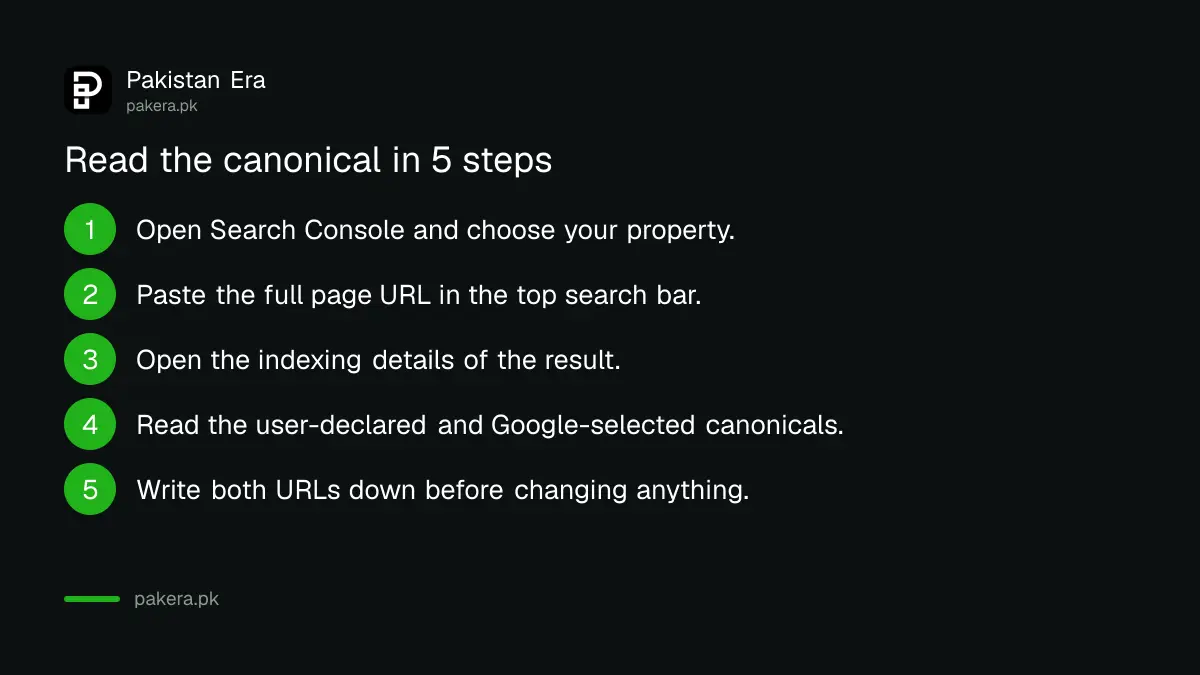
- Open Search Console and choose your property.
- Paste the full page URL in the search bar at the top.
- Open the indexing section of the result.
- Read the user-declared canonical and the Google-selected canonical.
- Write both URLs down before you change anything.
Match the cause to the fix
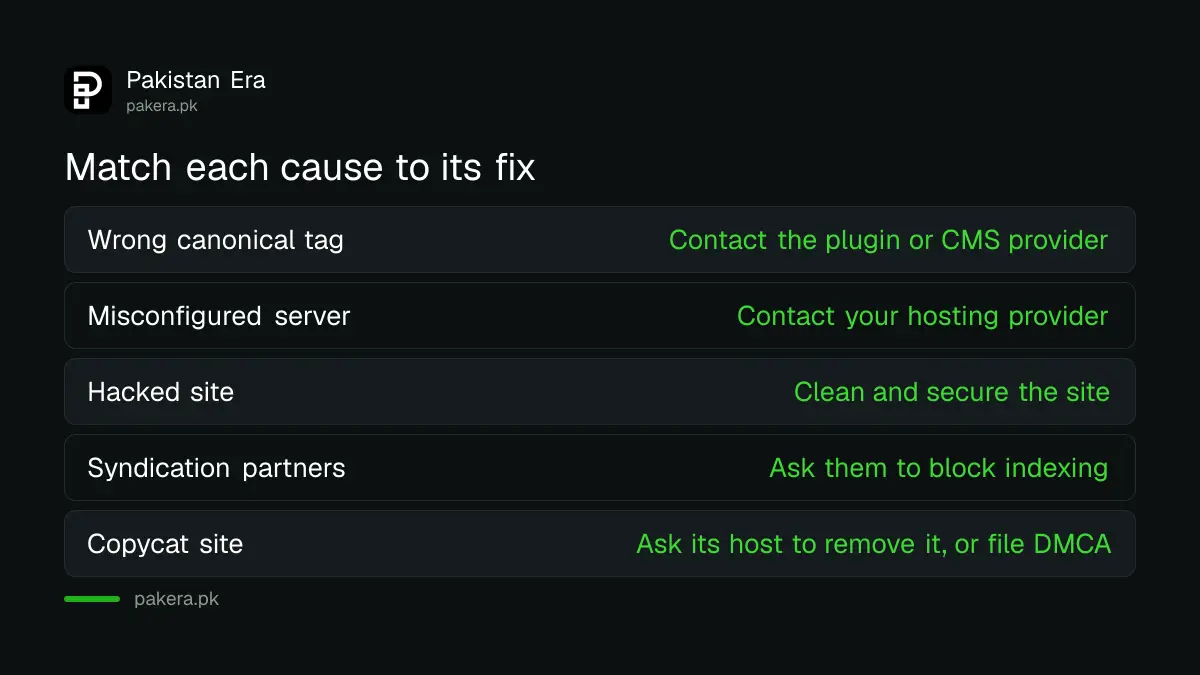
Google lists six common causes. Most small Pakistani sites meet one of three: a plugin writing the wrong canonical tag, a hosting setup that returns the wrong content, or near-identical pages. Find your row in the table, then act on it.
| Cause Google lists | What it looks like | What to do |
|---|---|---|
| Language variants without annotations | Same English content on several country sites | Add hreflang annotations |
| Incorrect canonical elements | A CMS or plugin points to the wrong URL | Check the page source, then contact the plugin or CMS provider |
| Misconfigured servers | One domain returns another domain's content, or identical soft 404 pages | Contact your hosting provider |
| Malicious hacking | Injected redirect or cross-domain canonical to a spam URL | Clean the site and secure it |
| Syndicated content | Partners republish your articles | Ask partners to block indexing of your content |
| A copycat website | Another site hosts your content without permission | Ask the host to remove it, or file a DMCA request with Google |
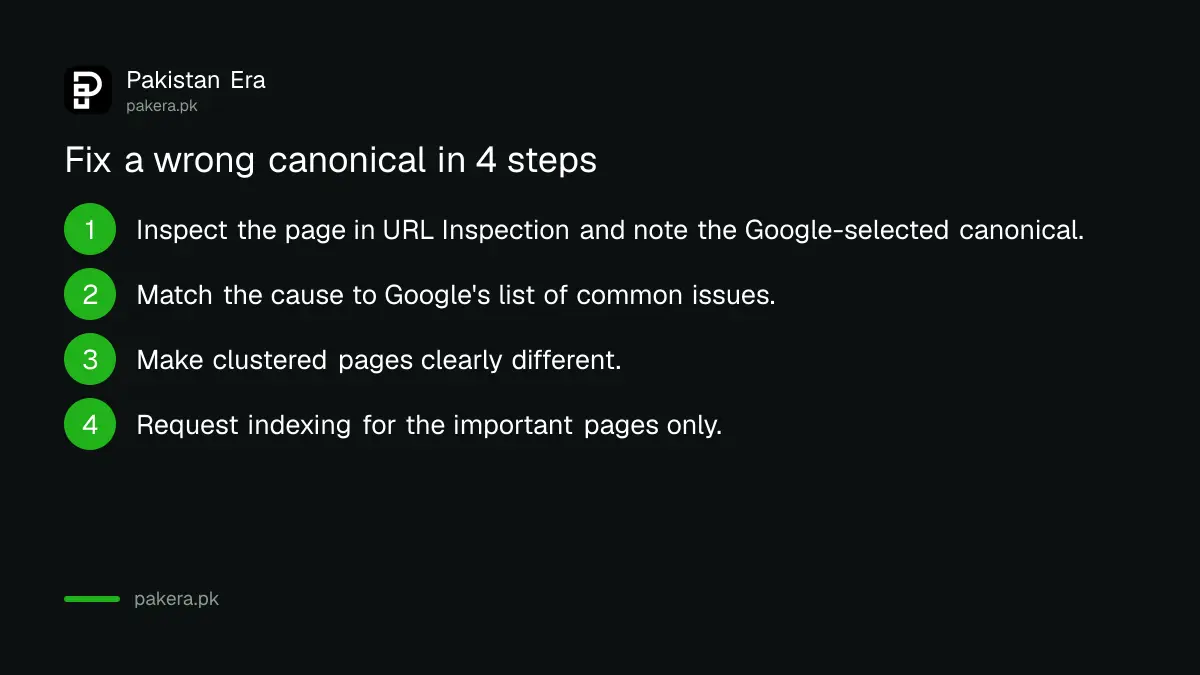
Make clustered pages clearly different
Google says the technical fix comes down to making pages that are grouped together sufficiently different. A product page for a red and a blue version of the same shirt with one copied description will keep clustering. Write real differences: size chart, fit, price, use.
Google also gives two expectations. First, re-evaluation takes time, and pages may stay held in a duplicate cluster for up to two weeks after content issues are fixed. Second, pages split out faster when the new content is clearly and significantly different from the others.
Request indexing, but only for pages that matter
After fixing the page, use Request Indexing in the URL Inspection tool so Google re-evaluates the clustered pages. The feature has quotas, so Google tells owners to save it for the most important URLs. Do not request a hundred product pages in one go.
If the page still will not index, the reason may not be duplication at all. Noindex tags, robots.txt blocks and server errors show up in the Page indexing report as separate reasons, each with its own fix.
Common questions
How long does Google take to fix a wrong canonical?
Google says pages can stay in a duplicate cluster for up to two weeks after you fix the content issues. Pages that are clearly different split out faster. Do not change the page again in the meantime.
Is "Google chose a different canonical" an error?
No, not by itself. It is a message that Google picked another URL as the main copy. It matters only when the chosen URL is not the one you want people to find.
Can I force Google to use my canonical tag?
No. Google treats your canonical as a signal and can choose differently for content quality or technical reasons. The only reliable route is to fix the signals and make the pages different.
What if another website has copied my article?
Google says an algorithm can rarely pick a URL from an external site that hosts your content without permission. You can contact that site's host to request removal, and you can file a DMCA request with Google.
Should I use the canonical tag for syndicated news content?
Google does not recommend it, because the partner pages are often very different. The most effective fix it names is for partners to block indexing of your content.
Does hreflang help Pakistani sites?
It helps if you run separate sites for different countries with substantially the same content, such as a Pakistan site and a UK site in English. A single Pakistan-only site does not need it for this problem.
How we verified this
What we checked, where we read it, and what we could not confirm.
Checked on 11 October 2026 against Google Search Central's page Fix canonicalization issues, last updated 21 August 2026, and its documentation updates page for the 10 July 2026 entry. We did not run the tool on a live property.
About the author

Founder and Editor
Umer Kureshi founded Pakistan Era in July 2024 and runs it as administrator, SEO lead and writer, overseeing website operations, search growth, content strategy and coverage of technology and current affairs.