How to Free a Woman or Girl Held Unlawfully: Section 552 in Pakistan
A Sessions Judge can order the immediate restoration of a woman or a girl under sixteen who is abducted or held unlawfully. See what the complaint needs.
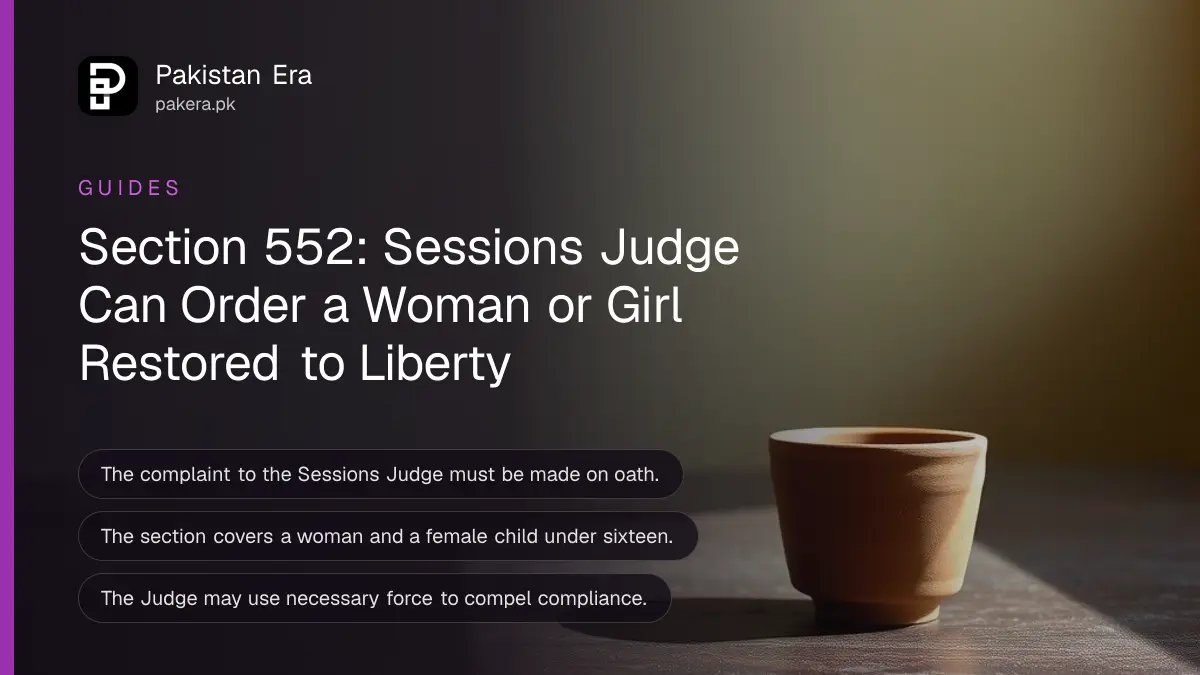
A complaint on oath to a Sessions Judge can lead to an order for the immediate restoration to liberty of a woman, or of a girl under sixteen, who is abducted or unlawfully detained for any unlawful purpose. Section 552 of the Code of Criminal Procedure gives the Judge power to enforce it with the force necessary.
When a woman or a child is being held and the family cannot get the police to act, people look for the fastest legal door. Section 552 is one such door. We read it, with the sections around it, in the Code of Criminal Procedure, 1898, on 21 October 2026. For a missing person whose whereabouts are unknown, start with the guide to reporting a missing person in Pakistan.
Section 552 lets a Sessions Judge order a woman or girl restored to liberty
Upon a complaint made on oath to a Sessions Judge of the abduction or unlawful detention of a woman, or of a female child under sixteen years, for any unlawful purpose, he may make an order for the immediate restoration of the woman to her liberty.
For a girl, the Judge may order her restored to her husband, parent, guardian or other person with lawful charge of her. He may compel compliance with the order, using such force as is necessary. The text does not set a deadline for his decision.
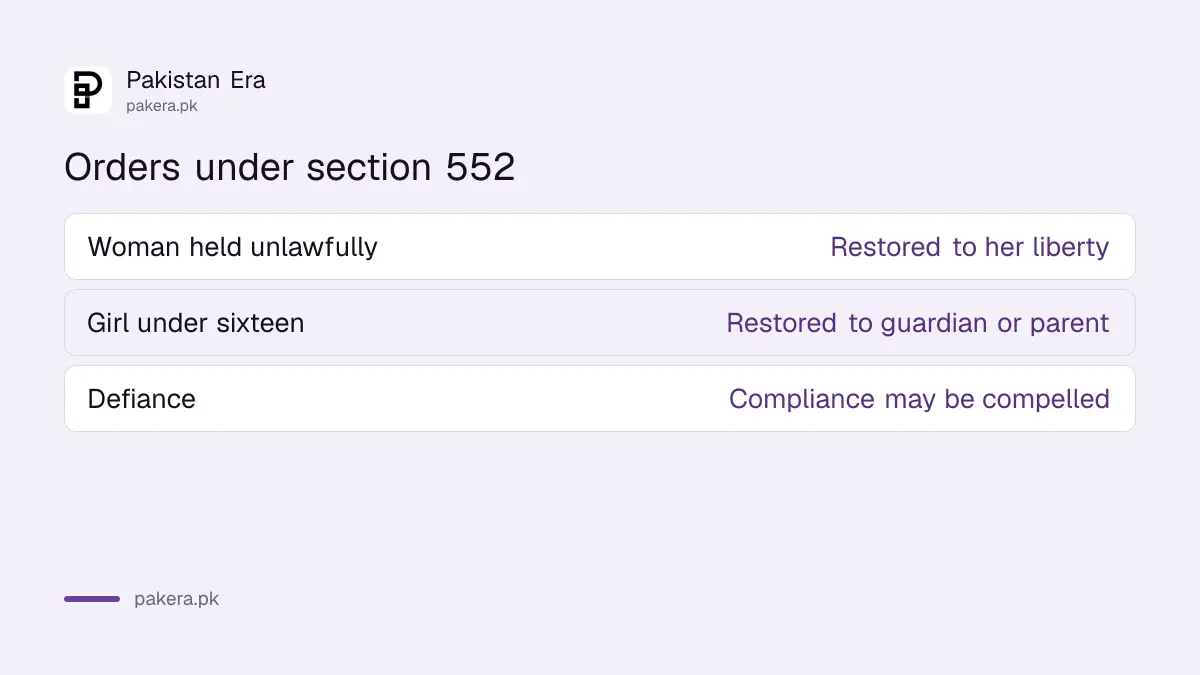
| Person held | Order the Judge may make |
|---|---|
| A woman held unlawfully | Immediate restoration to her liberty |
| A female child under sixteen | Restoration to husband, parent, guardian or person in lawful charge |
| Anyone who defies the order | Compliance may be compelled, using force if necessary |
The complaint must be on oath and name an unlawful purpose
The section requires a complaint made on oath. This means a sworn statement, usually backed by an affidavit. It must say that the woman or girl has been abducted or is being unlawfully detained, and that this is for an unlawful purpose.
Include her full name, age, address, who holds her and where, the date she was taken, and any police report numbers. Attach proof of age for a girl, such as a birth certificate or B-Form. Our guide to attesting an affidavit before an oath commissioner in Punjab shows how the oath is taken.
Report to the police as well, because section 552 does not replace an FIR
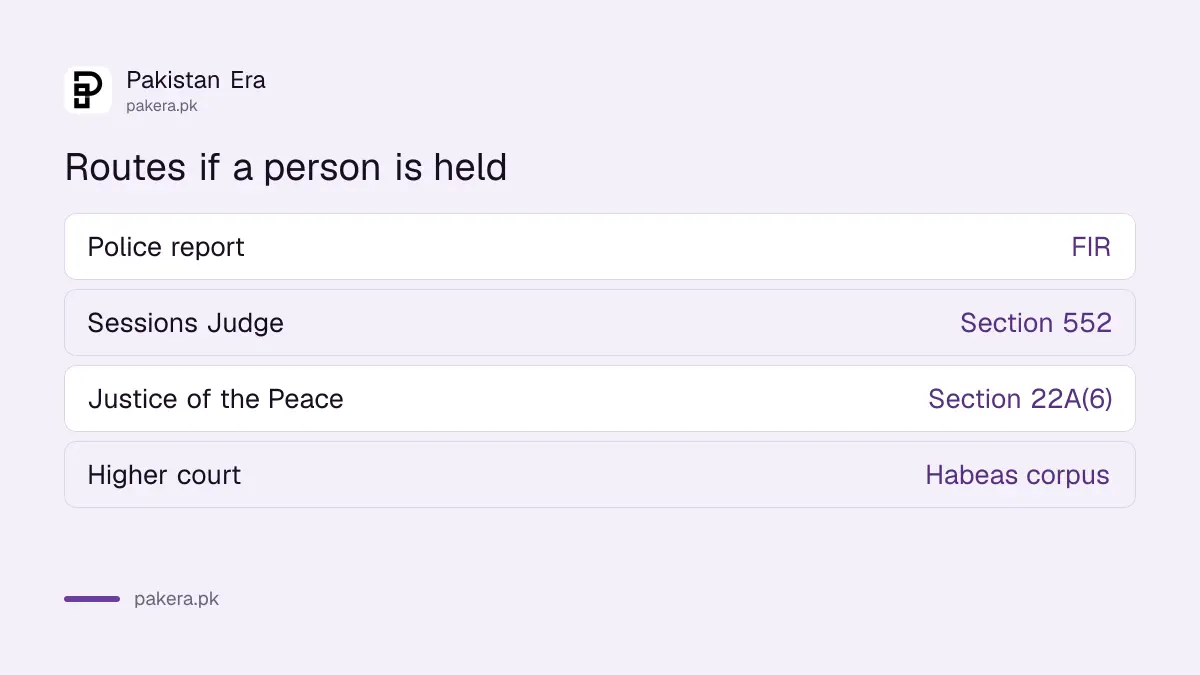
Section 552 is a separate remedy before the Sessions Judge. It does not stop you from reporting an offence to the police. If police refuse, our page on getting an FIR registered explains the options.
The Sessions Judge is also an ex officio Justice of the Peace under section 25, and section 22A(6) lets a Justice of the Peace issue directions where an offence is not registered. Use that route when the main problem is police inaction. Use section 552 when the main problem is that a person is being held.
Courts decide who is held, so evidence of the holding matters
The Judge must be satisfied that the detention is unlawful. Bring anyone who saw the abduction, messages, call records and any CCTV you can legally obtain. We did not read court rulings on what evidence is accepted, so treat this as a checklist, not a legal test.
The section turns on unlawful abduction or detention. Whether a given situation meets that test is for the Judge to decide on the evidence. We read no court rulings on how that is judged.
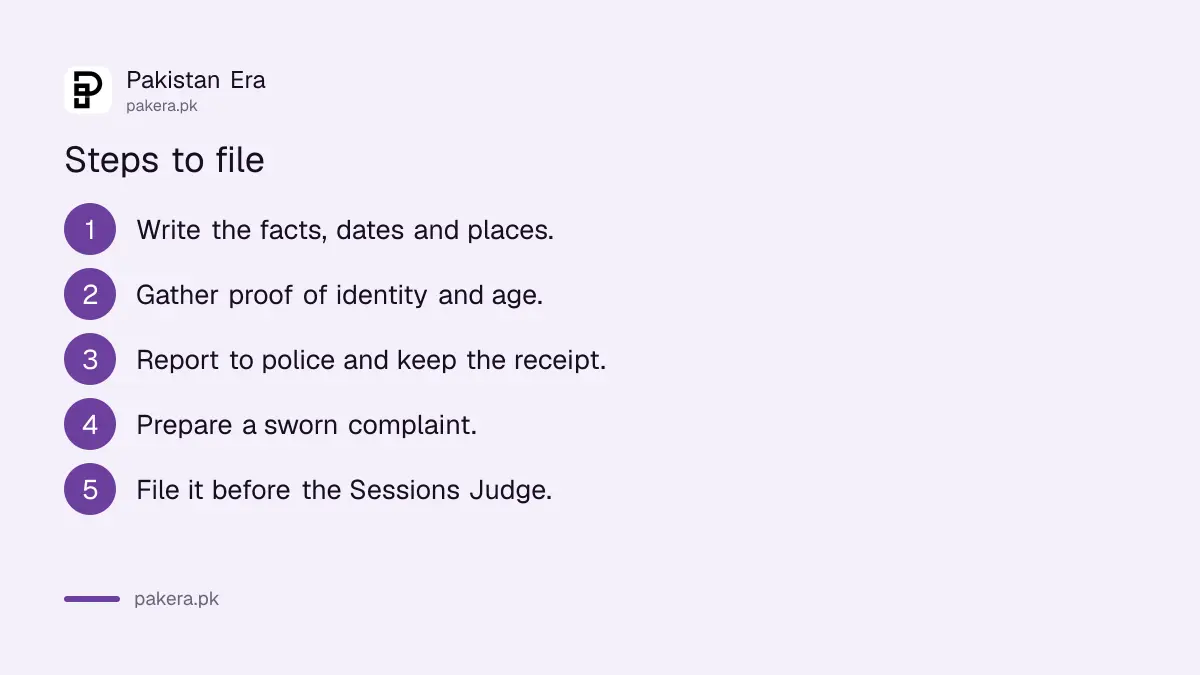
- Write down the facts, dates and places in order.
- Gather proof of identity and age for the woman or girl.
- Report to the nearest police station and keep the receipt.
- Prepare a sworn complaint and have it attested.
- File it before the Sessions Judge of the district through a lawyer.
- Attend each hearing and bring your witnesses.
Other remedies exist if the person is an adult held without law
A related route is a petition to a higher court over unlawful detention. Our page on a habeas corpus petition covers that route in the Federal Constitutional Court. Ask a lawyer which forum suits your facts.
The section names a woman and a female child under sixteen. It does not name men or boys, so for them ask a lawyer about other remedies.
Common questions
Who can file a section 552 complaint?
The section says only "complaint made on oath". It does not list who may make it. Family members or other concerned people usually file.
Is there a court fee?
The Code names none. We could not check current fee rules, so ask the court's reader.
Does the Judge have to act at once?
The Code says "immediate restoration" if he orders it, but sets no time for deciding the complaint.
What if the girl is under sixteen but married?
The section lets the Judge restore her to her husband, parent, guardian or person in lawful charge. Other laws on child marriage may apply, and we did not read them here.
Is the age limit still sixteen?
The text we read says sixteen. A footnote shows the number was changed once before. We could not check for later amendments.
How we verified this
What we checked, where we read it, and what we could not confirm.
Last checked 21 October 2026. We read sections 552, 22A, 22B and 25 of the Code of Criminal Procedure, 1898, in the Pakistan Code PDF marked as last amended on 16 February 2017, from a copy saved earlier this week. The Pakistan Code portal did not open for us on the day, so later amendments are unchecked. We did not read court rulings, High Court rules or child marriage laws.
About the author

Global Affairs & Political Economy Writer
Muhammad Hatim is a book lover who started writing because he enjoys it. At Pakistan Era he writes about international relations, geopolitics and the global economy, with a particular interest in South Asia and the forces behind current events.