How to File a Habeas Corpus or Fundamental Rights Petition in the Federal Constitutional Court
How to file a habeas corpus or fundamental rights petition at the Federal Constitutional Court of Pakistan: affidavit, copies, 7 day hearing and no court fee.
Short answer: A habeas corpus petition goes to the Registry of the Federal Constitutional Court with an affidavit from the detained person or, if that is not possible, from someone who knows the facts. The Rules say it must be fixed for hearing within 7 days of filing, and no court fee is payable on it.
When a family member is taken and nobody will say where, the first hours decide everything. People waste them looking for the right form. The court's new rules answer the question in a few lines, and they are worth reading before you call a lawyer.
We read Order XXVI of the Federal Constitutional Court (Practice and Procedure) Rules, 2026, which covers petitions under Article 175E, as printed in the Gazette of Pakistan of 16 September 2026. We also read the court's website. We did not file a petition.
Order XXVI sets the procedure for habeas corpus petitions
Habeas corpus means asking the court to order that a detained person be produced and the detention justified. Under Order XXVI rule 1, the petition is filed in the Registry or a Branch Registry, with an affidavit from the person held, or from another person who knows the facts.
The petition must also say whether you already asked the High Court for the same relief, and what happened. This is not a formality. Say clearly if a High Court petition is pending, was dismissed or was never filed.
The court's own About page lists enforcement of fundamental rights under Article 175E(3) among its core functions. The Rules add one condition in the proviso to rule 1: this jurisdiction is exercised only on an application made before the court and subject to the court's satisfaction.
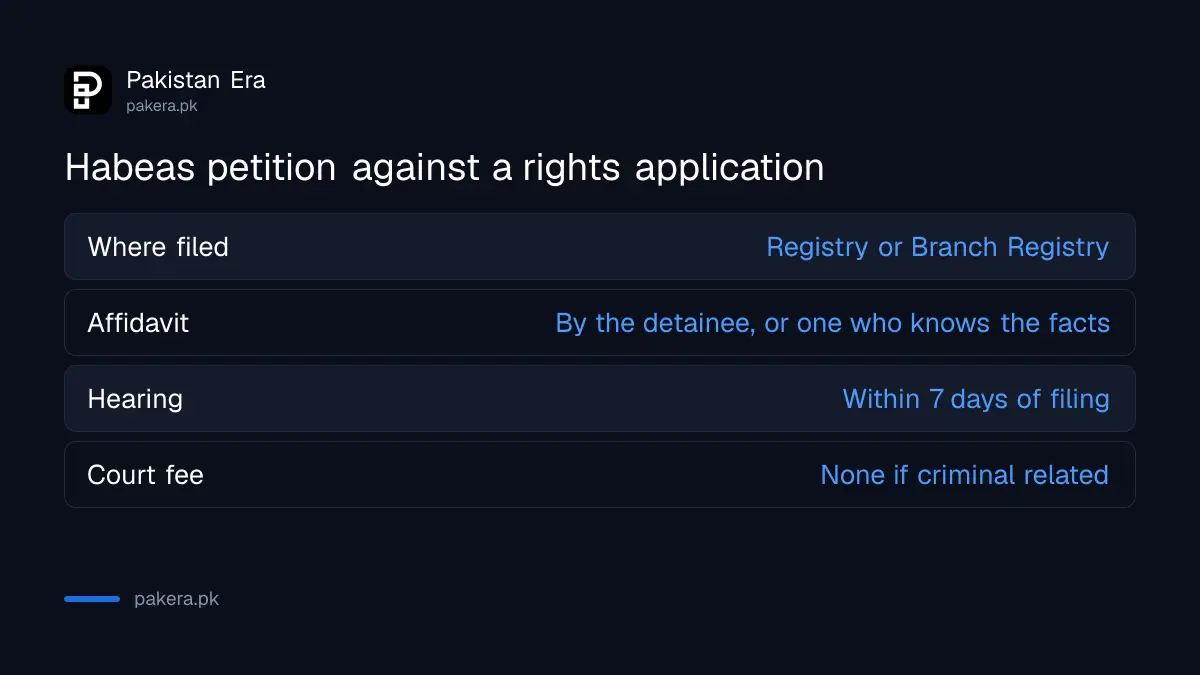
| Item | Habeas corpus petition | Other fundamental rights application |
|---|---|---|
| Where filed | Registry or Branch Registry | Registry |
| Affidavit | From the person restrained, or another who knows the facts | Verifying the facts relied on |
| Copies | Not specified in the rule | Not less than eight |
| Must state | Whether the High Court was approached, and the result | Name, relief sought, grounds, High Court history |
| Hearing | As early as possible, within 7 days of filing | At least eight clear days after notice of motion is served |
| Court fee | None for criminal related petitions | Ask the Registry; the Third Schedule sets fees |
Filing is free for criminal related petitions
Rule 2 says no court fee is payable on a habeas corpus petition, or on any other Article 175E(3) petition arising out of criminal proceedings or connected with them. Nobody should ask you for a "filing fee" for such a petition. If they do, ask for the rule in writing.
Other costs still exist. Copying, a lawyer and travel to the registry are real expenses. Rule 5 lets the court award costs at the end, so an unfounded petition can cost you.
If you cannot afford a lawyer, see how free legal aid works in Punjab. In a criminal case, bail is a different remedy with a different forum, which we explained in how to get bail in Pakistan.
How the court handles a habeas petition after you file
If the court is satisfied that a prima facie case exists, it issues a rule nisi. That is an order calling on the people holding the detainee to appear and show cause. At the same time it can direct that the detained person be produced before the court.
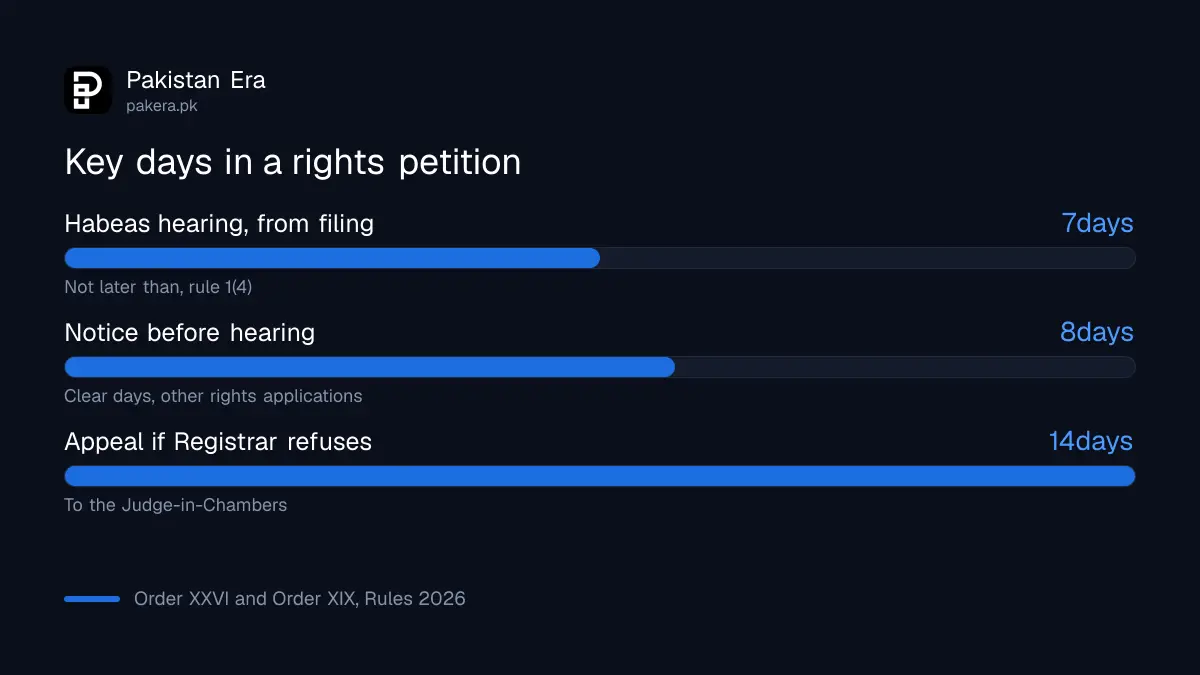
On the date fixed, the court hears those present and passes the order it considers just. Rule 5 allows costs either way. The hearing timeline is fast on paper: not later than seven days from the filing date.
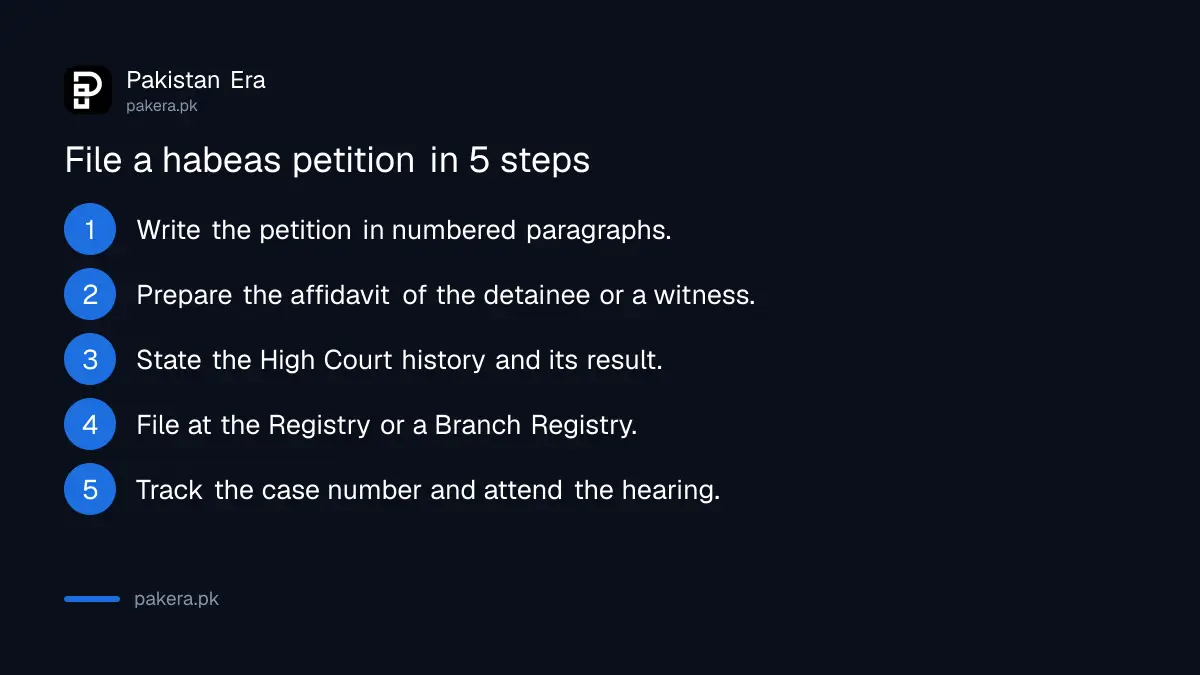
- Prepare the petition in numbered paragraphs, typed or written legibly, as Order XIX requires for petitions generally.
- Prepare the affidavit. If the detainee cannot sign, a person with knowledge swears it and states why the detainee could not.
- Write the High Court history: filed or not, and the result.
- Take the set to the Registry or a Branch Registry. The cause list page groups lists by Islamabad, Karachi, Lahore, Peshawar and Quetta.
- Note the case number and track it on the court's online case information page.
- Attend on the date. If you are told of a rule nisi, make sure the respondent has been served.
Other fundamental rights applications work differently
An application to enforce another fundamental right is filed in the Registry with an affidavit and not less than eight copies. It starts by notice of motion. The court allows at least eight clear days between service of notice and the hearing, unless it directs otherwise.
The application names the applicant, the relief sought and the grounds. It must also say whether the High Court was approached and with what result. Notice goes to all persons directly affected, and the court can let a proper party be heard even without notice, subject to costs.
This route is slower than habeas corpus on purpose, because the other side must be heard. If the issue is a delayed police report rather than an arrest, our page on what to do in Punjab when police delay your FIR shows the cheaper first steps.
Where to ask and what to be careful about
The court lists a helpline on +92 51 111 322 322 and the email info@fccp.gov.pk on its contact page, with its address at Constitution Avenue, G-5/2, Islamabad. Confirm every date with the registry yourself. Do not rely on a middleman's word for a hearing date.
Urgent matters have a definition in Order II: a matter that needs immediate hearing to prevent irreparable loss, injury or injustice. If a person is in danger now, tell the registry that in plain words and ask for the matter to be placed before a judge.
Common questions
Where do I file a habeas corpus petition at the Federal Constitutional Court?
In the Registry or a Branch Registry, under Order XXVI rule 1 of the 2026 Rules.
Who signs the affidavit?
The person alleged to be restrained. If they cannot, another person with knowledge swears an affidavit and gives the reason.
Is there a court fee?
No court fee is payable on a habeas corpus petition or an Article 175E(3) petition arising from criminal proceedings.
How fast must it be heard?
As early as possible and not later than seven days from filing, under rule 1(4).
Must I go to the High Court first?
The petition must state whether you approached the High Court and the result. The rule does not use the words "must go first". Ask a lawyer about your own facts.
How we verified this
What we checked, where we read it, and what we could not confirm.
Last checked on Sunday 11 October 2026. We read Order XXVI, Order XIX and Order II of the Federal Constitutional Court (Practice and Procedure) Rules, 2026, as listed on the court's notifications page, and the court's About Us and Contact Us pages. This is general information, not legal advice.
About the author

Public Services and Education Journalist
Fajr Riaz is a journalist and content writer at Pakistan Era, based in Lahore. She covers the questions people meet in everyday life in Pakistan: how a public service works, what a change in the rules means, and where to find a reliable answer.