Environmental Approval for Mining and Stone Crushing in Punjab: EPA Papers Checklist
EPA Punjab asks mining, crushing and smelting projects for colour maps, a no-dredger undertaking, a closure plan and an explosives NOC. See the 14-item list.
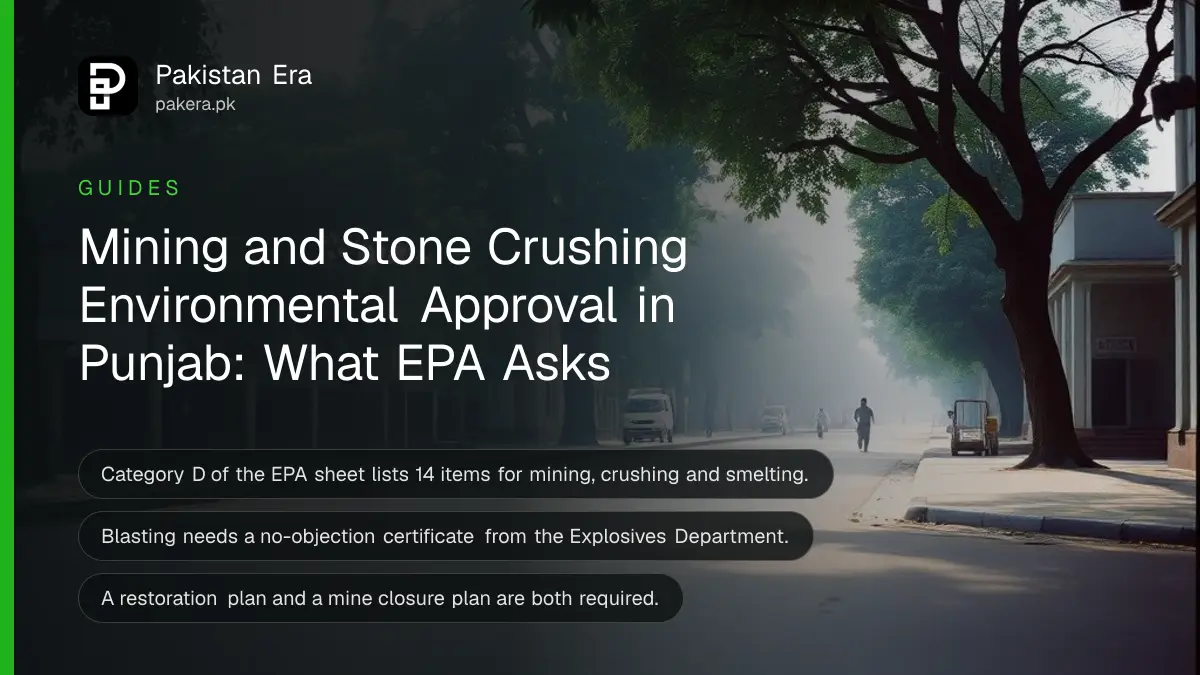
A mining, crushing or smelting project in Punjab must give EPA Punjab colour maps of the site, an undertaking not to use a dredger or cut thick vegetation, a restoration plan, a mine closure plan and, if you blast, a no-objection certificate from the Explosives Department. These are among 14 items in category D of the agency's "Specific points" sheet, the list its reviewers use when an IEE or EIA report has gaps.
We read the sheet on 22 October 2026. It covers mining, crushing and smelting in one category, so a stone crusher and a coal miner answer many of the same questions. Start with the shared 16 general points, then this list. The process, with review times of 45 days for an IEE and 90 days for an EIA, is in the guide to Punjab environmental approval.
Colour maps must show homes, water and roads around the site
The sheet asks for coloured Google Earth maps, at A3 or A2 size, marking the project area and its distance from homes, water bodies, highways and other sensitive receptors. It also wants details of those receptors and the buffer distance you will keep around each.
Order the maps early and check the distances on the ground. A buffer you quote from a map and cannot defend at the site visit will cost you time in review. The sheet also asks for the nature of each block or zone as per the local council's record.
Three undertakings are specific to mining
The sheet asks for a signed undertaking with three statements. No dredger will be used for excavation. Thick vegetation will not be damaged or cut. Any land acquisition issues will be settled before excavation work starts, on priority.
Sign only what you can keep. The sheet also asks for the mode of excavation and the threshold limits of extraction, so what you write there should match the undertakings.
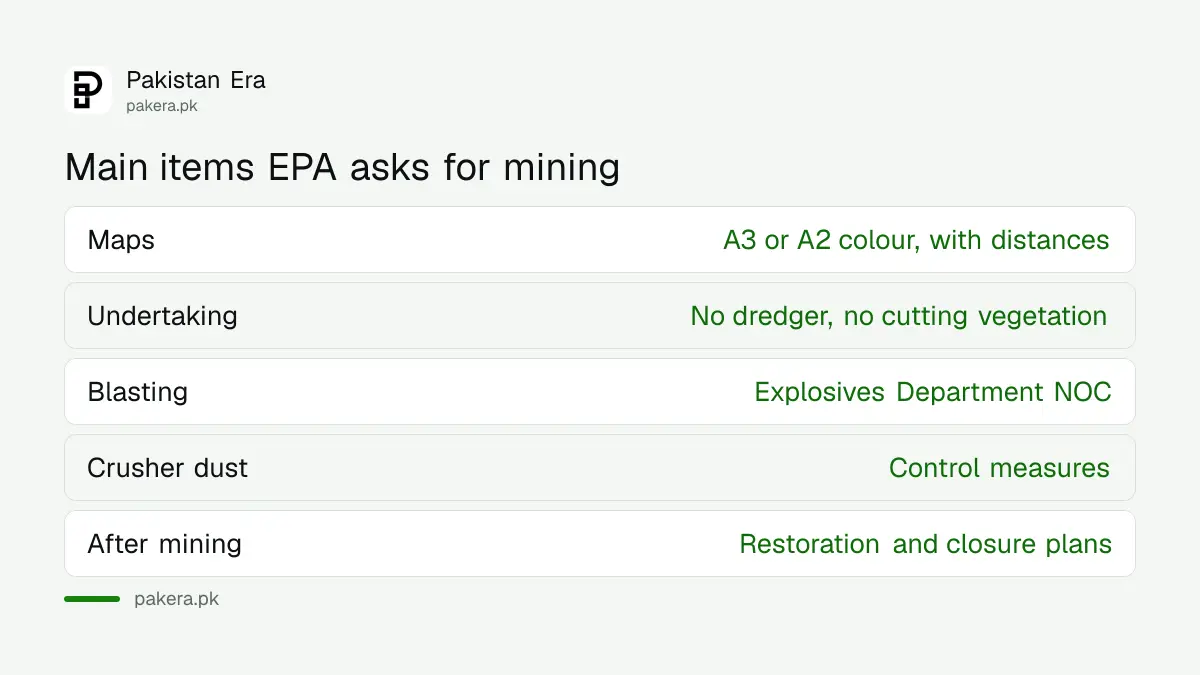
| Item | What EPA asks |
|---|---|
| Excavation | Mode of excavation and extraction limits |
| Maps | Coloured A3 or A2 maps with distances to homes, water and roads |
| Buffers | Details of receptors and buffer distance around each |
| Undertaking | No dredger, no cutting thick vegetation, land issues settled first |
| Blasting | NOC from the Explosives Department |
| Smelting | Furnace drawings, ignition source, dust controls |
| Crushing and grinding | Measures to control crusher dust |
| After mining | Restoration and rehabilitation plan, mine closure plan |
Smelters and crushers answer dust and furnace questions
For smelting, the sheet wants specifications and legible drawings of the furnace, the source of ignition, and control measures for particles and metal dust. For crushing and grinding units, it asks for measures to control dust from the crushers.
Dust from trucks and heaps is also a concern in smog season. The rules for covering loads are in the guide to covering sand and clay trolleys, and the sheet's own transport items ask for traffic management during construction.
You must plan how the site will be restored and closed
Two plans come at the end. A restoration and rehabilitation plan explains how the site will be restored after excavation. A mine closure plan covers shutting the mine down. The sheet also asks for best practice on land use change, soil erosion, overburden disposal and run-off.
Overburden is the soil and rock removed to reach the mineral. Put a cost next to each restoration action. A plan without a budget is the easiest one for a reviewer to mark as lacking. Special lines also cover coal, gold, copper, sulphur and precious stones.
Reviewers will also compare your answers across sections. If the restoration plan promises a planted buffer but the maps show no space for one, the file is likely to be marked as lacking. Keep the maps, the budget and the plans consistent with each other, and keep a signed copy of every undertaking in case an inspector asks to see it at the site.
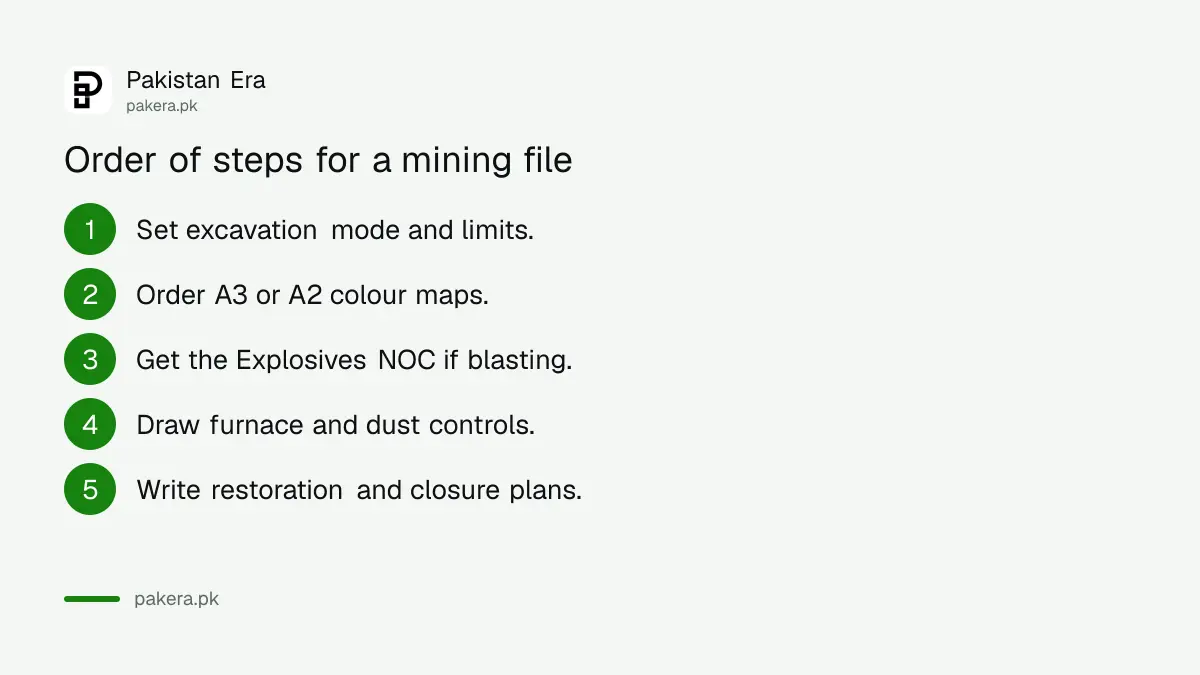
- Decide the mode of excavation and extraction limits.
- Order the A3 or A2 colour maps with distances marked.
- Obtain the Explosives Department NOC if you will blast.
- Draw the furnace and dust controls if you smelt or crush.
- Write the restoration and mine closure plans with budgets.
- Sign the three undertakings.
- Submit with the paper and electronic report copies.
Common questions about mining and crushing approval
Is a stone crusher covered by category D?
Yes. The category lists mining, crushing and smelting, and one question is about crusher dust.
Do I need the Explosives Department NOC if I do not blast?
The sheet asks for it "in case of blasting". It does not ask for it otherwise.
What is a sensitive receptor?
It is something nearby that pollution could harm, such as homes, a school or a water body. The sheet asks you to list them and the buffer distance.
Are there extra EPA guides for mining?
EPA Punjab also lists "Guidelines for preparation of ERs of mining projects" on its checklists page. We did not read that file.
Is the sheet a law?
No. It lists what reviewers ask. The binding rules are the regulations and the mining laws.
Who do I call?
EPA Punjab's helpline is 1373, and its email is ddisepa@punjab.gov.pk.
How we verified this
What we checked, where we read it, and what we could not confirm.
Last checked 22 October 2026. We read the EPA Punjab "Specific points" sheet, general points and category D, through the checklists page on epd.punjab.gov.pk. The file shows a 2022 date. We did not read the mining guideline file, the regulations or any mining law, and we cannot say which projects need an IEE or EIA. The table is our own summary.
About the author

Tax, Bills and Technology Writer
Ali Akhtar is a young and curious voice here at Pakistan Era. He is currently pursuing his A-Levels and has a growing interest in Pakistan’s changing industrial landscape and educational trends. Ali likes to write in a way that helps him explain and explore the world around him. His writing reflects the perspective of the new generation navigating the evolving trends of Pakistan where technology, youth innovation, and shifting opportunities are reshaping the country’s future.