How to Get a Sindh Zakat Scholarship at a Public University: Tuition Plus Rs 3,000 a Month
Sindh zakat pays a poor student's tuition at a public university plus up to Rs 3,000 a month for a year. Get an istehqaq certificate from the district chairman.
A poor student at a public university in Sindh can get tuition fees paid from zakat plus a stipend of up to Rs 3,000 a month for one year, by applying through the university's need-cum-merit scholarship committee with an istehqaq certificate from the chairman of the District Zakat and Ushr Committee. The university picks the students and sets the number of awards from the zakat grant it receives.
Most students hear about HEC and Ehsaas scholarships and never about this one, because the application does not go to the zakat office. It goes to the university. We read the educational stipend section of the Sindh Zakat Disbursement Procedure on the Auqaf, Religious Affairs, Zakat and Ushr Department's site on 19 October 2026, as amended by the Sindh Zakat Council on 17 April 2018.
The award covers tuition and up to Rs 3,000 a month, for one year at a time
Clause 16 says that in addition to the tuition fee, depending on the extent of need, a grantee may be paid up to Rs 3,000 stipend per month. Clause 17 fixes the duration at one year. Continuation depends on the next year's grant arriving and on the student's istehqaq still holding.
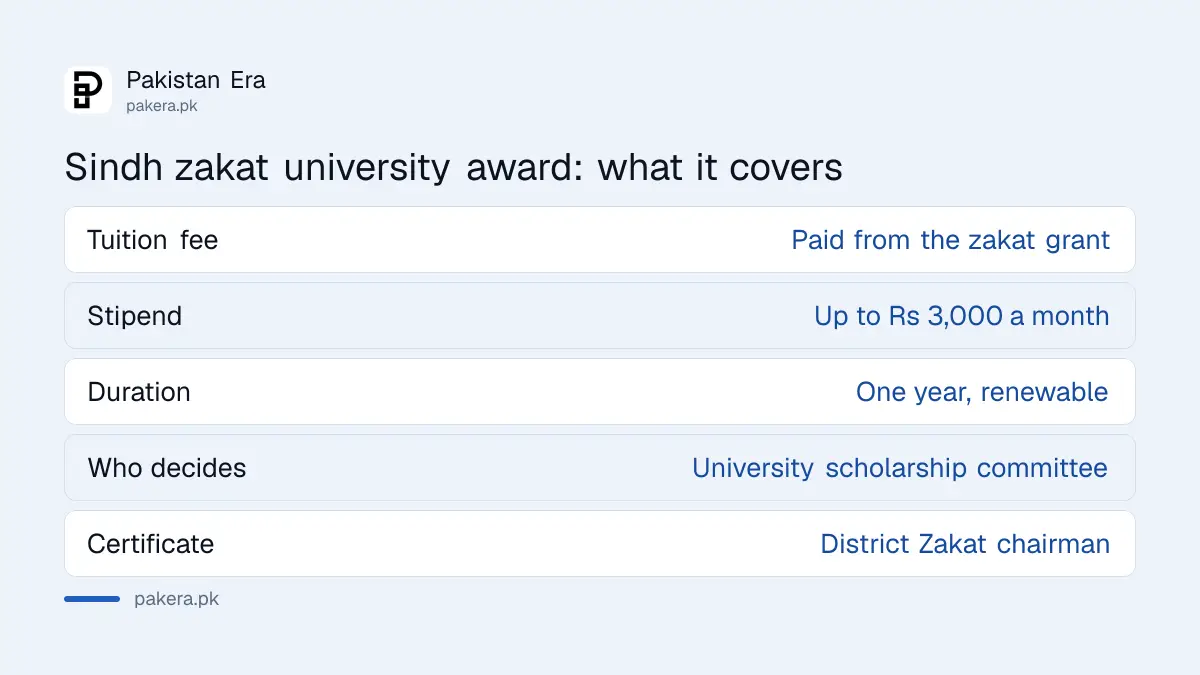
| Element | What the procedure says |
|---|---|
| Tuition fee | Paid from the university's zakat grant |
| Stipend | Up to Rs 3,000 a month, by need |
| Duration | One year, renewable on the next grant and continued istehqaq |
| Number of awards | Set by each university from the grant sanctioned to it |
| Who decides | The institution's Need-cum-Merit Scholarship Committee |
| Paid through | A joint account titled Need-cum-Merit Scholarship Committee at Sindh Bank |
Clause 15 lets the university adjust the number of scholarships so the grant stretches to cover fees and stipends. A university with a small grant may fund fees only. Ask the financial aid office what this year's grant allows before you count on the Rs 3,000.
You must be enrolled or admitted at a public institution in Sindh and prove need
Clause 1 limits the scheme to public sector universities and institutions established in Sindh. Clause 8 says students in financial need who are already enrolled or have been offered admission in a participating institution can apply. A private university student cannot use this route.
Need is checked hard. Clause 11 says the family's financial background is thoroughly evaluated, including utility bills of the residence and family dependence. Clause 9(a) adds that the shortlisted students must be of high merit. So it is need first, then merit among the needy, which is what need-cum-merit means.
Clause 7 tells the committee to split awards fairly between genders in line with the student body. Clause 10 says the award follows Islamic principles of zakat disbursement, which in practice means the student must be a Muslim, as with every zakat head in Pakistan.
The istehqaq certificate comes from the District Zakat chairman, not the local committee
This is the detail most students get wrong. Clause 12 says no award is disbursed without an istehqaq certificate issued by the chairman of the District Zakat and Ushr Committee concerned. For the guzara allowance the local committee certifies; for the university scholarship the district chairman signs.
The procedure prints the certificate format. It states that the student is a permanent resident of the given address, is poor and deserving, and that the chairman has verified the position. Take your CNIC, your admission or enrolment letter and proof of the family's income or lack of it to the district zakat office.
If your family is already on a BISP list, the rules for a BISP undergraduate scholarship through HEC may suit you better, because that route does not depend on the district chairman's signature. A student can also look at the SEEF scholarship in Sindh, which the provincial endowment fund runs on its own criteria.
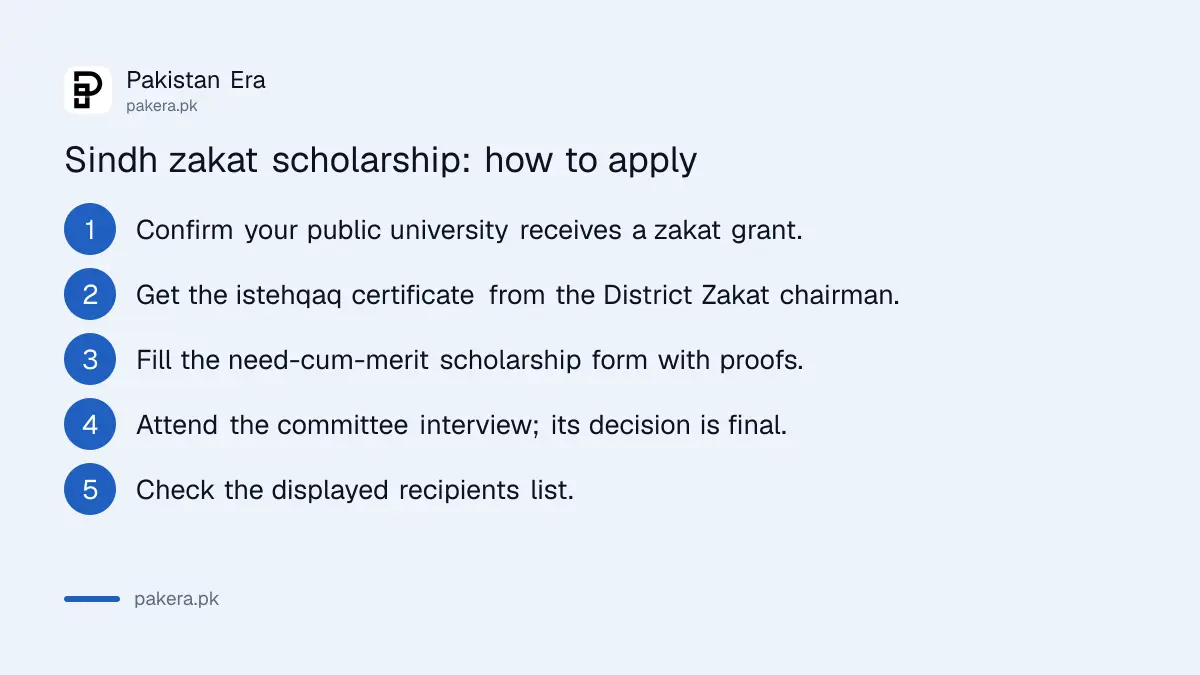
How to apply: certificate first, then the university's form
Clause 18 requires every university to keep a Need-cum-Merit Scholarship Form on the HEC pattern, with the istehqaq certificate added, and a committee that may include a representative of the zakat department. Clause 18(v) says the university must display the list of applicants and recipients every year.
- Confirm with your university's financial aid or student affairs office that it receives a zakat grant and when its committee meets.
- Get the istehqaq certificate from the chairman of the District Zakat and Ushr Committee for your permanent residence.
- Fill the university's need-cum-merit scholarship form and attach the certificate, CNIC, admission letter and income proof.
- Attend any interview the committee holds. Its decision is final under clause 13.
- Check the displayed list of recipients. If your name is there, the fee is paid from the joint account and the stipend follows monthly.
The university records your name, father's name, address, the certifying district committee, the certificate number, the annual scholarship amount, the monthly payments and remarks on your performance. Poor performance can end the award at renewal.
Deeni madaris students use a different form and a different committee
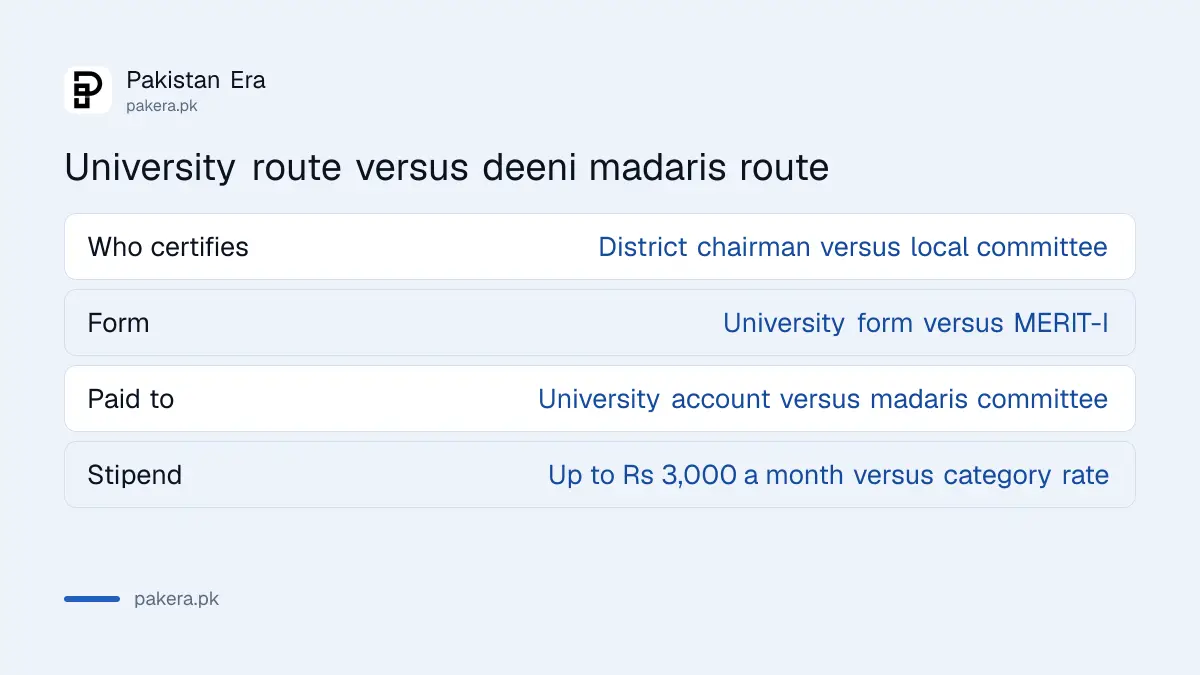
The same section of the procedure carries a separate route for students of deeni madaris. There the Local Zakat and Ushr Committee certifies istehqaq on a form called MERIT-I, which the student, a parent or the madrasa head can file. The committee must return the completed form within 30 days of receiving it.
The stipend rate depends on the madrasa's category, from model madaris set up by government and those affiliated with the Pakistan Madrasah Education Board at a preferential rate down to registered madaris recognised by a wafaq. The grant goes to a District Madaris Committee as an annual block, released in two halves, and the madrasa pays its students. The procedure does not print a rupee figure per student, so we cannot give one.
A madrasa approved for the annual grant can also claim a miscellaneous expenditure grant for the food, accommodation and clothing of resident students.
Common questions
How much is the Sindh zakat scholarship?
The tuition fee plus a stipend of up to Rs 3,000 a month, depending on need, for one year at a time.
Do I apply to the zakat department?
No. You apply to your public university's need-cum-merit scholarship committee. The zakat department pays the grant to the university.
Who signs the istehqaq certificate for a university student?
The chairman of the District Zakat and Ushr Committee for your permanent residence, not the local committee.
Can a private university student apply?
No. The procedure covers public sector universities and institutions established in Sindh.
Is the award renewed automatically?
No. It runs for one year. Renewal depends on the next grant and on your continued istehqaq, and the university decides.
Is there a zakat stipend for madrasa students?
Yes, through the Local Zakat and Ushr Committee on form MERIT-I, paid to the madrasa via a District Madaris Committee. The per-student rate is not printed in the procedure.
How we verified this
What we checked, where we read it, and what we could not confirm.
Last checked 19 October 2026. The Rs 3,000 monthly stipend, the tuition cover, the one year term, the public institution limit, the district chairman's certificate, the committee rules, the Sindh Bank joint account, the display requirement and the deeni madaris route with its 30 day form rule all come from the Educational Stipend sections of the Sindh Zakat Disbursement Procedure PDF, approved on 16 July 2011 and amended on 17 April 2018 after Sindh High Court petitions D-2248 of 2013 and D-214, D-652 and D-857 of 2017, on the Auqaf, Religious Affairs, Zakat and Ushr Department's site, read on 19 October 2026. The department's universities budget allocation page is for 2024-25 and we could not find a later one, so which universities received a grant this year, and how much, is unverified. We did not apply or speak to a university committee.
About the author

Global Affairs & Political Economy Writer
Muhammad Hatim is a book lover who started writing because he enjoys it. At Pakistan Era he writes about international relations, geopolitics and the global economy, with a particular interest in South Asia and the forces behind current events.