How to Get Witness Protection in Sindh Under the Witness Protection Act 2013
Apply to the Witness Protection Unit at Sindh's Home Department or ask the court. Who qualifies, what the Act gives, and the 20 year penalty for leaks.
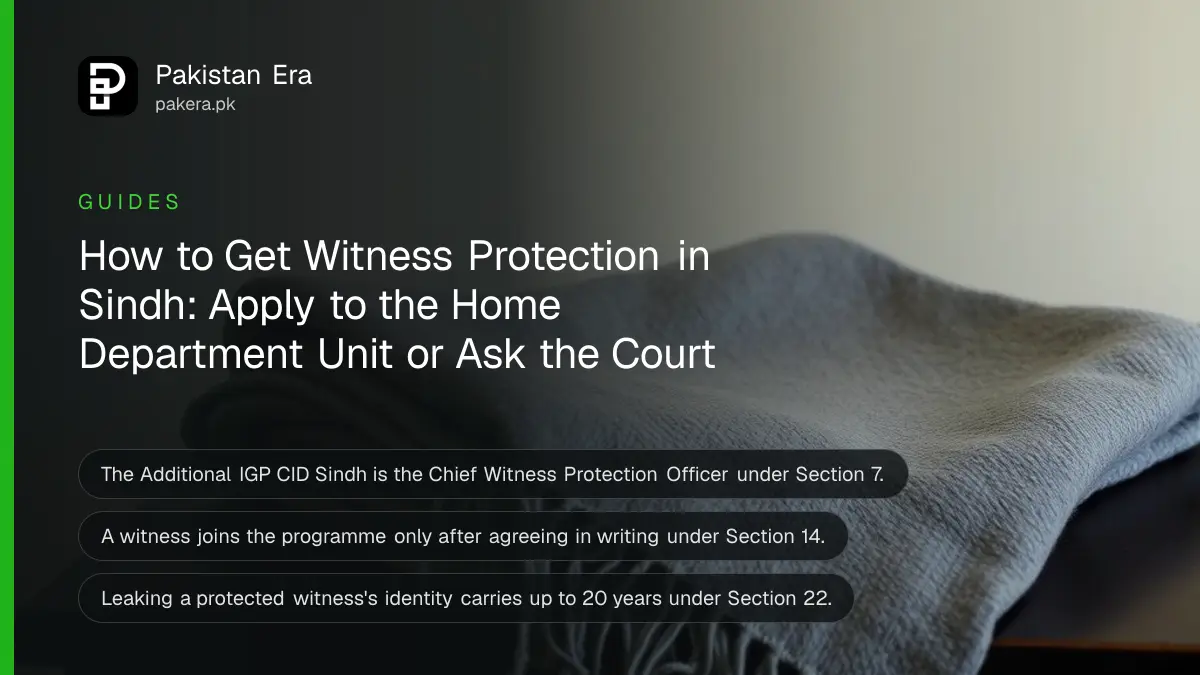
A threatened witness in a serious criminal case in Sindh can ask for protection under the Sindh Witness Protection Act, 2013 by applying in writing to the Witness Protection Unit at the Home Department, or by asking the trial court for an order. The decision rests with the Chief Witness Protection Officer, who is the Additional Inspector General of Police, CID Sindh. Protection can include a new identity, relocation, security, money for a livelihood, and compensation for the family if the witness is killed.
We read the full text of the Act on 19 October 2026 in the copy published by the Sindh Judicial Academy. The law has no rules under it yet, and the province told the Sindh High Court in October 2026 that it plans to amend the Act first. But the Act is in force, the unit exists, and the home department says it acts on applications. This is how it works, section by section.
Only witnesses in serious offences qualify
Section 2 defines a witness as a person who has given, or may be required to give, a statement or evidence about a serious offence, or who is related to such a person and may need protection because of that, or who has given important information to a public officer and agreed to give evidence for the State.
A serious offence is one with a maximum penalty of death or at least twelve months in prison, any offence under the Pakistan Penal Code, and any offence listed in the Schedule. The Schedule names treason, sedition, murder, rape, public violence, kidnapping, perjury, aggravated robbery, drug offences worth over Rs 1 million, terrorism offences, arms and explosives offences, and fraud, extortion or corruption over Rs 5 million. It also covers any offence committed by a gang or by a law enforcement officer.
A "threatened witness" is one whose life, or whose close relatives' lives, or property, is in likely danger because they are a witness. That is the test the unit applies.
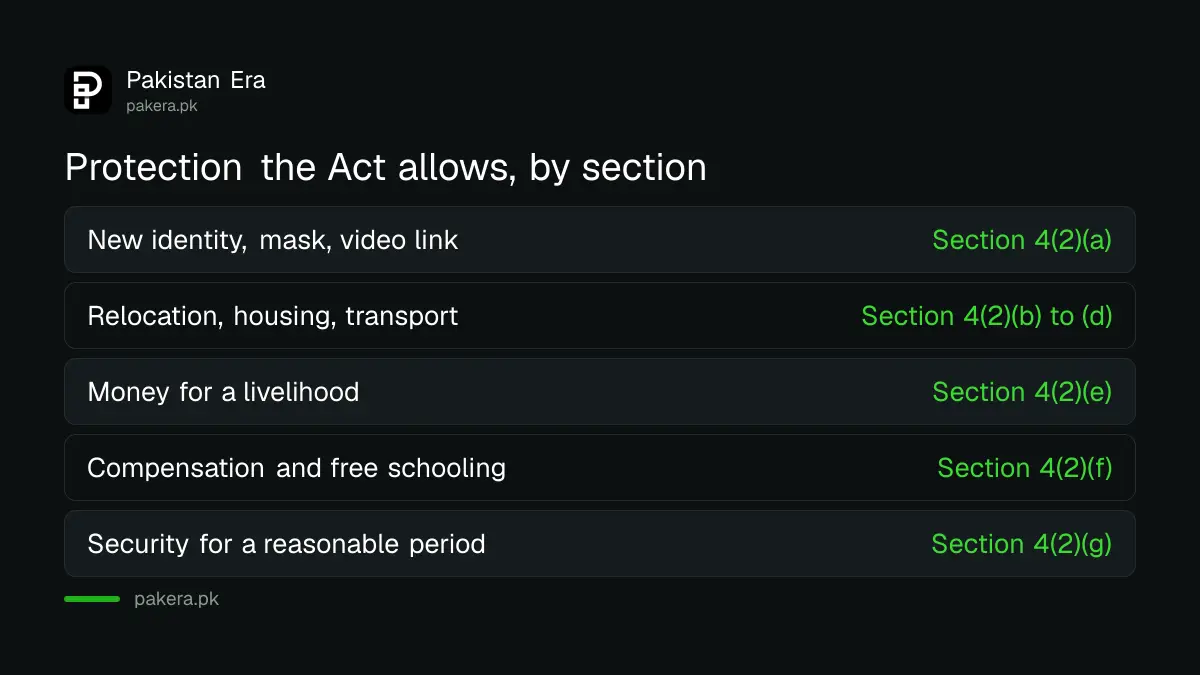
The programme can hide you, move you and pay your way
Section 4 lists the measures. A witness can be allowed to take a new identity, or to give evidence wearing a mask, with a changed voice or appearance, or by video link. The unit can relocate the witness, provide accommodation, transport the witness's property, give reasonable financial help for a livelihood, and arrange security for a reasonable period.
If a protected person is killed because of the programme, the legal heirs get compensation. If the person dies or is permanently incapacitated while under protection, dependent minors get free education. Family members get the same protection and facilities if the witness asks for them.
| Measure | Section | Who decides |
|---|---|---|
| New identity, mask, voice change, video link | 4(2)(a) | Unit, with court order for a new identity |
| Relocation, accommodation, transport | 4(2)(b) to (d) | Chief Witness Protection Officer |
| Financial help for livelihood | 4(2)(e) | Chief Witness Protection Officer |
| Compensation to heirs, free education for minors | 4(2)(f) | Government |
| Security for a reasonable period | 4(2)(g) | Unit, with police |
The Chief Witness Protection Officer decides, after a committee report
Section 14 puts the decision on inclusion with the Chief Witness Protection Officer, who must give due regard to the report of a committee under Section 9 and of the witness protection officer for the case. The committee has four members: a home department officer, the Additional IGP Special Branch, the DIG Headquarters and the DIG of the range where the case is registered.
The officer weighs the seriousness of the offence, the importance of the evidence, the nature of the danger, the cost of protection, whether the witness can adjust to protection, any psychological assessment, whether there are other ways to protect the witness, and whether the witness has a violent criminal record. A witness is never included without agreeing in writing.
Section 15 then requires a written protection agreement. The unit promises reasonable steps to protect you and not to keep you in a prison or police cell unless you agree. You promise to give the evidence, to obey the unit's reasonable directions, to stay out of crime, to meet your own legal and financial obligations, and to tell the unit about any other case you are involved in.
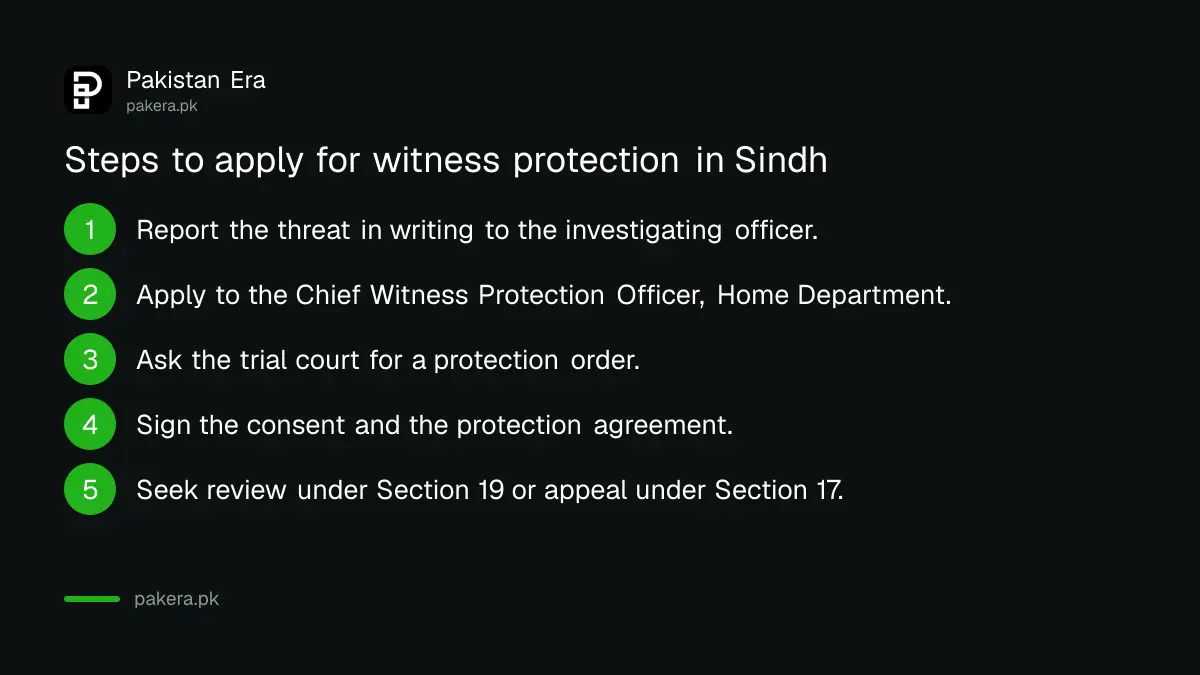
How to apply, step by step
The Act does not prescribe a form, and no rules have been made. The home department told the Sindh High Court in October 2026 that the unit extends protection when an application is made or a court orders it, and that witness protection officers are notified in every district. So these are the routes that exist today.
- Report the threat in writing to the investigating officer and the prosecutor in your case, and keep a signed copy. If the police refuse to record it, use the route for getting an FIR registered in Sindh when police refuse.
- Write an application to the Chief Witness Protection Officer, Witness Protection Unit, Home Department, Government of Sindh, Karachi. State the case number, the court, what you witnessed, the threat, who made it, and what protection you need.
- Ask the trial court, through your lawyer or the prosecutor, for an order directing the unit to protect you. Section 23 also lets the court hear the part of a case that touches your identity in camera.
- Sign the written consent under Section 14(3) and the protection agreement under Section 15 when the unit offers them, and read every obligation before you sign.
- If the unit refuses or withdraws protection, apply to the Government for a review under Section 19. A court order about your identity under Section 16 can be appealed to the High Court within thirty days under Section 17.
If you cannot afford a lawyer for step three, the free legal aid routes through the Supreme Court's 1818 call centre and the district legal aid committees apply. Before you give any statement, read what happens when you are questioned by police as a witness, and get free copies of the FIR and witness statements so your account stays consistent.
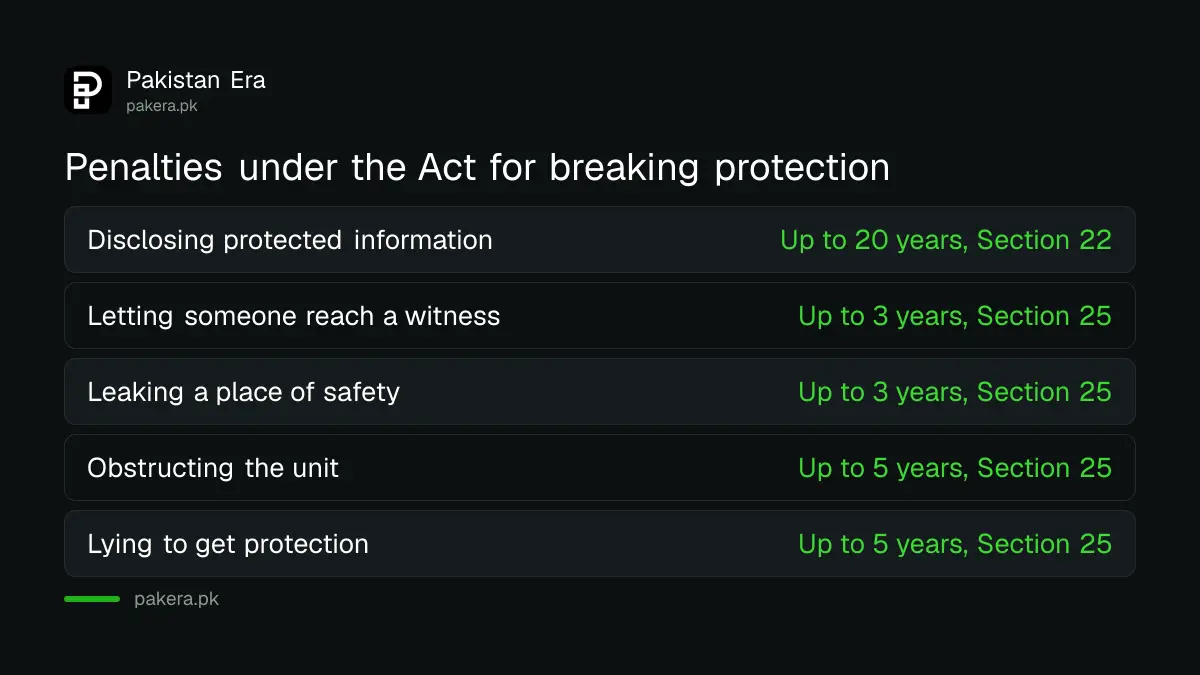
Leaking a protected witness's identity carries up to twenty years
Section 22 bars anyone who holds information under the Act from disclosing it, except to carry out the Act, on a court's requirement, or with the Chief Witness Protection Officer's authority. Breaking that bar is punishable with up to twenty years in prison. Section 25 adds up to three years for carelessly letting an unauthorised person reach a protected witness or leaking the place of safety, and up to five years for obstructing the unit or lying to get protection.
Section 24 lets the protection officer order a ban on publishing anything that could reveal where a protected person is, or that a person is protected. Section 20 obliges a protected person with a new identity not to disclose the old one. Section 18 allows the unit to end protection if you breach the agreement, if the danger has passed, or at your own written request, with twenty-eight days' notice if you cannot be found.
Where the law is thin, and what the November hearing may change
Three gaps matter. Section 19 says a review is applied for "within the prescribed period and in the prescribed manner", and nothing has been prescribed. Section 2(h) leaves "other related assistance" to be prescribed. And the Act does not say how fast the unit must decide an application. The province's plan to amend the Witness Protection Act before framing rules is before the Sindh High Court, with the next hearing on 12 November 2026.
Section 27 keeps the ordinary police power to protect a witness under the Police Act, 1861. So even without the programme, the SHO and the DIG of your range can post security. Ask for both. The Act's programme is the stronger route, but police protection is the faster one.
Common questions
Who can get witness protection in Sindh?
A witness, or a relative of a witness, in a serious offence under Section 2 of the Act, whose life or property is in likely danger because of the evidence.
Where do I apply?
In writing to the Chief Witness Protection Officer at the Witness Protection Unit, Home Department, Government of Sindh, or through an order of the court hearing your case. There is no prescribed form.
Can I give evidence without being seen?
Yes. Section 4 allows a mask, a changed voice or appearance, and video conferencing, if approved under the Act. Section 23 lets the court sit in camera for your identity.
What if the unit refuses?
Section 19 gives a review by the Government. For a court order about your identity, Section 17 gives an appeal to the High Court within thirty days.
Is my family covered?
Yes, on demand. Section 4(2)(h) extends the same protection and facilities to the witness's family members, and related persons get their own protection agreement under Section 15.
Does the Act apply outside Sindh?
No. It extends to the province of Sindh only. Punjab, Khyber Pakhtunkhwa, Balochistan and Islamabad have their own laws or none.
How we verified this
What we checked, where we read it, and what we could not confirm.
Last checked 19 October 2026. Every section, the Schedule, the definitions and the penalties come from the text of the Sindh Witness Protection Act, 2013, Sindh Act LI of 2013, published by the Sindh Judicial Academy, which we read in full on 19 October 2026. The statement that the unit acts on applications and court orders and that officers are notified in every district is what the home and law departments told the Sindh High Court, as reported on 18 October 2026, and is not on an official page we could find. We could not find a published form, address line, phone number or decision time for the unit, and the Act prescribes none. This is general information, not legal advice.
About the author

Global Affairs & Political Economy Writer
Muhammad Hatim is a book lover who started writing because he enjoys it. At Pakistan Era he writes about international relations, geopolitics and the global economy, with a particular interest in South Asia and the forces behind current events.