Called by Police as a Witness in Pakistan: What You Must Answer and Why You Do Not Sign
If police call you as a witness in Pakistan, see what you must answer under section 161, why section 162 says you do not sign, and who records a confession.
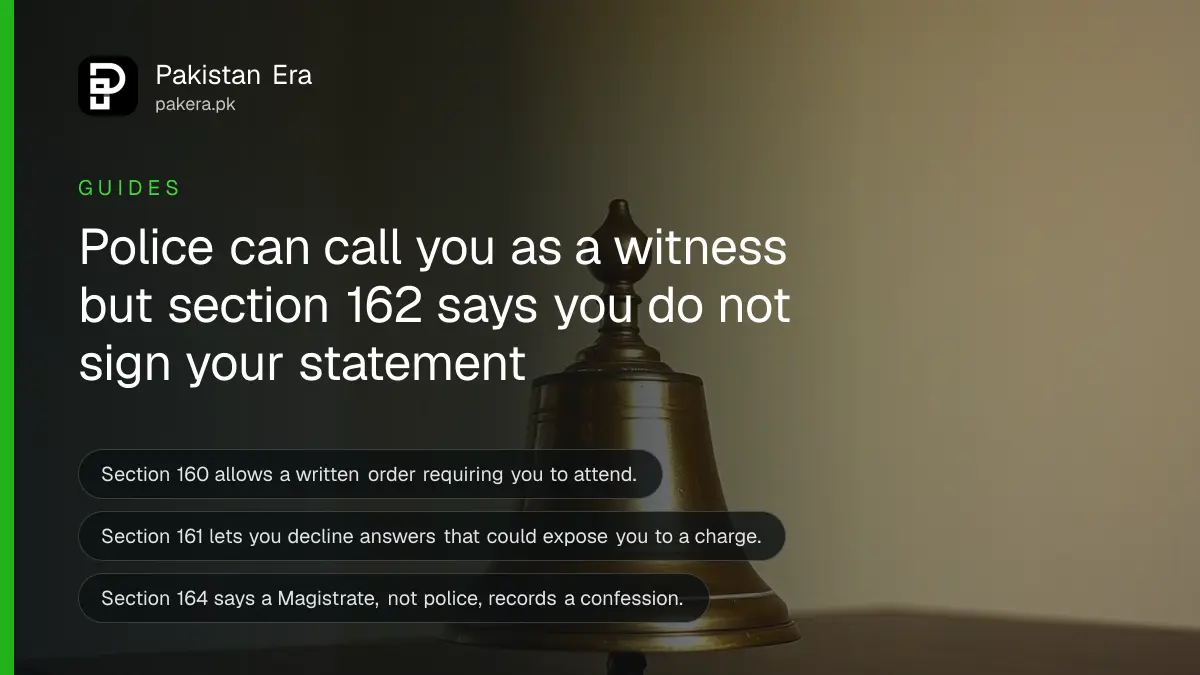
Short answer: If police call you as a witness, section 161 of the Code of Criminal Procedure says you must answer their questions about the case, except answers that could expose you to a criminal charge, a penalty or a forfeiture. Section 162 says a statement you give police is not signed by you.
A phone call or a written order from a police officer asking you to come to the station can worry anyone. You may only have seen an accident or know a person involved. The Code sets out what the officer may ask and what you do not have to do.
We read sections 160 to 164 of the Code of Criminal Procedure, 1898 on the Pakistan Code portal (pakistancode.gov.pk) on 14 October 2026. This guide follows that text. It is general information, not legal advice for your situation.
Police may require you to attend by written order
Section 160 says a police officer making an investigation may, by order in writing, require the attendance before himself of any person within the limits of his own or an adjoining station who appears to know the circumstances of the case. The person shall attend as required.
Notice the words "by order in writing". Ask to see the written order or ask for a copy. Note the officer's name, the station, the date and the case or FIR number.
The text we read has no exemption by age or sex in section 160. Women who report certain offences have a special rule on how their statement is recorded, which we explain in our guide on reporting an offence as a woman.
You must answer, except where the answer could expose you
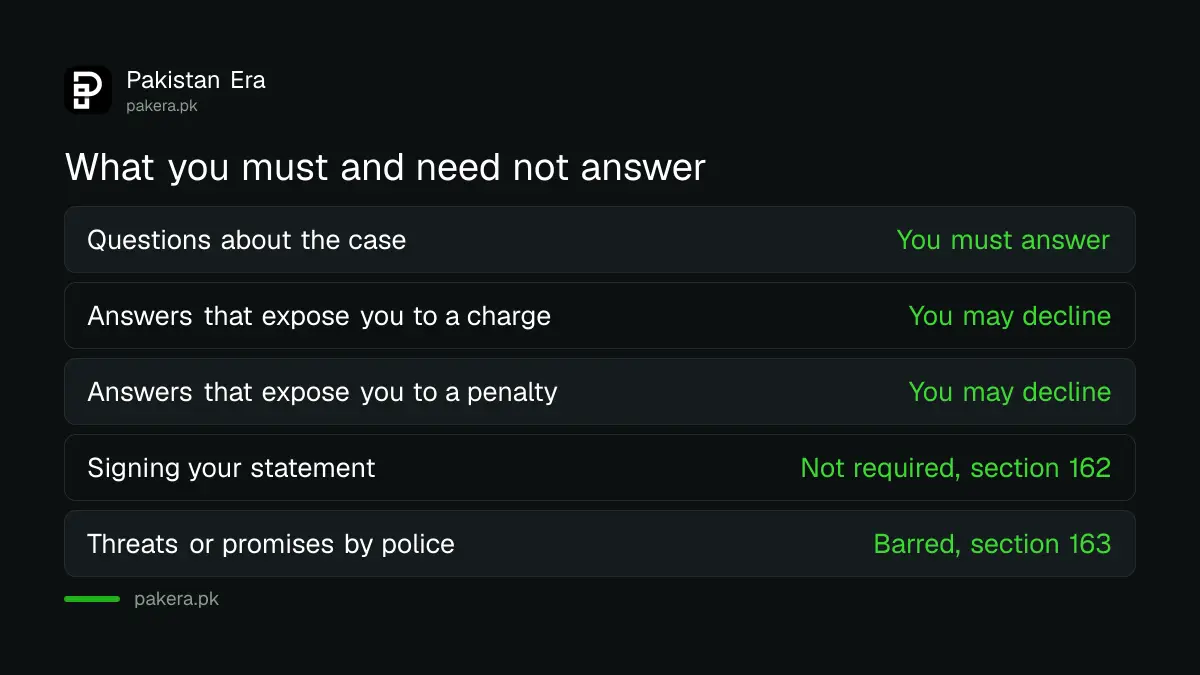
Section 161(2) says a person questioned by police shall be bound to answer all questions relating to the case, other than questions the answers to which would have a tendency to expose him to a criminal charge, to a penalty or to forfeiture.
So you cannot just refuse to speak. But you are not forced to give an answer that could be used to charge you. If a question touches on your own possible guilt, you may say you decline to answer that question. A lawyer can advise you before you attend.
The officer writes the statement but you do not sign it
Section 161(3) allows the officer to write down what you say, with a separate record for each person. Section 162(1) says no statement made to police in the course of an investigation shall, if written, be signed by the person making it.
If an officer asks for your signature on your statement, point to section 162. You may be asked to sign other papers, such as a receipt for something handed over. Read what you sign and ask what it is.
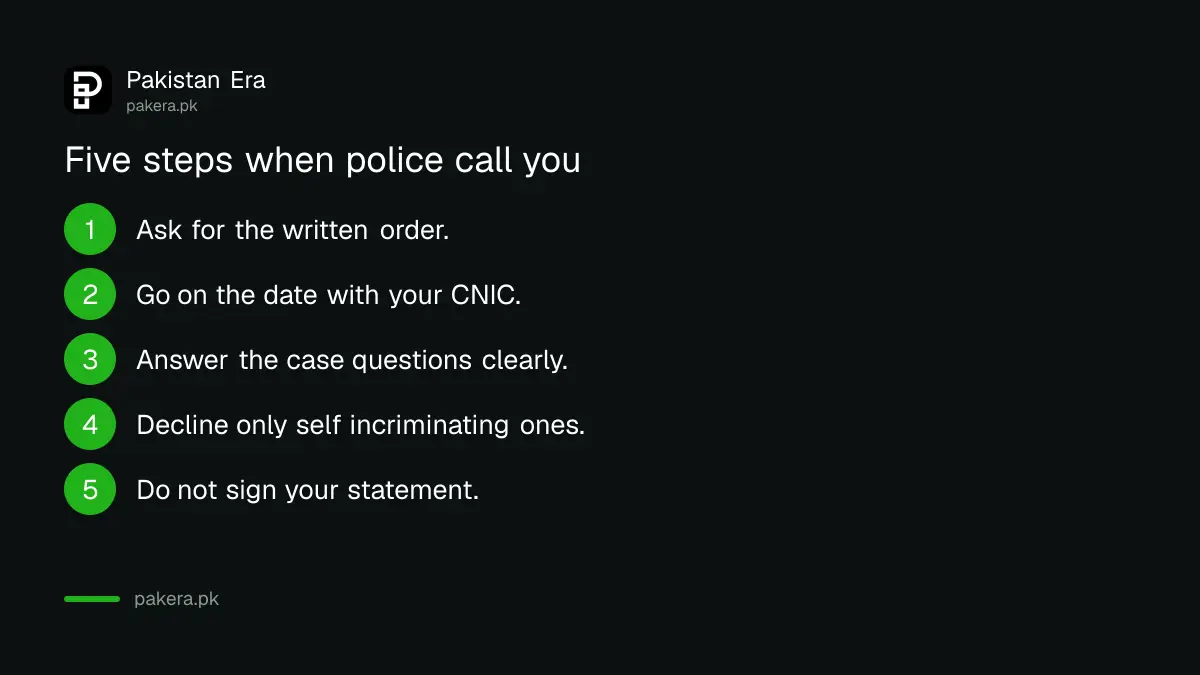
- Ask for the written order that calls you, and note the case number.
- Go on the date given, with your CNIC.
- Answer the questions about the facts you know, in short and clear words.
- Decline only questions whose answers could expose you to a charge, and say why.
- Do not sign your statement. Read any other paper before you sign it.
A police statement is not evidence by itself, but it can test a witness
Section 162(1) says a statement made to police and its record cannot be used for any purpose at the inquiry or trial of the offence under investigation, except as the section allows. The main exception is this: if a prosecution witness's statement was written down, the court shall, on the request of the accused, refer to it and give the accused a copy.
The accused can then use any part of it to contradict that witness, in the way section 145 of the Evidence Act provides. That is why your statement should be accurate. If you later say something different in court, it can be put to you.
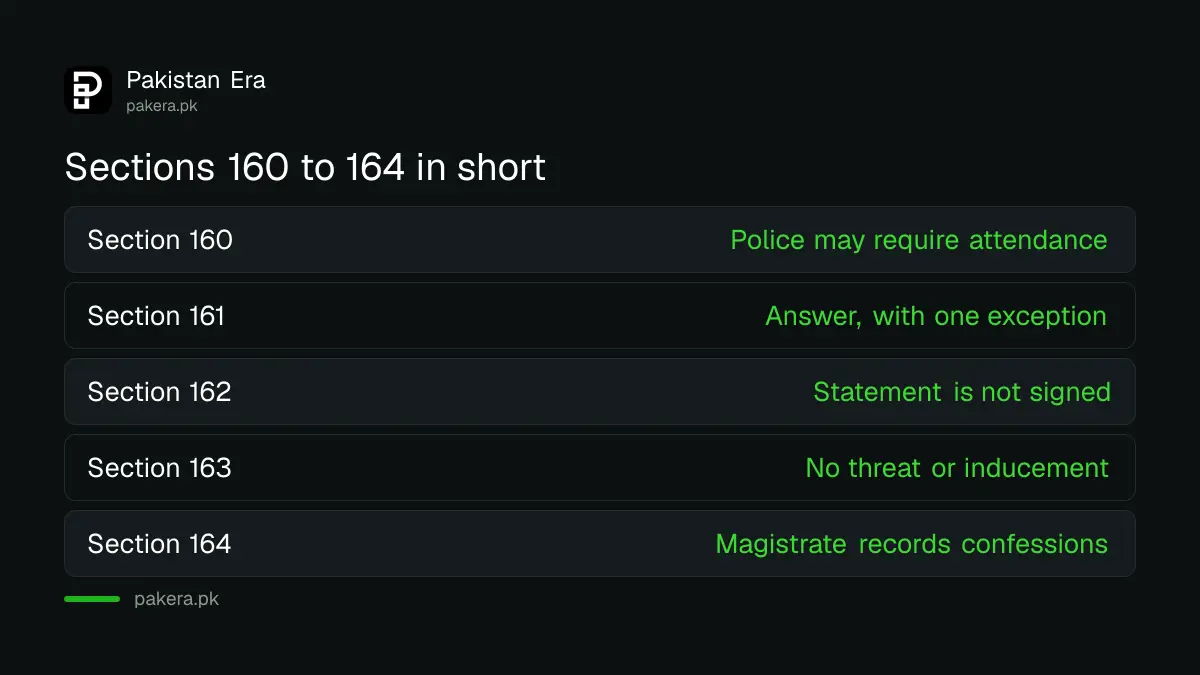
| Section | What it says in plain words |
|---|---|
| 160 | Police may require attendance by written order |
| 161(2) | Answer case questions, except those that could expose you to a charge, penalty or forfeiture |
| 161(3) | The officer may write your statement down, one record per person |
| 162(1) | You do not sign a statement made to police |
| 163 | No threat, inducement or promise by police |
| 164(3) | A Magistrate must explain a confession is not compulsory and may be used as evidence |
Police cannot threaten you, and a Magistrate takes any confession
Section 163 says no police officer or person in authority shall offer or cause any inducement, threat or promise of the kind described in section 24 of the Evidence Act. It also says nobody shall stop you, by caution or otherwise, from making a statement of your own free will.
A confession is handled differently. Under section 164, a Magistrate, not a police officer, records it. Before he records it, he must explain that you are not bound to make a confession and that it may be used as evidence against you. He may record it only if he believes it was made voluntarily.
If you are arrested, read your rights when you are arrested in Pakistan. If a child is involved, see what the law says when a child is arrested. For help finding a lawyer, see free legal aid in Punjab.
Common questions
Can I refuse to go to the police station as a witness?
Section 160 says the person shall attend as required by the written order. If you cannot attend on the date, tell the officer in writing and ask for another date.
Do I have to answer every question?
Section 161(2) says you must answer all questions about the case except those whose answers would tend to expose you to a criminal charge, a penalty or a forfeiture.
Should I sign my statement?
No. Section 162(1) says a statement made to police shall not be signed by the person making it.
Can police threaten me to make a statement?
No. Section 163 bars any threat, inducement or promise by a police officer or other person in authority.
Who records a confession?
A Magistrate records it under section 164, after explaining that you need not confess and that it may be used as evidence.
How we verified this
What we checked, where we read it, and what we could not confirm.
We read sections 160, 161, 162, 163 and 164 of the Code of Criminal Procedure, 1898 in the PDF on the Pakistan Code portal (pakistancode.gov.pk) on 14 October 2026. The file says it was last amended on 16 February 2017. We did not read court rulings on how these sections are applied, or any police rules on summoning witnesses. Confirm your position with a lawyer before you attend.
About the author

Tax, Bills and Technology Writer
Ali Akhtar is a young and curious voice here at Pakistan Era. He is currently pursuing his A-Levels and has a growing interest in Pakistan’s changing industrial landscape and educational trends. Ali likes to write in a way that helps him explain and explore the world around him. His writing reflects the perspective of the new generation navigating the evolving trends of Pakistan where technology, youth innovation, and shifting opportunities are reshaping the country’s future.