GitLab Critical Patch for Pakistani Software Houses: Upgrade Self-Managed Servers to 19.5.1 or 18.11.13
GitLab fixed a CVSS 10.0 remote code flaw on 21 October 2026. See which self-managed versions are affected, the fixed releases and who needs no action.
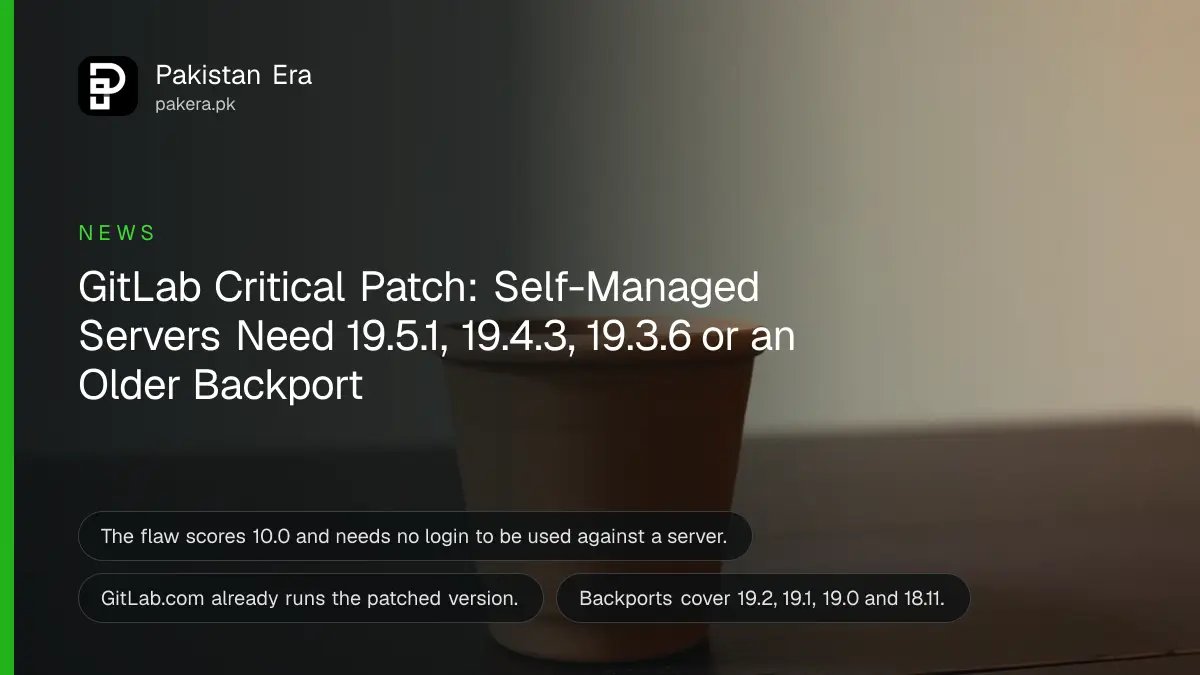
GitLab released critical patches on 21 October 2026 for CVE-2026-110264, a flaw rated 10.0 out of 10 that could let an unauthenticated attacker run code on a self-managed GitLab server. Fixed versions are 19.5.1, 19.4.3, 19.3.6, 19.2.9, 19.1.9, 19.0.10 and 18.11.13. GitLab.com is already patched.
This matters to Pakistani software houses, freelancers' teams and university labs that host their own GitLab to keep code private. If you only use gitlab.com, nothing is needed from you. We read GitLab's official patch release notice on 22 October 2026.
The flaw is an integer overflow in the regular expression compiler
GitLab says that under certain conditions an unauthenticated user could run arbitrary code on the server by sending a specially crafted regular expression, because of an integer overflow while the expression is compiled. It gives the flaw a CVSS score of 10.0, the maximum.
A regular expression is a pattern used to match text. An integer overflow is a number that grows too large for the space reserved for it. Together they can let an attacker write outside safe memory. GitLab has not published more attack detail, and the researcher credit goes to a reporter on its bug bounty programme.
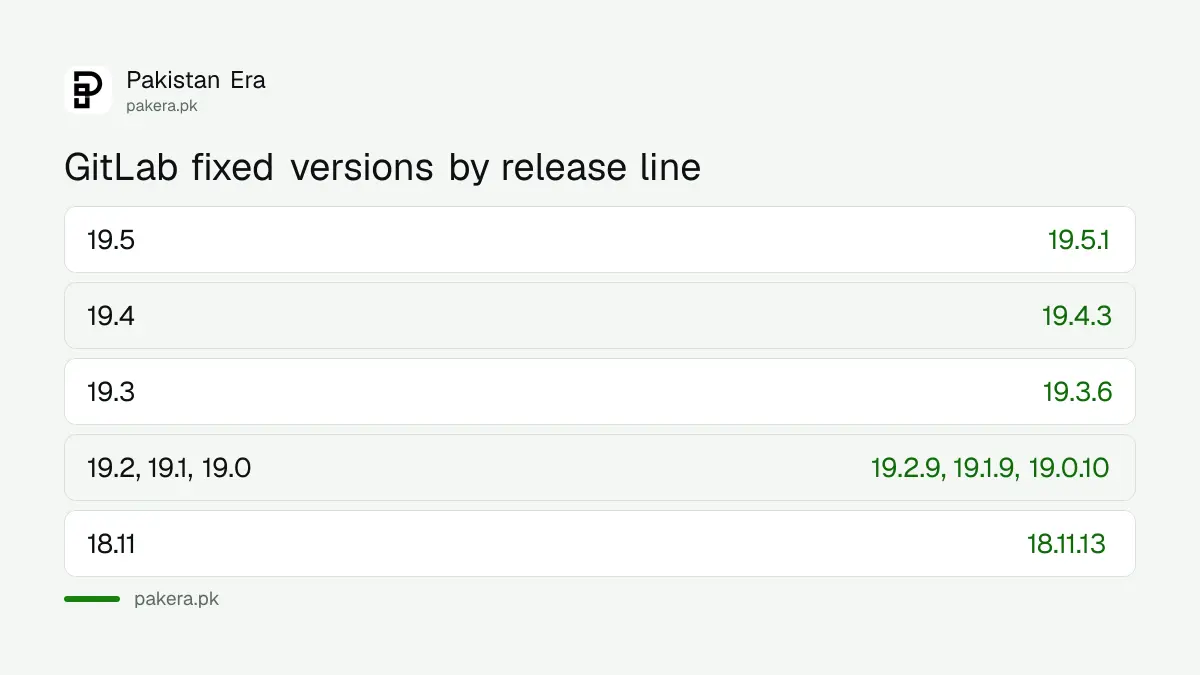
| Your GitLab line | Fixed version |
|---|---|
| 19.5 | 19.5.1 |
| 19.4 | 19.4.3 |
| 19.3 | 19.3.6 |
| 19.2 | 19.2.9 (backport) |
| 19.1 | 19.1.9 (backport) |
| 19.0 | 19.0.10 (backport) |
| 18.11 | 18.11.13 (backport) |
Every self-managed version from 7.0 before the fixed releases is affected
GitLab lists the impacted versions as all CE and EE versions from 7.0 before 18.11.13, 19.0 before 19.0.10, 19.1 before 19.1.9, 19.2 before 19.2.9, 19.3 before 19.3.6, 19.4 before 19.4.3 and 19.5 before 19.5.1.
The range is very wide, so almost any self-managed install that is not on the new patch is affected. GitLab backported the fix to the older lines 18.11 through 19.2 as well as the three newest, which it says it did in addition to its standard patch releases. If you run something older than 18.11, plan an upgrade.
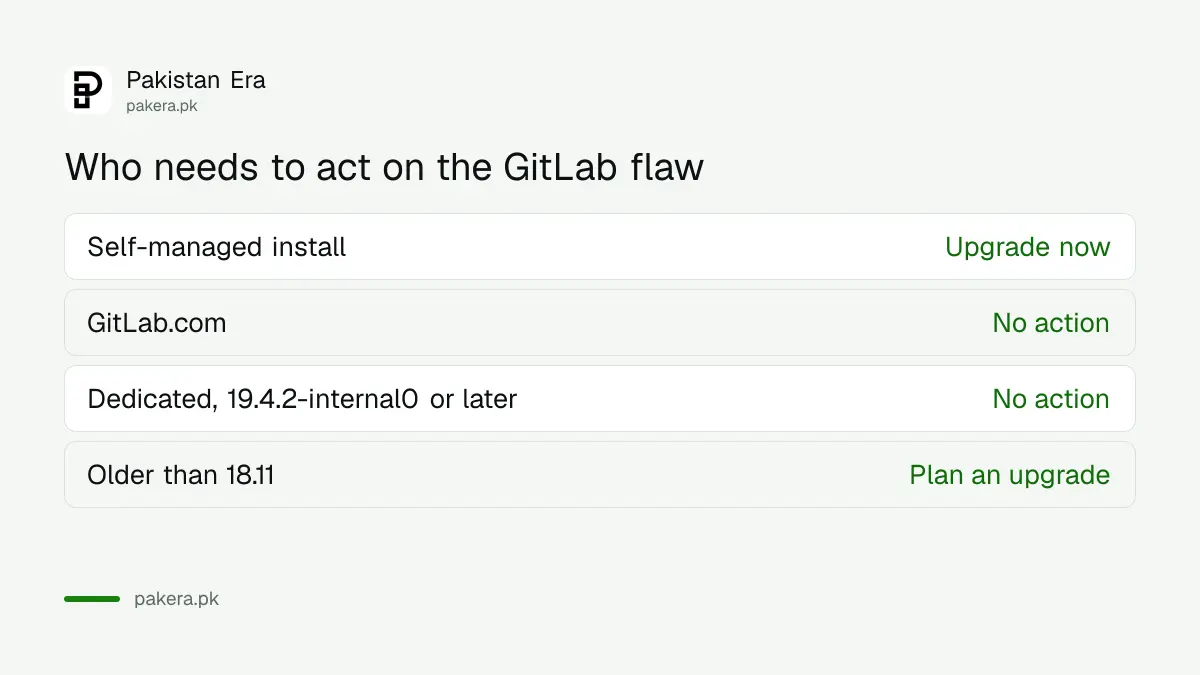
GitLab.com and Dedicated tenants need no action
GitLab says GitLab.com already runs the patched version. GitLab Dedicated tenants on 19.3.5-internal0 and 19.4.2-internal0 or later already include the fixes. Only teams that installed GitLab themselves, whether Omnibus, source or Helm chart, need to upgrade.
The notice says all deployment types are affected when none is named, and the company strongly recommends upgrading immediately. Check which version you run in the Help page of the admin area, or ask whoever set up your server.
Other fixes in the same release are rated high, medium and low
The release fixes 12 security issues in all. Besides the critical one, two are rated high: a possible account takeover when SAML and LDAP auto-linking are both on, and cache poisoning in OAuth and OIDC discovery. The rest are medium or low.
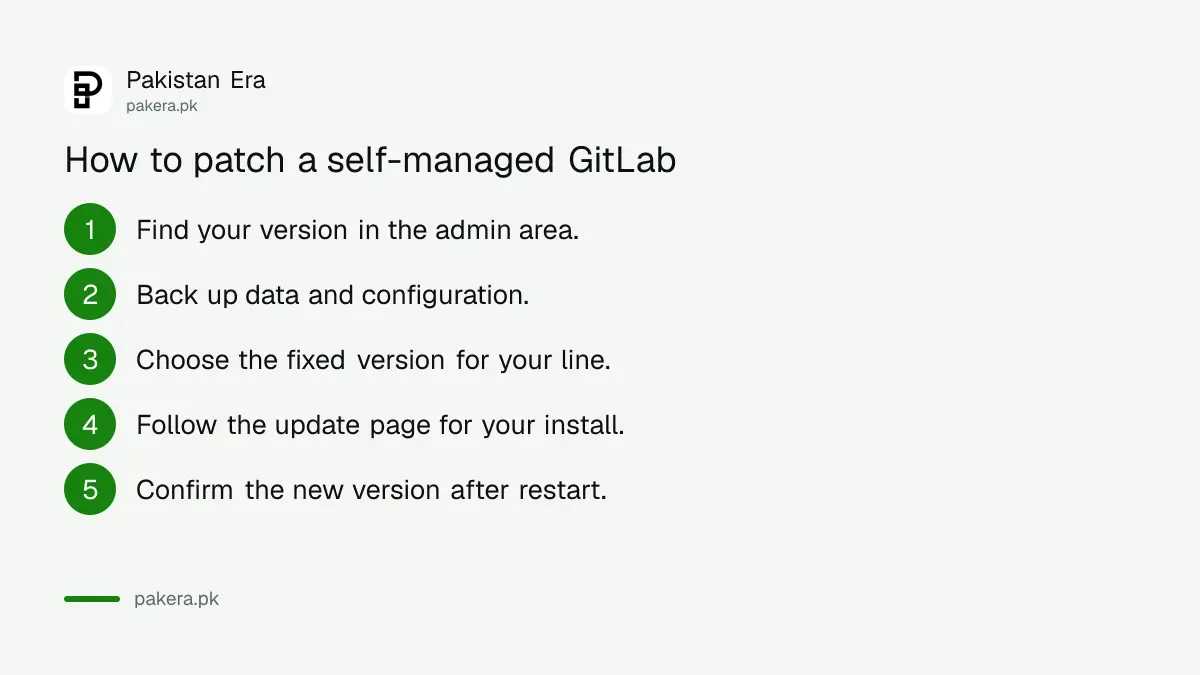
- Find your GitLab version in the admin area.
- Back up your data and configuration.
- Pick the fixed version for your line from the table above.
- Follow GitLab's update page for your install type.
- Restart and confirm the new version shows in the admin area.
The notice links two detection rules, an Onigmo native worker crash and an Org mode render error burst, so administrators can look in their logs for exploit attempts. We have not run them.
Treat an exposed GitLab server as a possible entry to your code and keys
A GitLab server usually holds source code, CI/CD secrets and deploy keys. If it is open to the internet and you cannot patch today, restrict access by IP or VPN until you can. Then rotate secrets if you find any sign of misuse.
If you find an intrusion, report it to PKCERT or NCCIA. For safer logins on your team accounts, set up passkeys for Google accounts that your developers use.
Plan the upgrade around your team, not around the clock
A self-managed GitLab often sits on a server that one engineer set up years ago. Before you upgrade, find that person, or the notes they left, and check the install type. An Omnibus package, a Helm chart and a source install each have a different update path on GitLab's update page.
Take a full backup first, including configuration files and secrets, and test the restore if you can. If your version is far behind, GitLab's upgrade path may need several steps rather than one jump, so read the update page before you start. Pick a quiet hour, tell your developers, and keep the old server image until the new version has run for a day.
If you need time, put the server behind a VPN or an IP allow list. That reduces exposure but is not a fix, and GitLab's notice recommends upgrading immediately.
Common questions about the GitLab critical patch
Do I need to act if I use gitlab.com?
No. GitLab says GitLab.com already runs the patched version.
Which version should I upgrade to?
The fixed release for your line, or the latest: 19.5.1, 19.4.3, 19.3.6, 19.2.9, 19.1.9, 19.0.10 or 18.11.13.
Is the flaw being attacked?
GitLab's notice does not say. It strongly recommends upgrading immediately and links detection rules.
How serious is a score of 10.0?
It is the highest on the CVSS scale. GitLab rates it critical, with no login and no user click needed.
Where do I report a compromised server in Pakistan?
To National CERT at cert@pkcert.gov.pk or through its incident portal.
How we verified this
What we checked, where we read it, and what we could not confirm.
Last checked 22 October 2026. We read GitLab's patch release notice for 19.5.1 and its companion versions, dated 21 October 2026, including the security fix table, impacted versions and detection links. We did not upgrade or test a server. We did not find a statement from GitLab on whether the flaw is being exploited, and we have no information on any Pakistani organisation being affected.
About the author

Technology Journalist & Multimedia Producer
Ahmad Ali is a technology journalist and multimedia producer at Pakistan Era, joining the team in October 2026. He covers consumer technology and digital life for Pakistani readers, combining research with hands-on product testing.