Punjab Police 1787 Complaint Centre Says It Resolved 98,000 Complaints This Year
Punjab Police says its 1787 IGP Complaint Centre resolved over 98,000 complaints this year. See the nine groups, why they add up to more, and what to do next.
Punjab Police says its 1787 IGP Complaint Centre has resolved more than 98,000 citizen complaints this year. In a statement dated 8 October 2026, Inspector General Abdul Kareem said complaints are being settled within the set timelines under standard operating procedures. Complaints about case registration make up the largest group.
The statement says District Police Officers (DPOs) now oversee complaints from their districts personally, and that monitoring of the centre has been strengthened. Citizens are urged to call 1787 about any police grievance. We read the statement on the Punjab Police website on 13 October 2026.
These are the police's own figures. We have not audited them. The sections below say what the numbers show, and what they do not.
The police report more than 98,000 resolved complaints
Punjab Police says the centre resolved over 98,000 complaints in the current year. The statement gives no start date for the year and no count of complaints still open. A resolved complaint is one the police closed, not necessarily one the complainant accepted.
The IG said complaints are resolved within the prescribed timeline under the SOPs. The statement does not give that timeline. Our page on how to complain against Punjab Police on 1787 explains how the complaint line works.
Case registration complaints are the largest group
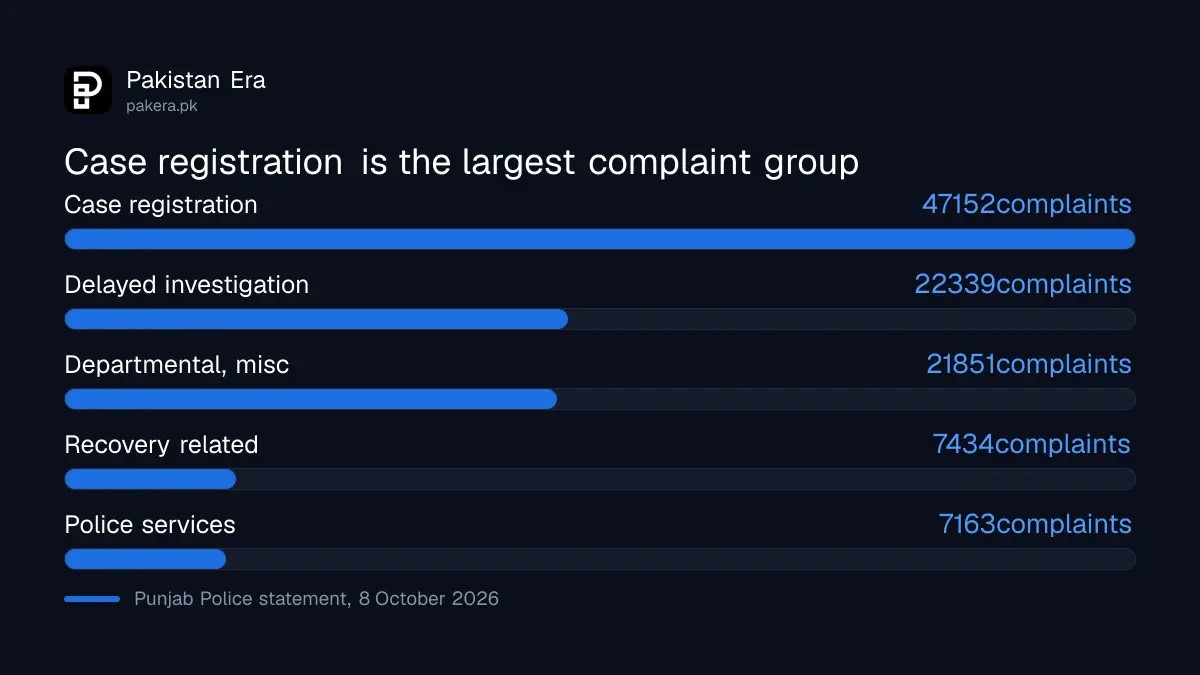
The statement lists nine groups of complaint. Case registration leads, with 47,152. Delayed investigation follows with 22,339. Departmental and miscellaneous complaints number 21,851.
| Type of complaint | Number |
|---|---|
| Case registration | 47,152 |
| Delayed investigation | 22,339 |
| Departmental and miscellaneous | 21,851 |
| Recovery related | 7,434 |
| Police services | 7,163 |
| Arrest related | 5,053 |
| Faulty investigation | 4,849 |
| False case cancellation | 2,287 |
| Investigation transfer | 1,682 |
The group figures do not add up to 98,000
The nine groups in the statement add up to 119,810. That is more than the headline figure of 98,000. The statement does not explain the gap. A complaint may sit in more than one group, or the groups may count complaints raised, not resolved.
We did not ask the police to explain. When you read the table, treat each row as a size comparison between groups, not as a count of closed cases.
What this means for a complainant
If a police station refuses to register your case, delays your investigation or keeps an arrest pending, the statement shows these are the most common reasons people call 1787. The centre is a place to take that grievance after you have tried the station.
- Write down the station name, the date and the officer you dealt with.
- Call 1787 and give the details.
- Note the complaint number you are given.
- Follow up with the DPO's office if nothing happens.
The Punjab Police website lists an online complaint form for the centre. It did not open for us, so we cannot describe it. If you only want to know whether an FIR was registered, use the page on how to check an FIR online.
What the statement does not say
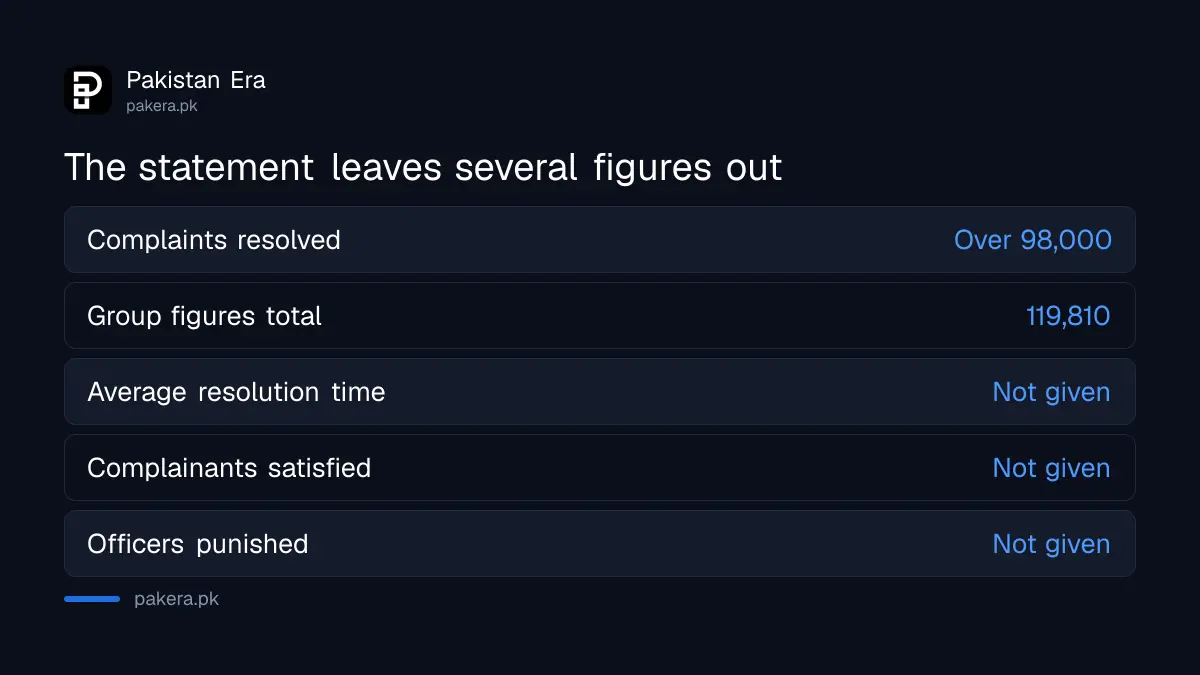
The statement does not give the average time to resolve a complaint. It does not say how many complainants were satisfied, or how many complaints were rejected. It does not list the number of officers punished.
Without these figures, the count of 98,000 tells you the volume of work, not the quality of the outcome. We will update this page if the police publish more detail.
How to read a police statistic
A count of resolved complaints is a count of closed files. It is a fair measure of how busy a centre is. It is a weaker measure of whether people were helped. For that you need the complainant's own view, which the statement does not give.
If you have used 1787, your own experience adds to the picture. Keep the complaint number, the date and the name of the officer who handled it. If a complaint is closed without a result, you can call again and quote the number. The statement does not say how many people reopened a complaint.
Other police numbers to keep
The Punjab Police website lists 15 for police emergencies, 16 for the fire brigade and 1122 for rescue. For tenant and other police services, see our page on the Punjab Police Pakistan app services.
Why the date of the statement matters
The statement is dated 8 October 2026 and we checked it on 13 October. Police counts change every day, so the figure today is likely higher than 98,000. Use the number as a snapshot of early October, not as a live total. Check the Punjab Police news page for any newer release.
If you plan to cite the figure, quote the date and say it is the police figure. That keeps the claim honest and lets readers judge it for themselves.
Common questions
What is the IGP Complaint Centre number in Punjab?
The Punjab Police website lists 1787 as the IGP Complaint Centre number.
How many complaints did 1787 resolve this year?
Punjab Police says more than 98,000, in a statement dated 8 October 2026.
Which complaints are most common?
Case registration complaints lead, at 47,152 in the police list.
Why do the group figures add up to more than 98,000?
The statement does not say. The groups may overlap, or they may count complaints received.
Who oversees the complaints?
The IG said District Police Officers now oversee complaint resolution personally.
Can I check my FIR online instead?
Yes, for the FIR itself, using the online check. For a grievance about the police, call 1787.
How we verified this
What we checked, where we read it, and what we could not confirm.
Last checked on 13 October 2026, Pakistan time. We read the Punjab Police statements dated 8 October 2026 on the Punjab Police news page. The figures are the police's own and have not been audited. The statement was published five days before we checked, so it is not breaking news.
About the author

Tax, Bills and Technology Writer
Ali Akhtar is a young and curious voice here at Pakistan Era. He is currently pursuing his A-Levels and has a growing interest in Pakistan’s changing industrial landscape and educational trends. Ali likes to write in a way that helps him explain and explore the world around him. His writing reflects the perspective of the new generation navigating the evolving trends of Pakistan where technology, youth innovation, and shifting opportunities are reshaping the country’s future.