How to Increase a Company's Authorised Capital With SECP in Pakistan
Increase your company's authorised capital with SECP in Pakistan: check the articles, pass a special resolution, file notice in 15 days and how the fee works.
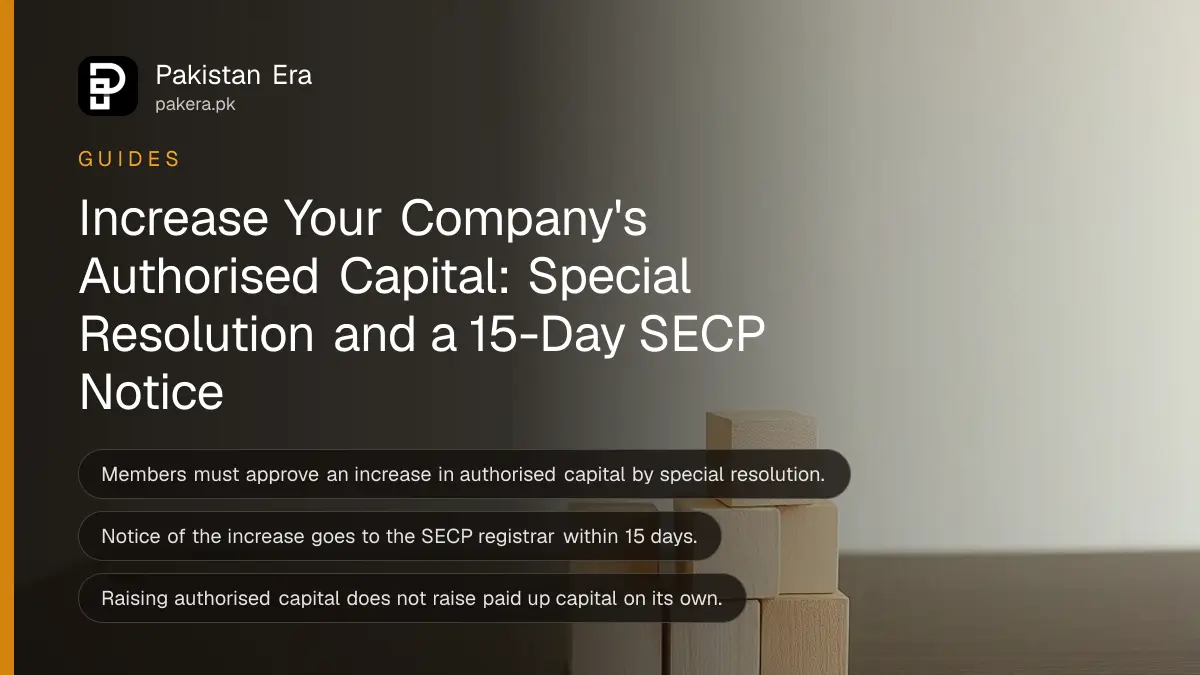
To increase a company's authorised capital in Pakistan, the articles must allow it, members must pass a special resolution changing the capital clause of the memorandum, and the company must file notice of the increase with the SECP registrar within 15 days. SECP charges a fee on the increase, based on its fee table for the capital before and after.
Authorised capital is the ceiling on the shares a company can issue. A private company registered with Rs 100,000 of authorised capital cannot take Rs 2 million from a new investor until it raises that ceiling. Section 85 of the Companies Act, 2017 sets out how.
| Requirement | Rule |
|---|---|
| Power in the articles | The articles must authorise the change (section 85) |
| Members' approval | Special resolution, at least three quarters of votes |
| Notice to SECP | Within 15 days of the change (section 85(4)) |
| Copy of resolution | Filed within 15 days of passing (section 150) |
| Penalty for default | Up to Rs 25,000, plus up to Rs 500 a day |
Authorised capital is the ceiling, not the money in the bank
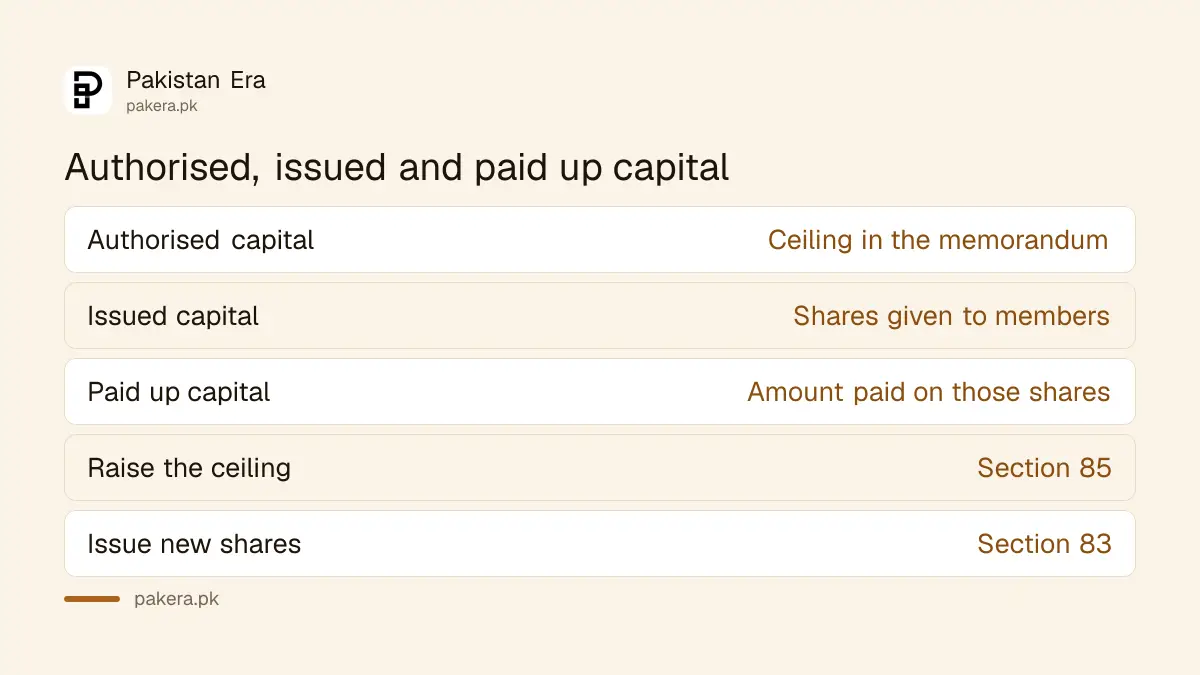
Authorised capital is the maximum value of shares the memorandum allows. Paid up capital is the value of shares actually issued and paid for. Raising the authorised figure does not put money into the company. It only makes room to issue more shares later.
So the sequence is two separate jobs. First raise the ceiling under section 85. Then issue the new shares under section 83 and file a return of allotment. The second job is set out in issuing new shares in a private company.
| Term | What it means | Example |
|---|---|---|
| Authorised capital | Maximum shares allowed by the memorandum | Rs 5,000,000, as 500,000 shares of Rs 10 |
| Issued capital | Shares actually given to members | Rs 1,000,000, as 100,000 shares |
| Paid up capital | Amount members have paid on issued shares | Rs 1,000,000 if fully paid |
Increase authorised capital in five steps
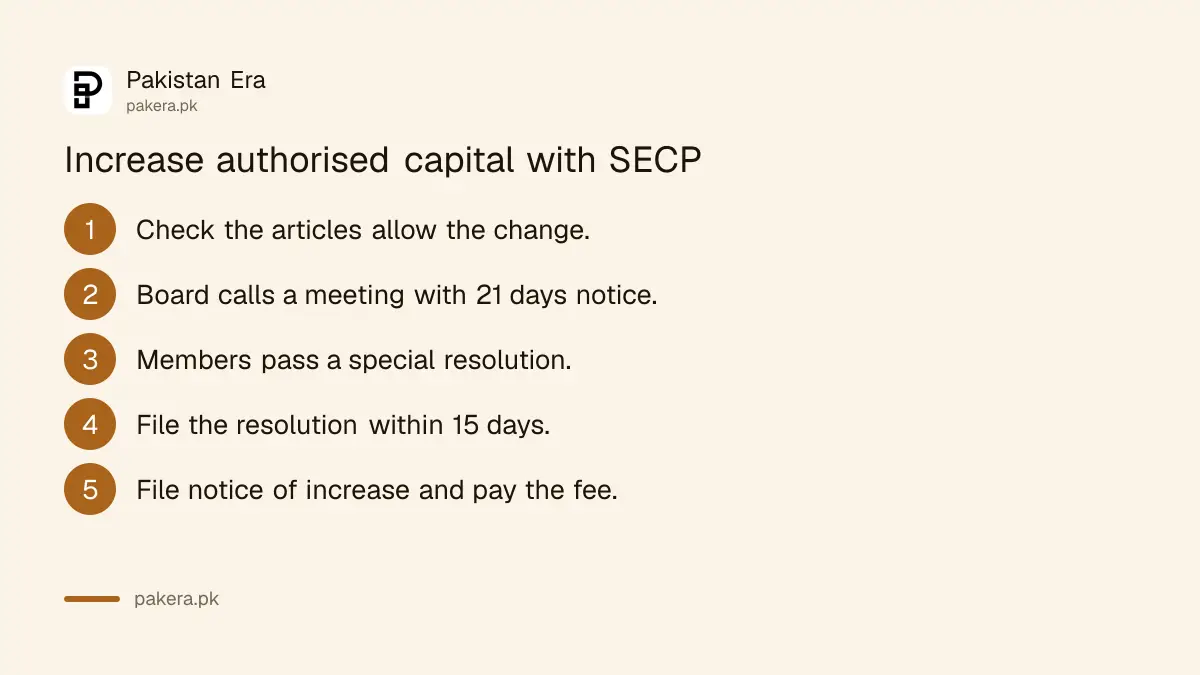
Check the articles, call a general meeting, pass the special resolution, then file the notice and the resolution with SECP within 15 days each. Pay SECP's fee on the increase with the filing.
- Check that the articles allow the company to alter its share capital. If not, change the articles first by special resolution under section 38 and file them within 30 days.
- The board proposes the new authorised capital and calls a general meeting with at least 21 days' notice, stating that a special resolution is proposed.
- Members pass the special resolution by at least three quarters of the votes cast.
- File the special resolution with the registrar within 15 days, signed by a director or the company secretary.
- File notice of the increase with the registrar within 15 days, with SECP's fee on the increase.
If all members entitled to vote agree, the meeting can be held on shorter notice. For a two-member private company, both members can sign their agreement and hold the meeting the same week. The voting rules are in voting at a company meeting by proxy or postal ballot.
SECP's fee is the difference on the higher capital
The Seventh Schedule to the Act charges the fee on an increase as the difference between what registration would cost at the new capital and what it would have cost at the old capital. Filing online costs less than filing on paper. So the bigger the jump, the bigger the fee.
SECP revises the rates in its fee table from time to time by notification, so check the current table before filing. The method stays the same: work out the registration fee at the new figure, subtract the fee at the old figure, and pay the gap.
A company that is only reorganising shares, without raising the ceiling, still uses section 85. Merging shares into larger ones or splitting them into smaller ones also needs the special resolution and the 15-day notice. Cancelling shares nobody has taken reduces authorised capital without counting as a reduction of capital under the Act.
| Change under section 85 | Example |
|---|---|
| Increase authorised capital | Rs 100,000 to Rs 5,000,000 |
| Consolidate shares | Ten Rs 10 shares become one Rs 100 share |
| Sub-divide shares | One Rs 100 share becomes ten Rs 10 shares |
| Cancel untaken shares | Unissued shares removed from the ceiling |
New shares rank equally with the old ones
Section 85(2) says new shares of an existing class rank equally with existing shares of that class, including for later bonus shares, right issues and dividends. When shares are merged or split, members' rights must stay strictly in proportion to what they held before.
This protects existing shareholders. A family member holding 40 per cent before a split still holds 40 per cent after it. Dilution happens only when new shares are issued to someone, and that is controlled by the right offer rules in section 83.
Late filing costs up to Rs 25,000 plus a daily penalty
Missing the 15-day notice, or the 15-day resolution filing, is a level 1 default. The penalty is up to Rs 25,000, plus up to Rs 500 for each day it continues. It applies to the company and to officers responsible, and is decided by the officer in charge of your company registration office.
Missed deadlines also show up when the company files its annual return, because the capital on SECP's record will not match your books. The annual return rules are in filing a company's annual return with SECP. Investors and banks often ask for a certified copy of the altered memorandum, so order one once the filing is accepted.
Common questions
Can the board increase authorised capital without members?
No. Section 85 requires a special resolution of members. The board can only propose it and call the meeting.
Does increasing authorised capital increase paid up capital?
No. It only raises the ceiling. Paid up capital rises when new shares are issued and paid for, which is a separate step under section 83.
What is the deadline to tell SECP about the increase?
Fifteen days from the change under section 85(4), and the special resolution itself must also be filed within 15 days under section 150.
Can we raise authorised capital and issue shares at the same meeting?
Yes, members can pass both special resolutions at one general meeting. A private company issuing shares to an outsider needs its own special resolution under section 83(1)(c), and the return of allotment follows within 45 days.
Can a single member company increase its authorised capital?
Yes. A single member company follows section 85 too, with the sole member passing the resolution.
How we verified this
What we checked and where we read it.
We checked this guide on 25 November 2026 against sections 2(66), 38, 83, 85, 150 and 479 and the Seventh Schedule, item I(3), of the Companies Act, 2017 on the Pakistan Code, the Ministry of Law and Justice's statute portal, in the text as amended to 2021.
Free on WhatsApp
Get last dates and rule changes on WhatsApp
We post new last dates, fee changes and fixes for common problems, a few short posts a day.
Follow Pakera on WhatsAppOther followers cannot see your number.
Pakera Solves It
Which online process wasted your time this week?
A portal that will not load, a form nobody explains, a complaint that went nowhere. Tell us. Every week we pick one, solve it step by step and publish the answer.
About the author

Tax, Bills and Technology Writer
Ali Akhtar is a young and curious voice here at Pakistan Era. He is currently pursuing his A-Levels and has a growing interest in Pakistan’s changing industrial landscape and educational trends. Ali likes to write in a way that helps him explain and explore the world around him. His writing reflects the perspective of the new generation navigating the evolving trends of Pakistan where technology, youth innovation, and shifting opportunities are reshaping the country’s future.