How to Vote at a Company AGM in Pakistan: In Person, Video-Link, Proxy or Postal Ballot
Vote at a Pakistani company's AGM in person, by video-link, proxy or postal ballot. The 21 day notice, 48 hour proxy rule and votes each resolution needs.

Short answer: As a shareholder in Pakistan you can vote at a company's AGM in person, through video-link or by proxy, and on a poll also by postal ballot or e-voting where the notice offers it. A proxy form must reach the company at least 48 working hours before the meeting. You get one vote for every share's worth of paid-up capital you hold.
The company must send you the notice at least 21 days before the meeting, with a proxy form attached. These rights come from the Companies Act, 2017, and no company's articles can take your vote away.
Every company must hold an AGM within 120 days of its year end
A company must hold its annual general meeting (AGM) once every calendar year, within 120 days after its financial year closes. For a company with a 30 June year end, that means by 28 October. Every shareholder on the register can attend.
The AGM is where shareholders approve the accounts, declare the final dividend, elect directors when their term ends and appoint the auditors. Any other meeting of shareholders is an extraordinary general meeting (EOGM). The board calls an EOGM when a decision needs shareholder approval between AGMs.
The June deadline and the SECP's reminder for this year are in our report on AGMs due by 28 October 2026. AGM and EOGM dates for listed companies appear on the PSX data portal.
The notice must reach you 21 days before the meeting
The company must send each shareholder a notice at least 21 days before the AGM. It must give the day, time, place and business, and list all material facts on any special business. It must also say you can appoint a proxy and include a proxy form.
| Rule | Detail | Section |
|---|---|---|
| AGM deadline | Within 120 days of the financial year end | 132 |
| Notice period | At least 21 days before the meeting | 132 |
| Newspaper notice | Published in an English and an Urdu daily with nationwide circulation | 132 |
| Proxy form | Must come with the notice | 137 |
| Ways to attend | In person, video-link or by proxy | 134(4) |
| Quorum for a listed company | 10 members with at least 25% of voting power | 135 |
If you hold shares through a broker, the notice goes to the address the company holds for you. Keep your address and email up to date with your broker, or you will miss the notice and the proxy deadline.
Four ways to cast your vote
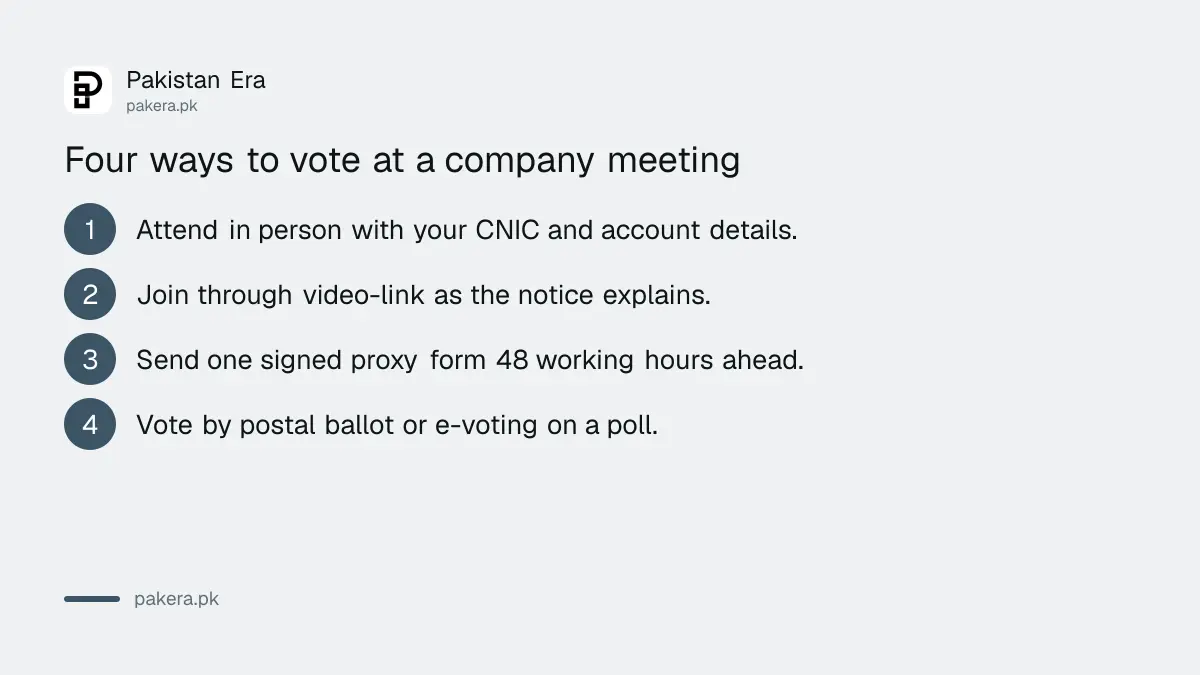
You can vote in person at the venue, join through video-link, send a proxy, or, when a poll is held, vote by postal ballot or e-voting if the notice offers it. Each route counts the same number of votes for the shares you hold.
- In person. Go to the meeting with your CNIC and your CDC account or folio details. Arrive early so you have time to register at the desk.
- Video-link. Members may take part through video-link under section 134(4). The notice explains how to register for the link.
- Proxy. Fill in the proxy form, sign it and lodge it with the company at least 48 hours before the meeting. Non-working days do not count in the 48 hours.
- Postal ballot or e-voting. On a poll, votes can be cast by postal ballot in the manner the SECP specifies. The notice must say whether e-voting is available and how to use it.
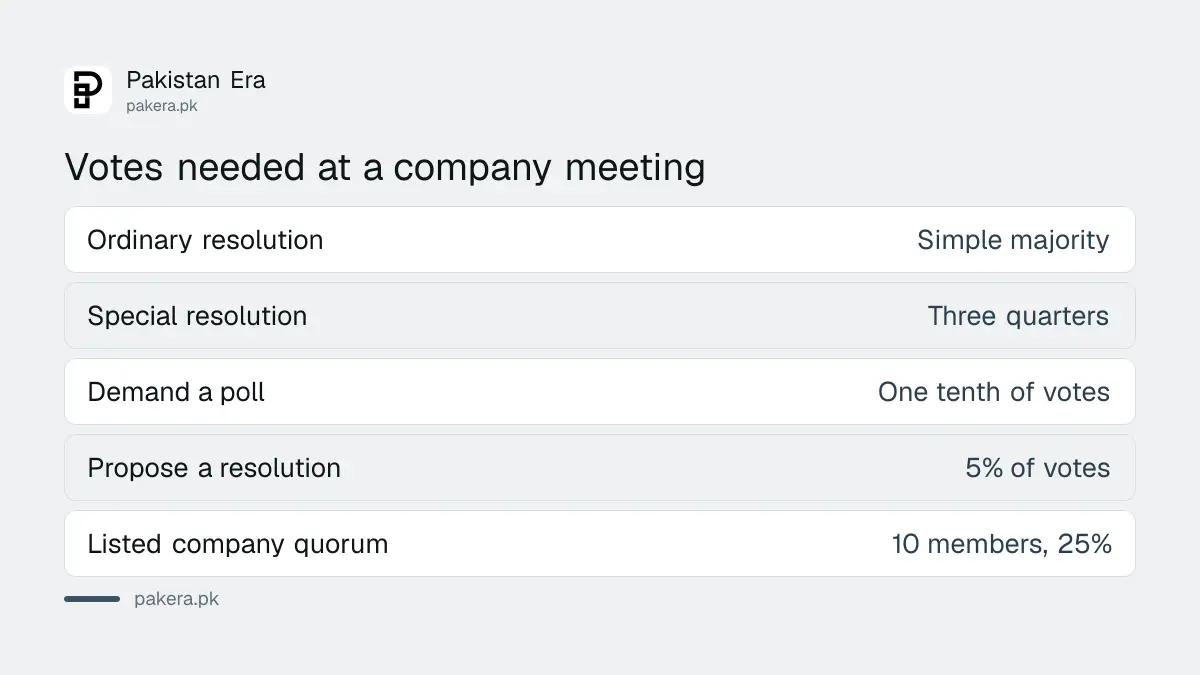
Most resolutions are first decided on a show of hands. A poll, where votes are counted by shares held, happens if the chairman orders one or if members holding at least one tenth of the voting power demand it. Members with that same one tenth can also demand a secret ballot.
Proxy rules: one proxy, 48 hours, and usually a fellow member
You can appoint only one proxy for a meeting. If you lodge two, both are invalid. The proxy must be a member of the company unless its articles allow an outsider. The form must be in writing and signed by you or your authorised attorney.
A proxy has the same right as you to attend, speak and vote. A proxy can also demand a poll, or choose not to use all your votes on a question. Every shareholder may inspect the proxies lodged with the company during business hours.
| Proxy rule under section 137 | What happens if you get it wrong |
|---|---|
| Only one proxy per meeting | Two or more proxy forms are all invalid |
| Lodge 48 hours before the meeting, working days only | A late form can be refused |
| Proxy must be a member unless the articles allow otherwise | Check the notice before naming a family member |
| Written and signed by you or your attorney | An unsigned form is not valid |
| A company shareholder signs through an officer or attorney | Keep the written authority with the form |
A useful trick for a small shareholder: give your proxy to another shareholder you trust who will attend anyway. Your votes are counted on any poll, and your proxy can speak for you.
How many votes a resolution needs
An ordinary resolution passes by a simple majority of votes cast in person, by proxy or by postal ballot. A special resolution needs at least three quarters. Shareholders with at least 5% of voting power can propose their own resolution for the meeting.
| Decision | Votes needed |
|---|---|
| Ordinary resolution: accounts, dividend, electing directors, auditors | Simple majority of votes cast |
| Special resolution: changing the articles and other major decisions | At least three quarters of votes cast |
| Demand a poll or a secret ballot | Members with at least one tenth of voting power |
| Propose a resolution | Members with at least 5% of voting power |
| Requisition an EOGM | Members with at least one tenth of voting power |
Your votes follow the paid-up value of your voting shares, and fractions of a vote are ignored. Section 134(7) says no shareholder with voting shares can be barred from voting, and nothing in the articles can change that. Changes to how meetings may be held online were before Parliament this year, as covered in the Companies (Amendment) Bill 2026.
Common questions
Can I vote at an AGM without attending in Pakistan?
Yes. Send a proxy form at least 48 working hours before the meeting, join through video-link, or vote by postal ballot or e-voting on a poll where the notice offers it.
How many proxies can I appoint?
One. If you lodge more than one proxy form for the same meeting, all of them become invalid.
Does my proxy have to be a shareholder?
Yes, unless the company's articles allow a non-member to act as proxy. The notice or articles will say.
How much notice must a company give before its AGM?
At least 21 days. The notice must list the business, give material facts on any special business and include a proxy form.
How are votes counted at a company meeting?
First by show of hands. On a poll, each member's votes are in proportion to the paid-up value of their voting shares.
Can a company stop a small shareholder from voting?
No. Section 134(7) of the Companies Act, 2017 says no member holding voting shares can be debarred from voting, whatever the articles say.
How we verified this
What we checked and where we read it.
Last checked 17 November 2026. The AGM deadline and notice rules (section 132), the ways to attend and vote, votes by paid-up value and the bar on debarring members (section 134), the quorum (section 135), the proxy rules (section 137) and the poll and secret ballot thresholds (sections 143 and 144) come from the Companies Act, 2017 as amended to 2021, in the text published on Pakistan Code. The newspaper notice in English and Urdu, the 5% threshold to propose a resolution, the three quarters majority for a special resolution, the e-voting line in the notice and the Companies (Postal Ballot) Regulations, 2018 are summarised in the PSX shareholders' rights guide. Exact registration and e-voting steps differ by company and are given in each meeting notice. This is general information, not legal advice.
About the author

Global Affairs & Political Economy Writer
Muhammad Hatim is a book lover who started writing because he enjoys it. At Pakistan Era he writes about international relations, geopolitics and the global economy, with a particular interest in South Asia and the forces behind current events.