Help for Disabled Persons in Pakistan: 10 Government Schemes Compared by Province
Compare 10 government schemes for disabled persons in Pakistan: Himmat Card, Humqadam, KP Umeed Card, Bait-ul-Mal and BISP, with amounts and conditions.
A disabled person in Pakistan can get government cash or free equipment from at least 10 schemes. The largest regular payment is Punjab's Himmat Card at Rs 10,500 a quarter. Pakistan Bait-ul-Mal pays Rs 20,000 to Rs 30,000 a year in every province, and BISP raises its cut-off score to 37 for a household with a disabled member.
Almost every one of these schemes starts with the same paper: a disability certificate from the provincial social welfare or disability department, and then a special CNIC from NADRA. Get those two first. The table below shows which schemes then open up in your province.
All 10 schemes for disabled persons at a glance
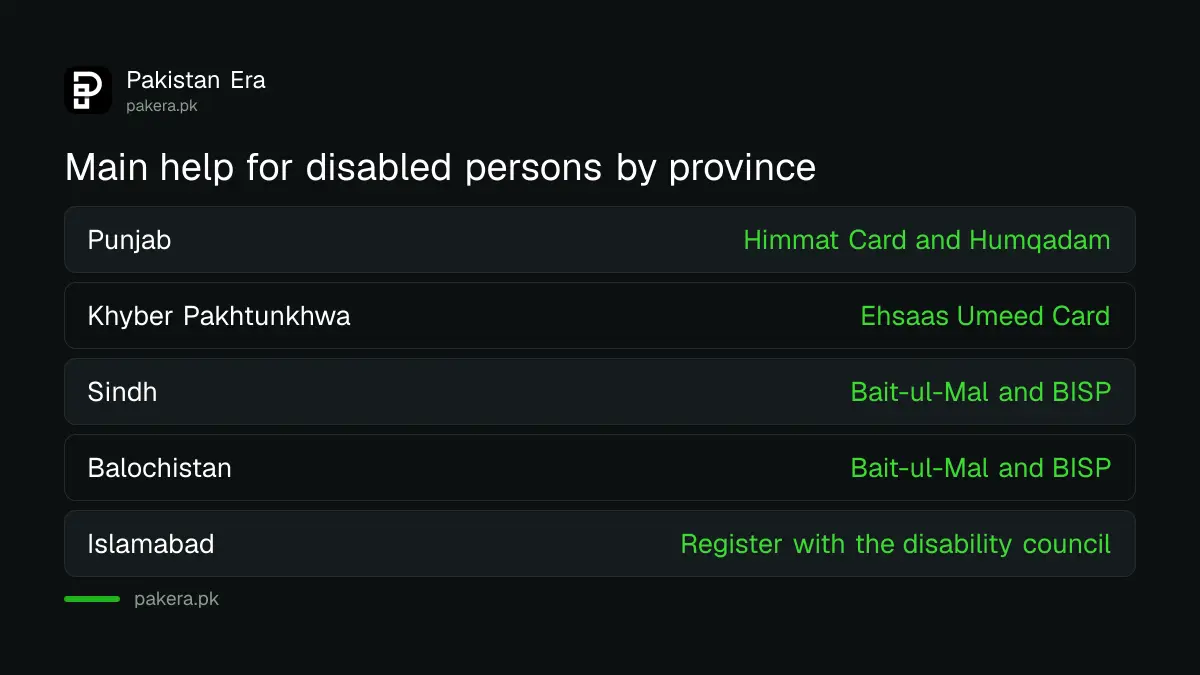
Punjab runs the most schemes, with two monthly or quarterly cash programmes, free devices and business loans. Khyber Pakhtunkhwa has the Umeed Card. Pakistan Bait-ul-Mal and BISP cover every province, including Sindh, Balochistan and Islamabad.
| Scheme | Where | What it gives | Key condition |
|---|---|---|---|
| Himmat Card | Punjab | Rs 10,500 a quarter | Not fit to work, poverty score 45 or less |
| Humqadam | Punjab | Rs 2,000 a month | Special CNIC, poverty score 30 or less |
| Assistive Devices and Wheelchair Programme | Punjab | Free wheelchair, hearing aid, artificial limb | Certificate and specialist's note |
| Income Generation Scheme | Punjab | Interest-free loan, about Rs 25,000 to Rs 100,000 | Call 1221 first |
| Ehsaas Umeed Card | Khyber Pakhtunkhwa | Monthly stipend, announced as Rs 5,000 | Apply through Local Zakat Committee |
| Special Friends | All Pakistan, Bait-ul-Mal | Rs 20,000 a year, Rs 30,000 for two or more | Poor family with a disabled member |
| Wheelchairs and aids | All Pakistan, Bait-ul-Mal | Wheelchair, hearing aid, white cane, limb | Item's own form |
| BISP Kafaalat | All Pakistan | Quarterly cash, cut-off raised to 37 | Household with a disabled member |
| Subsistence allowance | Azad Kashmir | Monthly allowance, amount not in the Act | Registered with the Social Protection Board |
| Disability Act rights | Sindh, Balochistan, Islamabad | Job quotas, fee and housing concessions | Disability certificate |
Start with the disability certificate and special CNIC
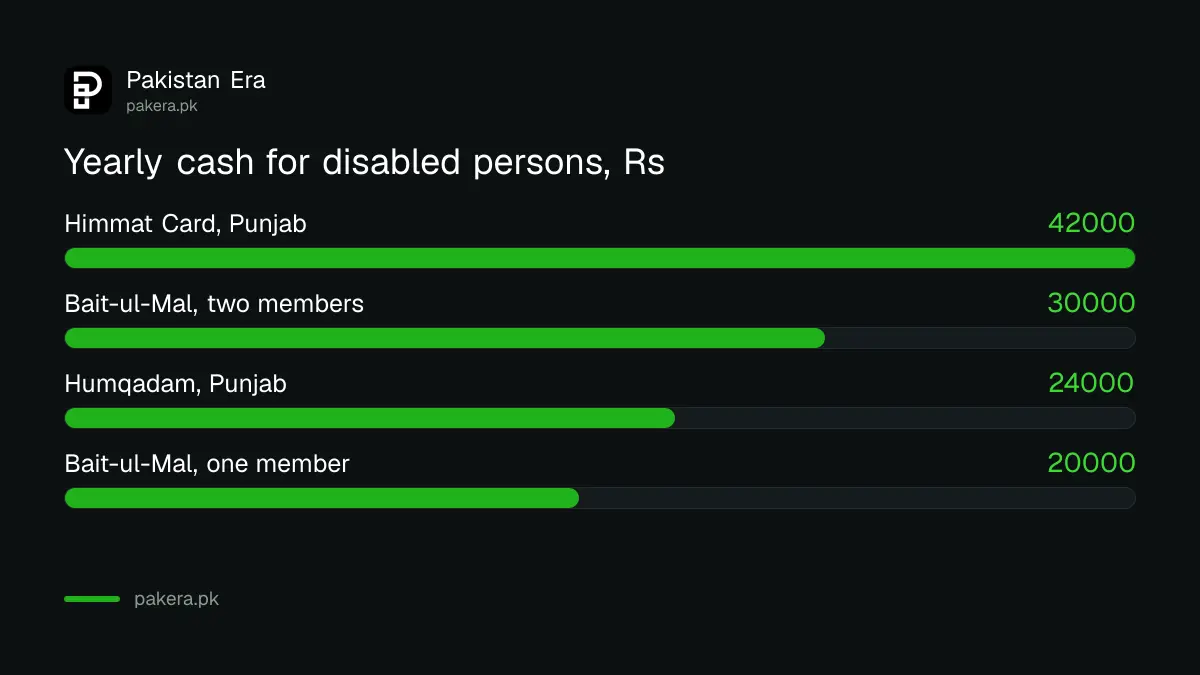
Every scheme on this list asks for proof of disability. That proof is a certificate from your province's disability or social welfare office, followed by a special CNIC from NADRA. NADRA will not issue the special CNIC without the certificate.
- Get a disability certificate. In Punjab apply through the DPMIS portal or a Social Welfare office. In Sindh the Department of Empowerment of Persons with Disabilities (DEPD) assesses you.
- Take the certificate to NADRA and apply for the special CNIC, or a special B-Form for a child.
- Make sure your household has a poverty score from the BISP survey. Most cash schemes use it.
- Apply for the scheme in your province from the table above.
- Apply for Bait-ul-Mal help separately. It is federal and works in every province.
The full route, office by office, is in the disability certificate and special CNIC steps. In Sindh, the DEPD disability assessment certificate is issued from the Sindh Secretariat in Karachi, with enquiries on 021-99222015.
Punjab pays the most, through two separate programmes
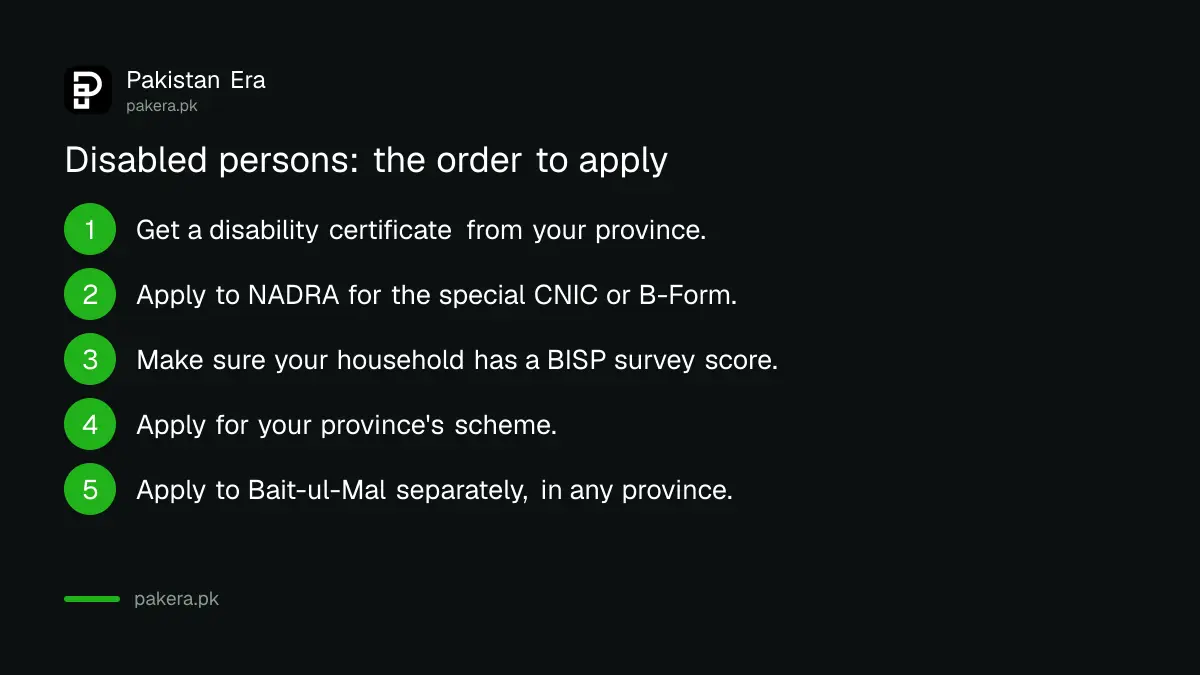
Punjab has two cash programmes for disabled persons, run by different offices. The Himmat Card pays Rs 10,500 a quarter through the Social Welfare Department. Humqadam pays Rs 2,000 a month through the Punjab Social Protection Authority. Each has its own poverty score limit.
The Punjab Himmat Card is for persons assessed as not fit to work, with a poverty score of 45 or less. It excludes people who recently took a grant from BISP, Zakat or Bait-ul-Maal. Status is checked with the disabled person's CNIC on the DPMIS portal, and the helpline is 1312.
Humqadam needs a special CNIC or B-Form and a score of 30 or less. Its helpline is 1221.
Punjab also gives free devices. The free wheelchair and hearing aid programme takes applications at adwc.punjab.gov.pk or a Social Welfare office, and sends the distribution date by SMS. For a disabled person who wants to earn, the Income Generation Scheme offers an interest-free business loan run by Akhuwat with funds held by the Punjab Small Industries Corporation.
Khyber Pakhtunkhwa pays through the Zakat department
In Khyber Pakhtunkhwa the Ehsaas Umeed Card is the disability stipend. You apply on a free form through your Local Zakat Committee, a district committee checks the papers, and the province pays. The provincial government announced Rs 5,000 a month, though the department's own form prints no amount.
The form covers four types of disability and accepts a B-Form with a guardian for a child. The result is checked by CNIC on the KP Zakat department's search page. Umeed sits beside Sahara for widows and Roshan Mustaqbil for orphans, which use the same route.
Bait-ul-Mal and BISP help disabled persons in every province
Pakistan Bait-ul-Mal's Special Friends scheme pays Rs 20,000 a year to a poor family with one disabled member, or Rs 30,000 with two or more. It also gives wheelchairs, hearing aids, white canes and artificial limbs. BISP gives disabled households a higher cut-off score, 37 instead of 32.
For Sindh and Balochistan families, these two federal schemes are the main cash routes, because the provincial Disability Acts set rights rather than monthly payments. Bait-ul-Mal applications go through its district office, with a separate form for each item. The Bait-ul-Mal wheelchair and hearing aid forms list the papers for each one.
The BISP rule matters more than it looks. A household that scored 35 is out of Kafaalat in general, but in with a disabled member. If your survey was done before the disability was recorded, update it at the BISP tehsil office. The BISP cut-off score of 37 explains how the score works.
Sindh, Balochistan and Islamabad give rights in law
The Sindh Act of 2018, the Balochistan Act of 2017 and the Islamabad Act of 2020 give disabled persons job quotas, fee concessions and housing quotas. Sindh and Balochistan set 5 per cent job quotas and Islamabad a 1 per cent rule. Several Sindh allowances still need a policy before they can be claimed.
Balochistan's law requires a 50 per cent fee relaxation in higher education and 50 per cent lower charges in private hospitals. Sindh's law promises a 5 per cent housing quota at half price for disabled persons who own no property. Islamabad's law promises free education and free public health care, and asks you to register with its disability council.
Common questions
Which disability scheme pays the most in Pakistan?
Punjab's Himmat Card, at Rs 10,500 a quarter, or Rs 42,000 a year. Outside Punjab, Bait-ul-Mal's Special Friends scheme pays up to Rs 30,000 a year for a family with two or more disabled members.
Can I get the Himmat Card and Humqadam together?
Check before you apply. The Himmat Card excludes people who recently took a grant from other government bodies such as BISP, Zakat or Bait-ul-Maal. Ask the 1312 and 1221 helplines how a second programme affects your case.
Is there a disability allowance in Sindh?
The Sindh Act of 2018 promises disability, unemployment and caregiver allowances, but several depend on a policy the government must still frame. Bait-ul-Mal and BISP are the main cash routes in Sindh today.
Do I need a special CNIC for BISP?
BISP needs the disabled member recorded in your household survey. A disability certificate and special CNIC make that easier and are needed for most other schemes.
Can a disabled child get help?
Yes. Most schemes accept a special B-Form for a child, with a parent or guardian applying. Bait-ul-Mal also supplies hearing aids and wheelchairs for children.
Is there a fee to apply for any of these schemes?
No. None of the schemes on this list charges an application fee. Anyone asking for money to release a card or a wheelchair is not from the government.
How we verified this
What we checked and where we read it.
This comparison was compiled on 17 November 2026 from our individual guides, each checked against the responsible body's own page between 31 August and 8 November 2026: the Social Welfare Department Punjab's Himmat Card page and DPMIS portal, the Punjab Social Protection Authority pages for Humqadam and the Income Generation Scheme, the Assistive Devices and Wheelchair Programme portal, the KP Zakat and Ushr Department's 2025-26 Umeed form and search page, Pakistan Bait-ul-Mal's projects page, BISP's Kafaalat page, the Sindh Empowerment of Persons with Disabilities Act 2018, the Balochistan Persons with Disabilities Act 2017, the ICT Rights of Persons with Disability Act 2020 and the AJK Social Protection of Vulnerable Population Act 2024. The Umeed Card amount comes from the KP government's announcement in August 2026, not the form.
About the author

Public Services and Education Journalist
Fajr Riaz is a journalist and content writer at Pakistan Era, based in Lahore. She covers the questions people meet in everyday life in Pakistan: how a public service works, what a change in the rules means, and where to find a reliable answer.