Punjab Family Pension for Daughters: Refused Under the Spouse-Only Rule? Ask for a Fresh Decision After the LHC Ruling
The Lahore High Court held Punjab's spouse-only family pension rule cannot shut out eligible daughters. How unmarried and divorced daughters can reapply.
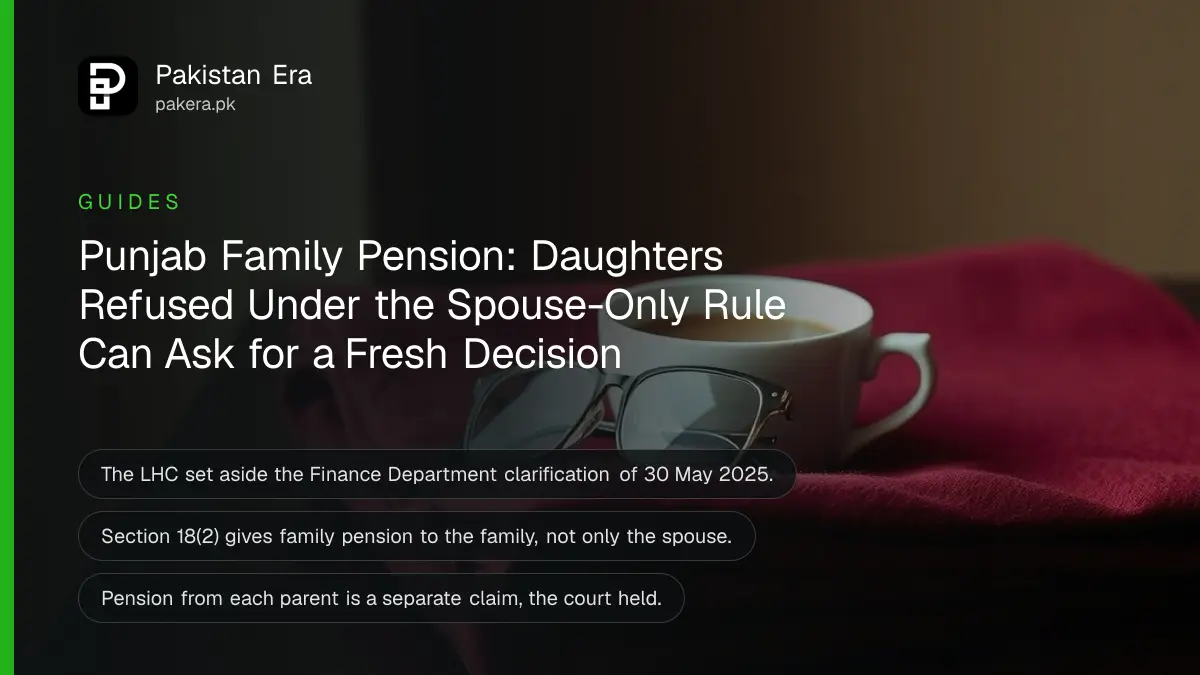
If your claim to a Punjab government employee's family pension was refused only because you are a daughter and not the widow, you can ask the department to decide it again. The Lahore High Court has held that the Punjab Finance Department's "spouse-only" changes cannot shut out other eligible family members, because section 18(2) of the Punjab Civil Servants Act, 1974 gives the pension to the deceased's "family".
The ruling, uploaded on 6 November 2026, covered an unmarried daughter and two divorced daughters. It ordered their departments to rehear each claim within about 60 days and pay arrears if they qualify. Below is what changed, who it helps, and how to apply.
What the Lahore High Court decided on family pension
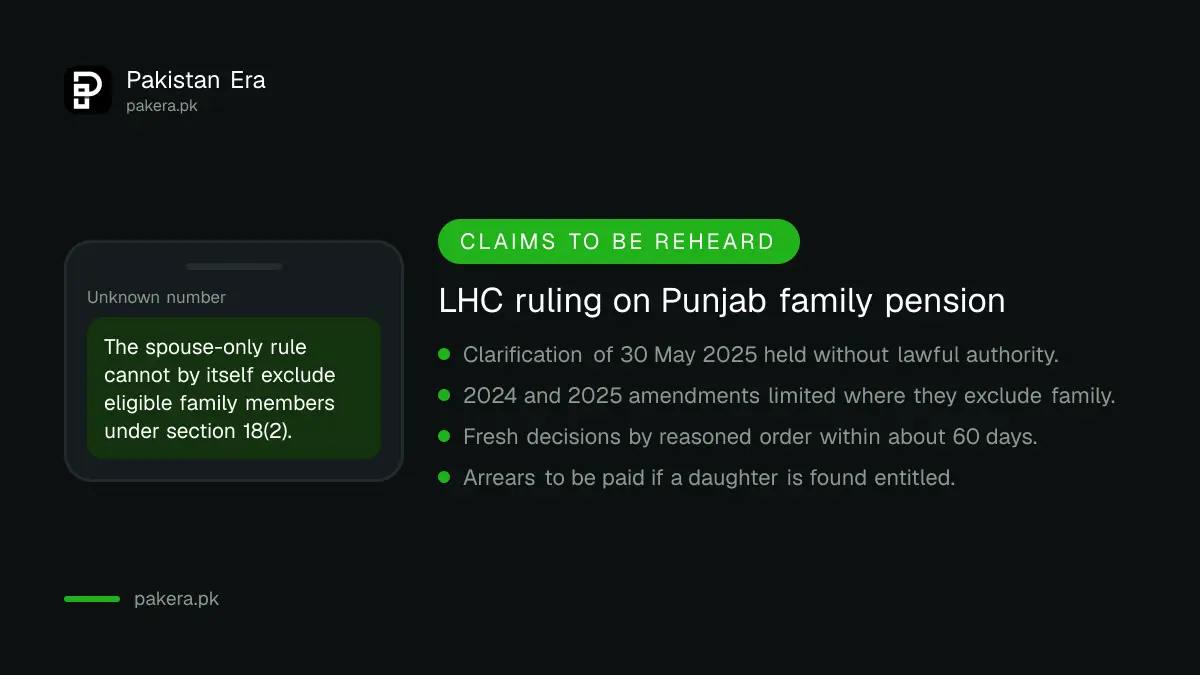
The court declared the Finance Department's clarification of 30 May 2025 to be without lawful authority. It also held the Rule 4.10 amendments of 2 December 2024 and 20 August 2025 of no effect where they are used to exclude eligible family members against section 18(2).
Justice Syed Ahsan Raza Kazmi decided Writ Petition No. 26 of 2026 with two connected petitions at the Rawalpindi Bench after a hearing on 28 October 2026. The judgment is approved for reporting. It did not order payment outright. It told each department to decide the claim again by a reasoned order, after hearing the daughter.
| Instrument | What it did | Effect after the ruling |
|---|---|---|
| Notification of 2 December 2024 | Limited family pension to the spouse for 10 years or until remarriage | Of no effect to the extent it excludes eligible family members |
| Clarification of 30 May 2025 | Explained how to apply the spouse-only rule | Without lawful authority |
| Notification of 20 August 2025 | Spouse for life or until remarriage, shared among widows | Of no effect to the extent it excludes eligible family members |
Who this ruling can help
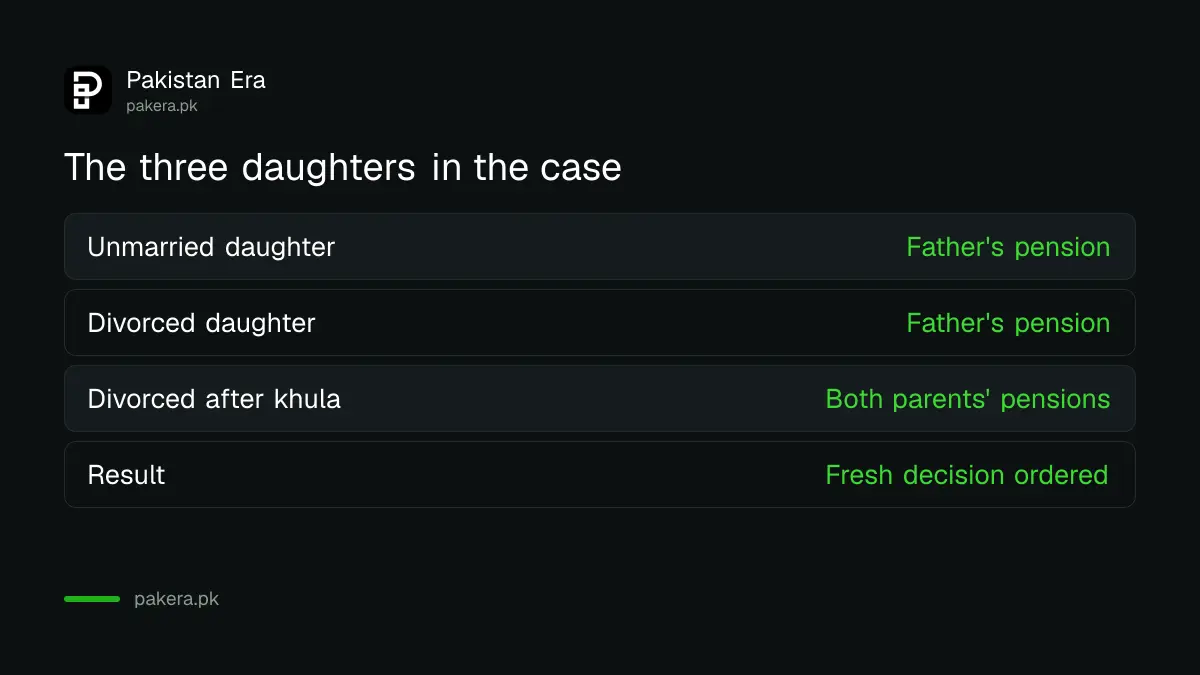
It helps a daughter or other family member of a deceased Punjab government servant whose claim was refused only because of the spouse-only rule. The three petitioners were an unmarried daughter, a divorced daughter whose mother had died first, and a divorced daughter claiming from both parents.
The court said marital status alone cannot be the reason for refusal without checking the eligibility conditions in the law and the rules. The earlier rule it set out, before the 2024 change, gave the order of claimants like this:
- First the widow, or the husband of a female servant, shared with eligible children where the rule allowed.
- Failing them, sons up to 24 years and unmarried daughters, in equal shares.
- Then the eldest widowed daughter, and after her other relatives in a set order.
- Pension stopped for an unmarried female member on marriage, and a widowed member on remarriage.
Each claim still turns on its own facts. The court did not decide that every divorced daughter qualifies. It said the departments must test each one against the governing law, not treat the spouse-only change as the final word.
Pension from both parents is two separate claims
If both your mother and father were Punjab government servants, their family pensions are two separate entitlements. Receiving one does not count as your own "regular source of income" to cancel the other, the court held, following the Supreme Court's 2021 ruling in the Kanwal Rashid case.
That Supreme Court case involved an unmarried daughter who drew family pension from both parents until a Finance Department clarification tried to stop one and recover the money. The Supreme Court held the department had no power to cut the right that way, and that treating one pension as income was discriminatory under Article 25. The Lahore High Court applied the same principle, and also cited a 2025 Supreme Court ruling that a department cannot add a condition about a daughter's marital status that the rules do not contain.
How to ask for your claim to be reheard
Apply in writing to the department where the deceased last served, citing the judgment. Ask for a fresh decision by a speaking order, meaning a written order with reasons. If you are refused again only because of the spouse-only rule, a lawyer can take it back to the High Court.
- Find the refusal letter and note its date and the instrument it relied on.
- Write to the head of the deceased's last office and the district accounts office, asking for a fresh decision.
- Cite Writ Petition No. 26 of 2026, Lahore High Court Rawalpindi Bench, file 2026LHC8584.
- Attach the death certificate, your CNIC, the deceased's pension or service papers, and proof of your marital status.
- If both parents served, file a separate claim for each pension.
- Ask for a hearing and for arrears if the claim is accepted, as the judgment directs.
The court gave the departments in its three cases about 60 days from receiving a certified copy. Others are not covered by that order directly, so act through your own application. Federal rules are different, and are set out in federal family pension rules in Pakistan. For another recent Punjab pension ruling, see commuted pension restoration in Punjab.
Limits of the ruling
This is a single bench High Court judgment. The Punjab government can challenge it in a higher court, and the spouse-only rule has not been withdrawn by the Finance Department itself. Each claim also depends on the conditions that applied to the deceased and to you.
The court was careful to say it was not creating a new entitlement outside the law. It was stopping the word "family" in section 18(2) from being narrowed to the spouse alone by an executive order. Keep copies of everything you file, and ask for a received stamp each time. If you need help, see getting a free lawyer through legal aid in Punjab.
Common questions
Can a daughter get family pension in Punjab?
The Lahore High Court held that a daughter cannot be refused only because of the 2024 and 2025 spouse-only changes. Her claim must be decided against the eligibility conditions in the Act and the rules.
Does a divorced daughter qualify?
Two of the three petitioners were divorced daughters, and the court said marital status alone cannot decide it. The department must check the conditions that apply, so each case is decided on its facts.
Can I get pension from both my mother and father?
The court said the two pensions are separate entitlements, and one cannot be treated as your own income to cancel the other, following the Supreme Court's 2021 Kanwal Rashid ruling.
Will I get arrears?
The judgment says that if a petitioner is found entitled, the pension and consequential arrears shall be released in accordance with law.
Has the Punjab government withdrawn the spouse-only rule?
The court set aside the clarification and limited the effect of the amendments. A formal withdrawal by the Finance Department is a separate step, and the ruling can be appealed.
Which law gives the family a right to pension?
Section 18(2) of the Punjab Civil Servants Act, 1974: on the death of a civil servant, "his family shall be entitled to receive such pension or gratuity or both as may be prescribed".
How we verified this
What we checked and where we read it.
We read the full judgment in Writ Petition No. 26 of 2026 with W.P. Nos. 3426 and 4050 of 2026, Lahore High Court Rawalpindi Bench, on 17 November 2026. It is on the LHC reported judgments page, uploaded 6 November 2026, file 2026LHC8584. The text of section 18(2) and the earlier Rule 4.10 are as quoted in the judgment. The Punjab Civil Servants Act, 1974 is on the Punjab Code. The petitioners' names are left out on purpose.
About the author

Global Affairs & Political Economy Writer
Muhammad Hatim is a book lover who started writing because he enjoys it. At Pakistan Era he writes about international relations, geopolitics and the global economy, with a particular interest in South Asia and the forces behind current events.