Federal Family Pension Rules in Pakistan: Who Gets It, the 75% Rate and the 10 Year Limit
Federal family pension in Pakistan is 75% of the pension. See the order from widow to daughters and parents, the 10 year limit since 2024 and who is exempt.
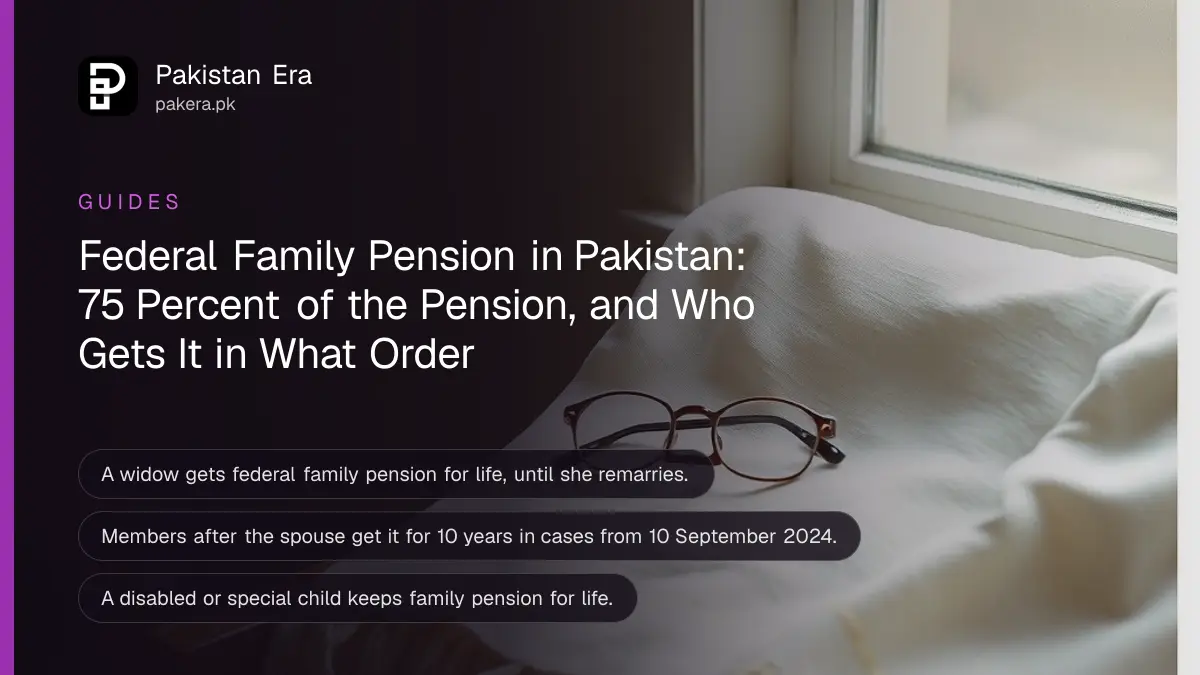
When a federal government pensioner or employee dies in Pakistan, the family pension is 75 per cent of the pension. A widow gets it for life. Since 10 September 2024, the family members who come after the spouse get it for 10 years only, except a disabled child, who keeps it for life.
We read every Finance Division office memorandum on family pension listed on its circulars page on 7 November 2026, including the consolidated 1983 order updated on 24 June 2024 and the three clarifications issued after the 2024 change. The full order of who gets the pension, and in what share, is below. These rules cover federal civil servants. Provinces issue their own pension orders, so a Punjab or Sindh pensioner should check the provincial finance department as well.

Family pension is 75 per cent of the pension, paid in a fixed order
Family pension is 75 per cent of the gross or net pension, as the case may be. It goes to one person or one group at a time, in an order set by the Finance Division. A person lower in the list gets nothing while someone higher is still eligible.
The 75 per cent rate comes from an office memorandum of 5 July 2010, now folded into the consolidated order No. 1(13)-Reg.6/83. Gross pension means the pension before any part was commuted for a lump sum. Net pension means the monthly pension left after commutation. The order uses whichever one applies to the case.
The yearly pension increases follow the family pension too. The Finance Division's memorandum of 29 July 2026 gives 7 per cent on the baseline pension from 1 July 2026, and its paragraph 4 says the increase is also admissible on family pension. The working of that increase is in the 2026 federal pension increase.
The widow comes first, and several widows share
The widow of a male government servant gets family pension for life. If he had more than one wife, the widows and children share it. The split depends on whether the widows and children together number four or fewer, or more than four.
- Four or fewer widows and children together: the pension is divided equally among all of them.
- More than four together: each widow gets one quarter of the pension, and whatever is left is divided equally among the children.
- Sons above 21 are not counted as children for this split.
A widow's pension stops if she remarries. That rule is in paragraph 8(3) of the order, which says no pension is payable to a widow female member of the family in the event of her remarriage. For a female government servant, the husband is the first in line, unless she told her accounts office in writing that he should not be counted as family.
After the spouse, children and others follow in this order
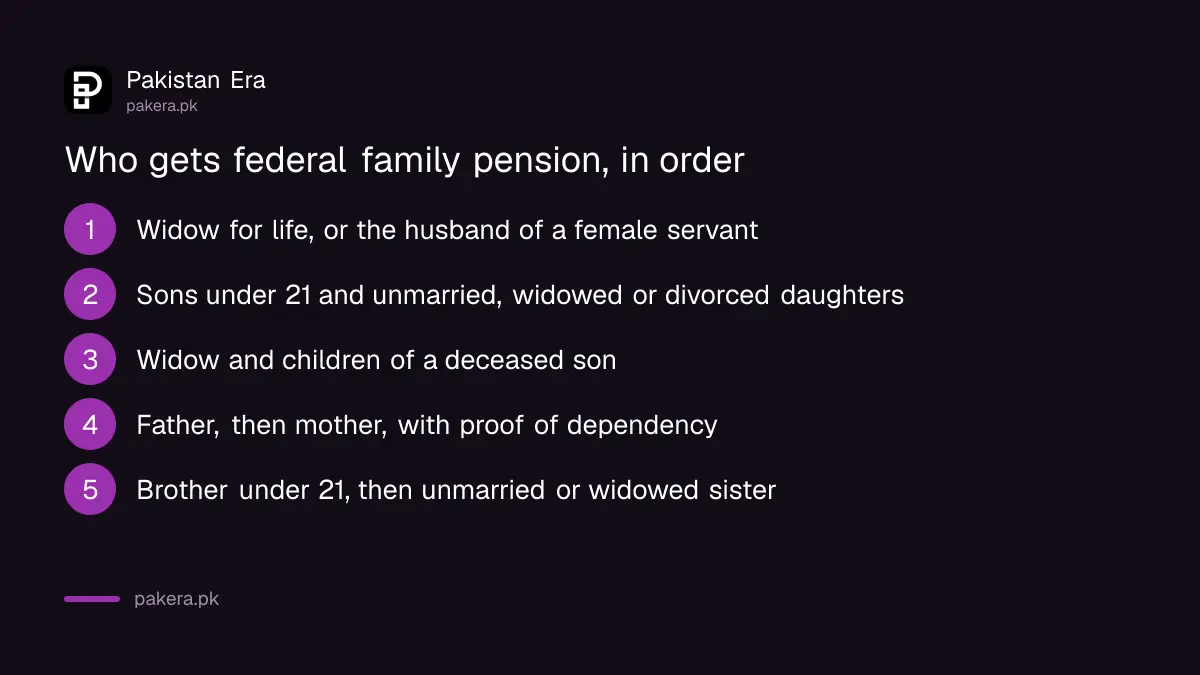
When there is no widow or husband, or the spouse dies or stops being eligible, the pension moves down a fixed list. Each step applies only when every step above it is empty. The list below is from paragraph 8(2)(a) of the consolidated order, updated on 24 June 2024.
- Sons not above 21 and unmarried, widowed or divorced daughters, in equal shares, each until marriage or remarriage.
- The eldest surviving unmarried daughter until her marriage, then the next eldest.
- A widowed daughter, for life or until she remarries.
- A divorced daughter, for life or until she remarries.
- The eldest widow of a deceased son, then the eldest son below 21 of a deceased son, then the eldest unmarried daughter below 21 of a deceased son, then the eldest widowed daughter of a deceased son, each for 10 years or the unexpired part of 10 years.
If nobody in that list is left, paragraph 8(2)(b) opens the pension to parents and siblings: the father for life, then the mother for life, then the eldest brother below 21, then the eldest unmarried sister for life or until marriage, then the eldest widowed sister for 10 years. Parents and siblings must give reasonable proof that they depended on the deceased for support.
The 10 year limit applies to cases that began on or after 10 September 2024
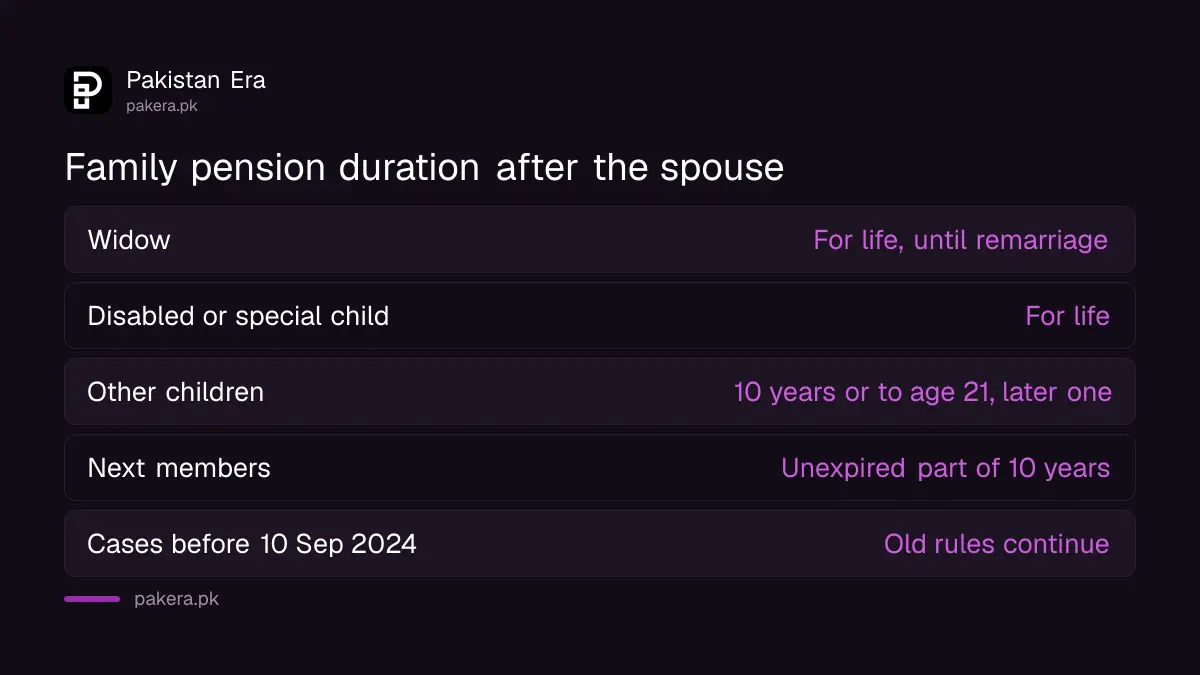
Since 10 September 2024, family pension after the spouse's death or ineligibility runs for at most 10 years for the remaining members. A disabled or special child keeps it for life. Other children get it for 10 years or until age 21, whichever is later.
The change came from the Pay and Pension Commission 2020 and was issued as memorandum F.No. 9(3)R-6/2024-264. Two clarifications then settled who it covers.
| Question | Finance Division answer | Memorandum |
|---|---|---|
| Does the 10 year limit stop pensions already being paid? | No. It does not apply to current family pensioners. | 10 October 2024 |
| Which cases does it cover? | Cases that became entitled, or whose family pension started, on or after 10 September 2024 | 22 January 2025 |
| How long does a minor child get it? | Until age 21, under the 1983 order | 22 January 2025 |
| A widow loses eligibility after 10 September 2024. How long does her daughter get it? | 10 years, or the unexpired part of 10 years only | 22 January 2025 |
| Disabled or special child | For life | 10 September 2024 |
The phrase "unexpired portion of 10 years" matters. The 10 years start when the spouse dies or becomes ineligible, not when each new person takes over. So if a daughter takes over after her brother turns 21 in year six, she gets the remaining four years, not a fresh ten.
That is a real cut for families with unmarried daughters. Under the older rules, an unmarried daughter could draw it until marriage, with no time limit. For a case that opened after 10 September 2024, she now gets 10 years from the spouse's death, unless she has a disability.
Gratuity on death goes to the family first, then to dependants
Gratuity follows a separate family list. It covers the wife or wives, the husband, the children, and the widows and children of a deceased son. A servant must make a nomination for gratuity once they complete 5 years of qualifying service.
If no such family exists, the gratuity goes in equal shares to the mother, the father, unmarried sisters below 21 and widowed sisters, and brothers below 21. If there is nobody in either list, no gratuity is paid at all. Where the beneficiary is a minor without a guardian, the sanctioning authority can pay the mother, or the father where the deceased servant was a woman.
Families of an employee who died in service should also claim the group insurance, which is set out in how to claim group insurance for a deceased federal employee.
How to claim family pension from AGPR
The claim goes through the deceased person's department, which sends the case to the accounts office that paid the pension or salary. For federal staff in Islamabad that is AGPR. Each step below is the general route; your department may ask for more papers.
- Get the death certificate from the union council and a NADRA family registration certificate (FRC) showing every family member.
- Apply to the last department, or to the pension section of the accounts office if the deceased was already a pensioner.
- Attach CNICs of the claimants, the pension book or pension payment order number, and the nomination form if one was filed.
- For a daughter, attach proof of being unmarried, widowed or divorced. For a disabled child, attach a medical board certificate.
- Give a bank account in the claimant's own name, since pensions are paid by direct credit, and keep the yearly pension proof of life up to date once payments start.
The general case file, including the papers the department prepares, is covered in the government pension case process.
Common questions
How much is family pension in Pakistan for federal employees?
75 per cent of the gross or net pension, as the case may be. The yearly pension increases, including the 7 per cent from 1 July 2026, also apply to it.
Does a widow get family pension for life?
Yes. The widow of a male government servant gets it for life, but it stops if she remarries.
Can an unmarried daughter get her father's pension?
Yes, if there is no eligible widow or husband. For a case that began on or after 10 September 2024, she gets it for 10 years, or the unexpired part of 10 years, after the spouse's death or ineligibility. A disabled daughter gets it for life.
Was the 10 year limit applied to old family pensions?
No. The Finance Division clarified on 10 October 2024 that it does not apply to current family pensioners. It covers cases that became entitled on or after 10 September 2024.
Can parents get family pension?
Only when there is no widow, husband, child or grandchild entitled under the first list. The father gets it first, then the mother, and they must prove they depended on the deceased.
Does a son get family pension after 21?
No. A son gets it until age 21, unless he is disabled, in which case it continues for life.
What we read
We read the Finance Division memoranda on its circulars page on 7 November 2026: the consolidated order No. 1(13)-Reg.6/83 updated on 24 June 2024, the ordinary family pension memoranda of 10 September 2024, 10 October 2024 and 22 January 2025, and the pension increase memorandum of 29 July 2026. The documents are scans, so check the original before relying on an exact clause. AGPR or your accounts office decides each case.
About the author

Tax, Bills and Technology Writer
Ali Akhtar is a young and curious voice here at Pakistan Era. He is currently pursuing his A-Levels and has a growing interest in Pakistan’s changing industrial landscape and educational trends. Ali likes to write in a way that helps him explain and explore the world around him. His writing reflects the perspective of the new generation navigating the evolving trends of Pakistan where technology, youth innovation, and shifting opportunities are reshaping the country’s future.